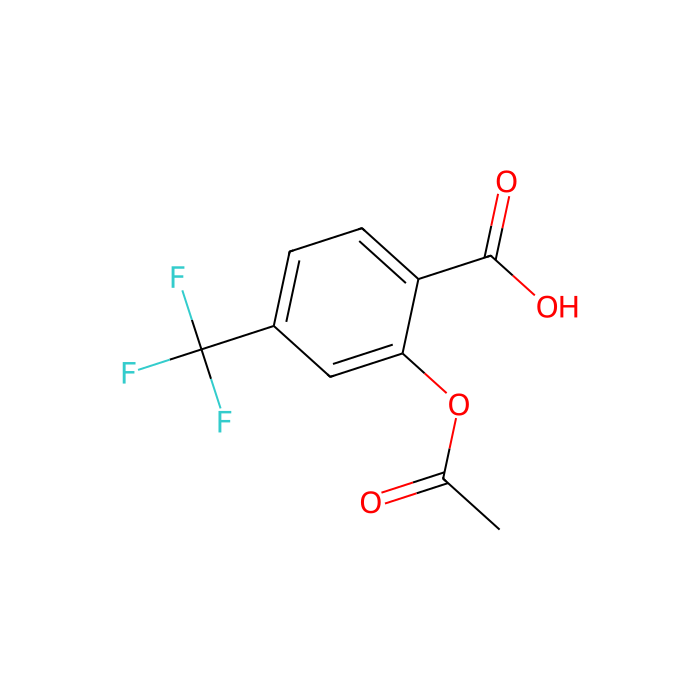
10mM in DMSO for sensitive chromatographic and analytical workflows requiring minimal baseline interference.
🌡
Storage & shipping
Store at -80°C Ships Dry ice packs + Cold packs Check lot-specific COA for exact specifications.
📋
Quality documents
SDS, COA, datasheet, and spec sheet available for download. Lot-specific COA accessible via lot number lookup.
📚
Literature proof
Cited in 0 peer-reviewed publications across chromatography, organic synthesis, and cross-coupling reactions.
Overview
Information
Triflusal (UR1501) irreversibly inhibits the production of thromboxane-B2 in platelets by acetylatingcycloxygenase-1. In vitro
The main Triflusal metabolite, HTB, preserves 6-keto-PGF1α synthesis in porcine aortic endothelial cells (PAEC) cells without a significant decline for up to 24 h even at the higher concentration. Triflusal at 10 mM, 100 mM and 1 M decreases LDH efflux in rat brain slices after anoxia/reoxygenation by 24%, 35% and 49% respectively. Triflusal also reduces inducible NO synthase activity by 18%, 21% and 30%.
In vivo
Triflusal (10 mg/kg i.v.) reduces platelet deposition on subendothelium-induced primary thrombus by about 68% in rabbits. Triflusal (10 mg/kg i.v.) reduces platelet deposition on a fresh thrombus formed over tunica media by about 48% in rabbits. Triflusal (40 mg/kg p.o.) reduces platelet deposition on a primary thrombus triggered by subendothelium and tunica media by 53% in rabbits. Triflusal (40 mg/kg p.o.) significantly reduces Cox-2 mRNA levels and protein levels without influence Cox-1 mRNA levels on the vascular wall in rabbits. Triflusal (600 mg/day for 5 days) results in an increase in NO production by neutrophils and an increase in endothelial nitric oxide synthase (eNOS) protein expression in neutrophils in healthy volunteers. Triflusal (300 mg, twice-daily orally) shows a more important increase in total walking distance and in pain-free walking distance over the basal values than those treated with placebo, together with an improvement of the symptomatology correlated with claudication in patients with chronic peripheral arteriopathy. Triflusal (300 mg, twice-daily orally) shows an increase in the peak-flow recorded through strain-gauge plethysmography in patients with chronic peripheral arteriopathy. Triflusal (30 mg/kg) strongly decreases iNOS immunolabeling at both survival times analyzed, attenuating iNOS immunoreactivity in astroglial cells and infiltrated neutrophils in rats. Triflusal (30 mg/kg) decreases neuronal and microglial COX-2 expression at 10 and 24 hours after lesion and microglial and astroglial expression of IL-1beta and TNF-alpha at 24 hours after lesion in rats. Cell Data
Determine the necessary mass, volume, or concentration for preparing a solution.
Dilution Calculator
Determine the dilution needed to prepare a stock solution.
Reconstitution Calculator
Reviews
Customer Reviews
Frequently Asked Questions
How should this product be stored?
Store at ?80 °C. Ultra-low temperature storage is required to maintain the specified shelf life.
How is this product shipped?
This product ships frozen with dry ice and cold packs. Unpack on arrival and transfer it to the storage condition stated above; handle dry ice with insulated gloves in a ventilated area.
What are the CAS number, molecular formula and molecular weight?
The CAS Number is 322-79-2, the molecular formula is C10H7F3O4, and the molecular weight is 248.16 g/mol.
What documentation is provided?
Available product documentation, including Certificates of Analysis (COA), Safety Data Sheets (SDS), and specification sheets, is shown in the product document area. Document availability and access follow the current site policy.
We use cookies to ensure the website functions properly and, where permitted, to improve your experience. You can manage your preferences at any time in Settings. Learn more in our Cookie Policy.
Shall we send you a message when we have discounts available?
Remind me later
Thank you! Please check your email inbox to confirm.
Products are supplied to verified businesses, institutions, and qualified professionals for research and development use only. Not for use in humans, animals, diagnosis, or therapy.