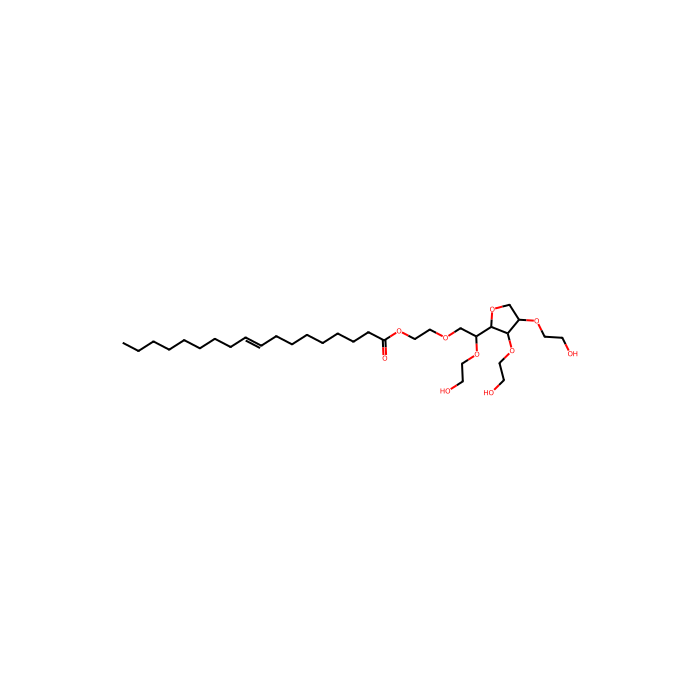
TWEEN® 80 - from non-animal source , CAS No.9005-65-6

CAS: 9005-65-6 Cat. No.: T434510 EC Number: 500-019-9
AVAILABLE TO ORDER
GRADE & PURITY from non-animal source
Synonyms
2-[2-[3,4-bis(2-hydroxyethoxy)oxolan-2-yl]-2-(2-hydroxyethoxy)ethoxy]ethyl octadec-9-enoate|2-{2-[3,4-Bis(2-hydroxyethoxy)tetrahydro-2-furanyl]-2-(2-hydroxyethoxy)ethoxy}ethyl 9-octadecenoate
Storage
Protected from light,Room temperature
Shipped In
Normal
★
Size
Germany (EU)
USA*
Price
Qty
500ml
T434510-500ml
1 In stock
2 In stock
€69.33
Enter a quantity for the sizes you want to add.

Overview

Application

Non-ionic detergent used for selective protein extraction and isolation of nuclei from mammalian cell lines.

Specifications

Synonyms
2-[2-[3,4-bis(2-hydroxyethoxy)oxolan-2-yl]-2-(2-hydroxyethoxy)ethoxy]ethyl octadec-9-enoate | 2-{2-[3,4-Bis(2-hydroxyethoxy)tetrahydro-2-furanyl]-2-(2-hydroxyethoxy)ethoxy}ethyl 9-octadecenoate
Specifications & Purity
from non-animal source
Legal Information
Storage
Protected from light,Room temperature
Shipped In
Normal
Names and Identifiers
Pubchem Sid
Pubchem Sid Url
https://pubchem.ncbi.nlm.nih.gov/substance/528770712
SMILES
CCCCCCCC/C=C/CCCCCCCC(=O)OCCOCC(C1C(CC(O1)OCCO)OCCO)OCCO
IUPAC Name
2-[2-[3,4-bis(2-hydroxyethoxy)oxolan-2-yl]-2-(2-hydroxyethoxy)ethoxy]ethyl octadec-9-enoate
InChIKey
HDTIFOGXOGLRCB-UHFFFAOYSA-N
InChI
1S/C32H60O10/c1-2-3-4-5-6-7-8-9-10-11-12-13-14-15-16-17-30(36)40-25-24-37-26-28(38-21-18-33)32-31(41-23-20-35)29(27-42-32)39-22-19-34/h9-10,28-29,31-35H,2-8,11-27H2,1H3
Isomeric SMILES
CCCCCCCCC=CCCCCCCCC(=O)OCCOCC(C1C(C(CO1)OCCO)OCCO)OCCO
WGK Germany
1

Advanced Data

Taxonomic Classification

Taxonomy Tree

KingdomOrganic compounds
SuperclassLipids and lipid-like molecules
ClassFatty Acyls
SubclassFatty acid esters
Intermediate Tree Nodes Not available
Direct ParentFatty acid esters
Alternative Parents Oxolanes  Carboxylic acid esters  Oxacyclic compounds  Monocarboxylic acids and derivatives  Dialkyl ethers  Primary alcohols  Organic oxides  Hydrocarbon derivatives  Carbonyl compounds  
Molecular FrameworkAliphatic heteromonocyclic compounds
Substituents Fatty acid ester - Oxolane - Carboxylic acid ester - Carboxylic acid derivative - Dialkyl ether - Ether - Monocarboxylic acid or derivatives - Organoheterocyclic compound - Oxacycle - Organic oxide - Carbonyl group - Alcohol - Organooxygen compound - Hydrocarbon derivative - Primary alcohol - Organic oxygen compound - Aliphatic heteromonocyclic compound
DescriptionThis compound belongs to the class of organic compounds known as fatty acid esters. These are carboxylic ester derivatives of a fatty acid.
External Descriptors a small molecule
3D Structure
Interactive Chemical Structure Model


Certificates (CoA,COO,BSE/TSE and Analysis Chart)
C of A & Other Certificates(BSE/TSE, COO):
Analytical Chart:

Find and download the COA for your product by matching the lot number on the packaging.

2 results found

Lot NumberCertificate TypeDateItem
H2615063H2615063Certificate of AnalysisAug 18, 2026 T434510
E2319208E2319208Certificate of AnalysisMay 25, 2023 T434510
Chemical and Physical Properties
SensitivityLight sensitive
Refractive Index1.471-1.473
Flash Point>235.4 °F
Flash Point>110℃
Boil Point100 °C
Melt Point–21 °C
Molecular Weight604.8
XLogP34.800
Hydrogen Bond Donor Count3
Hydrogen Bond Acceptor Count10
Rotatable Bond Count31
Exact Mass604.419 Da
Monoisotopic Mass604.419 Da
Topological Polar Surface Area133.000 Ų
Heavy Atom Count42
Formal Charge0
Complexity632.000
Isotope Atom Count0
Defined Atom Stereocenter Count0
Undefined Atom Stereocenter Count4
Defined Bond Stereocenter Count0
Undefined Bond Stereocenter Count1
The total count of all stereochemical bonds1
Covalently-Bonded Unit Count1
Safety and Hazards(GHS)
WGK Germany
1
Merck Index
7582
Documents & Articles
Tween 20 and Tween 80 as Non-Ionic Surfactants: Structure, Properties, and Applications
How to Choose Between Tween 20, Tween 60, and Tween 80?
NPE (NP-n) Selection Guide: How EO Number Affects Solubility, HLB, Cloud Point, and CMC | With an Aladdin Product Reference Table
A Practical Guide to Fragrance Compositions: Turning a Black-Box Formula into an Engineerable System—Compatibility, Stability, Controlled Release, Traceability, and Selection
A Panoramic Guide to Surfactants: Definitions & Mechanisms, Key Metrics, Application Scenarios, and Selection Navigation (Tables 1–3)
Why Acridine Can Turn “Trace Molecules” into a Measurable Light Signal: A Mechanistic, Selection, and Troubleshooting Guide to Acridinium Ester Chemiluminescent Immunoassays (Including Product Tables 1–4)
Lipase (Triacylglycerol Hydrolase): Interfacial Catalysis, Selectivity Classes, and Assay/Application Systems
Phytase: Enzymological Properties, Mechanism of Action, and Applications in Feed and Food
Chitinases: Substrate-Specific Degradation Mechanisms, Enzymatic Properties, and Application Directions
Glutaraldehyde-mediated Microbial Inactivation: Chemical Mechanisms, Determinants, and Key Validation Considerations
Review of the Structural Characteristics, Biological Functions, and Application Advances of Lycopene
Preparation Methods and Precautions for Silane Coupling Agent Primer Solutions
Experimental Research on Candidate Probiotics: From Strain Identification and Mechanistic Evaluation to Product Selection
Solvents, Co-solvents, and Solubilization Systems in Home and Personal Care Formulations: Classification, Functions, and Selection Guide
Why Limonene Can Soften Greasy Soils Yet Is Difficult to Dissolve in Water: Understanding the Cleaning Mechanism and Formulation Applications of Naturally Derived Solvents from Molecular Structure
Interfacial Mechanism and Formulation Applications of AEO-9 (Fatty Alcohol Polyoxyethylene Ether): An Analysis of Emulsification, Wetting, Oil Soil Removal, and Co-Formulation Compatibility
Analysis of the Foaming Performance Differences Between K12 and AOS: Structure, Acid–Base Stability, and Formulation Selection
Structural Characteristics, Low-Temperature Flowability, and Home-Care Cleaning Applications of Palm-Derived Isomeric Alcohol Polyoxyethylene Ether PLE-S9
Structure, Properties, and Mechanisms of Powdered Fragrances and Fragrance Delivery Materials: Stability, Release Mechanisms, and Selection Logic
Structural Logic of Nonionic Surfactants: Mechanisms of Action, Classification Features, and Selection Principles
Understanding the Four Classes of Surfactants Through Molecular Charge: Application Logic of Anionic, Cationic, Amphoteric and Zwitterionic, and Nonionic Surfactants in Personal Care and Home Care
Mechanistic Analysis of Topical Glutathione in Skincare: Cellular Redox Regulation, Skin Delivery Challenges, and SLN-Based Delivery Strategies
Antioxidant Mechanisms, Stability, and Delivery Strategies of Resveratrol in Skincare Research
Antioxidant Mechanisms of Ferulic Acid in Skincare, Vitamin C/E Synergy, and Stable Delivery Applications
Mechanism of Action of Tranexamic Acid in Pigmentation Care: From the Plasmin System to Regulation of Inflammation-Driven Pro-Melanogenic Signaling
Moisturizing Mechanisms of Tremella fuciformis Polysaccharides: From Polysaccharide Structure and Hydration Rheology to Dynamic Film Formation on the Skin Surface
The Logic of Biomimetic Peptide Action in Skin: Sequence and Conformation, Skin Delivery, Stability, and Target Matching
How Coenzyme Q10 Acts on the Skin: Mitochondrial Electron Transfer, Antioxidant Protection of Membrane Lipids, and Lipid-Carrier Delivery
Citations of This Product
Solution Calculators
Reviews

Customer Reviews

Shall we send you a message when we have discounts available?

Remind me later

Thank you! Please check your email inbox to confirm.

Oops! Notifications are disabled.