GRADE & PURITYMoligand™?Moligand™ — Aladdin's line of ligands and bioactive small molecules. Use for receptor, pathway, and binding studies needing defined small-molecule tools.10 mM in DMSO
Moligand™, 10 mM in DMSO Moligand™ for sensitive chromatographic and analytical workflows requiring minimal baseline interference.
🌡
Storage & shipping
Protected from light,Store at -80°C Ships Dry ice packs + Cold packs Check lot-specific COA for exact specifications.
📋
Quality documents
SDS, COA, datasheet, and spec sheet available for download. Lot-specific COA accessible via lot number lookup.
📚
Literature proof
Cited in 0 peer-reviewed publications across chromatography, organic synthesis, and cross-coupling reactions.
Overview
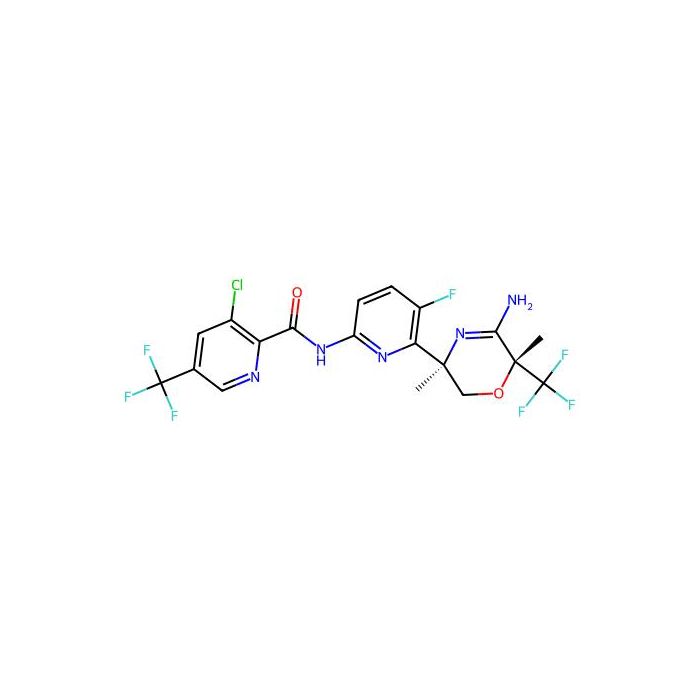
Umibecestat (CNP520) is a beta-site amyloid precursor protein cleaving enzyme-1 (BACE-1) inhibitor with IC 50 s of 11 nM and 10 nM for human BACE-1 and mouse BACE-1, respectively. Umibecestat can be used for the research of alzheimer's disease.
Specifications
Specifications & Purity
Moligand™, 10 mM in DMSO
Storage
Protected from light,Store at -80°C
Shipped In
Dry ice packs + Cold packs
This product requires cold chain shipping. Ground and other economy services are not available.
Determine the necessary mass, volume, or concentration for preparing a solution.
Dilution Calculator
Determine the dilution needed to prepare a stock solution.
Reconstitution Calculator
Reviews
Customer Reviews
Application Protocols
Tested/validated application details are not provided for this item.
Not specified for this item; refer to CoA/Spec Sheet.
Aladdin provides this compound for research use; any specific protocols (assay type, concentrations, detection methods) should be established and validated by the end user according to their system and endpoints.
Biological Roles
Literature context (non-item-specific; no medical claims):
Umibecestat is described in the literature as a potent small-molecule inhibitor of the aspartyl protease BACE1 (β-site APP cleaving enzyme 1). BACE1 catalyzes the initial cleavage of amyloid precursor protein (APP) within the amyloidogenic pathway, generating C99 and, subsequently via γ-secretase, Aβ peptides.
By occupying the BACE1 active site, inhibitors in this class reduce formation of amyloidogenic APP fragments in cellular and biochemical systems, enabling dissection of pathway kinetics, feedback, and compensatory processing (e.g., via α-secretase).
Selectivity considerations: Literature reports emphasize the importance of maintaining selectivity over BACE2 and off-target aspartyl proteases (e.g., cathepsin D) to avoid confounding biology in cell-based assays.
Research utilities:
As a positive control in BACE1 enzymology assays to benchmark assay performance.
To probe APP processing, trafficking, and secretase cross-talk in neuronal or engineered cell lines.
In target engagement experiments (CETSA, NanoBRET) to relate occupancy to pathway modulation.
ADME/PK exploration: The compound has been studied as a CNS-directed tool; researchers often evaluate permeability, efflux ratios, and metabolic stability to contextualize in vitro findings (report such data explicitly from your own experiments or primary literature; no item-specific values are provided here).
Buffer Applications
Not a buffering agent. This product does not serve as an acid/base buffer or pH control component.
Assay buffer notes (general guidance for using small-molecule enzyme inhibitors):
For BACE1 biochemical assays, common buffers include 50 mM sodium acetate (pH ~4.5) or optimized MES/citrate systems reflecting the enzyme’s acidic pH optimum; verify your specific enzyme construct/assay conditions.
For cell-based applications, use physiologically compatible buffers/media (e.g., HEPES-buffered DMEM or Neurobasal) and maintain consistent vehicle (DMSO) content across treatments.
Include appropriate detergents or carrier proteins only if required to prevent nonspecific adsorption; confirm lack of assay interference before routine use.
Green Alternatives
This product is a bioactive reference compound rather than a process solvent or bulk reagent; the concept of “green alternatives” applies chiefly to the choice of vehicles and assay media rather than to the compound itself.
Vehicle optimization: Minimize DMSO content in assays (≤0.5% v/v when possible) to reduce solvent burden and potential cell stress. Where assay-compatible, aqueous vehicles with cyclodextrin solubilizers can reduce reliance on high-boiling polar aprotic solvents.
Solvent selection for analytics: Prefer aqueous LC methods with short acetonitrile gradients; when feasible, reduce MeCN by using MeOH or buffered water-rich methods.
Waste minimization: Use microplate formats and low-dead-volume delivery to cut organic solvent use. Consolidate analytical injections and apply autosampler vial inserts to reduce solvent volumes.
Storage footprint: Aliquot to right-size vials to decrease dry ice shipments for resupply and reduce cold-chain waste.
Not applicable: There is no greener “substitute compound” for Umibecestat within the context of target-specific biochemical studies; choice of alternative tool compounds should be driven by target pharmacology, not environmental metrics.
Pharmaceutical Uses
No therapeutic or clinical claims are made. For research use only.
Reference standard: Suitable as a research reference compound for analytical method development (e.g., LC–MS/MS quantitation in matrices), in vitro ADME panels (microsomal stability, CYP phenotyping, plasma protein binding), and target engagement studies.
Formulation screening (in vitro): Solubilization strategies for stock and dosing solutions (DMSO, cosolvents, cyclodextrins, lipid-based carriers) can be explored to support exposure in cell assays or ex vivo tissues.
Solid-form considerations: If polymorph/salt form affects dissolution rate or stability, document the supplied form from the CoA and remain consistent across studies.
Regulatory status: Not intended for human or veterinary use; not compendial. Any GMP-related attributes are not implied by Moligand™ grade.
Physical Properties
Item-specific properties:
Appearance: Not specified for this item; refer to CoA/Spec Sheet.
Molecular weight: Not specified for this item; refer to CoA/Spec Sheet.
Molecular formula: Not specified for this item; refer to CoA/Spec Sheet.
Melting point: Not specified for this item; refer to CoA/Spec Sheet.
Boiling point: Not applicable/Not typically reported for complex bioactive solids.
Density: Not specified for this item; refer to CoA/Spec Sheet.
Refractive index: Not applicable (solid) / Not specified for this item.
Aqueous solubility: Not specified for this item; refer to CoA/Spec Sheet.
Literature/general expectations (not item-specific, for planning only):
Solubility profile: Many BACE1-inhibitor-like scaffolds are sparingly soluble in water but dissolve well in DMSO; working stocks are commonly prepared at 10–50 mM in anhydrous DMSO, then diluted into assay buffers with a final DMSO fraction ≤0.5–1% v/v to maintain target activity.
Lipophilicity: Tool compounds in this class often show moderate-to-high lipophilicity; ensure adequate mixing and pre-warming when making concentrated stocks.
Salt forms/hydrates: If present, these can markedly change apparent solubility; verify on the CoA which solid form is supplied.
Quality & Grades
Grade/Purity: Moligand™ (item-specific).
What Moligand™ implies (general description): A screening/ligand-grade small-molecule quality intended for discovery workflows such as biochemical screening, cellular target engagement, and biophysical assays. Emphasis is typically on identity confirmation and suitability for in vitro research rather than compliance with pharmacopeial monographs.
Documentation: For exact acceptance criteria (purity assay method, residual solvents, water content, polymorph/salt form), consult the item’s CoA/Spec Sheet.
UV/LC suitability: Moligand-grade materials are generally compatible with analytical LC–UV/LC–MS for quantitation and QC method development; actual UV cutoff and background absorbance are not specified for this item.
Stabilizers/additives: Not specified for this item; refer to CoA/Spec Sheet.
Lot-to-lot continuity: For screening campaigns, procure single-lot quantities when possible; retain analytical fingerprints (LC–MS, 1H NMR) to ensure continuity across studies.
Recommended verification on receipt: Quick-check LC–MS for mass match, and a short HPLC purity screen using your in-house method to align with assay sensitivities.
Reaction & Applications
This product is primarily a tool compound for research, not a general-purpose synthetic reagent.
Research applications (general, literature-based for Umibecestat-like tool compounds):
Enzymology: Biochemical inhibition studies against human BACE1 using fluorogenic peptide substrates; determination of IC50/Ki in steady-state assays.
Cell biology: Modulation of amyloidogenic APP processing in cell lines to study pathway biochemistry; readouts may include Aβ fragment quantitation by ELISA or LC–MS.
Biophysics: Target engagement by thermal shift (DSF/CETSA), SPR, or MST to characterize binding affinity and kinetics.
Chemical biology: Use as a reference control in screening libraries or for benchmarking novel inhibitor chemotypes.
Practical tips:
Prepare concentrated DMSO stocks (e.g., 10 mM), aliquot, and store at −80°C protected from light to limit degradation.
When profiling potency, keep final DMSO ≤0.5–1% v/v and include vehicle controls.
For time-dependent effects, preincubate compound with enzyme (e.g., 10–30 min) before initiating reactions to approach steady-state inhibition profiles.
Synthetic chemistry applicability: Minimal; this is a finished bioactive scaffold rather than a building block. If derivatization is pursued for SAR, perform small-scale feasibility with orthogonal protection strategies tailored to the specific functional groups reported in the literature structure.
Reaction Conditions
Not typically applicable. Umibecestat is a finished tool compound rather than a reagent used to promote or catalyze chemical reactions.
If employing the compound in biochemical reactions/assays (general guidance; literature-based):
Enzyme inhibition assays:
Temperature: Commonly 25–37°C depending on assay format and substrate stability.
pH: BACE1 exhibits activity in acidic buffers (often pH 4.0–5.0). Choose buffer systems (acetate, MES, citrate) compatible with your substrate and readout.
Incubation: Preincubate inhibitor with enzyme for 10–30 min to approach equilibrium binding before initiating with substrate.
DMSO tolerance: Validate that final DMSO concentration (≤0.5–1% v/v) does not perturb enzyme kinetics or detection chemistry.
Data analysis: Determine IC50 with appropriate vehicle controls and fit to a four-parameter logistic model; for mechanistic insights, perform substrate-variation studies to estimate Ki and mode of inhibition.
Safety & Handling
Item-specific hazard data:
GHS classification: Not specified for this item; refer to SDS.
Signal word: Not specified for this item; refer to SDS.
Hazard (H-) statements: Not specified for this item; refer to SDS.
Pictograms: Not specified for this item; refer to SDS.
General laboratory precautions (guidance; defer to SDS as authoritative):
Handle in a chemical fume hood; avoid inhalation of dust and contact with skin/eyes.
Wear appropriate PPE: lab coat, safety glasses, and nitrile gloves.
Avoid repeated freeze–thaw of DMSO stocks; use aliquots to limit exposure and maintain integrity.
Storage incompatibilities: Keep away from strong oxidizers and acids/bases that may cause decomposition; protect from light per item-specific storage instruction.
First-aid overview: In case of skin contact, wash with soap and water; for eye contact, rinse cautiously with water for several minutes and seek medical attention; if inhaled, move to fresh air; if ingested, rinse mouth and seek medical advice.
Spill response: Avoid dust generation; absorb solutions with inert material; dispose according to institutional and local regulations.
Waste: Treat as organic hazardous waste; segregate halogenated vs non-halogenated solvents used for rinsing as per facility protocols.
Solvent Selection
Applicability: As a bioactive small molecule supplied for screening, solvent selection focuses on preparing stable stock solutions and reliable dilutions for assays.
Practical guidance (general; verify with CoA for any item-specific constraints):
Primary stock solvent: Anhydrous DMSO is typically preferred due to high solvating power for hydrophobic inhibitors. Start with 5–50 mM stocks.
Co-solvents: If precipitation occurs on dilution, incorporate co-solvents such as 0.1–1% v/v DMSO in the final assay buffer; small fractions of ethanol or acetonitrile can also help, subject to assay tolerance.
Aqueous buffers: Maintain physiological pH (e.g., HEPES, PBS, or Tris, pH 7.2–7.6) and include 0.01–0.05% nonionic surfactant (e.g., Tween 20 or Pluronic F-68) only if needed to prevent adsorption—confirm no assay interference.
Avoid: Strong acids/bases and oxidizing media; they may degrade sensitive functional groups.
Filtration: For working solutions, 0.22 µm PTFE filters are compatible with DMSO-containing solutions; avoid nylon if strong H-bonding or adsorption is observed.
Solubility screening tip: Sonication and gentle warming (25–40°C) can assist dissolution; cool to room temperature before use to maintain defined concentrations.
Storage & Reconstitution
Item-specific storage:
Store at −80°C, protected from light (as provided).
Shipped on dry ice packs + cold packs to maintain cold chain.
General reconstitution guidance (user-established; not item-specific specifications):
Stock solutions: Dissolve in anhydrous DMSO to prepare concentrated stocks (e.g., 5–50 mM). Mix gently, sonicate if needed, and verify complete dissolution visually.
Aliquoting: Dispense single-use aliquots in low-bind microtubes to avoid repeated freeze–thaw; flush with inert gas (optional) and cap tightly to limit moisture/oxygen ingress.
Storage of solutions: Keep DMSO stocks at −80°C, protected from light. For short-term working use, −20°C storage for up to several weeks is common; confirm stability with your analytical method (e.g., LC–MS).
Thaw/use: Thaw on ice or at room temperature, vortex briefly, and inspect for precipitation. Avoid more than 2–3 freeze–thaw cycles per aliquot.
Aqueous dilutions: Prepare immediately before use by adding the DMSO stock to buffer with vigorous mixing; maintain consistent vehicle percentage across controls and treatments.
Adsorption control: For low-nanomolar applications, consider low-bind plastics or add inert carriers (e.g., 0.1% BSA) if compatible with your assay.
Stability note: No item-specific stability data are provided; verify integrity by LC–MS/HPLC before critical experiments.
Molecular formula: Not specified for this item; refer to CoA/Spec Sheet.
Molecular weight: Not specified for this item; refer to CoA/Spec Sheet.
SMILES: Not specified for this item; refer to CoA/Spec Sheet.
InChIKey: Not specified for this item; refer to CoA/Spec Sheet.
Literature/context (non-item-specific):
Umibecestat (also known in the literature as CNP520) is a small-molecule enzyme inhibitor scaffold reported against the aspartyl protease BACE1. Public databases (e.g., PubChem CID 88602735) list complete structural identifiers.
Structural features (literature, generalized): polyaromatic/heteroatom-rich scaffold consistent with protease inhibitor chemotypes; designed for high target affinity and metabolic stability.
2D structure (descriptive, literature-based):
An aromatic-rich core connected to heteroatom-bearing linkers and carbonyl-containing moieties; substituents optimized for binding within a protease active site pocket. Refer to external structure databases for exact atom connectivity.
Synthetic Utility
This product is supplied as a finished bioactive tool compound rather than a synthetic building block; it is not typically used as a reagent or intermediate in organic synthesis.
Potential uses in a synthetic/analytical chemistry context (general):
Analytical benchmarking: Serve as a system-suitability control for LC–MS methods targeting related scaffolds (optimize source/fragmentation to characteristic ions reported in the literature).
Metabolite identification: Use as a parent standard in in vitro metabolism studies to generate and characterize phase I/II metabolites; develop synthetic routes to major metabolites if needed for quantitation.
SAR inspiration: The literature structure can guide retrosynthetic planning for analog programs (e.g., modular assembly of heteroaromatic cores and amide/urea linkages), but such work requires independent route design and verification.
If derivatization is required (general cautions):
Complex inhibitors often contain multiple functional groups with potential lability; protect sensitive motifs and adopt chemoselective coupling methods.
Confirm structure after any modification by orthogonal techniques (HRMS, 1H/13C NMR, and, when feasible, single-crystal XRD for solid forms).
Target Specificity
Item-specific target details are not provided for this product listing.
Not specified for this item; refer to CoA/Spec Sheet.
Note: Literature sources discuss Umibecestat as a BACE1 inhibitor; however, Aladdin reports target specificity only when explicitly stated in product documentation. Rely on your own verification or primary literature for target annotations in your application.
Need help choosing the grade?
Our grade selection guide covers purity, stabilizer status, and application suitability for all variants in our catalog.
We use cookies to ensure the website functions properly and, where permitted, to improve your experience. You can manage your preferences at any time in Settings. Learn more in our Cookie Policy.
Shall we send you a message when we have discounts available?
Remind me later
Thank you! Please check your email inbox to confirm.
Products are supplied to verified businesses, institutions, and qualified professionals for research and development use only. Not for use in humans, animals, diagnosis, or therapy.