GRADE & PURITYMoligand™?Moligand™ — Aladdin's line of ligands and bioactive small molecules. Use for receptor, pathway, and binding studies needing defined small-molecule tools.10 mM in DMSO
Moligand™, 10 mM in DMSO Moligand™ for sensitive chromatographic and analytical workflows requiring minimal baseline interference.
🌡
Storage & shipping
Protected from light,Argon charged,Store at -80°C Ships Dry ice packs + Cold packs Check lot-specific COA for exact specifications.
📋
Quality documents
SDS, COA, datasheet, and spec sheet available for download. Lot-specific COA accessible via lot number lookup.
📚
Literature proof
Cited in 4 peer-reviewed publications across chromatography, organic synthesis, and cross-coupling reactions.
Overview
Umifenovir is a potent, orally active broad-spectrum antiviral agent with activity against a number of enveloped and non-enveloped viruses. Umifenovir is used as an anti-influenza virus agent. Umifenovir could effectively inhibit the fusion of virus with host cells . Umifenovir is an efficient inhibitor of SARS-CoV-2 in vitro. Umifenovir shows anti-inflammatory activity.
Specifications
Specifications & Purity
Moligand™, 10 mM in DMSO
Storage
Protected from light,Argon charged,Store at -80°C
Shipped In
Dry ice packs + Cold packs
This product requires cold chain shipping. Ground and other economy services are not available.
Determine the necessary mass, volume, or concentration for preparing a solution.
Dilution Calculator
Determine the dilution needed to prepare a stock solution.
Reconstitution Calculator
Reviews
Customer Reviews
Application Protocols
No item-specific, vendor-validated protocols are provided for this product.
Product Data:
Tested applications and recommended conditions: Not specified for this item; refer to CoA/Spec Sheet.
General research-use guidance (for planning):
Stock preparation: dissolve in dry DMSO to 10–50 mM; aliquot under argon, protect from light, and store at −80 °C.
Cell-based assays: titrate over a broad range (e.g., 0.1–50 µM final), controlling for DMSO concentration; include cytotoxicity counterscreens and membrane-perturbation controls.
Biochemical assays: if a detergent is present, evaluate its effect on compound solubility and non-specific binding; adjust BSA or detergent content accordingly.
Analytical: develop LC–MS methods using reverse-phase columns with acidified mobile phases; monitor for oxidative degradants.
Note: Always consult your institutional SOPs and validate conditions locally. This product is for research use only.
Biological Roles
Context: The following summarizes literature-reported biochemical roles of the Umifenovir chemotype for research use only. No medical or clinical claims are made.
Reported molecular interactions (literature):
The scaffold has been studied as a modulator of viral entry, often discussed in the context of interactions with viral envelope proteins and host membrane components. It is frequently used as a research tool to interrogate membrane fusion steps in endocytosis-dependent entry pathways.
Lipophilicity and aromatic surface area suggest membrane association; tertiary amine protonation can influence endosomal partitioning (qualitative biophysical rationale).
Pathway-level probes (research):
Utilized in cell biology to benchmark assays involving clathrin-mediated endocytosis, pH-dependent fusion, and host lipid trafficking.
Serves as a reference ligand in comparative studies of fusion inhibitors, enabling structure–activity insight into indole-based, halogenated, sulfur-containing chemotypes.
High lipophilicity and basic center suggest potential for lysosomal/endosomal accumulation (ion trapping); ester and thioether may undergo metabolic transformations (hydrolysis, oxidation) in biological systems.
Experimental considerations:
Prepare concentrated DMSO stocks; pre-screen acceptable final solvent percentages for your assay.
Include orthogonal controls to distinguish membrane perturbation from target-specific effects.
Buffer Applications
Not a classical buffering agent. Umifenovir does not function as a pH buffer. Guidance below focuses on preparing assay-compatible solutions of a hydrophobic amine-containing small molecule.
Stock preparation (general practice):
Dissolve in anhydrous DMSO to 10–50 mM; vortex and, if needed, gently warm (≤40 °C) briefly to aid dissolution. Filter through 0.2 µm PTFE for sterile applications.
For aqueous assays, dilute the DMSO stock into pre-warmed buffer with vigorous mixing to minimize precipitation. Consider adding a small percentage of co-solvent (e.g., 0.1–1% Tween-80 or 1–5% ethanol) if compatible with the assay.
Buffer compatibility:
Works with standard biological buffers (PBS, HEPES, Tris) so long as final organic solvent content is kept within assay tolerance.
Avoid strong basic buffers for prolonged periods if ester integrity must be maintained; avoid oxidizing buffer components that could affect the thioether.
Storage of working solutions:
Keep aqueous working solutions on ice and use promptly to minimize precipitation and degradation. For multi-day work, prefer frozen DMSO aliquots.
Green Alternatives
This product is a target small molecule, not a process solvent or commodity reagent. “Green alternatives” therefore relate to how you handle and modify the compound during synthesis or analysis rather than substituting the compound itself.
Greener handling choices (general):
Prefer DMSO, ethanol, or water-miscible solvent systems for stocks and dilutions when assay-compatible; minimize DMF and chlorinated solvents.
For chromatography, use acetonitrile/water over halogenated eluents; recover and recycle acetonitrile where possible.
Greener synthetic considerations for analogs (literature guidance):
Cross-coupling at the aryl bromide: consider Pd-catalysis in aqueous micellar media or with bio-based solvents (2-MeTHF, CPME) instead of DMF/DMAC/CH2Cl2 when feasible.
Oxidations of the thioether: select H2O2/urea or Oxone under phase-transfer conditions as milder, less hazardous alternatives to peracids; monitor to avoid overoxidation.
Ester transformations: use organocatalyzed or biocatalytic routes for transesterification/hydrolysis under milder conditions.
Tradeoffs:
Greener solvents may reduce solubility of this lipophilic scaffold, requiring co-solvents or surfactants.
Micellar or aqueous conditions may be incompatible with base/air-sensitive steps; inert and dark handling remains important.
Note: If your goal is to replace this chemotype, define the biological or physicochemical function first; alternatives will be project-specific rather than universally “greener.”
Pharmaceutical Uses
No therapeutic use is claimed or implied. The following describes non-clinical, research-oriented uses pertinent to pharmaceutical R&D workflows.
Roles in R&D (research only):
Reference standard: applied as a system suitability or positive-control ligand in antiviral entry assay development and in analytical method validation (e.g., LC–MS quantitation in complex matrices).
Screening library member: Moligand™ grade is suitable for inclusion in medicinal chemistry screening decks to probe indole-based, halogenated, sulfur-containing space.
Formulation considerations for in vitro studies:
Stock solutions in DMSO at 10–50 mM; assess solubility limits empirically for the supplied form.
For nanosuspensions or lipid-based carriers, the lipophilic and amphipathic nature may favor encapsulation; strictly research use.
Compendial/excipient status:
Not specified for this item; no pharmacopeial monograph is provided here. Refer to institutional standards if required.
Stability considerations:
Protect from light, oxygen, and moisture; low-temperature storage under inert gas is recommended as specified to preserve integrity during long-term holding.
Note: Any in vivo or clinical formulation development lies outside the permitted scope of use; this product is for laboratory research only.
Physical Properties
Important: Only literature/general properties are provided below for planning; they are not specifications for this catalog item.
Item-specific values (this lot):
Appearance: Not specified for this item; refer to CoA/Spec Sheet.
Molecular Formula: Not specified for this item; refer to CoA/Spec Sheet.
Molecular Weight: Not specified for this item; refer to CoA/Spec Sheet.
Literature properties (free base; reference only):
Physical state: crystalline solid; typically pale to off-white (literature; appearance may vary by lot and salt form).
Melting point: commonly reported around 131–136 °C (literature, free base).
Solubility profile: sparingly soluble in water; soluble in organic solvents such as DMSO, DMF, dichloromethane, ethanol, and acetonitrile (literature). For screening, 10–50 mM DMSO stock solutions are commonly used.
Acid–base behavior: contains a tertiary amine (can form salts with mineral acids) and a phenolic OH (weakly acidic); overall neutral free base at physiological pH (literature qualitative assessment).
LogP/cLogP: reported as lipophilic in the high 4–6 range (literature, method-dependent); exact value varies with source.
UV–Vis: aromatic chromophore; expect strong UV absorbance in the 200–300 nm region (literature, qualitative).
Guidance: Verify exact values and salt form on your CoA prior to method development, especially for solubility, mp, and purity-sensitive workflows.
Quality & Grades
Item-specific grading:
Grade: Moligand™
What Moligand™ implies (general description of Aladdin Scientific’s ligand/screening line; not a certificate of analysis):
Intended use: discovery chemistry and screening campaigns where reliable identity and performance as a small-molecule ligand are critical.
Typical quality controls (program-level, not item-specific guarantees): structure confirmation by orthogonal methods (e.g., 1H NMR/LC–MS), assessment of salt form where relevant, and documentation suitable for inclusion in screening libraries. Exact tests and thresholds are lot-dependent.
Purity and stabilizers:
Purity specification, residual solvents, water, metals, and stabilizers: Not specified for this item; refer to CoA/Spec Sheet.
UV suitability: Not specified for this item; refer to CoA/Spec Sheet if planning analytical detection at low wavelengths.
Practical implications for users:
Screening-ready handling: provided with stringent storage guidance (−80 °C, argon, protect from light) to preserve integrity of the thioether- and phenol-containing scaffold.
Reproducibility: verify salt form (free base vs. salts) and exact identity from the CoA before comparing activity across lots or vendors; salt form alters solubility and assay results.
Documentation: For regulated workflows, request CoA/CoC and any available spectral data to align internal quality systems with supplier records.
Reaction & Applications
As supplied, Umifenovir is primarily a screening/ligand small molecule rather than a reagent. The following highlights typical research applications and relevant chemistry of this scaffold.
Screening and probe applications (general research use):
Employed in biochemical and cell-based assays investigating membrane fusion, endocytosis pathways, and host–pathogen entry processes (literature context; no clinical claims). Often used as a positive control or reference chemotype in viral entry studies.
Utilized as a ligand in phenotypic screens to benchmark assay sensitivity and to develop analytical methods (LC–MS, HPLC) for lipophilic amines with sulfur and halogen substituents.
Chemical behavior relevant to derivatization (literature chemistry):
Aryl bromide enables cross-coupling (e.g., Suzuki–Miyaura, Buchwald–Hartwig after conversion) to explore SAR analogs.
Phenolic OH can be protected (e.g., silyl/benzyl) or functionalized (carbonate/etherification) for probe attachment.
Tertiary amine can be quaternized to tune solubility or converted to salts for formulation. Ester at the indole-3-position is susceptible to hydrolysis/transesterification under basic or acidic conditions.
Thioether is oxidation-sensitive; controlled oxidation to sulfoxide/sulfone offers polarity modulation.
Practical handling tips:
Work under inert atmosphere and subdued light as recommended to limit oxidative degradation.
For analog synthesis, sequence transformations to protect the indole and phenol functionalities before strong base or oxidative steps.
Reaction Conditions
This section provides literature-style general conditions for transforming functional groups present in the Umifenovir scaffold. These are not item specifications and should be optimized per project.
Aryl bromide cross-coupling (literature typical):
Suzuki–Miyaura: Pd(PPh3)4 or Pd-PEPPSI catalyst (1–2 mol%), base (K2CO3, Cs2CO3), dioxane/H2O or 2-MeTHF/H2O, 60–90 °C, 2–12 h.
Buchwald amination (after appropriate activation or with Ar–Br): Pd2(dba)3/XPhos, NaOtBu, toluene or dioxane, 80–110 °C.
Phenol functionalization:
Alkylation: Na2CO3/K2CO3 in acetone/MeCN with alkyl halides; protect phenol when incompatibilities arise.
Carbonate formation: CDI or triphosgene equivalents, then alcohol coupling under base.
Ester modifications:
Hydrolysis: aq. NaOH or LiOH in THF/MeOH/H2O, 0–50 °C; acidification to isolate the acid.
Amide coupling: EDCI/HOBt, HATU, or modern uronium reagents in DMF/MeCN with base (DIPEA), rt–40 °C.
Thioether oxidation:
Controlled oxidation to sulfoxide: urea–H2O2 or m-CPBA (≤1 equiv), 0–25 °C, monitor by LC–MS.
To sulfone: excess oxidant (2–3 equiv), 0–25 °C, avoid over-oxidation of indole/phenol by protecting groups and temperature control.
General notes:
Inert atmosphere and light protection reduce side reactions.
Indole-sensitive steps may require N-protection or careful base selection (e.g., mild carbonate bases).
Safety & Handling
Authoritative safety information is provided in the SDS; consult it before use.
GHS/Classification (item-specific):
Signal word, hazard statements, pictograms: Not specified for this item; refer to SDS.
General laboratory precautions (good practice for lipophilic amines/aryl bromides; not a substitute for SDS):
PPE: lab coat, safety glasses, and appropriate gloves (e.g., nitrile). Handle powders in a fume hood to minimize inhalation and dust exposure.
Avoid: inhalation of dust, contact with skin/eyes, and ingestion. Prevent environmental release.
Incompatibilities: strong oxidizers (due to thioether and phenolic functions), strong acids/bases may cause salt formation or hydrolysis of the ester; halogenated organics may undergo undesired reactions under strongly basic or radical conditions.
Thermal/light sensitivity: item must be protected from light; store at low temperature under inert gas as specified to limit oxidation of the thioether and degradation of the phenolic/indole moieties.
First-aid overview (general):
Inhalation: move to fresh air; seek medical attention if symptoms persist.
Skin/eye contact: rinse with plenty of water for several minutes; remove contaminated clothing; seek medical advice for persistent irritation.
Ingestion: rinse mouth; do not induce vomiting; seek medical attention.
Waste: Collect organic waste containing brominated organics and sulfur compounds in halogenated waste streams per institutional and local regulations.
Solvent Selection
This product is a solid small molecule (not a solvent). Guidance below addresses dissolution for handling, screening, and analytical workflows.
Common stock solvents: DMSO (preferred), DMF, and to a lesser extent ethanol or acetonitrile. Dichloromethane and ethyl acetate dissolve the free base but are less suitable for bioassays.
Practical selection by use case:
High-throughput screening: prepare 10–50 mM DMSO master stocks; dilute into assay buffers ensuring final DMSO ≤0.5–1% v/v unless your assay tolerates more.
Chromatography: reverse-phase LC with acetonitrile/water + acid modifier often gives robust peak shape for tertiary amines; adjust based on observed retention and ionization in MS.
Solid-phase operations: if needed, minimal volumes of DMSO or DMF can be used to pre-wet before dilution with miscible solvents.
Comparison (qualitative):
DMSO: highest solvating power, assay-compatible, hygroscopic; may require dry handling.
DMF: strong solvent, but less preferred in bioassays; remove thoroughly for biological work.
Ethanol/MeOH: greener but limited solubility; consider cosolvent systems.
Note: Verify any item-specific solubility on the CoA/Spec Sheet, especially if the supplied form differs (free base vs. salt).
Storage conditions: Protected from light, Argon charged, Store at −80 °C.
Shipped in: Dry ice packs + Cold packs.
Stability considerations:
The scaffold contains a thioether and phenolic/indole functionalities that can oxidize or degrade upon exposure to light, oxygen, and heat. The provided inert, low-temperature storage guidance minimizes these pathways.
Reconstitution and aliquoting (general best practice):
Use anhydrous, oxygen-minimized DMSO for initial dissolution. Target 10–50 mM stocks depending on solubility of the supplied form.
Prepare small, single-use aliquots in amber vials or light-protective tubes. Flush headspace with argon or nitrogen before freezing at −80 °C.
Avoid repeated freeze–thaw; thaw on ice, mix gently, and promptly return unused aliquots to −80 °C.
Short-term handling:
Keep solutions protected from ambient light (foil-wrap) and minimize time at room temperature. For aqueous working solutions, prepare fresh and use immediately to limit precipitation and hydrolysis of the ester.
Shelf-life and specifications:
Retest/expiry dates, water content, residual solvents, and purity limits: Not specified for this item; refer to CoA/Spec Sheet.
Research use note: For research use only; not for diagnostic or therapeutic applications.
Structure & Identity
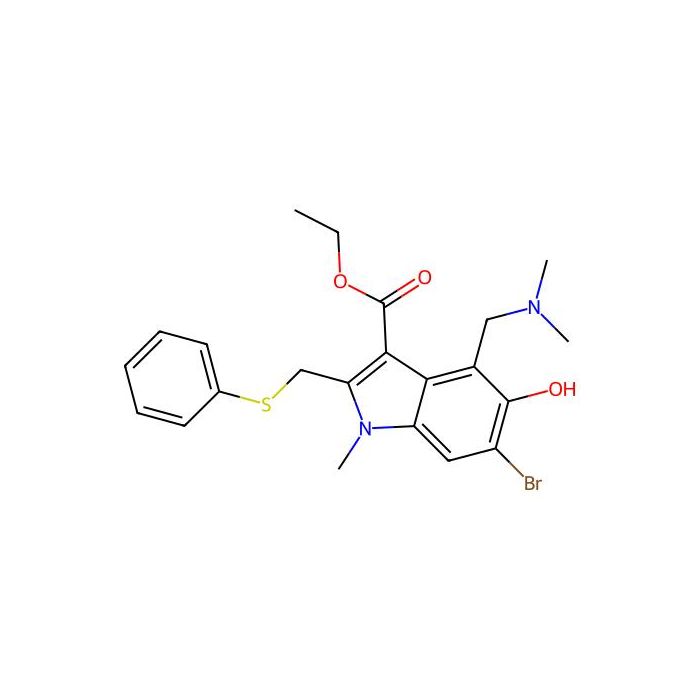
Brief: Umifenovir (also known in literature as Arbidol) is a bromo–indole small molecule featuring a tertiary dimethylamino substituent, an ester, and a thioether-linked phenyl group.
Product Data (item-specific):
SKU: U1497576
CAS: 131707-25-0
Grade: Moligand™
Storage: Protected from light; Argon charged; Store at −80 °C
Shipping: Dry ice packs + Cold packs
Research Use: For research use only
InChIKey: Not specified for this item; refer to CoA/Spec Sheet.
SMILES: Not specified for this item; refer to CoA/Spec Sheet.
Literature identity (for reference only; not item specifications):
Core scaffold: substituted indole ring system bearing a 6-bromo substituent, N1-methyl, a 3-ethyl ester (indole-3-carboxylate), a 4-(dimethylaminomethyl) substituent, a 5-hydroxyl, and a 2-(phenylthio)methyl group.
Structural features (descriptive):
Aromatic heterocycle: indole fused bicyclic system (benzene + pyrrolic nitrogen).
Functional groups: tertiary amine (dimethylamino), phenyl thioether (–CH2–S–Ph), aryl bromide, phenolic OH, and an ethyl ester.
Heteroatoms: N (indole N and tertiary amine), O (phenol and ester), S (thioether), halogen (Br).
2D depiction in words: an indole core substituted with Br on the benzene ring, an ethyl ester at C3, a benzylic –CH2NMe2 at C4, a phenol at C5, an N-methyl on the indole nitrogen, and a –CH2–S–phenyl at C2.
Synthetic Utility
Although sold as a finished small molecule for screening, the Umifenovir scaffold offers multiple vectors for derivatization and SAR exploration in medicinal chemistry.
Functional handles (literature):
Aryl bromide: enables cross-coupling to diversify the benzene ring (Suzuki–Miyaura, Stille, Negishi) or facilitate amination after halide exchange/activation.
Phenolic OH: platform for etherification/esterification or carbonate linkers to attach tags and affinity handles.
Tertiary amine: quaternization or salt formation to tune solubility and permeability; reductive alkylation on a corresponding secondary amine precursor for analog series.
Ethyl ester at indole-3: hydrolysis to the acid, then amide coupling for bioisosteric replacements.
Thioether: selective oxidation to sulfoxide/sulfone for polarity modulation; thia-Michael or nucleophilic substitutions after activation to generate heteroaryl sulfides.
Retrosynthetic notes:
Common strategies build the indole core first (Fischer, Bartoli, or modern C–H functionalization) followed by stepwise installation of the bromide, thioether, ester, and aminomethyl sidechains, with protection of the phenol as needed.
Late-stage cross-coupling on the aryl bromide allows rapid analoging with minimal disruption to the core.
Analytical support:
LC–MS-friendly; positive ESI typically strong due to tertiary amine. Monitor for oxidized sulfur species and ester hydrolysis products under stress testing.
Target Specificity
Item-specific biological target data are not provided for this catalog entry.
Product Data:
Tested/validated target(s): Not specified for this item; refer to CoA/Spec Sheet or primary literature relevant to your application.
Literature context (for planning only; not item claims):
The chemotype is widely used as a tool compound in studies of viral entry and membrane fusion. Reported interactions include viral envelope proteins and host membrane processes; however, target engagement can be context-dependent and assay-specific.
Recommendation: Establish target engagement in your system via orthogonal assays (e.g., CETSA, pull-down with tagged analogs, or phenotypic rescue experiments) before drawing mechanistic conclusions.
Frequently Asked Questions
What is Moligand??
Moligand? is one of Aladdin Scientific's premium product lines, formulated for high-purity applications across multiple workflows. Compared to standard grades in the same workflow, Moligand? products typically offer tighter specifications, more rigorous QC, and stronger lot-to-lot consistency.
How should this product be stored?
Store at ?80 °C, protected from light, under argon. It is supplied under an argon blanket; reseal under inert gas after each use.
How is this product shipped?
This product ships frozen with dry ice and cold packs. Unpack on arrival and transfer it to the storage condition stated above; handle dry ice with insulated gloves in a ventilated area.
What are the CAS number, molecular formula and molecular weight?
The CAS Number is 131707-25-0, the molecular formula is C22H25BrN2O3S, and the molecular weight is 477.43 g/mol.
What documentation is provided?
Available product documentation, including Certificates of Analysis (COA), Safety Data Sheets (SDS), and specification sheets, is shown in the product document area. Document availability and access follow the current site policy.
We use cookies to ensure the website functions properly and, where permitted, to improve your experience. You can manage your preferences at any time in Settings. Learn more in our Cookie Policy.
Shall we send you a message when we have discounts available?
Remind me later
Thank you! Please check your email inbox to confirm.
Products are supplied to verified businesses, institutions, and qualified professionals for research and development use only. Not for use in humans, animals, diagnosis, or therapy.