≥98% for sensitive chromatographic and analytical workflows requiring minimal baseline interference.
🌡
Storage & shipping
Store at 2-8°C,Desiccated Ships Wet ice Check lot-specific COA for exact specifications.
📋
Quality documents
SDS, COA, datasheet, and spec sheet available for download. Lot-specific COA accessible via lot number lookup.
📚
Literature proof
Cited in 0 peer-reviewed publications across chromatography, organic synthesis, and cross-coupling reactions.
Overview
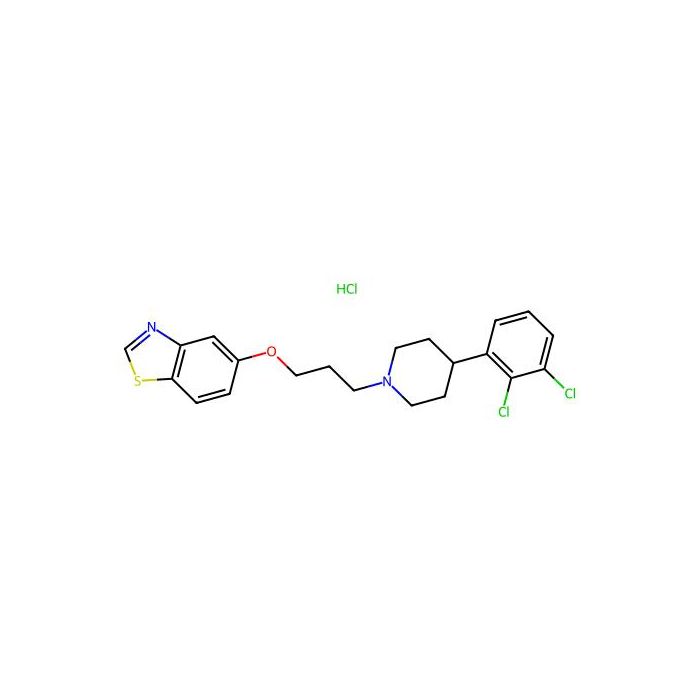
UNC9994 hydrochloride is a functionally selective, β-arrestin–biased dopamine D 2 receptor ( D 2 R ) agonist that selectively activates β-arrestin recruitment and signaling. UNC9994 hydrochloride shows a binding affinity with a K i of 79 nM for D 2 R . UNC9994 hydrochloride is also an antagonist of G i -regulated cAMP production and partial agonist for D2R/β-arrestin-2 interactions. UNC9994 hydrochloride shows antipsychotic-like activity
In Vitro
UNC9994 hydrochloride induces D 2 -mediated β-arrestin-2 translocation with an EC 50 s of 6.1 nM and 448 nM in Tango assay and DiscoveRx assay, respectively. UNC9994 hydrochloride is an antagonist at 5HT 2A and 5HT 2B and an agonist at 5HT 2C and 5HT 1A. MCE has not independently confirmed the accuracy of these methods. They are for reference only.
In Vivo
UNC9994 (2.0 mg/kg; i.p.; once) hydrochloride shows antipsychotic activity that is attenuated in β-arrestin-2 knockout mice . MCE has not independently confirmed the accuracy of these methods. They are for reference only. Animal Model: C57BL/6J wild-type and β-arrestin-2 knockout mice Dosage: 2.0 mg/kg, followed 30 min later with 6 mg/kg phencyclidine (PCP, i.p.) Administration: IP, once Result: Markedly inhibited PCP-induced hyperlocomotion in wild-type mice and the activity was completely abolished in β-arrestin-2 knockout mice.
UNC9994 hydrochloride is a functionally selective, β-arrestin–biased dopamine D 2 receptor ( D 2 R ) agonist that selectively activates β-arrestin recruitment and signaling. UNC9994 hydrochloride shows a binding affinity with a K i of 79 nM for D 2 R . UN
Storage
Store at 2-8°C,Desiccated
Shipped In
Wet ice
This product requires cold chain shipping. Ground and other economy services are not available.
Determine the necessary mass, volume, or concentration for preparing a solution.
Dilution Calculator
Determine the dilution needed to prepare a stock solution.
Reconstitution Calculator
Reviews
Customer Reviews
Application Protocols
No vendor-tested protocols are provided in the Product Data for this item.
General practice for small-molecule screening compounds (not item-specific)
Prepare a concentrated DMSO stock under desiccation, vortex until dissolved, and filter if particulate remains.
Perform serial dilutions in assay-compatible buffer, maintaining constant final DMSO across conditions.
Include vehicle controls and reference ligands for assay qualification.
For item-specific dilutions, incubation times, or plate formats, consult your internal SOPs or primary literature. Verify any protocol against the properties in the CoA.
Biological Roles
Product use note: For research use only.
Literature context (not product-specific)
UNC9994 is reported as a serotonergic receptor ligand, frequently discussed in the context of 5-HT2A signaling and biased agonism studies. Researchers have used it to probe differential engagement of G-protein versus β-arrestin pathways in cell culture and ex vivo systems.
Such ligands are valuable chemical probes for dissecting receptor pharmacology, mapping downstream signaling cascades (e.g., ERK, PLC/IP3, calcium flux), and evaluating structure–activity relationships of GPCR modulators.
Experimental considerations (general)
Confirm receptor expression levels and assay window using positive and negative controls; counter-screen at related receptors if selectivity data are needed.
Normalize dosing to free-base equivalents if potency comparisons across batches or salts are required.
Consider potential light sensitivity or oxidative degradation typical for some aryl-amine scaffolds; protect from light if degradation is suspected (this item’s sensitivity is not specified).
Caution: Do not infer therapeutic properties from in vitro pharmacology. All uses must remain within research contexts, with appropriate institutional approvals for biological testing.
Buffer Applications
This product is a small-molecule research ligand rather than a buffering reagent.
It does not serve as a pH buffer component in typical laboratory protocols. If used in biological assays, it is dissolved in a suitable buffer (e.g., PBS, HEPES, HBSS) as a carrier.
Choose buffer based on the biological system (cell type, receptor assay) and ensure compatibility with any required cosolvent (DMSO, ethanol). Maintain constant final cosolvent percentage across controls and test wells.
Green Alternatives
Green chemistry considerations for this product focus on solvent and workflow choices during handling and assay preparation rather than replacement of the active itself.
Solvent choices (general guidance)
Prefer water or buffered aqueous media when solubility and assay design allow.
If organic cosolvent is necessary, minimize DMSO content in final assay wells (≤0.5–1% v/v) and evaluate greener cosolvents such as ethanol or glycerol/water mixtures when compatible with biology.
Workup and waste minimization
Use microscale stock preparation and aliquoting to reduce waste of both compound and solvent.
Consolidate DMSO/MeOH waste streams for appropriate disposal.
Packaging/handling
Store desiccated to prevent hydrolysis or hydrate formation, reducing the need for repeated re-preparation.
Illustrative comparison (general)
DMSO: Excellent solvency, higher EHS footprint; may be necessary for initial dissolution.
Ethanol/water: Greener profile, acceptable for many biochemical assays; limited by compound solubility and potential assay interference.
Buffered saline: Greenest option; use when compound’s aqueous solubility permits and biological context tolerates low organic content.
Note: No direct “green substitute” for the active is suggested, as the compound’s identity is integral to its research purpose.
Pharmaceutical Uses
No excipient or pharmacopeial use is stated for this item.
Item-specific status: Not specified for this item; refer to CoA/Spec Sheet.
General note
As a research-grade small molecule, UNC9994 hydrochloride is intended for non-clinical laboratory research only. It is not formulated to GMP specifications and is not suitable for human or veterinary use.
In pre-formulation research contexts, hydrochloride salts are sometimes evaluated for solubility and stability relative to free-base forms; such activities are strictly non-clinical and for exploratory studies.
Physical Properties
Only limited item-specific physical data are provided.
Item-specific data (Product Data)
Appearance: Not specified for this item; refer to CoA/Spec Sheet.
Molecular weight: Not specified for this item; refer to CoA/Spec Sheet.
Molecular formula: Not specified for this item; refer to CoA/Spec Sheet.
Typical properties of small-molecule hydrochloride salts (general/literature)
State: Often crystalline solids with enhanced hygroscopicity relative to free bases.
Solubility: Frequently more soluble in water and polar protic/aprotic solvents (e.g., water, methanol, ethanol, DMSO). Exact solubility for this item is not specified; determine empirically.
pKa considerations: Protonated amine salts typically display solution pH in acidic range when dissolved in water; actual pKa relates to the parent amine (not specified here).
Partitioning: Hydrochloride salts show lower apparent logP in aqueous systems versus the free base; quantitative values for UNC9994 HCl are not specified.
Melting point, boiling point, density, refractive index: Not specified for this item; refer to CoA/Spec Sheet.
Practical note (general): When preparing stock solutions for screening, DMSO is commonly used; filter sterilize if required by assay. Always verify concentration by weight and consider hygroscopic water uptake for salts.
Quality & Grades
Item-specific grade/purity: Not specified for this item; refer to CoA/Spec Sheet.
What the absence of a stated grade implies
Without an explicit “HPLC,” “≥98%,” or “Screening” grade designation, users should verify purity and identity on receipt via CoA and, if critical, by independent methods (e.g., LC–MS, 1H NMR).
Typical quality considerations for small-molecule screening compounds (general)
Purity: Screening libraries often target ≥95% LC purity; verify by the chromatographic method described on the CoA (UV/ELSD/charged aerosol).
Identity: Confirm by HRMS/elemental composition and, when needed, 1H/13C NMR; salt form should be clearly stated (hydrochloride) and stoichiometry confirmed.
Counterion content: HCl stoichiometry and residual inorganic content can influence assay performance (osmolarity, pH). Titrate chloride if needed.
Residual solvents/water: Hygroscopic salts may retain water; Karl Fischer and residual solvent data are recommended for sensitive applications.
Stabilizers/additives
None stated for this item. If stabilizers are present, they will be listed on the CoA; absence typically indicates neat material.
Recommendation: For quantitative pharmacology, record batch number and CoA data (purity, ID, salt equivalence) in ELN and normalize dosing to free-base equivalents if applicable.
Reaction & Applications
This compound is supplied as a research ligand/screening small molecule rather than a synthetic reagent.
Synthetic reaction use: Not typically applicable. It is not commonly employed as a solvent, catalyst, or stoichiometric reagent in preparative organic synthesis.
Research applications (general/literature context, not product-specific)
UNC9994 has been described in the literature as a serotonergic receptor ligand used in chemical biology and pharmacology studies to interrogate signaling bias. Users employ it in cell-based assays, receptor binding, or pathway readouts. Consult primary references for specific protocols and concentrations.
Practical handling tips for bioactive small molecules (general)
Prepare accurately weighed portions under low humidity to limit mass error from hygroscopic uptake.
Use DMSO stocks, aliquot, and store cold to minimize degradation; avoid repeated freeze–thaw and prolonged exposure to light if the scaffold is photosensitive (unknown for this item).
If your intended use is synthetic derivatization or conjugation, confirm functional handles and salt stoichiometry from the CoA and literature; otherwise, consider procuring the free-base form if required.
Reaction Conditions
Not typically applicable. UNC9994 hydrochloride is intended as a bioactive research ligand rather than a substrate or reagent for synthetic transformations.
If used in probe development or conjugation (general guidance, literature-based)
Solvent: Anhydrous DMF, DMSO, or ACN for amide couplings; ensure removal of HCl or conversion to free base to avoid acid-induced side reactions.
Bases/coupling: DIPEA/TEA with carbodiimide or uronium reagents; temperatures 0–25°C commonly sufficient for sensitive scaffolds.
Atmosphere: Inert gas if the scaffold is air- or moisture-sensitive (unknown for this item).
These are general conditions and are not item-specific. Consult primary literature on UNC9994 chemistry and perform small-scale trials to establish compatibility.
Safety & Handling
Safety information specific to this item is not provided in the Product Data. Handle according to good laboratory practices and consult the SDS before use.
Item-specific hazard info (Product Data)
Signal word: Not specified for this item; refer to SDS.
H-statements: Not specified for this item; refer to SDS.
GHS classification/pictograms: Not specified for this item; refer to SDS.
General precautions for small-molecule hydrochloride research ligands
PPE: Lab coat, nitrile gloves, safety glasses; handle powders in a fume hood to avoid inhalation.
Avoid contact with skin, eyes, and clothing; prevent inhalation of dust.
Incompatibilities: Strong bases (may liberate free amine), strong oxidizers, and moisture (many HCl salts are hygroscopic). Store desiccated.
First aid (general): Inhalation—move to fresh air; Skin/Eye—rinse with water for several minutes; Ingestion—rinse mouth. Seek medical attention as appropriate. Follow SDS guidance.
Spill response: Avoid dust generation; collect with dampened inert absorbent, place in a suitable container for disposal.
Special risks
No evidence of peroxide formation or flammability hazards typical of volatile solvents; treat as a non-volatile bioactive solid with unknown toxicological profile. Minimize exposure and avoid aerosolization.
Always defer to the official SDS for authoritative hazard classification and emergency measures.
Solvent Selection
This product is a non-volatile organic hydrochloride salt, generally used as a bioactive small molecule rather than as a reaction solvent.
Item-specific solubility: Not specified for this item; refer to CoA/Spec Sheet.
General solvent guidance for hydrochloride salts (literature/general)
Aqueous systems: Frequently soluble in water due to ionic character; solubility depends on the scaffold. Adjust pH only if compatible with assay.
Organic solvents: Highly soluble in DMSO; moderate in methanol/ethanol; limited in nonpolar solvents (e.g., hexanes, toluene). If free-base form is needed, basify an aqueous solution and extract (research use only, observe safety).
Stock solutions: For screening, DMSO stocks (e.g., 10–50 mM) are commonly prepared and aliquoted to minimize freeze–thaw.
Selection considerations
Choose water or buffered aqueous media for biochemistry assays if solubility permits; otherwise use DMSO cosolvent at minimal final percentages (e.g., ≤0.5–1% v/v in assay).
For spectroscopy or LC–MS characterization, use MeOH, ACN, or DMSO; add 0.1% acid (FA/HCOOH) if protonation aids signal.
Comparison (general)
DMSO: maximal solvating power, but hygroscopic and higher viscosity.
Water/buffer: most benign; limited by compound solubility and pH stability.
MeOH/EtOH: good miscibility with water; may affect certain assays (enzyme or receptor systems).
Storage & Reconstitution
Item-specific storage (from Product Data)
Storage conditions: Store at 2–8°C, desiccated.
Shipping: Shipped on wet ice.
Stability considerations (general)
Keep container tightly closed to limit moisture uptake and hydrolysis. Allow vial to warm to room temperature in a desiccator before opening to prevent condensation.
Protect from prolonged exposure to ambient humidity and, if suspected photosensitive, from light (photosensitivity not specified for this item).
Reconstitution (general guidance; not item-specific)
Solvent: DMSO is commonly used to prepare concentrated stocks for small-molecule ligands. Aqueous solubility varies; verify empirically.
Aliquoting: Prepare single-use aliquots to avoid repeated freeze–thaw. Record concentration, date, and batch number on each aliquot.
Storage of solutions: Short-term at 2–8°C; for longer-term, freeze solutions according to your lab SOPs. Inspect for precipitation or discoloration prior to use.
Always refer to the lot-specific CoA/SDS for any additional handling or stability instructions for UNC9994 hydrochloride.
Structure & Identity
Intro: UNC9994 hydrochloride is a small-molecule research ligand supplied as the hydrochloride salt. Structural identifiers in the product data are incomplete; consult the CoA for definitive identity parameters.
Item-specific identifiers (from Product Data)
CAS: 2108826-33-9
CID: 121230971
InChIKey: Not specified for this item; refer to CoA/Spec Sheet. (Product Data lists an incomplete value.)
SMILES: Not specified for this item; refer to CoA/Spec Sheet.
Molecular formula: Not specified for this item; refer to CoA/Spec Sheet.
Molecular weight: Not specified for this item; refer to CoA/Spec Sheet.
General structural notes (literature, not product-specific)
UNC9994 is reported in literature as a serotonergic receptor ligand; the hydrochloride form indicates a protonated amine center paired with chloride.
As a hydrochloride salt, the compound typically contains a tertiary or secondary amine functionality forming an ammonium chloride in the solid state.
2D structure description (general for HCl salts)
Cationic organic scaffold bearing at least one basic nitrogen (protonated), with chloride as counterion. Functional groups and ring systems depend on the exact scaffold; consult primary literature/CoA for definitive features.
Note: For unambiguous identification (exact stereochemistry, ring composition, and connectivity), rely on the CoA/SDS or primary literature for UNC9994.
Synthetic Utility
This compound is provided as a finished bioactive small molecule, not as a synthetic building block.
Typical synthetic roles: Not typically used as a reagent, catalyst, or monomer in preparative chemistry.
If derivatization is desired (general guidance)
Confirm presence and accessibility of functional groups (amines, amides, heteroaryl sites) from literature/CoA before planning prodrug or probe conjugation strategies.
Salt form considerations: Hydrochloride salts can complicate coupling reactions; conversion to the free base and precise neutralization may be necessary for reproducible yields.
Quality control for derivatization (general)
Monitor by LC–MS and NMR; confirm retention of stereochemical integrity if applicable.
For routine synthetic methodology development, consider using simpler, well-characterized scaffolds unless UNC9994-derived analogs are the specific objective.
Target Specificity
Only product-data-sourced information may be listed here.
Target, epitope, species reactivity, clone/isotype: Not applicable; this product is a small molecule, not an antibody or biological. No target specificity details are provided in the Product Data for this item.
Note: While literature discusses potential GPCR interactions for UNC9994, such information is not provided in the Product Data and is therefore not asserted here.
Frequently Asked Questions
What is the purity of this product?
This product is supplied at ≥98% purity (chemical assay). Lot-specific values are stated on the Certificate of Analysis.
How should this product be stored?
Store at 2–8 °C, desiccated. Keep the container tightly closed with desiccant — the material is moisture-sensitive.
How is this product shipped?
This product ships chilled on wet ice. Unpack on arrival and transfer it to the storage condition stated above.
What are the CAS number, molecular formula and molecular weight?
The CAS Number is 2108826-33-9, the molecular formula is C21H23Cl3N2OS, and the molecular weight is 457.84 g/mol. InChIKey MTDQOQYYKZUEEK-UHFFFAOYSA-N.
What documentation is provided?
Available product documentation, including Certificates of Analysis (COA), Safety Data Sheets (SDS), and specification sheets, is shown in the product document area. Document availability and access follow the current site policy.
We use cookies to ensure the website functions properly and, where permitted, to improve your experience. You can manage your preferences at any time in Settings. Learn more in our Cookie Policy.
Shall we send you a message when we have discounts available?
Remind me later
Thank you! Please check your email inbox to confirm.
Products are supplied to verified businesses, institutions, and qualified professionals for research and development use only. Not for use in humans, animals, diagnosis, or therapy.