GRADE & PURITYMoligand™?Moligand™ — Aladdin's line of ligands and bioactive small molecules. Use for receptor, pathway, and binding studies needing defined small-molecule tools.10 mM in DMSO
Moligand™, 10 mM in DMSO Moligand™ for sensitive chromatographic and analytical workflows requiring minimal baseline interference.
🌡
Storage & shipping
Store at -80°C Ships Dry ice packs + Cold packs Check lot-specific COA for exact specifications.
📋
Quality documents
SDS, COA, datasheet, and spec sheet available for download. Lot-specific COA accessible via lot number lookup.
📚
Literature proof
Cited in 54 peer-reviewed publications across chromatography, organic synthesis, and cross-coupling reactions.
Overview
Undecane has anti-allergic and anti-inflammatory activities on sensitized rat basophilic leukemia (RBL-2H3) mast cells and HaCaT keratinocytes. In sensitized mast cells, Undecane inhibits degranulation and the secretion of histamine and TNF-α [
Specifications
Specifications & Purity
Moligand™, 10 mM in DMSO
Storage
Store at -80°C
Shipped In
Dry ice packs + Cold packs
This product requires cold chain shipping. Ground and other economy services are not available.
Determine the necessary mass, volume, or concentration for preparing a solution.
Dilution Calculator
Determine the dilution needed to prepare a stock solution.
Reconstitution Calculator
Reviews
Customer Reviews
Application Protocols
No application protocols are specified for this item. As a small-molecule hydrocarbon, undecane does not have immunoassay or staining protocols (WB, IHC, IF, FC). For use as a GC reference or as a reaction medium/substrate, follow laboratory SOPs or relevant literature methods, validating conditions on small scale.
Biological Roles
Undecane has no intrinsic biological function as a nutrient or cofactor; it is a simple saturated hydrocarbon. Nevertheless, linear alkanes, including C11, appear in various natural contexts (general literature information):
Natural product/volatile component: Trace amounts of undecane are reported among volatile organic compounds from plants, algae, and microorganisms, contributing to scent profiles and potential ecological interactions (attraction/repulsion signals).
Cuticular hydrocarbons: Linear and branched alkanes, including C11–C30 ranges, function as protective layers on insect cuticles; they modulate desiccation resistance and chemical communication. Specific composition varies by species and environment.
Biodegradation: Certain microbes can oxidize long-chain alkanes via alkane monooxygenases, initiating terminal or subterminal oxidation to alcohols, aldehydes, and acids en route to β-oxidation. Undecane serves as a model substrate in such metabolic studies.
Toxicology context (non-clinical): Like many hydrophobic hydrocarbons, aspiration into the lungs poses a risk of chemical pneumonitis; systemic bioactivity is generally low, but hydrocarbons can disrupt biological membranes at sufficient concentrations in vitro.
Note: All uses of this product are for research only. No medical, diagnostic, or clinical claims are implied. Any biological testing should incorporate appropriate controls, solvent blanks, and consider undecane’s strong hydrophobicity and poor aqueous solubility.
Buffer Applications
Undecane is a highly nonpolar hydrocarbon and is not used to formulate aqueous buffer systems. It is immiscible with water and lacks acid/base functionality.
Not applicable: pH buffering, electrophoresis buffers, and cell culture media buffering.
If used in bioassays, undecane would typically appear only as a separate hydrophobic phase or as a minor carrier/overlay (e.g., to limit evaporation), not as a buffer component.
For aqueous buffer needs, select conventional systems (HEPES, PBS, Tris, MOPS) appropriate to the biological application.
Green Alternatives
Sustainability considerations for nonpolar hydrocarbon media (general):
Undecane is a petroleum-derived, nonpolar hydrocarbon with low acute toxicity but poor biodegradability and aquatic hazard at sufficient concentrations (literature). Its high boiling point increases energy demand for removal.
Potential alternatives (trade-offs apply):
Bio-derived isoparaffins or hydrogenated terpenes (e.g., farnesane, squalane fractions):
Pros: renewable carbon source, similar nonpolarity, comparable or higher flash points; often low odor/toxicity.
Cons: supply variability, higher viscosity, different volatility/boiling profiles; cost premium.
Heptane/isooctane (including renewable grades):
Pros: lower boiling points reduce energy for solvent removal; widely available, established safety data.
Cons: higher volatility increases VOC emissions and flammability risk; greater evaporative loss during long runs.
Cyclick ethers (2-MeTHF, CPME) where modest polarity is acceptable:
Pros: often bio-based (2-MeTHF), improved process intensification, better solvation for many organics; favorable EHS profiles vs chlorinated solvents.
Cons: more polar/reactive than alkanes; may coordinate to catalysts or undergo peroxide formation—requires inhibitor/peroxide control.
Brief comparison (literature, qualitative):
Undecane: nonpolar, high bp (~196–198 °C), low vapor pressure; energy-intensive removal.
Heptane: nonpolar, mid bp (~98 °C), easier removal, more VOCs.
Farnesane (bio-isoparaffin): nonpolar, high bp, renewable source; availability and cost considerations.
Selection should balance safety, environmental impact, performance, and downstream removal constraints.
Pharmaceutical Uses
This product is offered for research use only. Undecane is not listed here with a pharmacopeial grade.
General formulation context (literature, non-therapeutic):
Hydrocarbon excipient role: Long-chain alkanes can serve as hydrophobic vehicles in topical research formulations, barrier creams, or as components in ointment bases when blended with waxes/oils. However, undecane specifically is less common than mineral oil or isoparaffins designed for excipient use.
Prototype solvent/carrier: In pre-formulation studies, undecane may act as a nonpolar model vehicle to assess lipophilicity effects, permeation through hydrophobic matrices, or partitioning of actives into nonaqueous phases.
Analytical reference: As a GC reference hydrocarbon for method development/validation.
Regulatory note:
No pharmacopeial compliance or GMP status is stated for this item. Any use in manufacturing or human/animal administration would require appropriate grade, qualification, and regulatory review—not covered by this listing.
Always verify excipient suitability (tox, impurity, residuals) and compatibility with APIs and packaging if transitioning from research to development contexts.
Physical Properties
Item-specific specifications: Not specified for this item; refer to CoA/Spec Sheet.
Typical properties for undecane (literature, approximate):
Appearance: colorless, hydrophobic liquid with very low odor (literature)
Boiling point: ~196–198 °C at 1 atm (literature)
Melting point: ~−26 to −25 °C (literature)
Density: ~0.740 g/mL at 20 °C (literature)
Refractive index (n20/D): ~1.412 (literature)
Vapor pressure: ~1–2 mmHg at 25 °C (literature)
Flash point (closed cup): ~70–72 °C (literature)
Solubility: practically insoluble in water (<1 mg/L at 25 °C); miscible with nonpolar organic solvents (literature)
LogP (octanol/water): ~6.1–6.3 (literature)
Dielectric constant: ~2.0 at 20–25 °C (literature)
pKa: not applicable (no ionizable functional groups)
Practical notes (general):
Volatility/handling: higher-boiling than hexane/heptane; slower evaporation reduces losses during extended heating or film-coating steps.
Solvent behavior: strongly nonpolar; excellent for dissolving hydrophobic substrates, waxes, and long-chain reagents; poor for polar or ionic species.
Chromatography: used as a reference in GC (Kovats index ~1100 on nonpolar columns, literature) and occasionally as a nonpolar diluent in preparative work where high-boiling eluents are acceptable.
For lot-specific physical property limits and release criteria, consult the item’s CoA/Spec Sheet.
Quality & Grades
Item grade: Moligand™ (as provided in Product Data)
What this means: Moligand™ denotes inclusion in a curated small-molecule/compound library designed for research screening, profiling, and chemical biology workflows. It reflects catalog curation and handling suitable for discovery applications, rather than a commodity “solvent grade.”
Clarifications for this item:
Item-specific analytical limits (e.g., detailed purity %, GC area %, water content, residual solvents, trace metals, UV cutoffs) are Not specified for this item; refer to CoA/Spec Sheet.
The provided storage directive (Store at −80 °C) and shipping on dry ice/cold packs are consistent with best practices for library integrity—minimizing evaporation, oxidative aging, and cross-contamination during long-term archival.
Context on common grades (general knowledge):
Reagent/ACS grade: defined assay limits and impurity profiles for general lab use.
Anhydrous grade: moisture specification to support air-/water-sensitive chemistry.
Stabilizers: none indicated in Product Data. If stabilizers or additives are present in a specific lot, they will be disclosed on the CoA/Spec Sheet.
Recommendation: For analytical or synthetic applications that demand a particular purity or moisture level, verify the lot-specific CoA and, if necessary, perform in-house conditioning (e.g., percolation through basic alumina to remove polar traces) prior to critical experiments.
Reaction & Applications
Use cases of undecane in research and process labs (general chemistry guidance):
Inert high-boiling diluent/heat-transfer medium: Suitable for reactions requiring bulk temperatures near 150–190 °C, where aromatic solvents (xylene) are too polar or where minimal solvating power is desired. Examples include thermal isomerizations, polymer curing, and catalyst pre-treatments.
Gas chromatography standard: Linear alkanes define Kovats retention indices (e.g., 1100 for C11 on nonpolar columns, literature). Undecane supports column performance checks and temperature-program calibration.
Hydrophobic extraction and phase modifier: Enhances partitioning of long-chain, lipophilic substrates or separates hydrophobic product phases in biphasic systems (e.g., aqueous-organic separations with salting-out).
Model substrate for C–H functionalization: Benchmark in studies of undirected radical halogenation, photocatalytic borylation, and metal-catalyzed alkane activation to probe selectivity at primary vs secondary C–H sites.
Combustion/engine-relevant surrogate fuel: Employed in combustion kinetics and pollutant formation research as a representative long-chain paraffin (research-only).
Practical tips:
Thoroughly dry glassware and reagents; although alkane is water-immiscible, trace moisture can affect catalysts or cause phase behavior issues.
For C–H activation or halogenation, expect positional isomer mixtures; plan for careful GC analysis and potential derivatization or fractionation.
To remove residual undecane post-reaction, use vacuum stripping at elevated temperature, or co-evaporate with a more volatile solvent (e.g., toluene then heptane) to aid displacement.
Reaction Conditions
General literature guidance for representative transformations of undecane (values are typical ranges; optimize per protocol):
Radical chlorination (benchmark):
Conditions: Cl2 (or SO2Cl2), hν (UV/blue) in neat undecane or inert solvent; 0–25 °C to moderate exotherm.
Outcome: mixed primary/secondary chlorides; enhanced reactivity at secondary sites. Monitor by GC; quench with base to neutralize HCl.
Photocatalytic/Ir-catalyzed C–H borylation:
Catalyst: [Ir(COD)OMe]2 (0.5–1 mol% Ir) with dtbpy; B2pin2 (1.2–2.0 equiv per C–H event).
Solvent: neat undecane or heptane; 80–120 °C; inert atmosphere; 6–24 h.
Notes: favors secondary C–H; products are undecyl–Bpin isomers amenable to oxidation (to alcohols) or cross-coupling.
Autoxidation (mechanistic studies only):
Initiation: AIBN or heat; O2 or air; 80–120 °C.
Products: hydroperoxides/alcohols/ketones; handle peroxides with extreme caution; avoid scale-up unless specifically designed for it.
As solvent/diluent in high-T processes:
Temperature window: up to ~180–190 °C under reflux; nitrogen sweep to limit oxidation.
Workup: vacuum stripping at elevated temp; co-evaporation with toluene/heptane to reduce residuals.
Expected yields are highly reaction-dependent; for undirected halogenation or borylation, product distributions rather than single isolated yields typically dominate. Always consult primary literature and perform small-scale trials to establish selectivity and material balance.
Safety & Handling
Hazard classification for this specific item: Not specified; refer to the product SDS for authoritative information.
Typical GHS information for undecane (literature; for guidance only):
GHS classification: Flammable liquid, Cat. 3; Aspiration hazard, Cat. 1; Hazardous to the aquatic environment (chronic), Cat. 2
Signal word: Danger
H-statements (examples): H226 (Flammable liquid and vapor); H304 (May be fatal if swallowed and enters airways); H411 (Toxic to aquatic life with long lasting effects)
Use in a fume hood to control vapors and avoid inhalation. Avoid aerosol generation.
PPE: safety glasses, lab coat, and appropriate chemical-resistant gloves (e.g., nitrile). Prevent skin/eye contact and ingestion.
Fire safety: keep away from ignition sources, hot surfaces, and open flames. Ground/bond containers during transfer. Use only non-sparking tools.
Spill response: absorb with inert material (vermiculite, dry sand) and place in chemical waste. Ventilate area.
First aid (overview): if inhaled, move to fresh air; if on skin, wash with soap and water; if in eyes, rinse cautiously with water for several minutes; if swallowed, do NOT induce vomiting—seek medical attention (aspiration hazard).
Incompatibilities: strong oxidizers (risk of exothermic reaction). Avoid halogenation reagents and powerful electrophiles unless under controlled synthetic conditions.
Peroxide formation: saturated alkanes are not peroxide formers; nonetheless, avoid prolonged air/UV exposure at elevated temperature to minimize autoxidation.
Always defer to the current SDS for this item for definitive hazards, exposure limits, and emergency procedures.
Solvent Selection
Undecane functions as a highly nonpolar, high-boiling hydrocarbon medium.
Boiling range advantage: reflux near ~196–198 °C (literature) supports high-temperature processing while remaining liquid at ambient conditions.
Miscibility: excellent with other alkanes and hydrophobic organics (e.g., toluene, ethers to a degree); immiscible with water and most polar solvents.
Evaporation: low volatility relative to hexane/heptane minimizes evaporative loss during long reactions or film formation.
When to choose undecane vs alternatives (general):
Choose undecane when a very nonpolar and high-boiling inert diluent is needed (e.g., thermal curing, high-T catalysis, hydrophobic extractions where solvent retention is acceptable).
Choose heptane (bp ~98 °C) or isooctane (bp ~99 °C) for faster evaporation and room-temperature processing where lower toxicity/handling similarity is desired.
Choose dodecane (bp ~216 °C) if still higher thermal headroom is required.
For greener/polar-leaning needs, 2-MeTHF or cyclopentyl methyl ether (CPME) may be appropriate, but these differ in polarity and reactivity (see Green Alternatives).
Small comparison (literature values):
Heptane: bp ~98 °C; faster drying, more volatile.
Undecane: bp ~196–198 °C; much lower volatility, excellent thermal stability.
Dodecane: bp ~216 °C; maximum thermal window among common linear alkanes while remaining a manageable liquid.
Note: For chromatographic use, undecane’s high bp can complicate complete removal; ensure adequate drying protocols or select a more volatile solvent if residue-free workup is critical.
Appearance: Not specified for this item; refer to CoA/Spec Sheet.
Guidance and rationale:
Ultra-cold storage minimizes evaporation, oxidative aging, and cross-contamination in small-molecule libraries. Keep container tightly sealed to prevent vapor loss and ingress of contaminants.
If frozen/viscous at −80 °C, allow the vial to equilibrate to room temperature before opening to avoid condensation ingress. Mix gently to homogenize prior to use.
For frequent access, consider aliquoting into crimped or PTFE-lined screw-cap vials to reduce headspace and minimize repeated temperature cycling.
Short handling at ambient temperature during experimental setup is acceptable; return promptly to specified storage after use.
Reconstitution: Not applicable. Undecane is supplied neat (no buffer required). If dilution is needed, choose a compatible nonpolar solvent (e.g., heptane, isooctane) and label secondary containers with concentration and date.
Always refer to the lot-specific CoA and SDS for stability information, container compatibility, and safe handling during thawing and transfer.
Structure & Identity
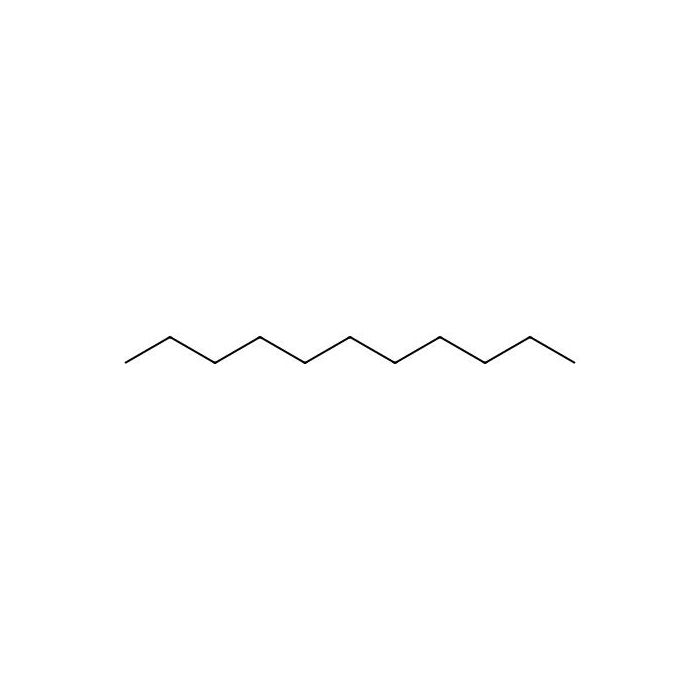
Undecane is a linear, saturated hydrocarbon (an n-alkane) composed of eleven carbon atoms in an unbranched chain with only sp3 C–C and C–H bonds.
Structural features (general chemistry description):
Backbone: straight (unbranched) C11 chain; no rings, no unsaturation, no heteroatoms.
Functional groups: none beyond alkyl C–H; all bonds are nonpolar covalent.
Stereochemistry: achiral; no stereocenters.
2D depiction in words: a zig-zag chain of eleven methylene/methyl units, terminating in methyl groups at both ends (CH3–(CH2)9–CH3).
Item-specific identifiers and specifications not provided in Product Data are given above as literature identifiers for compound recognition only; they are not item release specifications.
Synthetic Utility
Although chemically inert under many conditions, undecane serves several useful roles in synthesis and methodology development (general literature guidance):
Inert reaction medium: Its high boiling point and non-coordinating nature make it ideal as a diluent for reactions sensitive to polar or coordinating solvents (e.g., certain nanoparticle syntheses, thermally driven rearrangements, hydrophobic polymerizations).
Substrate for C–H functionalization benchmarking:
Radical halogenation (Cl2, hν) affords chloroalkane isomer mixtures, illustrating selectivity trends of primary vs secondary C–H sites.
Transition-metal or photochemical C–H borylation (e.g., Ir/dtbpy with B2pin2) can convert C–H to C–Bpin, enabling downstream diversification to alcohols, amines, and halides.
Carbene or nitrene insertions (photoredox/catalytic) provide context for undirected C–H insertion selectivity studies.
Combustion/oxidation studies: Controlled oxidation (e.g., autoxidation, catalytic aerobic conditions) produces hydroperoxides/alcohols/ketones, informing mechanism and selectivity of alkane oxidation.
Building block via stepwise derivatization: Halogenation → substitution (e.g., to 1- or 2-alkanols, amines) yields C11 functionalized materials relevant to surfactants and specialty intermediates.
Practical considerations:
Expect isomer distributions without directing groups; analytical separation (GC, GC–MS) is central.
Avoid strongly polar or coordinating media when studying intrinsic reactivity/selectivity; undecane itself can be both substrate and solvent, simplifying matrices for kinetics.
Target Specificity
Not applicable. This product is a small-molecule hydrocarbon, not a biological targeting reagent (e.g., antibody, ligand with defined receptor selectivity). No antigen/epitope, clone, isotype, or species reactivity information applies.
We use cookies to ensure the website functions properly and, where permitted, to improve your experience. You can manage your preferences at any time in Settings. Learn more in our Cookie Policy.
Shall we send you a message when we have discounts available?
Remind me later
Thank you! Please check your email inbox to confirm.
Products are supplied to verified businesses, institutions, and qualified professionals for research and development use only. Not for use in humans, animals, diagnosis, or therapy.