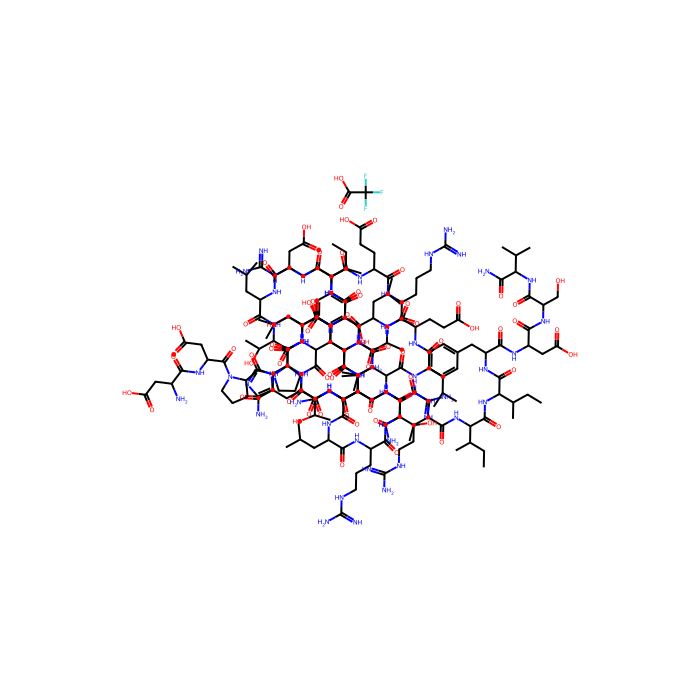
Urocortin rat - ≥97%(HPLC) , CAS No.171543-83-2

CAS: 171543-83-2 Cat. No.: U118945 Formula: C206H338N62O64 Molecular Weight: 4707.26 PubChem CID: 137699472
AVAILABLE TO ORDER
GRADE & PURITY ≥97%(HPLC)
Synonyms
H-Asp-Asp-Pro-Pro-Leu-Ser-Ile-Asp-Leu-Thr-Phe-His-Leu-Leu-Arg-Thr-Leu-Leu-Glu-Leu-Ala-Arg-Thr-Gln-Ser-Gln-Arg-Glu-Arg-Ala-Glu-Gln-Asn-Arg-Ile-Ile-Phe-Asp-Ser-Val-NH2
Storage
Store at -20°C
Shipped In
Ice chest + Ice pads
★
Size
Germany (EU)
USA*
Price
Qty
0.5mg
U118945-0.5mg
Made to order · 8–12 wks
€245.48
1mg
U118945-1mg
Made to order · 8–12 wks
€411.22
2.5mg
U118945-2.5mg
Made to order · 8–12 wks
€729.68
Enter a quantity for the sizes you want to add.

Specifications

Synonyms
H-Asp-Asp-Pro-Pro-Leu-Ser-Ile-Asp-Leu-Thr-Phe-His-Leu-Leu-Arg-Thr-Leu-Leu-Glu-Leu-Ala-Arg-Thr-Gln-Ser-Gln-Arg-Glu-Arg-Ala-Glu-Gln-Asn-Arg-Ile-Ile-Phe-Asp-Ser-Val-NH2
Specifications & Purity
≥97%(HPLC)
Biochemical and Physiological Mechanisms
Endogenous CRF agonist. Kivalues are 13, 1.5 and 0.97 nM for hCRF1, rCRF2αand mCRF2βrespectively.
Storage
Store at -20°C
Shipped In
Ice chest + Ice pads
This product requires cold chain shipping. Ground and other economy services are not available.
Purity
≥97%(HPLC)
Names and Identifiers
SMILES
CCC(C)C(C(=O)NC(C(C)CC)C(=O)NC(CC1=CC=CC=C1)C(=O)NC(CC(=O)O)C(=O)NC(CO)C(=O)NC(C(C)C)C(=O)N)NC(=O)C(CCCNC(=N)N)NC(=O)C(CC(=O)N)NC(=O)C(CCC(=O)N)NC(=O)C(CCC(=O)O)NC(=O)C(C)NC(=O)C(CCCNC(=N)N)NC(=O)C(CCC(=O)O)NC(=O)C(CCCNC(=N)N)NC(=O)C(CCC(=O)N)NC(=O)C(CO)NC(=O)C(CCC(=O)N)NC(=O)C(C(C)O)NC(=O)C(CCCNC(=N)N)NC(=O)C(C)NC(=O)C(CC(C)C)NC(=O)C(CCC(=O)O)NC(=O)C(CC(C)C)NC(=O)C(CC(C)C)NC(=O)C(C(C)O)NC(=O)C(CCCNC(=N)N)NC(=O)C(CC(C)C)NC(=O)C(CC(C)C)NC(=O)C(CC2=CN=CN2)NC(=O)C(CC3=CC=CC=C3)NC(=O)C(C(C)O)NC(=O)C(CC(C)C)NC(=O)C(CC(=O)O)NC(=O)C(C(C)CC)NC(=O)C(CO)NC(=O)C(CC(C)C)NC(=O)C4CCCN4C(=O)C5CCCN5C(=O)C(CC(=O)O)NC(=O)C(CC(=O)O)N.C(=O)(C(F)(F)F)O
IUPAC Name
(4S)-4-[[(2S)-2-[[(2S)-2-[[(2S)-2-[[(2S)-2-[[(2S)-5-amino-2-[[(2S)-2-[[(2S)-5-amino-2-[[(2S,3R)-2-[[(2S)-2-[[(2S)-2-[[(2S)-2-[[(2S)-2-[[(2S)-2-[[(2S)-2-[[(2S,3R)-2-[[(2S)-2-[[(2S)-2-[[(2S)-2-[[(2S)-2-[[(2S)-2-[[(2S,3R)-2-[[(2S)-2-[[(2S)-2-[[(2S,3S)-2-[[(2S)-2-[[(2S)-2-[[(2S)-1-[(2S)-1-[(2S)-2-[[(2S)-2-amino-3-carboxypropanoyl]amino]-3-carboxypropanoyl]pyrrolidine-2-carbonyl]pyrrolidine-2-carbonyl]amino]-4-methylpentanoyl]amino]-3-hydroxypropanoyl]amino]-3-methylpentanoyl]amino]-3-carboxypropanoyl]amino]-4-methylpentanoyl]amino]-3-hydroxybutanoyl]amino]-3-phenylpropanoyl]amino]-3-(1H-imidazol-5-yl)propanoyl]amino]-4-methylpentanoyl]amino]-4-methylpentanoyl]amino]-5-carbamimidamidopentanoyl]amino]-3-hydroxybutanoyl]amino]-4-methylpentanoyl]amino]-4-methylpentanoyl]amino]-4-carboxybutanoyl]amino]-4-methylpentanoyl]amino]propanoyl]amino]-5-carbamimidamidopentanoyl]amino]-3-hydroxybutanoyl]amino]-5-oxopentanoyl]amino]-3-hydroxypropanoyl]amino]-5-oxopentanoyl]amino]-5-carbamimidamidopentanoyl]amino]-4-carboxybutanoyl]amino]-5-carbamimidamidopentanoyl]amino]propanoyl]amino]-5-[[(2S)-5-amino-1-[[(2S)-4-amino-1-[[(2S)-1-[[(2S,3S)-1-[[(2S,3S)-1-[[(2S)-1-[[(2S)-1-[[(2S)-1-[[(2S)-1-amino-3-methyl-1-oxobutan-2-yl]amino]-3-hydroxy-1-oxopropan-2-yl]amino]-3-carboxy-1-oxopropan-2-yl]amino]-1-oxo-3-phenylpropan-2-yl]amino]-3-methyl-1-oxopentan-2-yl]amino]-3-methyl-1-oxopentan-2-yl]amino]-5-carbamimidamido-1-oxopentan-2-yl]amino]-1,4-dioxobutan-2-yl]amino]-1,5-dioxopentan-2-yl]amino]-5-oxopentanoic acid;2,2,2-trifluoroacetic acid
InChIKey
BTOGVDGOXGIAEB-FJAJBMFWSA-N
InChI
1S/C206H338N62O64.C2HF3O2/c1-28-102(20)156(262-192(323)141(92-271)258-182(313)129(78-98(12)13)251-193(324)142-53-42-72-267(142)201(332)143-54-43-73-268(143)200(331)138(88-154(291)292)256-165(296)113(207)84-151(285)286)194(325)255-137(87-153(289)290)187(318)247-131(80-100(16)17)189(320)266-161(109(27)274)199(330)254-133(82-111-46-35-32-36-47-111)183(314)248-134(83-112-89-223-93-229-112)185(316)246-128(77-97(10)11)180(311)244-126(75-95(6)7)178(309)236-118(52-41-71-228-206(221)222)176(307)265-160(108(26)273)198(329)252-130(79-99(14)15)181(312)245-127(76-96(8)9)179(310)240-124(60-66-150(283)284)172(303)243-125(74-94(4)5)177(308)231-106(24)163(294)232-116(50-39-69-226-204(217)218)175(306)264-159(107(25)272)197(328)242-121(57-63-146(210)277)173(304)257-139(90-269)190(321)241-119(55-61-144(208)275)168(299)235-115(49-38-68-225-203(215)216)167(298)239-123(59-65-149(281)282)170(301)234-114(48-37-67-224-202(213)214)166(297)230-105(23)164(295)233-122(58-64-148(279)280)169(300)238-120(56-62-145(209)276)171(302)249-135(85-147(211)278)186(317)237-117(51-40-70-227-205(219)220)174(305)261-158(104(22)30-3)196(327)263-157(103(21)29-2)195(326)253-132(81-110-44-33-31-34-45-110)184(315)250-136(86-152(287)288)188(319)259-140(91-270)191(322)260-155(101(18)19)162(212)293;3-2(4,5)1(6)7/h31-36,44-47,89,93-109,113-143,155-161,269-274H,28-30,37-43,48-88,90-92,207H2,1-27H3,(H2,208,275)(H2,209,276)(H2,210,277)(H2,211,278)(H2,212,293)(H,223,229)(H,230,297)(H,231,308)(H,232,294)(H,233,295)(H,234,301)(H,235,299)(H,236,309)(H,237,317)(H,238,300)(H,239,298)(H,240,310)(H,241,321)(H,242,328)(H,243,303)(H,244,311)(H,245,312)(H,246,316)(H,247,318)(H,248,314)(H,249,302)(H,250,315)(H,251,324)(H,252,329)(H,253,326)(H,254,330)(H,255,325)(H,256,296)(H,257,304)(H,258,313)(H,259,319)(H,260,322)(H,261,305)(H,262,323)(H,263,327)(H,264,306)(H,265,307)(H,266,320)(H,279,280)(H,281,282)(H,283,284)(H,285,286)(H,287,288)(H,289,290)(H,291,292)(H4,213,214,224)(H4,215,216,225)(H4,217,218,226)(H4,219,220,227)(H4,221,222,228);(H,6,7)/t102-,103-,104-,105-,106-,107+,108+,109+,113-,114-,115-,116-,117-,118-,119-,120-,121-,122-,123-,124-,125-,126-,127-,128-,129-,130-,131-,132-,133-,134-,135-,136-,137-,138-,139-,140-,141-,142-,143-,155-,156-,157-,158-,159-,160-,161-;/m0./s1
PubChem CID
137699472
Molecular Weight
4707.26

Advanced Data

Certificates (CoA,COO,BSE/TSE and Analysis Chart)
C of A & Other Certificates(BSE/TSE, COO):
Analytical Chart:
Chemical and Physical Properties
SolubilitySoluble to 1 (mg/mL) in 1% acetic acid}
Solution Calculators
Reviews

Customer Reviews

Application Protocols

No manufacturer-tested applications are provided for this SKU. The following are general literature-style procedures for peptide ligands and should be adapted and validated in-house.

  • Stock preparation (general):

    • Bring vial to room temperature in a desiccated environment.
    • Briefly centrifuge to collect material at the bottom.
    • Add sterile water to achieve a high-concentration stock (e.g., 0.1–1 mg/mL), gently pipette to dissolve. If needed, pre-wet with a small volume of 0.1–1% acetic acid or use limited DMSO.
    • Aliquot into low-binding tubes; store frozen.
  • Cell-based signaling assay (outline):

    • Plate rat-derived cells expressing the receptor of interest.
    • Prepare serial dilutions in assay buffer (e.g., HBSS/HEPES, 0.1% BSA).
    • Treat cells for defined times (e.g., 5–30 min) and measure cAMP or downstream readouts (PKA substrate phosphorylation, reporter gene activity).
    • Include vehicle controls and a known reference ligand if available.
  • Ex vivo tissue assay (outline):

    • Equilibrate tissue in oxygenated physiological buffer.
    • Apply cumulative concentrations; record functional responses.

Document recovery/yield after reconstitution to ensure accurate dosing. Adjust conditions to your specific model.

Biological Roles

Literature/general perspective: Urocortin (urocortin-1) is a member of the corticotropin-releasing factor (CRF) peptide family implicated in stress-related signaling in vertebrates, including rat models. It functions as an endogenous neuropeptide ligand influencing intracellular cAMP/PKA signaling through CRF-family receptors in various tissues.

Key biological features (literature):

  • Family: CRF/urocortin peptides share conserved sequence motifs important for receptor engagement and efficacy.
  • Receptor pharmacology: engages CRF receptor subtypes in a tissue-dependent manner, leading to activation of adenylate cyclase and downstream kinase pathways.
  • Systems context: expressed in central and peripheral tissues; implicated in modulation of stress responses, energy balance, and cardiovascular/neuroendocrine axes in animal models.
  • Structure–activity: N-terminal residues are typically critical for receptor activation, while C-terminal regions contribute to affinity and selectivity; amidation state can modulate potency.

Use in research:

  • Tool for dissecting CRF-axis signaling in rat-derived cells, ex vivo tissues, and in comparative studies across species.
  • Calibration ligand in pharmacological assays to benchmark agonist/antagonist behavior.

Note: The above describes general biological roles from the literature. No target specificity or validated activity is claimed for SKU U118945 beyond its identity as urocortin (rat) for research use only.

Buffer Applications

This product is a peptide reagent and does not function as a buffering agent. It is typically dissolved in buffers for biological assays rather than used to control pH.

Practical note:

  • Choose a buffer compatible with your assay (e.g., PBS or HEPES at pH ~7.2–7.4) and confirm peptide stability and solubility under those conditions.
  • If initial dissolution is challenging, wet the peptide with sterile water or mildly acidified water before adjusting to the desired buffer and pH.
Green Alternatives

As a peptide reagent, the main environmental considerations are solvent choice, packaging, and waste minimization rather than substitution of the active itself.

Greener handling options (general):

  • Prefer aqueous buffers (PBS, HEPES) over organic solvents when solubility permits.
  • Minimize DMSO content by using modest stock concentrations and immediate dilution into water-based buffers.
  • Use low-volume aliquots to reduce waste from thawed, unused material.

Comparison of common vehicles (general):

| Vehicle | Greenness profile | Notes | |---|---|---| | Water/PBS | Preferred (low hazard) | Biocompatible; avoid microbial contamination; use sterile technique. | | HEPES buffer | Preferred | Good pH control near neutrality; stable. | | DMSO | Acceptable with care | Effective cosolvent; manage exposure and waste per local regulations. | | Acidified water (0.1–1% AcOH) | Acceptable | Aids dissolution; neutralize before biological use. |

Waste reduction:

  • Prepare only the amount required for near-term experiments.
  • Combine compatible aqueous waste streams and dispose according to institutional guidelines.

No alternative “green” substitute exists for the specific bioactive sequence; optimization focuses on solvent and workflow efficiency.

Pharmaceutical Uses

For research use only; not for human or veterinary use.

Context (general, non-clinical):

  • Peptide standards such as urocortin are employed in preclinical research settings for receptor pharmacology, comparative potency assessments, and mechanistic studies.
  • In formulation science studies, such peptides may serve as model compounds to evaluate peptide stabilization strategies (e.g., lyophilization, excipient screening) without implying therapeutic use.

Regulatory note:

  • No pharmacopeial monograph or excipient designation is implied for this SKU. Any GMP/clinical applications are outside the scope of this product.

Always consult institutional approvals and do not use this material for diagnostic or therapeutic purposes.

Physical Properties
  • Appearance: Not specified for this item; refer to CoA/Spec Sheet.
  • Molecular weight: Not specified for this item; refer to CoA/Spec Sheet.
  • Molecular formula: Not specified for this item; refer to CoA/Spec Sheet.
  • pI/pKa: Not specified for this item; refer to CoA/Spec Sheet.
  • Solubility: Not specified for this item; refer to CoA/Spec Sheet.

Literature/general properties for CRF-family peptides (guidance only; not specifications):

  • Physical state: usually supplied as lyophilized powder or film for stability.
  • Solubility behavior: readily soluble in water upon initial wetting with small volumes of sterile water or dilute acetic acid; DMSO can be used for hydrophobic sequences; final dilution typically in PBS or assay buffers.
  • Stability: peptides are sensitive to repeated freeze–thaw and to prolonged exposure to elevated temperatures; minimize air and light exposure to reduce oxidation of susceptible residues (e.g., Met, Trp).

Handling tips (general):

  • Reconstitute to a convenient high-concentration stock, aliquot, and store frozen to avoid multiple freeze–thaw cycles.
  • Use low-binding plasticware and add carrier protein (e.g., 0.1% BSA) if nonspecific adsorption is a concern in bioassays.

All exact physical specifications for SKU U118945 are not specified above; consult the CoA/Spec Sheet for authoritative values.

Quality & Grades
  • Grade/purity: Not specified for this item; refer to CoA/Spec Sheet.
  • Salt form/counterion: Not specified for this item; refer to CoA/Spec Sheet.
  • Residual solvents, TFA content, water content, metal content, UV cutoff: Not specified for this item; refer to CoA/Spec Sheet.

Context on peptide reagent quality (general):

  • Peptide grade terminology often includes research grade, >95% purity (HPLC), or crude/screening grade. Higher purity reduces background in receptor activation and binding assays.
  • Counterion/salt form (e.g., acetate vs trifluoroacetate) may affect solubility, pH upon dissolution, and mass balance in dosing. If critical, verify the exact salt form on the CoA.
  • Analytical characterization: RP-HPLC chromatogram, MS (ESI/MALDI) for molecular mass, and sometimes amino acid analysis or peptide content determination are standard. Ask for these where assay sensitivity is high.

Best practices:

  • Use freshly reconstituted aliquots for quantitative pharmacology.
  • If using UV quantification, verify extinction coefficient and peptide content on the CoA for accurate concentration determination.
Reaction & Applications

This product is a bioactive peptide used as a research reagent, not a synthetic intermediate. Applications focus on receptor pharmacology and signaling in rat systems.

Typical research uses (literature/general):

  • CRF-family peptide studies: used to probe corticotropin-releasing factor receptor pathways in vitro and ex vivo (e.g., measuring cAMP generation, PKA activation, or downstream gene expression) in rat-derived cells and tissues.
  • Ligand benchmarking: establish potency and efficacy relative to CRF and related peptides in receptor overexpression systems or native tissues.
  • Physiology experiments: evaluate peptide-triggered responses in isolated tissues, neurons, or organotypic slices under controlled conditions.
  • Antagonist/agonist profiling: use in concentration–response curves to characterize receptor modulators.

Experimental tips (general):

  • Prepare concentrated sterile stocks, aliquot, and avoid repeated freeze–thaw.
  • Include appropriate vehicle controls (water or buffer ± DMSO) and adsorption controls (carrier protein if permitted by the assay).
  • For time-course studies, pre-equilibrate solutions to assay temperature and protect from light where oxidation-sensitive residues are present.

Note: No manufacturer-validated application list is provided for SKU U118945. The above are general literature uses of urocortin-family peptides in rat research.

Reaction Conditions

This product is not intended for use as a reagent in organic synthesis; therefore, classical reaction conditions (solvent, catalyst, temperature) do not apply.

Assay preparation conditions (general guidance):

  • Reconstitution: sterile water or buffer at neutral pH; for difficult dissolution, pre-wet with sterile water or 0.1–1% acetic acid, then adjust to assay buffer.
  • Working concentrations: literature studies often use low nM to µM ranges depending on receptor expression and assay format; determine empirically for your system.
  • Temperature: equilibrate solutions to the assay temperature (typically 22–37°C) prior to dosing to minimize adsorption and precipitation.
  • Filtration: use 0.22 µm sterile filters for cell-based assays if compatible with peptide recovery; avoid unnecessary filtration if adsorption losses are significant.

All numeric conditions should be optimized empirically for each model system; no manufacturer-validated reaction/assay conditions are provided for SKU U118945.

Safety & Handling

For research use only. Handle as a laboratory chemical/biological reagent. SDS is the authoritative source for hazard information.

  • GHS classification, signal word, pictograms, H-statements: Not specified for this item; refer to SDS.

General safety guidance for peptides (literature/practice):

  • Expected hazards: low volatility; peptides typically present low acute toxicity via dermal exposure but may cause irritation or allergic sensitization in susceptible individuals.
  • PPE: lab coat, nitrile gloves, safety glasses; use a dust mask or operations in a fume hood when weighing fine powders to avoid inhalation of particulates.
  • Engineering controls: weigh in a clean, draft-free area or ventilated enclosure; avoid aerosolization.
  • Incompatibilities: avoid strong oxidizers (can oxidize sensitive residues), strong acids/bases for prolonged periods (can hydrolyze peptide bonds), and elevated temperatures.
  • First aid (overview, defer to SDS):
    • Inhalation: move to fresh air; seek medical attention if symptoms persist.
    • Skin/eye contact: rinse with water for several minutes; remove contaminated clothing.
    • Ingestion: rinse mouth; seek medical advice.
  • Spill response: gently dampen powder to avoid dust, collect with inert absorbent, and dispose per institutional guidelines.
  • Waste: dispose as laboratory chemical/biological waste per local regulations.

Always consult the product-specific SDS and your institution’s EH&S requirements before use.

Solvent Selection

This product is a peptide reagent rather than a conventional organic solvent. Solvent selection here refers to reconstitution and assay dilution.

General guidance (literature/practice):

  • Primary solvents: sterile water, PBS, or assay-specific buffered saline. For sequences with limited aqueous solubility, first wet with a minimal volume of sterile water or dilute acetic acid (0.1–1%) before stepwise dilution into buffer.
  • Organic cosolvents: DMSO can be used to prepare a concentrated stock when aqueous solubility is limited; final working DMSO concentration is commonly kept ≤0.1–0.5% v/v in biological assays to avoid solvent effects.
  • pH considerations: maintain near-neutral pH (6.8–7.4) for receptor assays; transient exposure to mild acid can aid dissolution but should be neutralized before use.
  • Adsorption mitigation: add 0.05–0.1% carrier protein (BSA) or 0.01% nonionic surfactant (e.g., Tween 20) where acceptable to reduce losses to plastics and glass.

Comparison (general):

  • Water/PBS: biocompatible, ideal for immediate use and in vitro assays.
  • DMSO stocks: maximize solubility and stability for hydrophobic segments; require careful dilution to avoid precipitation.
  • Acidified water: improves initial wetting/dissolution; adjust to physiological pH before application.

Always verify compatibility with the intended assay system and consult the CoA for any item-specific recommendations.

Storage & Reconstitution
  • Storage conditions (item-specific): Store at -20°C.
  • Shipping (item-specific): Shipped in ice chest + ice pads.

General best practices for peptide handling:

  • Upon receipt: store at recommended temperature. If lyophilized, allow vial to warm to room temperature in a desiccated environment before opening to prevent condensation.
  • Reconstitution:
    • Use sterile, nuclease/protease-free water or buffer. For difficult dissolution, pre-wet with sterile water or 0.1–1% acetic acid, then dilute with buffer to desired pH.
    • Target an initial stock concentration that minimizes adsorption (e.g., ≥0.1 mg/mL), adjusting for your assay’s dosing range.
  • Aliquoting and stability:
    • Prepare single-use aliquots in low-binding tubes.
    • Avoid repeated freeze–thaw cycles; thaw on ice and keep solutions cold until use.
    • For extended storage of solutions, freezing at ≤ -20°C is typical; verify peptide stability under your conditions.
  • Filtration: If sterility is required, pass through a 0.22 µm low-protein-binding filter, recognizing potential peptide loss.

Specifications not provided for this item:

  • Appearance, exact molecular weight/formula, salt form, stabilizers: Not specified for this item; refer to CoA/Spec Sheet.

Always follow your institution’s aseptic practices and consult the CoA/SDS for any additional item-specific instructions.

Structure & Identity

Peptidic neuropeptide reagent from the corticotropin-releasing factor (CRF) family, provided for rat research applications.

  • Item-specific identifiers:

    • CAS: 171543-83-2
    • CID: 137699472
    • InChIKey: 33950 (as provided; note: non-standard format for typical InChIKeys)
    • SMILES: Not specified for this item; refer to CoA/Spec Sheet.
    • Molecular formula: Not specified for this item; refer to CoA/Spec Sheet.
    • Molecular weight: Not specified for this item; refer to CoA/Spec Sheet.
  • Structural class and features (literature/general):

    • Urocortin (rat) is a peptide hormone of the CRF/urocortin family; typically a linear polypeptide (~40 amino acids) with an amidated C-terminus in native forms (literature), featuring multiple acidic and basic residues and potential intra-peptide stabilizing interactions.
    • Functional group landscape: multiple amide bonds (peptide backbone), side-chain functionalities (carboxylates, amines, alcohols) typical of standard amino acids.
  • 2D structure description (general):

    • A linear sequence of alpha-amino acids connected via peptide bonds with an N-terminal amine and a C-terminal carboxyl (or amide, depending on form). No disulfide bonds are present in urocortin-1 (literature). The backbone can adopt alpha-helical content in membrane-proximal environments or upon receptor binding (reported in literature for CRF-family peptides).

Note: When exact sequence, salt form, or post-translational modifications are required for experimental design, consult the specific CoA/Spec Sheet for this SKU.

Synthetic Utility

Not a general-purpose synthetic building block. As a bioactive peptide, its value lies in biological assays rather than chemical transformations.

General chemistry perspective:

  • Conjugation: peptides can be derivatized at N-terminus, C-terminus, or specific side chains (e.g., Lys, Cys if present) for labeling or immobilization. Any modification to SKU U118945 would be user-performed and is not implied by the product listing.
  • Immobilization: attachment to solid supports for binding studies or pull-down assays using NHS ester, maleimide, or click-chemistry handles introduced by the user.
  • Degradation chemistry: controlled proteolysis or chemical fragmentation may be used analytically to confirm identity (e.g., LC–MS/MS), not as a synthetic route.

If you require a modified urocortin (labels, biotin, fluorescent tags), contact technical support for custom synthesis options. Do not infer the presence of any tags or modifications for this item without CoA confirmation.

Target Specificity

No target specificity data are provided for this item in the supplied product data. Do not assume receptor subtype selectivity, binding constants, or activity profiles.

For planning experiments:

  • Consult primary literature for urocortin peptides in rat models to understand typical receptor interactions and potency, then verify in your own system.
  • If exact target affinity/efficacy is critical, perform in-house controls (e.g., concentration–response curves) under your assay conditions.

Frequently Asked Questions

What is the purity of this product, and how is it determined?
This product is supplied at ≥97% purity, determined by HPLC. Lot-specific values are stated on the Certificate of Analysis.
How should this product be stored?
Store at ?20 °C. Freezer storage is required to maintain the specified shelf life.
How is this product shipped?
This product ships in an insulated container with ice pads. Unpack on arrival and transfer it to the storage condition stated above.
What are the CAS number, molecular formula and molecular weight?
The CAS Number is 171543-83-2, the molecular formula is C206H338N62O64, and the molecular weight is 4707.26 g/mol. InChIKey BTOGVDGOXGIAEB-FJAJBMFWSA-N.
What documentation is provided?
Available product documentation, including Certificates of Analysis (COA), Safety Data Sheets (SDS), and specification sheets, is shown in the product document area. Document availability and access follow the current site policy.

Shall we send you a message when we have discounts available?

Remind me later

Thank you! Please check your email inbox to confirm.

Oops! Notifications are disabled.