Determine the necessary mass, volume, or concentration for preparing a solution.
Dilution Calculator
Determine the dilution needed to prepare a stock solution.
Reconstitution Calculator
Reviews
Customer Reviews
Application Protocols
Not applicable. No immunoassay or bioanalytical application protocols (WB, IHC, IF, FC) are associated with this small-molecule reagent.
For chemical use, see Reaction Conditions for representative synthetic protocols (Shapiro, Bamford–Stevens, and Barluenga-type couplings). Always tailor stoichiometry, solvent, base, and temperature to your specific substrate and scale.
Biological Roles
This product is a synthetic organic intermediate and is not intended for biological or clinical use. No endogenous biological role is known for valerophenone tosylhydrazone.
General context (chemistry-focused):
Hydrazones are encountered in bioconjugation and analytical derivatization of carbonyl compounds, but N-tosylhydrazones specifically are predominantly used as synthetic surrogates for carbanions/diazo species in organic chemistry.
The p-toluenesulfonyl group imparts stability, crystallinity, and predictable leaving-group behavior under basic/thermal conditions; these features are valued in reaction design rather than biology.
Any interactions with enzymes, receptors, or metabolic pathways have not been established and are outside the scope of research use for this reagent.
For all work potentially involving biological matrices, rigorously remove residual reagent and byproducts (e.g., p-toluenesulfinate, p-toluenesulfonamide) and verify absence by appropriate analytical methods (LC–MS/GC–MS) if required by your application.
Buffer Applications
Not typically applicable. Valerophenone tosylhydrazone is a non-ionic organic building block used in chemical synthesis rather than as a buffering agent.
Practical note: if aqueous workups are needed (e.g., after base-promoted reactions), standard laboratory buffers (phosphate, acetate, carbonate) may be used to adjust pH during quench/extraction, but the compound itself does not serve as a buffer component.
Green Alternatives
Using tosylhydrazones is often a greener, safer alternative to handling free diazoalkanes (e.g., diazomethane) while enabling similar reactivity under controlled release of N2.
Traditional: diazomethane or sulfonyl azides (high acute toxicity, shock sensitivity for some reagents).
Greener alternative: N-tosylhydrazones as bench-stable, crystalline precursors; generate diazo species in situ with base/heat.
Solvent choices:
Replace DCM/CHCl3 with EtOAc, 2-MeTHF, CPME, or toluene when compatible with base/catalyst system.
For Pd-catalyzed Barluenga couplings, dioxane or 2-MeTHF can substitute for DMF/DMA in many cases, improving EHS profiles.
Bases and conditions:
Favor carbonate bases (K2CO3, Cs2CO3) or organic superbases (DBU/TBD) over NaH when feasible, to reduce pyrophoric hazards.
Energy use:
Microwave or flow thermolysis of tosylhydrazones can shorten reaction times and enhance safety via smaller holdup of energetic intermediates.
Example tradeoffs (general):
2-MeTHF vs THF: improved sustainability and higher boiling point, but can be less miscible with water; drying may be slower.
EtOAc vs DCM: better EHS profile; sometimes lower solubility may require higher volumes or mild warming.
Always confirm green substitutions on small scale to ensure identical selectivity and acceptable impurity profiles.
Pharmaceutical Uses
No pharmacopeial or excipient role is indicated for this item. It is supplied for research use only as an organic intermediate.
Context for process chemists (general):
N-Tosylhydrazones can serve as masked diazo/carbanion sources in the synthesis of drug-like alkenes and substituted arenes via Barluenga-type couplings and Shapiro eliminations, often enabling late-stage diversification without handling hazardous diazo reagents directly.
When used in medicinal chemistry or route scouting, ensure full toxicological evaluation of residual sulfonyl byproducts (e.g., p-toluenesulfinate, p-toluenesulfonamide) during impurity assessments.
Regulatory note: this product is not intended for human or veterinary use, nor for diagnostic or therapeutic applications. Any GMP-related specifications or residual solvent/metal limits are not provided here; consult CoA and internal quality systems if considering process development studies.
Physical Properties
Item-specific numerical specifications (mp, bp, density, refractive index, UV cutoff, residual water/metals) are not provided in the Product Data for SKU V337979.
Item-specific values:
Melting point: Not specified for this item; refer to CoA/Spec Sheet.
Boiling point: Not applicable/Not typically reported for hydrazone solids; not specified for this item; refer to CoA/Spec Sheet.
Density: Not specified for this item; refer to CoA/Spec Sheet.
Solubility (qualitative, literature/general): generally soluble in common organic solvents (e.g., dichloromethane, chloroform, THF, dioxane, EtOAc, acetone, alcohols) and poorly soluble in water due to the hydrophobic aryl/butyl framework and sulfonyl group.
LogP, pKa, nD: Not specified for this item; refer to CoA/Spec Sheet.
Context/literature notes for tosylhydrazones (general):
Physical state: typically crystalline organic solids at ambient temperature.
Stability: hydrazones are generally stable under neutral, dry conditions; they may hydrolyze back to the parent carbonyl compound under aqueous acidic conditions. Prolonged exposure to strong base or high heat can induce nitrogen-eliminating transformations.
Polymorphism/E/Z isomerism: E/Z around the C=N may influence melting behavior and NMR patterns; mixtures are common unless specifically isomerized or crystallized.
Always consult the item’s CoA/SDS for definitive physical property data before process design.
Quality & Grades
Item-specific grade/purity: Not specified for this item; refer to CoA/Spec Sheet.
Appearance: Not specified for this item; refer to CoA/Spec Sheet.
Guidance on interpreting grades for this class of reagent (general):
Research grade organic intermediates are typically suitable for synthetic applications, method development, and screening. Where chromatography-grade or HPLC-grade specifications exist, they mainly relate to low UV background and impurity control; these designations are uncommon for solid building blocks like tosylhydrazones.
Tosylhydrazones can display E/Z isomer content and residual inorganic salts (from crystallization) or trace parent ketone. If your process is base-/catalyst-sensitive, request CoA data on:
Purity by NMR/LC (area %), residual starting materials, water (KF), and inorganic residue (ash/metals) if relevant.
Isomer ratio (if controlled or specified); for this item, not specified.
Stabilizers: none are typically added to tosylhydrazones. If any stabilizer or additive is present, it would be explicitly stated on the CoA/spec sheet; not specified for this item.
Use case fit:
For palladium-catalyzed reactions or photo-/thermally sensitive steps, low residual halides, peroxides, or acids may be desirable—verify via CoA if critical.
For scale-up, confirm batch-to-batch consistency and solid-state form (E/Z composition, solvate/hemihydrate status) where applicable.
Reaction & Applications
Valerophenone tosylhydrazone is a versatile synthon that leverages the reactivity of N-tosylhydrazones to access carbanions, diazo species, and alkenes.
Key application families (literature):
Shapiro reaction: deprotonation with strong base (e.g., n-BuLi, LDA) at the hydrazone α-position forms a vinyllithium equivalent after elimination of p-toluenesulfinate. Quench with electrophiles to forge C–C bonds or protonate to give alkenes derived from valerophenone. The butyl substituent biases regioselectivity in eliminations.
Bamford–Stevens reaction: base/heat-promoted generation of diazo intermediates from tosylhydrazones; under neutral or basic conditions, thermolysis/extrusion of N2 affords alkenes. Solvent polarity and acidity (MeOH vs toluene) influence carbocation vs radical pathways.
Metal-catalyzed couplings (Barluenga-type): Pd-catalyzed reactions of N-tosylhydrazones with aryl/alkenyl halides or boronic acids to give substituted alkenes or cross-coupled products, using the hydrazone as a diazo/carbanion surrogate.
Carbene transfer: in the presence of Rh/Cu catalysts, in situ diazo generation can deliver metal carbenes for cyclopropanations or insertions (conditions must be tuned to avoid uncontrolled nitrogen loss).
Reductive transformations: hydrazones can, under Wolff–Kishner-like conditions, be reduced to alkanes (here, removing the carbonyl oxygen equivalent) though classical WK uses simple hydrazones rather than tosyl variants.
Practical notes:
Exclude water/acid to prevent hydrolysis back to valerophenone.
Control temperature ramp in eliminations to manage gas evolution (N2) and suppress side reactions.
For scale-up, venting and calorimetry are recommended due to exothermic nitrogen extrusion.
Reaction Conditions
Typical conditions (literature/general guidance; optimize per substrate and scale):
Shapiro reaction (vinyl anion generation):
Base: n-BuLi or LDA (2.0–3.0 equiv).
Solvent: dry THF, Et2O, or 2-MeTHF.
Temperature: −78 °C to 0 °C, then warm to rt as needed.
Electrophiles: water/MeOH for alkene formation; aldehydes/ketones/epoxides for C–C bond formation.
Notes: preformation of the hydrazone lithium species at low temp improves selectivity; exclude moisture.
Bamford–Stevens (alkene formation/diazo release):
Base: KOH, t-BuOK, or DBU (1–3 equiv).
Solvent: toluene, dioxane, t-BuOH, or MeOH (pathway depends on solvent polarity/proticity).
Temperature: 60–140 °C (oil bath or sealed tube); gas evolution (N2) observed.
Notes: maintain venting or use sealed reactors rated for pressure; monitor by GC.
Barluenga coupling (Pd-catalyzed):
Catalyst: Pd(PPh3)4 (2–5 mol%) or Pd2(dba)3 with suitable ligands.
Base: K2CO3/Cs2CO3 (2–3 equiv).
Partner: aryl/alkenyl halides or boronic acids.
Solvent: 1,4-dioxane, toluene, or DMF; 80–120 °C.
Notes: slow addition of base or portionwise hydrazone can moderate exotherm; dry conditions preferred.
Carbene transfer (cyclopropanation/insertion):
Catalyst: Rh2(OAc)4 or Cu(I) salts (0.5–2 mol%).
Solvent: DCM, toluene, or 2-MeTHF.
Temperature: 0–25 °C or reflux depending on system.
These conditions are representative literature starting points. Verify compatibility with valerophenone-derived substrates and perform small-scale trials before scale-up.
Safety & Handling
GHS classification, signal word, and H/P statements are not provided in the Product Data for this SKU. Always consult the SDS for authoritative safety information.
General safety guidance for tosylhydrazones (literature/industry practice):
Hazards: organic sulfonylhydrazones can be irritants; dust may cause respiratory irritation. Under strong base/heat they can form transient diazo species or generate gases (N2) during eliminations. Avoid uncontrolled heating.
Peroxide formation: not typically an ether-containing peroxide former; however, standard solvent peroxide considerations still apply to ethers used with it.
Incompatibilities: strong oxidizers (due to organic sulfonyl moiety), strong acids (hydrolysis), and powerful bases at elevated temperature (can trigger Bamford–Stevens/Shapiro-type reactions). Avoid azide/diazo co-reagents unless reaction is planned and controlled.
PPE: laboratory coat, safety glasses, and suitable chemical-resistant gloves (e.g., nitrile). Use dust control and local exhaust when weighing. Handle inside a fume hood.
First aid (overview; defer to SDS):
Inhalation: move to fresh air; seek medical attention if symptoms persist.
Skin/eyes: rinse with plenty of water for at least 15 minutes; remove contaminated clothing; seek medical advice if irritation continues.
Ingestion: rinse mouth; do not induce vomiting; seek medical attention.
Fire-fighting: treat as combustible organic solid; use CO2, dry chemical, or foam. Thermal decomposition may release SOx/NOx. Firefighters should wear SCBA.
Spill control: avoid dust generation, collect with inert absorbent, and dispose of according to local regulations.
Solvent Selection
As a hydrophobic organic solid with a sulfonylhydrazone functionality, this material typically dissolves in mid-polar aprotic solvents and many oxygenated solvents.
Polarity/miscibility (literature/general):
Good solubility: DCM, chloroform, THF, 1,4-dioxane, EtOAc, acetone, acetonitrile, DMF/DMSO; solubility often improves upon gentle warming.
Moderate solubility: lower alcohols (MeOH/EtOH/i-PrOH); hydrogen bonding can both aid and limit solubility depending on isomer/solid form.
Poor solubility: water and very nonpolar alkanes (hexanes/heptane) unless used as antisolvents for crystallization.
Selection by application:
Base-promoted transformations (Shapiro, Bamford–Stevens): THF, 2-MeTHF, dioxane, toluene, or mixed alcohol/ether systems; choose solvent stable to strong base and temperature.
Pd-catalyzed couplings from N-tosylhydrazones: dioxane, toluene, THF, or DMA/DMF depending on substrate/catalyst.
Reductive or hydrolytic steps: alcohols or aqueous-organic mixtures are used when intentionally cleaving the hydrazone.
Practical tips:
Dry solvents when strong bases or moisture-sensitive catalysts are employed; water promotes retro-hydrazone hydrolysis to the parent ketone.
Begin with 5–20 mL solvent per mmol for screenings and adjust by visual dissolution; seed crystallization from EtOAc/hexanes or toluene/hexanes as needed.
Comparison (general): DCM offers fast dissolution and facile removal but poor EHS profile; EtOAc or 2-MeTHF are greener alternatives with often comparable solubility.
Storage & Reconstitution
Storage conditions (from Product Data): Room temperature. Store tightly closed in a dry, well-ventilated place.
Shipping (from Product Data): Shipped at ambient temperature (Normal).
Handling and stability (general guidance for tosylhydrazones):
Protect from moisture and acids to avoid hydrolysis back to valerophenone. Use desiccant in long-term storage.
Avoid prolonged exposure to elevated temperatures, especially in the presence of base, to prevent premature N2 extrusion.
If clumping occurs from ambient humidity, gently break up the solid under dry conditions; material performance is typically unaffected if purity remains within specification (confirm by NMR/LC).
Reconstitution/dissolution:
For stock solutions, dissolve in dry DCM, THF, dioxane, EtOAc, MeOH/EtOH, acetonitrile, DMF, or DMSO as required by your protocol. Filter to remove particulates if necessary.
Prepare fresh solutions for base-promoted or catalytic reactions; extended storage of basic solutions is not recommended.
Avoid repeated freeze–thaw of solutions; aliquot if long-term storage of solutions is necessary and verify stability by analytical methods.
Research use note: For research use only (from Product Data). Always consult the product’s CoA and SDS prior to use.
Structure & Identity
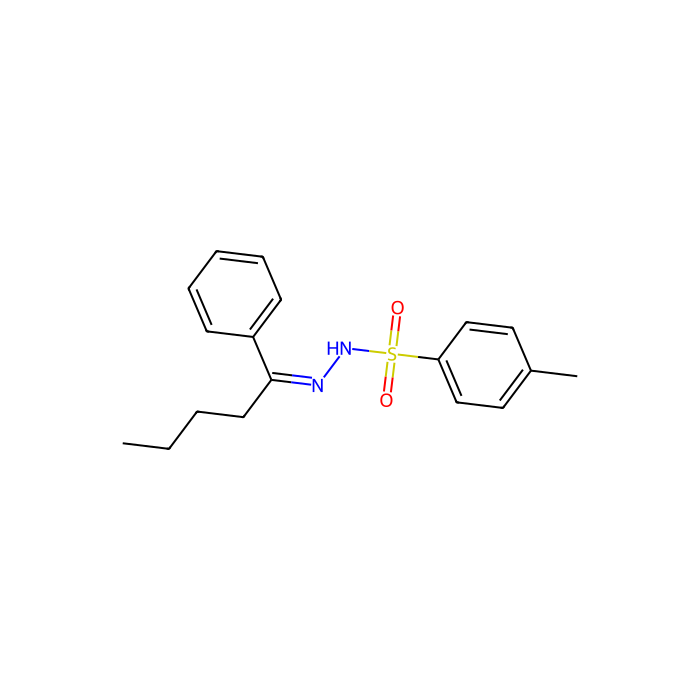
Valerophenone tosylhydrazone is the p-toluenesulfonylhydrazone derivative of valerophenone (butyl phenyl ketone), used as a stable diazo/carbanion surrogate in synthesis.
Item-specific identifiers (from Product Data):
CAS: 69015-74-3
PubChem CID: 3764702
InChIKey: Not specified for this item; refer to CoA/Spec Sheet.
SMILES: Not specified for this item; refer to CoA/Spec Sheet.
Composition and formula:
Molecular formula: Not specified for this item; refer to CoA/Spec Sheet.
• Note: For a generic valerophenone N-tosylhydrazone, a literature/computed formula is often reported around C18H22N2O2S (literature), but confirm against the CoA for this exact SKU.
Molecular weight: Not specified for this item; refer to CoA/Spec Sheet.
Structural features (general, literature):
Functional groups: aryl ketone-derived C=N–N linkage (hydrazone), para-tolyl sulfonyl (–SO2–Ar–CH3), phenyl ring from valerophenone side, and a linear butyl chain attached to the imine carbon (E/Z geometric isomerism possible about the C=N bond).
Core connectivity (described in words): a benzoylmethylene unit from valerophenone condensed with p-toluenesulfonylhydrazide to give an imine (C=N) attached to –NH–SO2–(p-tolyl). The imine carbon bears the butyl substituent that originated from the ketone’s alkyl side chain.
Stereochemistry: the hydrazone C=N can exist as E/Z isomers; commercial materials may contain an isomeric mixture unless otherwise specified (not specified for this item).
Synthetic Utility
Functional group logic (literature):
The C=N–NHTs motif behaves as a linchpin that can (i) be deprotonated α to the imine carbon to generate nucleophiles (Shapiro), (ii) release diazo intermediates and N2 (Bamford–Stevens), or (iii) serve as a leaving group to unveil alkenes or carbenes under catalytic conditions.
Retrosynthetic value:
Starting from valerophenone, formation of the tosylhydrazone locks in the carbonyl connectivity and delivers a bench-stable solid suitable for shipment and storage. Downstream, it can be converted into:
Terminal or internal alkenes corresponding to the ketone carbon skeleton (E/Z outcomes tuned by base, temperature, and solvent).
Cross-coupled products via Pd-catalyzed methods using the hydrazone as a diazo/carbanion equivalent.
Cyclopropanes and insertion products via metal-carbene transfer after in situ diazo formation.
Tips and transformations:
Shapiro: 2–3 equiv strong base (e.g., n-BuLi) at −78 to 0 °C, then electrophile or proton source; p-toluenesulfinate is expelled.
Bamford–Stevens: base (KOH, t-BuOK) and heat; solvent polarity modulates pathway and selectivity.
Barluenga coupling: Pd catalyst, base (K2CO3/Cs2CO3), and aryl halide partner in dioxane/toluene; forms substituted alkenes.
Scalability and handling:
Solid form simplifies dosing compared to neat aldehydes/ketones or gaseous diazo reagents.
Gas evolution (N2) requires vented apparatus; calorimetry advised for scale-up.
Target Specificity
Not applicable. This product is a small-molecule organic reagent and does not have biological target specificity (no antigen, clone, isotype, or species reactivity). For intended uses, see the Synthetic Utility and Reaction & Applications sections.
We use cookies to ensure the website functions properly and, where permitted, to improve your experience. You can manage your preferences at any time in Settings. Learn more in our Cookie Policy.
Shall we send you a message when we have discounts available?
Remind me later
Thank you! Please check your email inbox to confirm.
Products are supplied to verified businesses, institutions, and qualified professionals for research and development use only. Not for use in humans, animals, diagnosis, or therapy.

 E2309785