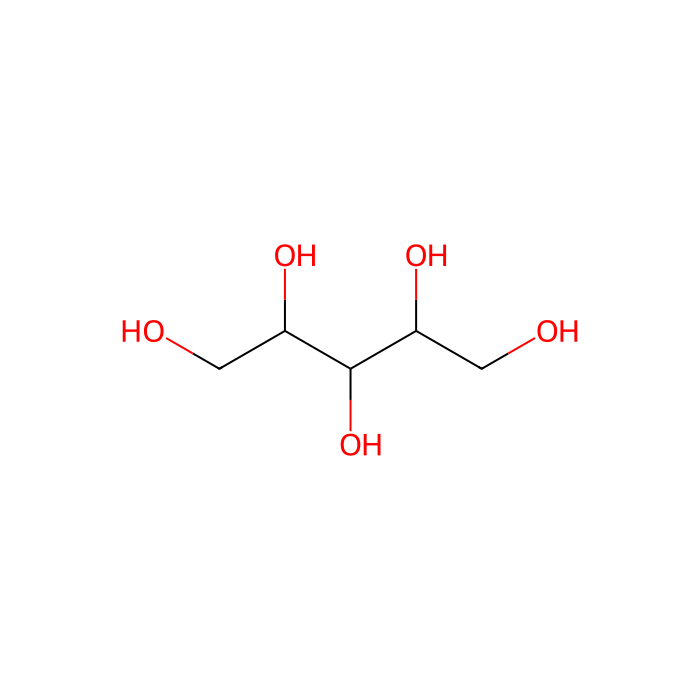
Xylitol - ≥98%, used for Xylitol has been used:as a standard for high performance liquid chromatography;in analysing antibacterial activity on oral biofilms;for thermodynamic data and densities measurement various applications , CAS No.87-99-0

CAS: 87-99-0 Cat. No.: X100092 Formula: C5H12O5 Molecular Weight: 152.15 Beilstein Registry Number: 1720523 EC Number: 201-788-0
AVAILABLE TO ORDER
GRADE & PURITY ≥98%
Synonyms
HEBKCHPVOIAQTA-NGQZWQHPSA-N | XYLITOL [WHO-DD] | QSPL 191 | Xylisorb 300 | 4-01-00-02832 (Beilstein Handbook Reference) | XYLITOL [EP IMPURITY] | XYLITOL [II] | Xylitol, >=99% | ADONITOL [MI] | bmse000062 | HY-N0538 | Xylitol, Meso-xylitol, C-Xylidex CR 1
Storage
Room temperature,Argon charged,Desiccated
Shipped In
Normal
★
Size
Germany (EU)
USA*
Price
Qty
25g
X100092-25g
—
3 In stock
€8.59
100g
X100092-100g
3 In stock
3 In stock
€9.46
500g
X100092-500g
—
2 In stock

€27.68

€41.56
Save €13.88 (33.40%)
Enter a quantity for the sizes you want to add.
🧪
Why this grade

≥98% for sensitive chromatographic and analytical workflows requiring minimal baseline interference.

🌡

Storage & shipping

Room temperature,Argon charged,Desiccated Ships Normal Check lot-specific COA for exact specifications.

📋

Quality documents

SDS, COA, datasheet, and spec sheet available for download. Lot-specific COA accessible via lot number lookup.

📚

Literature proof

Cited in 119 peer-reviewed publications across chromatography, organic synthesis, and cross-coupling reactions.

Overview

Xylitol is a natural five carbon sugar alcohol, which is equivalent to the sweetness of sucrose. Xylitol can be used to make candy, gum, toothpaste and mouthwash. Xylitol is a low-energy sweetener independent of insulin metabolism, which makes it a potential sugar substitute for diabetic patients. Xylitol is a kind of natural anti caries agent, which is not used by cariogenic bacteria and has a starving effect on dental caries. Xylitol can prevent otitis and upper respiratory tract infection. Commercially, microorganisms such as bacteria, fungi and yeasts produce xylitol by fermentation.

Specifications

Synonyms
HEBKCHPVOIAQTA-NGQZWQHPSA-N | XYLITOL [WHO-DD] | QSPL 191 | Xylisorb 300 | 4-01-00-02832 (Beilstein Handbook Reference) | XYLITOL [EP IMPURITY] | XYLITOL [II] | Xylitol, >=99% | ADONITOL [MI] | bmse000062 | HY-N0538 | Xylitol, Meso-xylitol, C-Xylidex CR 1
Specifications & Purity
≥98%
Biochemical and Physiological Mechanisms
A sugar alcohol sweetener detectable by humans. Produced from hemicellulose hydrolysate fermentation.
Application
Xylitol has been used:as a standard for high performance liquid chromatography;in analysing antibacterial activity on oral biofilms;for thermodynamic data and densities measurement
Storage
Room temperature,Argon charged,Desiccated
Shipped In
Normal
Action Type
ACTIVATOR
Purity
≥98%
Names and Identifiers
Pubchem Sid
Pubchem Sid Url
https://pubchem.ncbi.nlm.nih.gov/substance/488180201
Canonical Smiles
C(C(C(C(CO)O)O)O)O
IUPAC Name
(2S,4R)-pentane-1,2,3,4,5-pentol
InChIKey
HEBKCHPVOIAQTA-NGQZWQHPSA-N
INCHI
1S/C5H12O5/c6-1-3(8)5(10)4(9)2-7/h3-10H,1-2H2/t3-,4+,5?
Isomeric SMILES
C([C@H](C([C@H](CO)O)O)O)O
WGK Germany
2
RTECS
ZF0800000
Molecular Weight
152.15
Beilstein
1720523
Reaxy-Rn
1902256
Reaxys-RN_link_address
https://www.reaxys.com/reaxys/secured/hopinto.do?context=S&query=IDE.XRN=1902256&ln=

Documentation

📋 Safety Data Sheet (SDS)

Comprehensive hazard, handling, storage, and regulatory compliance document.

Download SDS →

✅ Certificate of Analysis (COA)

Lot-specific quality data. Enter your lot number to retrieve the exact COA.

Look up COA →

📊 Datasheet

Quick-reference summary of product specifications and applications.

View datasheet →

🔬 Specification Sheet

Full quality attributes and acceptance criteria for this grade.

View spec sheet →

Advanced Data

Taxonomic Classification

Taxonomy Tree

KingdomOrganic compounds
SuperclassOrganic oxygen compounds
ClassOrganooxygen compounds
SubclassCarbohydrates and carbohydrate conjugates
Intermediate Tree Nodes Not available
Direct ParentSugar alcohols
Alternative Parents Monosaccharides  Secondary alcohols  Polyols  Primary alcohols  Hydrocarbon derivatives  
Molecular FrameworkAliphatic acyclic compounds
Substituents Sugar alcohol - Monosaccharide - Secondary alcohol - Polyol - Hydrocarbon derivative - Primary alcohol - Alcohol - Aliphatic acyclic compound
DescriptionThis compound belongs to the class of organic compounds known as sugar alcohols. These are hydrogenated forms of carbohydrate in which the carbonyl group (aldehyde or ketone, reducing sugar) has been reduced to a primary or secondary hydroxyl group.
External Descriptors Not available
3D Structure
Interactive Chemical Structure Model


Certificates(CoA,COO,BSE/TSE and Analysis Chart)
C of A & Other Certificates(BSE/TSE, COO):
Analytical Chart:

Find and download the COA for your product by matching the lot number on the packaging.

46 results found

Lot NumberCertificate TypeDateItem
F2616475Certificate of AnalysisMay 28, 2026 X100092
F2616474Certificate of AnalysisMay 28, 2026 X100092
F2616467Certificate of AnalysisMay 28, 2026 X100092
L2526303Certificate of AnalysisDec 15, 2025 X100092
A2607391Certificate of AnalysisDec 15, 2025 X100092
A2607392Certificate of AnalysisDec 15, 2025 X100092
A2607403Certificate of AnalysisDec 15, 2025 X100092
A2607404Certificate of AnalysisDec 15, 2025 X100092
L2526302Certificate of AnalysisDec 15, 2025 X100092
L2526301Certificate of AnalysisDec 15, 2025 X100092
L2526300Certificate of AnalysisDec 15, 2025 X100092
F2503607Certificate of AnalysisMay 17, 2025 X100092
F2503608Certificate of AnalysisMay 17, 2025 X100092
F2503606Certificate of AnalysisMay 17, 2025 X100092
F2503605Certificate of AnalysisMay 17, 2025 X100092
F2503568Certificate of AnalysisMay 17, 2025 X100092
C2519690Certificate of AnalysisMar 29, 2025 X100092
C2519691Certificate of AnalysisMar 29, 2025 X100092
C2519689Certificate of AnalysisMar 29, 2025 X100092
K2404698Certificate of AnalysisOct 18, 2024 X100092
K2404613Certificate of AnalysisOct 18, 2024 X100092
K2404612Certificate of AnalysisOct 18, 2024 X100092
K2404611Certificate of AnalysisOct 18, 2024 X100092
J2410774Certificate of AnalysisJul 09, 2024 X100092
J2410773Certificate of AnalysisJul 09, 2024 X100092
J2326586Certificate of AnalysisOct 13, 2023 X100092
J2326585Certificate of AnalysisOct 13, 2023 X100092
H2324381Certificate of AnalysisAug 03, 2023 X100092
H2325003Certificate of AnalysisAug 03, 2023 X100092
H2324380Certificate of AnalysisAug 03, 2023 X100092
H2324379Certificate of AnalysisAug 03, 2023 X100092
H2324378Certificate of AnalysisAug 03, 2023 X100092
C2303110Certificate of AnalysisFeb 11, 2023 X100092
C2303115Certificate of AnalysisFeb 11, 2023 X100092
C2303117Certificate of AnalysisFeb 11, 2023 X100092
C2303118Certificate of AnalysisFeb 11, 2023 X100092
C2303121Certificate of AnalysisFeb 11, 2023 X100092
C2303136Certificate of AnalysisFeb 11, 2023 X100092
J1825190Certificate of AnalysisAug 12, 2022 X100092
C2209364Certificate of AnalysisFeb 17, 2022 X100092
A2310416Certificate of AnalysisFeb 17, 2022 X100092
E2309065Certificate of AnalysisFeb 17, 2022 X100092
C2209363Certificate of AnalysisFeb 17, 2022 X100092
C2209362Certificate of AnalysisFeb 17, 2022 X100092
C2209359Certificate of AnalysisFeb 17, 2022 X100092
A2310418Certificate of AnalysisFeb 17, 2022 X100092
Chemical and Physical Properties
SolubilitySoluble in water (50 mg/ml), abs methanol (6 g/100ml), abs ethanol (1.2 g/100ml), alcohol (very slightly), and pyridene. Insoluble in ether.
SensitivityMoisture sensitive
Melt Point(°C)93-94.5°C
Molecular Weight152.150 g/mol
XLogP3-2.500
Hydrogen Bond Donor Count5
Hydrogen Bond Acceptor Count5
Rotatable Bond Count4
Exact Mass152.068 Da
Monoisotopic Mass152.068 Da
Topological Polar Surface Area101.000 Ų
Heavy Atom Count10
Formal Charge0
Complexity76.100
Isotope Atom Count0
Defined Atom Stereocenter Count2
Undefined Atom Stereocenter Count0
Defined Bond Stereocenter Count0
Undefined Bond Stereocenter Count0
The total count of all stereochemical bonds0
Covalently-Bonded Unit Count1
Documents & Articles
Bio-based Chemicals: From Platform Molecules to Application Scenarios — Trend Insights and Aladdin’s Product Portfolio
An Introduction to Research-Grade Carbohydrates: Decoding the “Glycan Language” and a Product-Selection Guide (with Tables 1–3)
Functional Properties, Application Scenarios, and Manufacturing Processes of Maltotetraose (G4): A Review
Why Do Alcohols Differ in Function: Why Is Glycerol Mainly Moisturizing, Propylene Glycol Mainly Solubilizing, and Isopropyl Alcohol Fast-Drying? — Understanding Personal Care Formulation Functions from Structural Differences
The Moisturizing and Low-Moisture Protective Mechanisms of Trehalose: From Its α,α-1,1 Structure and Hydration Dynamics to In Vitro Skin Barrier Research
Moisturizing Mechanisms of Tremella fuciformis Polysaccharides: From Polysaccharide Structure and Hydration Rheology to Dynamic Film Formation on the Skin Surface
What Is Direct Compression? Process Characteristics, Suitability Criteria, and Excipient Selection
Citations of This Product
Solution Calculators
Reviews

Customer Reviews

Shall we send you a message when we have discounts available?

Remind me later

Thank you! Please check your email inbox to confirm.

Oops! Notifications are disabled.