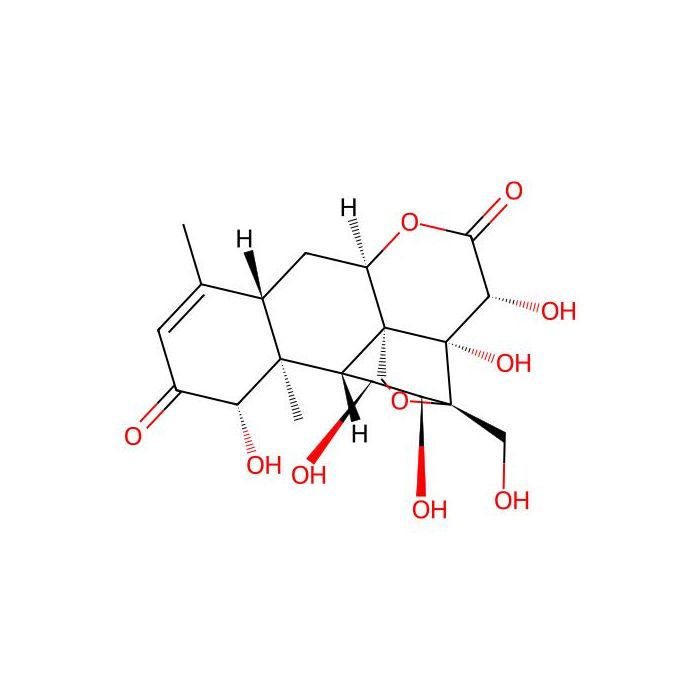
10mM in DMSO for sensitive chromatographic and analytical workflows requiring minimal baseline interference.
🌡
Storage & shipping
Store at -80°C Ships Dry ice packs + Cold packs Check lot-specific COA for exact specifications.
📋
Quality documents
SDS, COA, datasheet, and spec sheet available for download. Lot-specific COA accessible via lot number lookup.
📚
Literature proof
Cited in 0 peer-reviewed publications across chromatography, organic synthesis, and cross-coupling reactions.
Overview
Yadanziolide A, isolated from the cultivated dry seeds of Brucea javanica , has strong antiviral activities with IC 50 of 5.5 μM against tobacco mosaic virus. Yadanziolide A shows significant antitumor effects
IC50& Target:IC50: 5.5 μM (Tobacco mosaic virus)
Specifications
Specifications & Purity
10mM in DMSO
Biochemical and Physiological Mechanisms
Yadanziolide A, isolated from the cultivated dry seeds of Brucea javanica , has strong antiviral activities with IC 50 of 5.5 μM against tobacco mosaic virus. Yadanziolide A shows significant antitumor effects.
Storage
Store at -80°C
Shipped In
Dry ice packs + Cold packs
This product requires cold chain shipping. Ground and other economy services are not available.
Determine the necessary mass, volume, or concentration for preparing a solution.
Dilution Calculator
Determine the dilution needed to prepare a stock solution.
Reconstitution Calculator
Reviews
Customer Reviews
Application Protocols
No tested application protocols are provided for this item.
General handling protocol for small-molecule stocks (guidance):
Upon receipt, allow the sealed container to equilibrate to room temperature in a desiccator before opening to avoid moisture condensation.
Prepare a concentrated stock in anhydrous DMSO (e.g., 10–50 mM) using analytical balance-based gravimetric dilution for accuracy.
Filter through a 0.22 μm PTFE syringe filter if particulate is present and filtration is compatible with the compound.
Aliquot into amber vials or PCR tubes to minimize headspace and freeze–thaw cycles. Record exact concentration and date.
For bioassays, dilute into the assay buffer immediately before use; keep final organic co-solvent low (≤0.1–1% v/v depending on assay tolerance).
Analytical check:
Verify identity/purity by LC–MS and HPLC before critical experiments. Archive a reference chromatogram for lot traceability.
These are generic best practices and should be adapted to your application.
Biological Roles
No item-specific biological or mechanistic data are provided for this product. Do not infer biological activity without appropriate experimental validation.
Literature/general context:
Yadanziolide A has been described in natural products literature as a plant-derived terpenoid-type lactone. Compounds in this class are commonly studied for their roles as secondary metabolites involved in plant defense and ecological interactions.
As a purified small molecule, it can serve as a reference material in metabolomics, dereplication workflows, and natural-product library screening.
Usage notes:
For biochemical assays, prepare fresh solutions and include appropriate vehicle controls, as hydrophobic natural products may adsorb to plastics and exhibit apparent activity due to aggregation at higher concentrations.
No clinical or therapeutic claims are made for this material. It is supplied strictly for research use only.
Buffer Applications
This product is a hydrophobic small molecule and is not a buffering reagent. Conventional buffer systems (phosphate, HEPES, Tris, acetate) are more appropriate for pH control.
Practical note:
If using in aqueous biological buffers, dissolve Yadanziolide A first in a miscible organic solvent (commonly DMSO), then dilute into buffer while maintaining a low final co-solvent percentage to avoid precipitation.
Green Alternatives
When handling hydrophobic natural products like lactones, solvent choice dominates the environmental footprint.
Replace dichloromethane with ethyl acetate or 2-MeTHF for extractions and many reactions when feasible.
Consider CPME or 2-MeTHF instead of THF for moisture-sensitive steps; both show improved peroxide stability profiles and better EHS metrics (still monitor peroxides as appropriate).
Swap acetonitrile with ethanol or isopropanol in chromatographic/mobile-phase systems where selectivity permits; use water-rich gradients to reduce organic solvent consumption.
Illustrative comparison (general):
DCM vs EtOAc: EtOAc offers lower toxicity and is biodegradable; elution strength differences may require method re-optimization.
THF vs 2-MeTHF: 2-MeTHF is bio-based and has a higher boiling point, enabling energy savings in distillation; note different polarity and water miscibility.
DMF/DMSO vs MeOH/EtOH: For work-up and crystallization, protic alcohols are typically greener; retain DMSO/DMF for cases requiring high polarity and solvating power.
Operational practices:
Minimize volumes, reuse eluents when purity allows, and employ closed-loop solvent recovery.
At analytical scale, use UHPLC to reduce solvent per injection.
These recommendations are general; ensure they are compatible with Yadanziolide A’s actual solubility/stability in your application.
Pharmaceutical Uses
There are no item-specific pharmaceutical excipient or compendial listings provided for this product.
General context:
As a purified natural product, Yadanziolide A may be used as a reference standard or analytical control in discovery and preformulation research. It is not supplied with claims of GMP manufacture or pharmacopeial compliance.
If intended for formulation research, assess solid-state form, solubility, and stability (stress testing under ICH-like conditions) to inform enabling strategies (e.g., amorphous dispersions, lipid-based systems). These evaluations are the responsibility of the researcher and are outside the scope of this listing.
Important: For any regulated use, obtain detailed quality documentation (full CoA, impurity profile) and evaluate suitability per your quality system. The product is for research use only.
Physical Properties
Item-specific physico-chemical specifications are not listed in the product data.
Appearance: Not specified for this item; refer to CoA/Spec Sheet.
Melting point: Not specified for this item; refer to CoA/Spec Sheet.
Boiling point: Not applicable/rarely reported for complex natural products; Not specified for this item; refer to CoA/Spec Sheet.
Density: Not specified for this item; refer to CoA/Spec Sheet.
Refractive index: Not applicable (solid) unless provided; Not specified for this item; refer to CoA/Spec Sheet.
Solubility: Not specified for this item; refer to CoA/Spec Sheet.
Literature/general expectations for terpenoid lactones (for planning only; verify experimentally):
Physical state: Often crystalline or amorphous solids.
Solubility profile: Typically sparingly soluble in water; soluble in organic solvents such as DMSO, methanol, acetonitrile, ethyl acetate, dichloromethane (compound- and purity-dependent).
Partitioning: Frequently lipophilic (moderate to high logP), which guides use of DMSO stock solutions for screening workflows.
Important: Do not treat literature values as item specifications. For method validation, rely on lot-specific CoA/SDS and verify solubility and stability in your lab matrix.
Quality & Grades
Grade/Purity: Not specified for this item; refer to CoA/Spec Sheet.
Interpretation and guidance:
In the absence of an explicit grade (e.g., analytical, HPLC, bioactive screening grade), treat this listing as a research-use reagent suitable for discovery workflows, target validation, and method development. For regulated or quantitative applications, request a detailed CoA including identification (NMR/HRMS), purity method (HPLC/UPLC with detection wavelength), residual solvents, and water content if applicable.
UV behavior: If you intend to use HPLC-UV for assay, note that many terpenoid lactones have modest UV absorbance outside of 200–220 nm unless conjugation is present. Validate detection wavelength and extinction coefficients experimentally.
Stabilizers: Not specified for this item; refer to CoA/Spec Sheet. If no stabilizer is present, maintain stringent low-temperature storage to mitigate slow degradation.
Batch-to-batch considerations: Natural product isolates can show minor polymorphism or solvation differences. Confirm identity and purity on receipt (e.g., 1H NMR in CDCl3/CD3OD, LC–MS). If you require a specific polymorph or amorphous form, contact technical support prior to ordering.
Documentation: For audits or preclinical method development, request CoA/SDS and, if needed, supplementary QA documentation (impurity profile, chromatograms).
Reaction & Applications
Manufacturer application notes were not provided for this listing.
Research uses (general for natural-product lactones; literature-based guidance):
Reference standard: Utilized in natural products chemistry for dereplication, profiling, and as a structural benchmark in phytochemical studies.
SAR and probe development: Serves as a scaffold for semi-synthetic modification to explore structure–activity relationships (e.g., selective reduction/oxidation, lactone opening/reclosure, acylation of alcohols if present).
Analytical method development: Useful for validating extraction, LC–MS method performance, and stability-indicating assays for complex terpenoids.
Synthetic manipulations typically explored (verify functional groups for this specific molecule before use):
Lactone transformations: Base- or nucleophile-induced ring opening to hydroxy acids/esters; re-lactonization under dehydrating conditions.
Chemoselective reductions/oxidations: If enone or allylic alcohol motifs are present (common in terpenoids), selective hydrogenation or epoxidation may be leveraged.
Protection strategies: Formation of silyl ethers or acetonides on polyols when derivatization is required.
Practical tips:
Maintain anhydrous, oxygen- and light-limited conditions for sensitive steps. Monitor reactions by LC–MS and 1H NMR to avoid over-transformation of the lactone moiety.
For bioassay usage, prepare fresh DMSO stocks and minimize freeze–thaw cycles to preserve integrity.
Reaction Conditions
No item-specific reaction condition data are provided. The following are general, literature-style conditions applicable to lactone-containing terpenoids; confirm compatibility with Yadanziolide A’s confirmed structure before use.
Lactone opening: ROH (3–10 equiv), catalytic DMAP, and mild base (e.g., Et3N) in toluene or CH2Cl2 at 20–40°C; or NaOMe/MeOH at 0–25°C for more forcing conditions. Monitor to avoid overreaction.
Hydrogenation of enone motifs (if present): H2 (1–3 atm), Pd/C (5–10 wt%), EtOAc or EtOH, 20–25°C, 1–6 h; check for lactone stability and avoid hydrogenolysis of sensitive protecting groups.
Epoxidation (if isolated C=C present): mCPBA (1.1–1.5 equiv) in CH2Cl2 at 0°C to rt; quench and wash thoroughly to remove acids that might open the lactone.
Oxidation to adjust oxidation state: Dess–Martin periodinane or PCC for alcohol-to-ketone conversions at 0–25°C in CH2Cl2; strictly anhydrous conditions recommended.
Relactonization: Use carbodiimide (EDC) with catalytic DMAP in CH2Cl2 or MeCN at 0–25°C to re-form the lactone after ring opening.
Analytical/QA:
Track by LC–MS and quantitative 1H NMR. Establish mass balance and check for isomerization. Carry out small-scale scouting before scale-up.
Safety & Handling
Hazard information for this item is not provided in the product data and may vary by jurisdiction and lot.
GHS classification: Not specified for this item; refer to SDS.
Signal word / H-statements / pictograms: Not specified for this item; refer to SDS.
General laboratory precautions (good practice; consult SDS for authoritative guidance):
PPE: Wear lab coat, safety glasses, and appropriate chemically resistant gloves. Handle powders in a fume hood to avoid dust/aerosol inhalation.
Avoid ingestion, inhalation, and skin/eye contact. Wash thoroughly after handling.
Incompatibilities: Strong oxidizers, strong bases/acids may degrade ester/lactone functionalities (general consideration for lactones). Keep away from moisture and prolonged light/heat exposure.
First aid overview: If inhaled—move to fresh air; if on skin—wash with soap and water; if in eyes—rinse cautiously with water for several minutes; if ingested—rinse mouth and seek medical attention. Always follow your institution’s emergency procedures.
Environmental precautions: Prevent release to the environment; collect spills with inert absorbent and dispose of according to local regulations.
Special risks and stability:
Natural products with multiple stereocenters can be sensitive to hydrolysis or epimerization under strongly basic/acidic conditions. Minimize exposure to elevated temperature. Store and handle under the recommended cold-chain conditions.
Always defer to the product SDS and institutional EHS guidance.
Solvent Selection
This compound is provided as a small-molecule natural product. Item-specific solubility data are not listed.
Practical guidance (literature/general for hydrophobic lactones; verify in your lab):
Primary stock solvents: DMSO (analytical grade, anhydrous) is typically preferred for preparing concentrated stocks (e.g., 10–50 mM) due to broad solvating power and compatibility with screening assays. Methanol or acetonitrile are common alternatives for LC workflows.
Working solutions: For aqueous assays, dilute DMSO stocks into buffered media keeping final DMSO ≤0.1–1% v/v as your system tolerates. Use co-solvents (e.g., MeCN, EtOH) or cyclodextrins if precipitation occurs.
Nonpolar media: Ethyl acetate, dichloromethane, and toluene are often effective for extraction or reaction set-ups; choose based on downstream processing and safety.
Water miscibility: Expect low water solubility; pre-dissolve in organic solvent. Sonication and gentle warming can aid dissolution; avoid prolonged heating.
Small comparison (general):
DMSO vs DMF: DMSO is less volatile and broadly compatible with bioassays; DMF can be used for synthetic steps but is less desirable in biological contexts.
MeOH vs ACN: MeOH offers protic environment and is LC-friendly; ACN provides stronger elution power in reversed-phase LC and lower viscosity.
Always confirm actual solubility and stability under your specific conditions.
Storage & Reconstitution
Storage conditions (from product data):
Store at -80°C.
Shipped in dry ice packs + cold packs to maintain cold chain.
Best practices:
Upon receipt, immediately place the unopened container at -80°C. Allow to equilibrate in a desiccator to room temperature before opening to prevent moisture condensation.
For short-term working stocks, -20°C is often acceptable if the compound is kept dry and protected from light; retain a master aliquot at -80°C for long-term stability. Empirically verify stability under your conditions.
Reconstitution:
Solvent: Not specified for this item; refer to CoA/Spec Sheet. As general practice for hydrophobic natural products, use anhydrous DMSO to prepare concentrated stocks (e.g., 10–50 mM), then dilute into compatible media.
Filtration: Optional 0.22 μm PTFE filtration if particulate is observed and if no adsorption losses are expected.
Aliquoting: Prepare small, single-use aliquots in amber vials or tubes to minimize freeze–thaw cycles and light exposure.
Stability notes:
Avoid repeated freeze–thaw. Protect from light and moisture. Monitor for degradation by LC–MS/HPLC over time.
Research use note: For research use only.
Structure & Identity
Short description: Yadanziolide A is a small-molecule natural product supplied for research use.
CAS: 95258-14-3
PubChem CID: 10320238
InChIKey: Not specified for this item; refer to CoA/Spec Sheet.
SMILES: Not specified for this item; refer to CoA/Spec Sheet.
Molecular formula: Not specified for this item; refer to CoA/Spec Sheet.
Molecular weight: Not specified for this item; refer to CoA/Spec Sheet.
Structural features (literature/general):
The “-olide” suffix denotes a lactone functionality; literature sources describe Yadanziolide A as a plant-derived terpenoid-type lactone with multiple stereocenters.
Typical 2D depiction (literature) includes a carbocyclic scaffold bearing an internal ester (lactone) and oxygenated substituents; multiple fused/bridged rings are common in this family.
Notes:
Definitive structural identifiers (InChIKey/SMILES) and elemental composition for this specific lot are not provided here. Consult the product CoA/Spec Sheet or PubChem CID 10320238 for structural records used in your informatics workflows.
Synthetic Utility
Item-specific functional group mapping is not provided; the following guidance reflects general strategies for terpenoid lactones and should be adapted once the exact structure is confirmed from CoA or PubChem CID 10320238.
Lactone ring chemistry: Nucleophilic opening to hydroxy acids/esters; selective ring-opening with alcohols (transesterification) or amines (lactamization after activation), followed by re-lactonization to access analogs.
Redox modulation: If the scaffold contains enone/allylic motifs, chemoselective hydrogenation or epoxidation/hydroxylation enables SAR exploration without disrupting the ring system.
Functional group interconversions: Protection/deprotection of alcohols, acylation, and carbonate/urethane formation to tune polarity and stability.
Late-stage diversification: Radical or photocatalytic C–H functionalization (where feasible) to introduce minimal structural changes on complex backbones.
Analytical control:
Monitor conversions by LC–MS and 2D NMR to ensure stereochemical integrity. Many natural products undergo epimerization under basic conditions; maintain mild temperatures and buffered work-ups.
Target Specificity
Not applicable. This product is a small molecule and not an antibody, enzyme, or targeted biologic. No target-binding specificity, clone, or isotype information is relevant.
If used as a probe in biological assays, any observed target engagement must be established experimentally (e.g., biochemical IC50/Ki, CETSA, pull-down), as no target specificity is provided or implied.
Frequently Asked Questions
How should this product be stored?
Store at ?80 °C. Ultra-low temperature storage is required to maintain the specified shelf life.
How is this product shipped?
This product ships frozen with dry ice and cold packs. Unpack on arrival and transfer it to the storage condition stated above; handle dry ice with insulated gloves in a ventilated area.
What are the CAS number, molecular formula and molecular weight?
The CAS Number is 95258-14-3, the molecular formula is C20H26O10, and the molecular weight is 426.41 g/mol.
What documentation is provided?
Available product documentation, including Certificates of Analysis (COA), Safety Data Sheets (SDS), and specification sheets, is shown in the product document area. Document availability and access follow the current site policy.
We use cookies to ensure the website functions properly and, where permitted, to improve your experience. You can manage your preferences at any time in Settings. Learn more in our Cookie Policy.
Shall we send you a message when we have discounts available?
Remind me later
Thank you! Please check your email inbox to confirm.
Products are supplied to verified businesses, institutions, and qualified professionals for research and development use only. Not for use in humans, animals, diagnosis, or therapy.