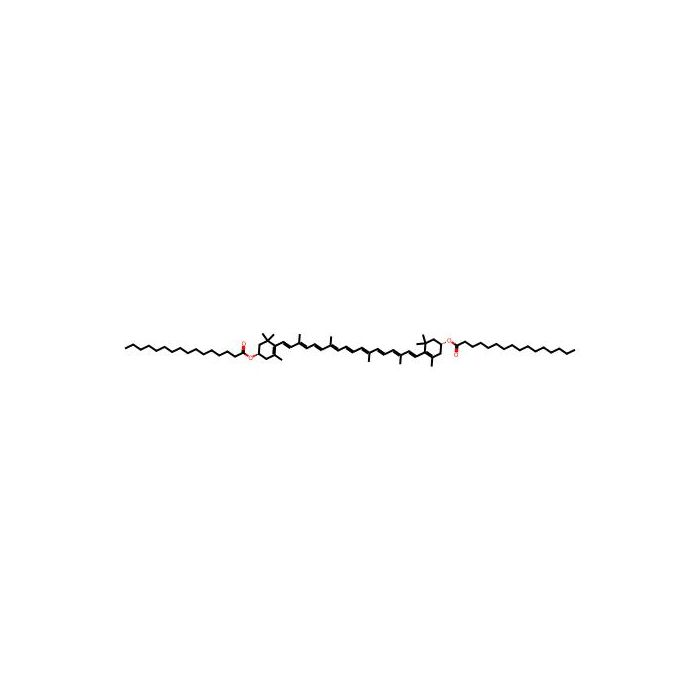
≥95% for sensitive chromatographic and analytical workflows requiring minimal baseline interference.
🌡
Storage & shipping
Store at -20°C Ships Ice chest + Ice pads Check lot-specific COA for exact specifications.
📋
Quality documents
SDS, COA, datasheet, and spec sheet available for download. Lot-specific COA accessible via lot number lookup.
📚
Literature proof
Cited in 1 peer-reviewed publications across chromatography, organic synthesis, and cross-coupling reactions.
Overview
Zeaxanthin dipalmitate (Physalien) is a wolfberry-derived carotenoid, has anti-inflammatory and anti-oxidative stress effects. Zeaxanthin dipalmitate directly interact with p2X7 receptor ( K d =81.2 nM) and adiponectin receptor 1 ( AdipoR1 ; K d =533 nM) in a positive dose-dependent manner. Zeaxanthin dipalmitate restores mitochondrial autophagy functions suppressed by ethanol intoxication. Zeaxanthin dipalmitate can be used in the research of alcoholic fatty liver disease (AFLD) and retinitis pigmentosa (RP)
In Vitro
Zeaxanthin dipalmitate (1 µM; 2 h) totally or partially reverses the down-regulation of Atg5, beclin-1, and LC3A/B by ethanol (250 mM), and the up-regulation of p62 by ethanol in BRL-3A cells. Zeaxanthin dipalmitate (1 µM; 2 h) partially recovers the ethanol-suppressed LC3B in BRL-3A cells. Zeaxanthin dipalmitate (1 µM; 2 h) partially recovers the ethanol-suppressed cell viability and ethanol-induced aspase-3/7 activity of BRL-3A cells. Zeaxanthin dipalmitate (1 µM; 2 h) recovers the ethanol-induced inhibition of mitophagy in BRL-3A cells. MCE has not independently confirmed the accuracy of these methods. They are for reference only.
In Vivo
Zeaxanthin dipalmitate (10 mg/kg; p.o.; daily for 2 weeks) reduces the serum ALT and AST levels increased by long-term ethanol challenge in at AFLD Model . Zeaxanthin dipalmitate (10 mg/kg; p.o.; daily for 2 weeks) effectively attenuates the histological injury . Zeaxanthin dipalmitate (10 mg/kg; p.o.; daily for 2 weeks) attenuates the AFLD-induced hepatic apoptosis (reveal by caspase-3/7 activity) and inflammation (TNF-α) in rat . Zeaxanthin dipalmitate (approximately 4 μM; intravitreal injection for once) improves the visual behavior of rd10 mice and delays the degeneration of retinal photoreceptors. Zeaxanthin dipalmitate (approximately 4 μM; intravitreal injection for once) improves the light responses of photoreceptors, bipolar cells and retinal ganglion cells. Zeaxanthin dipalmitate (approximately 4 μM; intravitreal injection for once) reduces the expression of genes that are involved in inflammation, apoptosis and oxidative stress in rd10 mice. MCE has not independently confirmed the accuracy of these methods. They are for reference only.
Zeaxanthin dipalmitate (Physalien) is a wolfberry-derived carotenoid, has anti-inflammatory and anti-oxidative stress effects. Zeaxanthin dipalmitate directly interact with p2X7 receptor ( K d =81.2 nM) and adiponectin receptor 1 ( AdipoR1 ; K d =533 nM)
Storage
Store at -20°C
Shipped In
Ice chest + Ice pads
This product requires cold chain shipping. Ground and other economy services are not available.
This compound belongs to the class of organic compounds known as xanthophylls. These are carotenoids containing an oxygenated carotene backbone. Carotenes are characterized by the presence of two end-groups (mostly cyclohexene rings, but also cyclopentene rings or acyclic groups) linked by a long branched alkyl chain. Carotenes belonging form a subgroup of the carotenoids family. Xanthophylls arise by oxygenation of the carotene backbone.
External Descriptors
C40 isoprenoids (tetraterpenes)
1. Djoumbou Feunang Y, Eisner R, Knox C, Chepelev L, Hastings J, Owen G, Fahy E, Steinbeck C, Subramanian S, Bolton E, Greiner R, and Wishart DS. ClassyFire: Automated Chemical Classification With A Comprehensive, Computable Taxonomy. Journal of Cheminformatics, 2016, 8:61.
Determine the necessary mass, volume, or concentration for preparing a solution.
Dilution Calculator
Determine the dilution needed to prepare a stock solution.
Reconstitution Calculator
Reviews
Customer Reviews
Application Protocols
No application protocols are specified in the Product Data for this item. The following general, non-binding examples illustrate common laboratory uses; adjust to your system and consult primary literature.
Preparation of a stock solution (general)
Under dim light, dissolve the solid in HPLC-grade chloroform or toluene to 1–5 mg/mL. Optionally add 0.01% BHT. Sparge with N2, aliquot into amber vials, store at −20°C.
HPLC reference solution (normal phase)
Dilute stock into hexane/MTBE (95:5) to ~10–50 µg/mL. Inject promptly; detect at 450–470 nm. Keep autosampler at 4–8°C and shield vials from light.
Mild saponification to free zeaxanthin (analytical scale)
Combine 0.5 mg zeaxanthin dipalmitate with 1 mL MeOH and 0.1 mL 1 M KOH under N2, 0–5°C, 15–30 min. Quench with cold water, extract with hexane, wash neutral, dry, and analyze by HPLC. Minimize light exposure.
Incorporation into oil-in-water emulsions (formulation screening)
Dissolve the carotenoid diester in a food-grade oil phase (e.g., triolein), warm gently (≤40°C), then emulsify into aqueous surfactant solution using high-shear mixing. Characterize droplet size and protect from light.
These procedures are illustrative only and are not specifications for this product batch.
Biological Roles
This section provides general biochemical context for zeaxanthin esters; it is not product-specific and does not imply any clinical use.
Natural occurrence (literature)
Zeaxanthin frequently occurs in plants as fatty acid mono- and diesters; zeaxanthin dipalmitate is a prominent storage form in certain fruits and petals. Esterification enhances lipophilicity, aiding sequestration in plastoglobuli and chromoplasts.
Biochemical function
Zeaxanthin participates in light-harvesting and photoprotection in photosynthetic organisms. Within the xanthophyll cycle, it contributes to non-photochemical quenching and scavenging of reactive oxygen species.
Esterified forms are generally de-esterified by plant or digestive esterases to yield free zeaxanthin before participation in downstream pathways.
Spectroscopic/structural aspects
The extended conjugation underlies strong absorption in the blue region, enabling protective energy dissipation and antioxidant interactions.
Research relevance
Zeaxanthin diesters serve as models to study carotenoid bioaccessibility, micellar incorporation, and esterase-mediated hydrolysis. Their lipophilicity and isomer stability profiles are useful for formulating hydrophobic antioxidants in experimental systems.
Note: Any references to metabolism or biological function are provided for research design context only. This product is for research use only and not for human or veterinary applications.
Buffer Applications
Zeaxanthin dipalmitate is not a buffering reagent and is practically insoluble in aqueous buffers. Consequently, it is not typically used to prepare or adjust pH in biochemical systems.
Practical guidance for use with buffers (general)
Prepare concentrated stock solutions in a suitable organic solvent (e.g., hexane, toluene, chloroform, ethanol/ethyl acetate mixtures) and introduce into aqueous systems via emulsification, lipid carriers, or co-solvent addition below cytotoxic/assay-interfering thresholds.
Employ surfactants (e.g., Tween-type, bile salt/lecithin mixed micelles for in vitro digestion models) or lipid nanoparticles to disperse the compound in buffered media.
Protect from light and oxygen; keep organic cosolvent content consistent across controls.
For experiments requiring strict aqueous compatibility, consider using delivery systems (liposomes, polymeric micelles) rather than attempting direct dissolution in buffer.
Green Alternatives
While the compound itself is a hydrophobic carotenoid diester, greener decisions can be made in its handling, analysis, and formulation by selecting lower-impact solvents and processes.
Greener solvent choices (literature/general)
Prefer ethyl acetate, ethanol, isopropanol, or 2-MeTHF over chlorinated solvents when solubility and method performance permit.
Use heptane instead of hexane to reduce neurotoxicity concerns; consider cyclopentyl methyl ether (CPME) for improved safety profile relative to diethyl ether.
Example comparison (general considerations)
Hexane vs Heptane: similar solvency for carotenoids; heptane has a better occupational health profile.
Chloroform/DCM vs Ethyl acetate/2-MeTHF: greener options reduce halogenated waste; may require slightly higher temperatures or co-solvents for dissolution.
Toluene vs p-cymene/limonene: bio-based aromatics can serve in some extraction/formulation contexts, though viscosity and odor may be limiting.
Process improvements
Minimize oxygen/light exposure to reduce waste from degradation.
Employ closed-loop solvent recovery in extractions and chromatographic purifications.
Use solid-phase or supercritical CO2 extraction (where methodologically suitable) as a lower-residue alternative to hexane extraction.
Trade-offs: Greener solvents can alter solubility, extraction selectivity, and chromatographic resolution. Validate changes with small-scale trials and adjust temperature, co-solvent ratios, and stationary phases accordingly.
Pharmaceutical Uses
No pharmacopeial or excipient status is provided in the Product Data for this item. The following points describe general research/formulation contexts only and do not imply suitability for clinical use.
Research formulation roles (general)
Hydrophobic payload for testing lipid-based delivery systems (self-emulsifying drug delivery systems, nanoemulsions, solid lipid nanoparticles) due to strong lipophilicity and characteristic chromophore for tracking.
Model carotenoid for studying oxidation protection strategies in dosage forms (antioxidants, light-opaque packaging).
Analytical uses in development
Reference standard for method development in normal-phase and reversed-phase HPLC/UPLC of carotenoid esters.
Regulatory status
Not specified for this item; refer to CoA/Spec Sheet. No claims are made regarding compliance with USP/Ph.Eur./JP or food additive regulations.
Any application toward human or veterinary products requires independent assessment of regulatory status, residual solvents, stabilizers, and impurity/isomer profiles beyond what is provided here.
Physical Properties
Item-specific physical constants are not provided in the Product Data. The following are general/literature characteristics for zeaxanthin diesters, offered as guidance only (not product specifications):
Appearance: Typically an orange to deep yellow crystalline solid/powder (literature, general for carotenoid diesters). Item-specific appearance: Not specified for this item; refer to CoA/Spec Sheet.
Melting point: Often in the range observed for long-chain carotenoid diesters; exact MP for zeaxanthin dipalmitate varies with isomer/purity (literature, general). Not specified for this item; refer to CoA/Spec Sheet.
Boiling point: Not meaningful due to thermal decomposition before boiling at ambient pressure (literature).
Density: Not specified for this item; refer to CoA/Spec Sheet.
Solubility (literature, general)
Insoluble in water; practically insoluble in aqueous buffers.
Soluble in nonpolar/weakly polar organic solvents: hexanes, toluene, chloroform, dichloromethane, MTBE, ethyl acetate (moderate), and in edible oils/lipids.
Partitioning: Very high hydrophobicity; logP expected to be very large (>10; literature, qualitative).
Spectroscopy (literature, general)
UV–Vis λmax typically ~450–470 nm (in nonpolar solvents) with characteristic three-band carotenoid pattern; exact maxima shift with solvent polarity and isomerization.
Strong light sensitivity; isomerization and bleaching possible under UV/oxygen.
Refractive index, pKa: Not applicable/reported for this non-ionizable, non-volatile solid; not specified for this item.
Always verify any quantitative property requirements against the item’s CoA/Spec Sheet before method development.
Quality & Grades
Item-specific grade/purity: Not specified for this item; refer to CoA/Spec Sheet.
Interpreting grades for carotenoid standards (general guidance)
Research or analytical grades typically emphasize defined identity, controlled isomer profile (all-trans vs mixed), and low levels of oxidative degradation products.
HPLC-grade reference materials may be accompanied by chromatographic purity and isomeric composition data and are often packaged under inert gas with light-protective vials.
Food- or bio-compatible grades (where applicable in general markets) emphasize residual solvent control and peroxide/anisidine values; not specified for this item.
Stabilizers/antioxidants
Some carotenoid products are packaged with trace antioxidants (e.g., BHT) or under nitrogen to limit oxidation. Presence/absence for this item: Not specified; refer to CoA/Spec Sheet.
What to check on receipt (practical tips)
CoA for assay and isomeric composition.
Chromatogram (if provided) to ensure expected profile.
Packaging (amber vial, inert headspace), storage conditions, and any stated stabilizer.
For method-critical work (e.g., quantitative HPLC), consult the item’s CoA/Spec Sheet for the definitive grade, purity basis (w/w, area%), and isomer profile before use.
Reaction & Applications
Manufacturer Applications: Not specified in Product Data. The following are common research applications for zeaxanthin diesters (literature/general guidance):
Analytical standards and profiling
Use as a reference for HPLC/UPLC of carotenoids, especially in plant matrices where zeaxanthin occurs predominantly as fatty acid diesters. Helps assign retention times and spectral fingerprints (λmax ~450–470 nm in nonpolar solvents).
Hydrolysis (saponification) to zeaxanthin
Controlled basic hydrolysis (KOH/MeOH or KOH/EtOH under N2, low temperature) liberates free zeaxanthin for comparative studies; minimize isomerization and oxidation by reducing light/oxygen.
Transesterification and acyl exchange
Preparation of alternate zeaxanthin diesters (e.g., di-Linoleate) via mild transesterification catalysts to study structure–solubility or bioaccessibility relationships.
Formulation studies
Model hydrophobic payload for lipid nanoparticles, emulsions, and microencapsulation; used to probe release, isomer stability, and antioxidant carry-through in complex matrices.
Photochemistry/oxidation studies
Polyene reactivity toward singlet oxygen and radical species; kinetic studies of bleaching, triplet quenching, and E/Z isomerization.
Practical tips
Work under amber light or wrap glassware with foil; sparge solutions with nitrogen/argon.
Include trace antioxidants (e.g., 0.01% BHT) when compatible, particularly for stock solutions.
Avoid strong acids/oxidants; monitor for isomerization by HPLC with photodiode array detection.
Reaction Conditions
The following conditions are provided as general literature guidance for working with zeaxanthin esters; they are not item-specific specifications.
Saponification to zeaxanthin (general)
Solvent: Methanol or ethanol (anhydrous), occasionally with small amounts of tetrahydrofuran or toluene to aid dissolution.
Base: KOH or NaOH (0.5–2 M), catalytic TBAB can assist phase transfer if biphasic.
Temperature: 0–25°C; lower temperatures help limit isomerization; exclude oxygen (N2/Ar).
Time: 10–60 min, monitor by TLC/HPLC (disappearance of diester peak, appearance of free zeaxanthin).
Workup: Quench with cold water, extract into hexane/MTBE, wash neutral, dry, and analyze under low light.
Transesterification (general)
Catalysts: Sodium methoxide (cat.), DBU, or lipase-catalyzed systems for mild conditions.
Alcohol donors: ROH (MeOH to long-chain alcohols); temperatures 20–40°C (enzymatic) or 0–25°C (base-catalyzed), under inert gas.
Photostability/isomerization studies
Solvents: Hexane, toluene, or ethanol; irradiance controlled; monitor E/Z ratios by HPLC–PDA.
Analytical HPLC (general)
Normal phase: Hexane/MTBE gradients; detect at 450–470 nm.
Reversed phase: C18 with MeOH/MTBE or MeOH/ACN with small percentages of MTBE/acetone for resolving esters.
Yields and kinetics strongly depend on isomer composition, oxygen exclusion, light exposure, and base strength; pilot trials are recommended.
Safety & Handling
GHS/CLP information (from Product Data)
Signal word: Not specified for this item; refer to SDS.
H-statements: Not specified for this item; refer to SDS.
GHS classification/pictograms: Not specified for this item; refer to SDS.
General safety considerations for carotenoid diesters (literature/good practice)
Low volatility solid; primary hazards are dust generation and solvent-related risks during dissolution.
Light, heat, and oxygen sensitivity: may undergo E/Z isomerization and oxidative bleaching; handle under subdued light and inert atmosphere when possible.
Avoid strong oxidizers; unsaturated polyenes are susceptible to oxidation.
PPE and engineering controls
Wear safety glasses, lab coat, and appropriate chemical-resistant gloves.
Use in a fume hood, especially when handling organic solvents for dissolution or chromatography.
First-aid overview (general)
Inhalation: Move to fresh air; seek medical attention if symptoms persist.
Skin/eye contact: Rinse with water for several minutes; remove contaminated clothing; obtain medical advice if irritation develops.
Ingestion: Rinse mouth; do not induce vomiting; seek medical attention.
Fire safety
Combustible organic solid; use CO2, dry chemical, or foam on surrounding solvent fires. Avoid high-temperature exposure causing decomposition.
Waste and spill
Collect solids with minimal dust; absorb solutions with inert material. Dispose in accordance with institutional and local regulations.
Authoritative safety data and classification are provided in the product SDS; always defer to the SDS.
Solvent Selection
Zeaxanthin dipalmitate is an extremely hydrophobic carotenoid diester. Solvent choice governs solubility, stability, and handling.
Polarity/miscibility (literature, general)
Practically insoluble in water and aqueous buffers.
Soluble in nonpolar/low-polarity organic solvents: n-hexane, heptane, toluene, chloroform, dichloromethane, MTBE; moderately soluble in ethyl acetate. Readily soluble in edible oils (e.g., triolein).
Stability considerations
Use low-peroxide solvents; dry and degas when possible. Protect from light; minimize oxygen exposure (nitrogen/argon overlay).
Typical use scenarios
HPLC/UPLC sample prep in hexane/MTBE or hexane/acetone mixtures for normal-phase separations of carotenoids.
Stock solutions in chloroform, dichloromethane, or toluene for spectroscopic work; dilute into hexane for UV–Vis.
Incorporation into lipid matrices or micelles via oil phases or co-solvent injection.
Comparison notes (general)
Hexane: high solubility, low polarity; poor environmental profile.
Ethyl acetate: greener alternative; moderate solubility and better biodegradability.
2-MeTHF/CPME: greener ethers; can dissolve carotenoid esters while offering improved process safety relative to THF/diethyl ether.
Always filter solvents through alumina to remove peroxides when needed and verify solvent choice against your analytical or formulation method.
Storage & Reconstitution
Storage conditions (from Product Data)
Store at −20°C.
Shipped in ice chest with ice pads.
Additional handling guidance (general best practice for carotenoids)
Protect from light and oxygen. Keep container tightly closed under inert gas (N2/Ar) with desiccant where possible.
Minimize freeze–thaw by aliquoting into amber vials on first opening. Allow vials to equilibrate to room temperature before opening to avoid moisture condensation.
Reconstitution (general)
For analytical work, dissolve in chloroform, dichloromethane, toluene, hexane, or mixtures with ethyl acetate; consider adding trace antioxidant (e.g., 0.01% BHT) if compatible.
For aqueous systems, use co-solvent, emulsification, or lipid carriers; do not attempt direct dissolution in buffers.
Stability notes (general)
Sensitive to light, heat, and oxidants; store solutions at −20°C, protected from light, under inert gas. Prepare fresh working solutions frequently.
Documentation
For any item-specific shelf life, stabilizers, appearance, and purity/isomer details: Not specified for this item; refer to CoA/Spec Sheet.
Research Use Note: For research use only.
Structure & Identity
Zeaxanthin dipalmitate is a diesterified xanthophyll carotenoid in which both terminal secondary alcohols of zeaxanthin are esterified with palmitic acid (hexadecanoate), yielding a highly lipophilic carotenoid diester.
Item identifiers (from Product Data)
CAS: 144-67-2
InChIKey: 412594
SMILES: Not specified for this item; refer to CoA/Spec Sheet.
Molecular formula: Not specified for this item; refer to CoA/Spec Sheet.
Molecular weight: Not specified for this item; refer to CoA/Spec Sheet.
Structural features (general chemistry description)
Core carotenoid polyene with ~11 conjugated double bonds connecting two substituted β-ionone-type end rings.
Two ester functionalities (–O–C(=O)–C15H31) replacing the free hydroxyls of zeaxanthin → “dipalmitate.”
Multiple E-alkenes; all-trans geometry is commonly encountered in isolated natural samples, with possible minor Z-isomers (literature, general).
No heteroatoms beyond the two ester oxygens per end; no charge under neutral conditions; hydrocarbon-dominated scaffold leading to extreme hydrophobicity.
2D description (in words)
A linear, highly conjugated backbone (alternating C=C/C–C) spans between two cyclohexene rings. Each ring bears an ether linkage to a palmitate carbonyl, extending to long C16 alkyl chains. The molecule is elongated and amphiphobic, with minimal polar surface aside from the two ester carbonyls.
Notes: Given identifiers are limited in the Product Data; for definitive structure strings (e.g., exact SMILES), please consult the item’s CoA/Spec Sheet or contact Technical Support.
Synthetic Utility
Although primarily a target analyte/formulation component, zeaxanthin dipalmitate has utility in synthetic and preparative chemistry contexts (general literature guidance):
Functional group landscape
Two secondary alkyl ester functions enable controlled hydrolysis or transesterification to modulate the acyl group identity without altering the carotenoid backbone.
Extensive conjugated polyene undergoes E/Z isomerization, electrophilic additions (under carefully controlled conditions), and oxidative cleavage to apocarotenoids.
Transformations
Saponification to free zeaxanthin (precursor for further derivatization: selective monoacylation, carbonate formation).
Transesterification to tailor solubility and physical properties (e.g., medium-chain vs long-chain esters for comparative studies).
Mild hydrogenation or Diels–Alder-type reactions with singlet oxygen can generate defined partially saturated or oxygenated derivatives for mechanistic studies.
Analytical/preparative aspects
Serves as a calibrant or retention marker in carotenoid separations; enables fraction collection for isomer-resolved studies.
Handling note: The polyene backbone is highly sensitive—carry out reactions under inert atmosphere, subdued light, and with radical inhibitors where compatible.
Target Specificity
Not applicable. Zeaxanthin dipalmitate is a small-molecule carotenoid diester and does not possess “target specificity” parameters such as antigen/epitope recognition, species cross-reactivity, clone, or isotype. For selectivity considerations relevant to this compound, see Reaction & Applications and Synthetic Utility.
Frequently Asked Questions
What is the purity of this product?
This product is supplied at ≥95% purity (chemical assay). Lot-specific values are stated on the Certificate of Analysis.
How should this product be stored?
Store at ?20 °C. Freezer storage is required to maintain the specified shelf life.
How is this product shipped?
This product ships in an insulated container with ice pads. Unpack on arrival and transfer it to the storage condition stated above.
What are the CAS number, molecular formula and molecular weight?
The CAS Number is 144-67-2, the molecular formula is C72H116O4, and the molecular weight is 1045.69 g/mol. InChIKey XACHQDDXHDTRLX-XLVVAOPESA-N.
What documentation is provided?
Available product documentation, including Certificates of Analysis (COA), Safety Data Sheets (SDS), and specification sheets, is shown in the product document area. Document availability and access follow the current site policy.
We use cookies to ensure the website functions properly and, where permitted, to improve your experience. You can manage your preferences at any time in Settings. Learn more in our Cookie Policy.
Shall we send you a message when we have discounts available?
Remind me later
Thank you! Please check your email inbox to confirm.
Products are supplied to verified businesses, institutions, and qualified professionals for research and development use only. Not for use in humans, animals, diagnosis, or therapy.