Determine the necessary mass, volume, or concentration for preparing a solution.
| Activity Type | Relation | Activity value | Units | Action Type | Journal | PubMed Id | doi | Assay Aladdin ID |
|---|

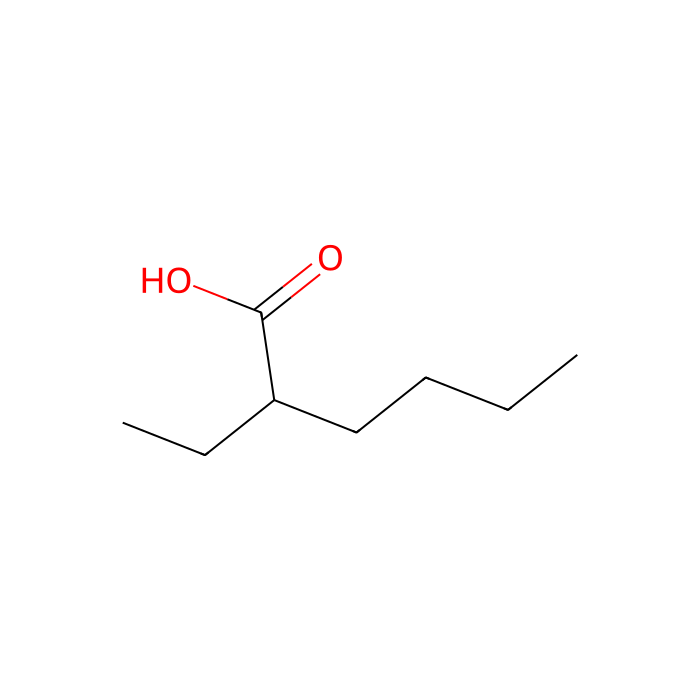
2-Ethylhexanoic acid (EHXA, 2-EHA) is an industrially important aliphatic carboxylic acid.
defoaming agent in pesticides
Taxonomy Tree
| Kingdom | Organic compounds |
|---|---|
| Superclass | Lipids and lipid-like molecules |
| Clase | Fatty Acyls |
| Subclass | Fatty acids and conjugates |
| Intermediate Tree Nodes | Not available |
| Direct Parent | Medium-chain fatty acids |
| Alternative Parents | Branched fatty acids Monocarboxylic acids and derivatives Carboxylic acids Organic oxides Hydrocarbon derivatives Carbonyl compounds |
| Molecular Framework | Aliphatic acyclic compounds |
| Substituents | Medium-chain fatty acid - Branched fatty acid - Monocarboxylic acid or derivatives - Carboxylic acid - Carboxylic acid derivative - Organic oxygen compound - Organic oxide - Hydrocarbon derivative - Organooxygen compound - Carbonyl group - Aliphatic acyclic compound |
| Descripción | This compound belongs to the class of organic compounds known as medium-chain fatty acids. These are fatty acids with an aliphatic tail that contains between 4 and 12 carbon atoms. |
| External Descriptors | Branched fatty acids |
| Activity Type | Relation | Activity value | Units | Action Type | Journal | PubMed Id | doi | Assay Aladdin ID |
|---|
| Activity Type | Relation | Activity value | Units | Action Type | Journal | PubMed Id | doi | Assay Aladdin ID |
|---|
| Activity Type | Relation | Activity value | Units | Action Type | Journal | PubMed Id | doi | Assay Aladdin ID |
|---|
| Activity Type | Relation | Activity value | Units | Action Type | Journal | PubMed Id | doi | Assay Aladdin ID |
|---|
| Activity Type | Relation | Activity value | Units | Action Type | Journal | PubMed Id | doi | Assay Aladdin ID |
|---|
| Activity Type | Relation | Activity value | Units | Action Type | Journal | PubMed Id | doi | Assay Aladdin ID |
|---|
Find and download the COA for your product by matching the lot number on the packaging.
| Lot Number | Certificate Type | Fecha | Articulo |
|---|---|---|---|
 K2605736 | Certificate of Analysis | Oct 28, 2026 | E103543 |
| K2605733 | Certificate of Analysis | Oct 28, 2026 | E103543 |
| K2605716 | Certificate of Analysis | Oct 28, 2026 | E103543 |
| E2620218 | Certificate of Analysis | May 08, 2026 | E103543 |
| E2620280 | Certificate of Analysis | May 08, 2026 | E103543 |
| E2620281 | Certificate of Analysis | May 08, 2026 | E103543 |
| B2625081 | Certificate of Analysis | Feb 27, 2026 | E103543 |
| G1824303 | Certificate of Analysis | Feb 05, 2026 | E103543 |
| C2215301 | Certificate of Analysis | Dec 10, 2025 | E103543 |
| L2524139 | Certificate of Analysis | Oct 14, 2024 | E103543 |
| J2424371 | Certificate of Analysis | Oct 14, 2024 | E103543 |
| J2424370 | Certificate of Analysis | Oct 14, 2024 | E103543 |
| J2424369 | Certificate of Analysis | Oct 14, 2024 | E103543 |
| J2424285 | Certificate of Analysis | Oct 14, 2024 | E103543 |
| I2511149 | Certificate of Analysis | Oct 14, 2024 | E103543 |
| L2010095 | Certificate of Analysis | Oct 12, 2024 | E103543 |
| I1917127 | Certificate of Analysis | Jul 07, 2023 | E103543 |
| G2311857 | Certificate of Analysis | Jul 04, 2023 | E103543 |
| I2404162 | Certificate of Analysis | Jul 04, 2023 | E103543 |
| G2311850 | Certificate of Analysis | Jul 04, 2023 | E103543 |
| G23111103 | Certificate of Analysis | Jul 04, 2023 | E103543 |
| G23111094 | Certificate of Analysis | Jul 04, 2023 | E103543 |
| G2308216 | Certificate of Analysis | Jun 13, 2022 | E103543 |
| F2221081 | Certificate of Analysis | Jun 13, 2022 | E103543 |
| F2221075 | Certificate of Analysis | Jun 13, 2022 | E103543 |
| F2221028 | Certificate of Analysis | Jun 13, 2022 | E103543 |
| E2330130 | Certificate of Analysis | Jun 13, 2022 | E103543 |
| D2301028 | Certificate of Analysis | Jun 13, 2022 | E103543 |
| Solubilidad | Miscible with water. |
|---|---|
| Sensibilidad | Moisture sensitive. |
| Índice de refracción | 1.424-1.426 |
| Punto de inflamación (°F) | 237.2 °F |
| Punto de inflamación (°C) | 114℃ |
| Punto de ebullición (°C) | 228°C |
| Punto de fusión (°C) | -59°C |
| Peso molecular | 144.21 |
| XLogP3 | 2.600 |
| Hydrogen Bond Donor Count | 1 |
| Hydrogen Bond Acceptor Count | 2 |
| Rotatable Bond Count | 5 |
| Exact Mass | 144.115 Da |
| Monoisotopic Mass | 144.115 Da |
| Topological Polar Surface Area | 37.300 Ų |
| Heavy Atom Count | 10 |
| Formal Charge | 0 |
| Complexity | 99.400 |
| Isotope Atom Count | 0 |
| Defined Atom Stereocenter Count | 0 |
| Undefined Atom Stereocenter Count | 1 |
| Defined Bond Stereocenter Count | 0 |
| Undefined Bond Stereocenter Count | 0 |
| The total count of all stereochemical bonds | 0 |
| Covalently-Bonded Unit Count | 1 |
H316:Causes mild skin irritation
H361:Suspected of damaging fertility or the unborn child
H361d:Suspected of damaging the unborn child
H303+H313:May be harmful if swallowed or in contact with skin
P201:Obtain special instructions before use.
P202:Do not handle until all safety precautions have been read and understood.
P280:Wear protective gloves/protective clothing/eye protection/face protection.
P312:Call a POISON CENTER or doctor/... if you feel unwell.
P332+P313:IF SKIN irritation occurs: Get medical advice/attention.
P405:Store locked up.
P501:Dispose of contents/container to an approved waste disposal plant.
No antibody/assay protocols apply to this small‑molecule reagent. For synthetic applications, see the Reaction Conditions and Synthetic Utility sections for representative procedures and practical guidance tailored to 2‑ethylhexanoic acid chemistry.
General biochemical context (literature; not item-specific)
Caveats
Applicability
General/literature note
Recommendations
Context: 2‑Ethylhexanoic acid (2‑EHA) is valued for producing lipophilic metal carboxylates and sterically hindered esters/amides. From a green chemistry perspective, considerations include origin (petro‑ vs bio‑based), toxicity classifications, volatility, and biodegradability.
Possible alternatives (literature/general)
Comparison highlights (qualitative)
Greener practice with 2‑EHA
Item-specific status
General context (literature; not medical claims)
Summary
Item-specific specifications
General/literature physical data (for reference; not item-specific)
Notes
Item-specific status
General guidance on grades for 2‑ethylhexanoic acid (for reference)
What to check on the CoA/Spec Sheet
Implications of stabilizers
Key application domains (literature/general)
Practical tips
General literature guidance (not item-specific; optimize per system)
Yields
Item-specific hazard information
General safety profile (literature/SDS references; not item-specific)
PPE and handling
First aid (overview; defer to SDS)
Spill/Fire response
This product is a carboxylic acid reagent rather than a general‑purpose solvent.
When to choose alternatives
Summary: Treat 2‑ethylhexanoic acid as a reagent; select the primary solvent based on the transformation (see Reaction Conditions) and product isolation strategy.
Item-specific storage and shipping
General guidance (literature; not item-specific)
Reconstitution/handling
Shelf life
Brief overview: 2‑Ethylhexanoic acid is a branched, C8 aliphatic carboxylic acid commonly used to prepare lipophilic metal carboxylates (“2‑ethylhexanoates”) and specialty esters.
Functional reactivity (literature/general)
Named/representative transformations
Retrosynthetic value
Not applicable. This product is a small‑molecule carboxylic acid, not an antibody, oligonucleotide, or targeted biological reagent. No antigen/epitope specificity, clone, isotype, or species reactivity applies.