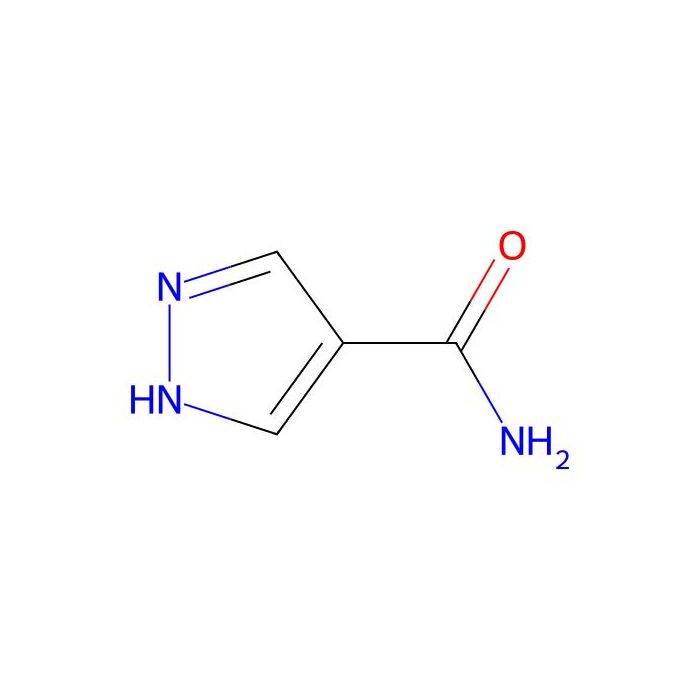
4-Pyrazolecarboxamide - ≥95% , CAS No.437701-80-9

CAS: 437701-80-9 Cat. No.: P729087 Fórmula: C4H5N3O Peso molecular: 111.10 Número EC: 836-983-5
Disponible para pedir
CALIDAD & PUREZA ≥95%
Storage
Store at 2-8°C,Protected from light,Argon charged,Desiccated
Shipped In
Wet ice
★
Talla
Alemania (EU)
USA*
Precio
Cantidad
50mg
P729087-50mg
Fabricado bajo pedido · 8–12 semanas
12,06€
250mg
P729087-250mg
Fabricado bajo pedido · 8–12 semanas
24,21€
1g
P729087-1g
Fabricado bajo pedido · 8–12 semanas
57,18€
5g
P729087-5g
Fabricado bajo pedido · 8–12 semanas
208,17€
Enter a quantity for the sizes you want to add.

Especificaciones

Especificaciones y pureza
≥95%
Condiciones de almacenamiento de almacenamiento
Store at 2-8°C,Protected from light,Argon charged,Desiccated
Enviado en
Wet ice
Este producto requiere envío en cadena de frío. Los servicios terrestres y otros servicios económicos no están disponibles.
Pureza
≥95%
Product Line
P729087-50mg
Nombres e identificadores
SMILES
C1=C(C=NN1)C(=O)N
IUPAC Name
1H-pyrazole-4-carboxamide
InChIKey
ZVXKYWHJBYIYNI-UHFFFAOYSA-N
InChI
1S/C4H5N3O/c5-4(8)3-1-6-7-2-3/h1-2H,(H2,5,8)(H,6,7)
Isómeros SMILES
C1=C(C=NN1)C(=O)N
Peso molecular
111.10

Datos avanzados

Taxonomic Classification

Taxonomy Tree

KingdomOrganic compounds
SuperclassOrganoheterocyclic compounds
ClaseAzoles
SubclassPyrazoles
Intermediate Tree Nodes Pyrazole carboxylic acids and derivatives
Direct ParentPyrazole-4-carboxamides
Alternative Parents Vinylogous amides  Heteroaromatic compounds  Primary carboxylic acid amides  Azacyclic compounds  Organooxygen compounds  Organonitrogen compounds  Organic oxides  Hydrocarbon derivatives  
Molecular FrameworkAromatic heteromonocyclic compounds
Substituents Pyrazole-4-carboxamide - Heteroaromatic compound - Vinylogous amide - Primary carboxylic acid amide - Carboxamide group - Azacycle - Carboxylic acid derivative - Organic nitrogen compound - Organic oxygen compound - Organic oxide - Hydrocarbon derivative - Organooxygen compound - Organonitrogen compound - Aromatic heteromonocyclic compound
DescripciónThis compound belongs to the class of organic compounds known as pyrazole-4-carboxamides. These are compounds containing a pyrazole ring that carries a carboxamide group at the 4-position.
External Descriptors Not available
Estructura 3D
Modelo de Estructura Química Interactiva


Certificados (CoA, COO, BSE/TSE y tabla de análisis)
C of A & Other Certificates(BSE/TSE, COO):
Analytical Chart:
Propiedades químicas y físicas
SensibilidadLight sensitive
Peso molecular111.1
XLogP3-0.900
Hydrogen Bond Donor Count2
Hydrogen Bond Acceptor Count2
Rotatable Bond Count1
Exact Mass111.043 Da
Monoisotopic Mass111.043 Da
Topological Polar Surface Area71.800 Ų
Heavy Atom Count8
Formal Charge0
Complexity103.000
Isotope Atom Count0
Defined Atom Stereocenter Count0
Undefined Atom Stereocenter Count0
Defined Bond Stereocenter Count0
Undefined Bond Stereocenter Count0
The total count of all stereochemical bonds0
Covalently-Bonded Unit Count1
Seguridad y peligros (GHS)
Pictogramas
Señal
Warning
Indicaciones de peligro

H302:Harmful if swallowed

H315:Causes skin irritation

H319:Causes serious eye irritation

H335:May cause respiratory irritation

Precauciones

P261:Avoid breathing dust/fume/gas/mist/vapors/spray.

P264:Wash hands [and …] thoroughly after handling.

P270:Do not eat, drink or smoke when using this product.

P271:Use only outdoors or in a well-ventilated area.

P280:Wear protective gloves/protective clothing/eye protection/face protection.

P321:Specific treatment (see ... on this label).

P330:Rinse mouth.

P302+P352:IF ON SKIN: wash with plenty of water.

P304+P340:IF INHALED: Remove person to fresh air and keep comfortable for breathing.

P305+P351+P338:IF IN EYES: Rinse cautiously with water for several minutes. Remove contact lenses if present and easy to do - continue rinsing.

P362+P364:Take off contaminated clothing and wash it before reuse.

P405:Store locked up.

P403+P233:Store in a well-ventilated place. Keep container tightly closed.

P501:Dispose of contents/container to an approved waste disposal plant.

P264+P265:Wash hands [and …] thoroughly after handling. Do not touch eyes.

P301+P317:IF SWALLOWED: Get medical help.

P337+P317:If eye irritation persists: Get medical help.

P332+P317:If skin irritation occurs: Get medical help.

P319:Get medical help if you feel unwell.

Preguntas frecuentes y artículos
Calculadoras de soluciones
Reseñas

Reseñas de cliente

Application Protocols

No tested bioassay or analytical application protocols are specified for this item. For general small-molecule handling in discovery workflows:

  • Stock preparation: Dissolve in dry DMSO to 10–100 mM; vortex and sonicate if necessary. Filter through 0.22 µm PTFE for particulate removal.
  • Aliquoting: Dispense into low-bind vials or plates; minimize freeze–thaw by preparing single-use aliquots.
  • Assay dilution: Add DMSO stock into assay buffer to desired final concentration, keeping final DMSO ≤1–2% v/v to limit solvent effects. Verify solubility and absence of precipitation.
  • Analytical QC: LC–MS and 1H NMR in DMSO-d6/CD3OD to confirm identity and concentration prior to screening.

These are general recommendations; adjust for your specific assay and consult the product’s CoA for identity/purity verification.

Biological Roles

No item-specific biological testing data are provided for this product. The following information is general and literature-based for the pyrazole-carboxamide motif:

  • Structural biology context:
    • Pyrazoles are “privileged” heteroaromatics with dual H-bond donor/acceptor capabilities (ring N lone pair and N–H). The appended primary amide adds a strong H-bond donor/acceptor pair and a planar carbonyl vector for binding in protein pockets.
  • Physicochemical profile:
    • Low molecular weight (~111 g/mol for C4H5N3O, literature) and high polarity support fragment-like behavior in screening collections.
  • Metabolic considerations (general):
    • Amide hydrolysis by amidases is typically slow for heteroaryl amides; major metabolic soft spots tend to be N-alkyl substituents if introduced, or ring N-oxidation under oxidative conditions.
  • Biochemical utility:
    • Useful as a reference scaffold to probe H-bonding patterns in enzyme active sites or as a handle for conjugation (via amide derivatization) to affinity tags or linkers.

Note: These points are general observations from chemical biology literature and are not specific activity claims for this item. This product is for research use only.

Buffer Applications

This small organic heteroaromatic amide is not a conventional buffering agent. It lacks a suitable conjugate acid/base pair in the physiological pH range to provide practical buffering capacity.

  • Guidance: If you require buffering, use established systems (e.g., phosphate, HEPES, MOPS) and dissolve 4-pyrazolecarboxamide in an appropriate co-solvent (e.g., DMSO) before dilution into the buffer, ensuring solubility and compatibility with your assay.
  • For pH-sensitive transformations or assays, consider the compound’s weakly basic ring nitrogens (pyrazole conjugate acid pKaH typically ~2–3, literature) which will be largely unprotonated at neutral pH.
Green Alternatives

Opportunities to improve sustainability focus on solvent and reagent choices when working with 4-pyrazolecarboxamide.

  • Preferred solvents (greener options):
    • Replace DMF/NMP with safer polar aprotics when feasible: Cyrene, NEP alternatives with better EHS profiles, or bio-derived 2-MeTHF for less polar needs.
    • Use ethanol or isopropanol instead of methanol where solubility permits.
  • Coupling chemistry:
    • Consider water-compatible coupling systems (e.g., EDC·HCl with NHS/HOBt alternatives like Oxyma) in aqueous-organic media to reduce reliance on chlorinated solvents.
    • Enzymatic amidation (acyl transfer using lipases) can be explored for specialized transformations, avoiding harsh reagents.
  • Dehydration/activation:
    • Avoid POCl3/SOCl2 where possible; use T3P or CDI for milder, lower-toxicity activation/dehydration strategies, acknowledging tradeoffs in waste streams.

Comparison (general):

  • Conventional vs greener routes
    • Solvent: DMF/NMP (excellent solvency; reproductive toxicity concerns) vs Cyrene/ethyl lactate/EtOH (safer, sometimes lower solubility and different evaporation profiles).
    • Activators: SOCl2/POCl3 (efficient; corrosive, HCl/POCl3 waste) vs T3P/CDI (safer handling; different byproducts, sometimes higher cost).

Trade-offs: Greener options may require process optimization (temperature, concentration, catalyst loading) to match yields/selectivity; perform small-scale scouting experiments.

Pharmaceutical Uses

Item-specific pharmacopeial status or excipient roles: Not specified for this item; refer to CoA/Spec Sheet.

General, non-clinical context:

  • Role in discovery chemistry: 4-pyrazolecarboxamide is commonly used as a heteroaryl fragment or intermediate for synthesizing more complex analogs by amide N-derivatization and pyrazole N1 functionalization.
  • Formulation relevance: As a small polar organic, it is not used as an excipient; rather, it serves as a synthetic intermediate. For screening stocks, DMSO solutions (e.g., 10–100 mM) are typical in early discovery workflows.
  • Regulatory note: No pharmacopoeial monograph is known for this simple heteroaryl amide; any GMP-related use would require custom specifications and validation.
Physical Properties

Item-specific physico-chemical specifications: Not specified for this item; refer to CoA/Spec Sheet.

Literature/general properties for reference (verify for your batch before use):

  • Phase/appearance (literature): typically a crystalline solid (heteroaromatic primary amide). Actual appearance may vary; confirm on CoA.
  • Molecular weight (literature): ~111.10 g/mol (for C4H5N3O).
  • Acid-base behavior (literature):
    • Pyrazole ring conjugate acid pKaH typically ~2–3, reflecting weak basicity of ring nitrogens.
    • Ring NH (as an acid) pKa typically ~14–15; largely non-deprotonated under neutral conditions.
    • Amide is neutral (non-basic) with very weak acidity at the amide NH.
  • Solubility tendencies (literature, qualitative):
    • Expected good solubility in polar aprotic solvents (DMSO, DMF, NMP) and polar protic alcohols (MeOH, EtOH).
    • Limited solubility in nonpolar solvents (hexane, toluene).
    • Water solubility: often moderate for small primary amides; assess experimentally.
  • Partitioning (estimated/generic): low logP expected due to one amide and heteroaromatic nitrogens; anticipate high polarity and hydrogen-bonding capacity.
  • Thermal behavior: melting point and boiling point are not specified for this item; consult the CoA/SDS and determine empirically for your application.
Quality and Grades

Item-specific grade/purity and stabilizer information: Not specified for this item; refer to CoA/Spec Sheet for actual assay, related substances, and residual solvent profile.

General notes on quality for heteroaromatic building blocks:

  • Research grade expectations: Provided for R&D use; typical QC includes identity (NMR, MS, IR) and purity by HPLC/GC. For heteroaromatic amides, water content (Karl Fischer) and residual polar aprotic solvents (DMF/DMSO) can be relevant.
  • Structural confirmation: Pyrazole-carboxamide motifs can be confirmed by distinctive IR bands (amide C=O ~1650–1690 cm⁻¹; N–H stretches), and 1H/13C NMR (amide NH exchangeable, downfield; carbonyl ~160–170 ppm). Verify ring tautomerism (1H vs 2H pyrazole signals) where applicable.
  • Trace metals/UV cutoff: Not specified for this item; refer to CoA/Spec Sheet.
  • Stabilizers: None typically required for simple amides; this product lists no stabilizer. If you require inhibitor-free material, confirm on CoA.
  • Batch documentation: Request full analytical package (CoA, spectra) if your application is for SAR libraries, medicinal chemistry routes, or materials screening where impurities can bias results.
Reaction and Applications

This compound serves as a versatile heteroaryl amide building block. While no item-specific application data are provided, the following literature-based uses are common for pyrazole-4-carboxamide scaffolds:

  • Amide derivatization:
    • N-acylation or N-alkylation of the amide nitrogen to give secondary/tertiary amides (requires activation; mindful of competitive ring N-alkylation).
    • Dehydration to the corresponding 4-pyrazolecarbonitrile using POCl3, SOCl2, or T3P under dehydrating conditions.
  • Hydrolysis/activation sequences:
    • Hydrolysis (acidic or basic, forcing conditions) to 4-pyrazolecarboxylic acid, then conversion to acid chlorides (SOCl2, oxalyl chloride) or active esters (NHS, pentafluorophenyl) for bioconjugation or coupling.
  • Heteroaryl N1 functionalization:
    • Selective N1-alkylation of the pyrazole ring using strong base (NaH, K2CO3 with phase-transfer, or Cs2CO3) in DMF/DMSO; choose conditions to avoid amide N-alkylation.
  • Cross-coupling routes (indirect):
    • While this substrate is not directly cross-coupled, it can be transformed to halogenated pyrazole intermediates (e.g., via prior ring halogenation on a suitable precursor) enabling Suzuki, Buchwald–Hartwig, or Sonogashira couplings.
  • Library synthesis:
    • The pyrazole-carboxamide motif is widely used in fragment and lead-like libraries due to balanced polarity and H-bonding capabilities; serves as a core for SAR around amide and N1 substituents.
  • Practical tips:
    • Protect the amide (e.g., as imidate or via transient activation) if strong bases are required for N1-alkylation.
    • Monitor for isomeric N- vs O-acylation in coupling steps; amide oxygen acylation is reversible but may complicate kinetics.
Reaction Conditions

General, literature-informed conditions for typical transformations (verify and optimize for your system):

  • Amide dehydration to nitrile:
    • Reagents: POCl3 (3–5 equiv) or T3P (50% in EtOAc, 2–3 equiv) with base (DIPEA).
    • Solvent/temperature: CH2Cl2 or toluene, 60–110 °C; or EtOAc with T3P, 50–80 °C.
    • Time/yield: 2–8 h, often moderate-to-high yields depending on substrate purity and water content.
  • Hydrolysis to carboxylic acid:
    • Conditions: 2–6 M HCl or NaOH, 80–120 °C (sealed tube for higher temps), 4–24 h. Work up by neutralization and crystallization/extraction.
  • Activation and coupling:
    • CDI or EDC/Oxyma in DMF, 0–25 °C to room temp, 2–16 h to form secondary/tertiary amides or ureas (with amines). Monitor by LC–MS.
  • N1-alkylation of pyrazole ring:
    • Base/solvent: NaH (1.1–1.5 equiv) or Cs2CO3 (2–3 equiv) in dry DMF or DMSO, 0–25 °C; add alkyl halide (1.2–1.5 equiv). 1–6 h. Quench carefully; check for amide N-alkylation side products.
  • Purification:
    • Reverse-phase prep HPLC (water/MeCN + 0.1% formic acid) for polar derivatives; or normal-phase silica with EtOAc/hexanes or EtOAc/MeOH.

Note: No item-specific reactivity testing data are provided; moisture control and careful base selection are crucial to direct chemoselectivity between ring N1 and amide N.

Safety and Handling

Item-specific hazard classification and statements: Not specified for this item; refer to SDS for authoritative safety data.

General safety guidance for heteroaromatic primary amides (informational only):

  • Likely hazards: May cause skin/eye irritation and respiratory tract irritation as dust or aerosol. Avoid inhalation of particulates. Not known to be volatile; dust management is preferred over vapor control.
  • PPE: Use lab coat, nitrile gloves, and safety glasses/goggles. Employ a fume hood during weighing, transfers, or any operation that can generate dust or involve reagents for derivatization (e.g., dehydrating agents, strong bases).
  • Handling: Avoid moisture ingress in reactions requiring anhydrous conditions. Minimize dust generation; use antistatic measures if necessary.
  • Incompatibilities (general): Strong oxidizers; strong acids/bases can cause degradation (e.g., hydrolysis under forcing conditions). Dehydrating agents (e.g., POCl3, SOCl2) convert amides to nitriles/acid chlorides—use with caution.
  • First aid (overview; defer to SDS):
    • Inhalation: Move to fresh air; seek medical attention if symptoms persist.
    • Skin/eye contact: Rinse with water for at least 15 minutes; remove contaminated clothing.
    • Ingestion: Rinse mouth; seek medical advice.
  • Fire safety: Organic solid; use CO2, dry chemical, or foam. Combustion may produce COx and NOx.
  • Waste: Dispose according to institutional and local regulations; segregate chlorinating/dehydrating byproducts if used.
Solvent Selection

Guidance focuses on dissolving a small, polar, hydrogen-bonding heteroaromatic amide.

  • Polarity/miscibility (general):
    • Highly polar and H-bonding; best solubility in DMSO, DMF, NMP, and protic alcohols (MeOH, EtOH).
    • Often sparingly soluble in acetone/MeCN at room temperature but can improve on warming or with small water content.
    • Poor solubility in nonpolar solvents (hexanes, cyclohexane) and limited in toluene.
  • Practical selection by use case:
    • Stock solutions for screening: DMSO (most reliable), 10–100 mM typical; filter-sterilize if needed.
    • Solution-phase coupling or derivatization: DMF or NMP facilitate carbodiimide/uronium coupling chemistry; MeCN can be used with soluble coupling systems.
    • Crystallization/purification: EtOAc/hexanes or EtOAc/MTBE mixtures often provide control; alcohols may cause oiling-out—test small scale.
  • Comparison (general trends):
    • DMSO: maximum solubilization; high boiling; difficult to remove.
    • DMF: excellent solvency; compatible with many coupling agents; requires thorough drying for moisture-sensitive steps.
    • MeOH/EtOH: greener profile; may participate in H-bonding and affect equilibria.
  • Water co-solventing: Small percentages of water can enhance dissolution in MeOH/EtOH; assess hydrolytic stability of any activated intermediates before adding water.
Storage and Reconstitution
  • Storage conditions (from Product Data): Room temperature.
  • Shipping: Not specified for this item; refer to CoA/Spec Sheet. Given its solid, non-volatile nature, ambient shipment is typically suitable unless otherwise noted on the SDS.
  • Stability (general guidance): Heteroaromatic primary amides are typically stable at ambient conditions when kept dry and protected from light. Avoid prolonged exposure to high humidity to prevent caking or hydrolysis of activated forms.
  • Container: Store tightly closed in the original container with desiccant if available. Purge with inert gas after opening if long-term storage is anticipated for moisture-sensitive applications.
  • Reconstitution/solution preparation (general):
    • Prepare concentrated stocks in dry DMSO (e.g., 10–100 mM). Alternatively, use DMF or alcohols if compatible with your workflow.
    • For aqueous use, dissolve in a miscible organic co-solvent before dilution into buffer; confirm solubility and absence of precipitation.
  • Freeze–thaw: If storing solutions, keep at −20 °C in aliquots to avoid repeated freeze–thaw cycles. Inspect for precipitation or degradation before use.
  • Shelf life: Not specified for this item; refer to CoA/Spec Sheet and perform periodic QC (HPLC/LC–MS) for long-term projects.
Structure and Identity

Brief overview: 4-Pyrazolecarboxamide is a small heteroaromatic amide based on the 1H-pyrazole scaffold bearing a carboxamide at the 4-position.

  • Item-specific identifiers (from Product Data)
    • SKU: P729087
    • CAS: 437701-80-9
    • InChIKey: Not specified for this item; refer to CoA/Spec Sheet.
    • SMILES: Not specified for this item; refer to CoA/Spec Sheet.
  • Literature/computed identifiers and descriptors (for reference only; verify against CoA)
    • Common name: 1H-pyrazole-4-carboxamide (literature synonym)
    • Molecular formula (literature): C4H5N3O
    • Molecular weight (literature): ~111.10 g/mol
    • Core features: 5-membered diazole ring (pyrazole) with adjacent N atoms (N1–N2); an amide carbonyl (–C(=O)NH2) at C4.
  • 2D structural description (general)
    • The pyrazole ring contains two ring nitrogens at positions 1 and 2; position 1 is typically protonated (1H-pyrazole). The 4-position bears a carboxamide substituent. Functional groups: aromatic diazole, secondary ring NH (pyrazole NH), primary amide (–CONH2). No stereocenters.
  • Connectivity (verbal)
    • N1–N2–C3–C4(–C(=O)NH2)–C5 forms the aromatic framework; the amide carbonyl is conjugated with the heteroaromatic ring via the C4 carbon.
Synthetic Utility

Key functional elements and their reactivity:

  • Primary amide (–CONH2): amenable to acyl activation (to acid, acid chloride via prior hydrolysis), dehydrations to nitrile, Curtius/Beckmann-type rearrangement analogs via appropriate precursors, and coupling to give secondary/tertiary amides or ureas (after activation).
  • Pyrazole ring (1H): weakly basic; N1 can be selectively alkylated/acylated under basic conditions; ring can participate in metal-catalyzed C–H functionalization at C3/C5 in appropriately directed systems.

Representative transformations (literature):

  • Dehydration to 4-pyrazolecarbonitrile with POCl3 or T3P under refluxing chlorinated solvent or neat conditions, respectively.
  • Hydrolysis to 4-pyrazolecarboxylic acid under hot mineral acid or base, followed by SOCl2 to the acid chloride and coupling with amines/alcohols.
  • CDI- or DCC-mediated coupling in DMF/MeCN to introduce diverse N-acyl groups on the amide nitrogen (control over N1 vs amide N functionalization via base and protecting strategies).
  • N1-alkylation with alkyl halides using NaH/Cs2CO3 in DMF; monitor for amide N-alkylation and adjust base/temperature accordingly.

Retrosynthetic value:

  • Serves as a convergent node: derive from pyrazole-4-carboxylic acid (amidation) or from nitrile (hydration); enables late-stage diversification on both the amide and the ring nitrogen.
Target Specificity

Not applicable. This product is a small-molecule building block and is not an antibody, enzyme, or affinity reagent. No target specificity information is provided for this item.

¿Quieres que te enviemos un mensaje cuando tengamos descuentos disponibles?

Recordármelo más tarde

¡Gracias! Por favor, revisa tu bandeja de entrada de correo electrónico para confirmar.

¡Vaya! Las notificaciones están desactivadas.