
Pyrazole Research Roadmap: Dual-Nitrogen Structural Features, Typical Applications, and Selection-Oriented Classification Navigation (Tables 1–4)
Pyrazole Research Roadmap: Dual-Nitrogen Structural Features, Typical Applications, and Selection-Oriented Classification Navigation (Tables 1–4)
1.Why does pyrazole appear so frequently in papers and catalogs?
In organic and medicinal chemistry, small yet stable aromatic heterocycles are often used as “functional scaffolds” that carry and express molecular function. Pyrazole belongs to this class and is one of the most representative scaffolds: it offers well-defined hydrogen-bonding sites, and its physicochemical properties and bioactivity can be rapidly tuned through substitution. As a result, it is widely encountered in drug discovery, agrochemical molecules, coordination chemistry, and methodological research. Many reviews describe pyrazole as a “commonly used / privileged scaffold” in medicinal chemistry and list numerous approved drugs and lead compounds containing pyrazole motifs.
2.What do “pyrazole” and “pyrazoles” mean, respectively?
Pyrazole itself is a five-membered aromatic heterocycle containing two adjacent nitrogen atoms (a 1,2-diazole ring). In databases and standardized nomenclature, it is also commonly referred to as 1,2-Diazole.
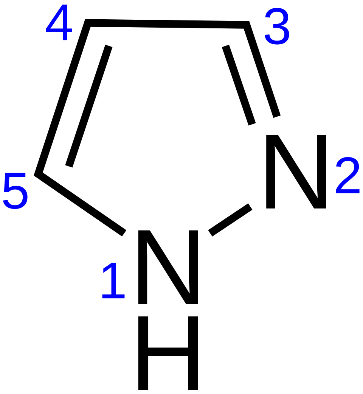
1. “Pyrazole”: usually refers to the parent ring itself (the simplest C₃H₄N₂ framework).
2. “Pyrazoles” / pyrazole derivatives: refers to a family of compounds formed by introducing substituents or functional groups onto the pyrazole ring (e.g., methyl-pyrazoles, halogenated pyrazoles, pyrazole carboxylic acids, pyrazole amides, fused pyrazoles, etc.).
2.1 Pyrazole “identity” and naming essentials
Key point | Core information |
Molecular formula / parent ring | C₃H₄N₂ (five-membered aromatic ring with two adjacent N atoms) |
Common aliases | Pyrazole; 1,2-Diazole |
Atom numbering | The two nitrogens are typically numbered 1 and 2, and the remaining ring positions are 3, 4, 5 (convenient for describing substitution patterns and reactive sites) |
1H/2H notation | Indicates on which nitrogen atom “that hydrogen” resides on the ring (related to tautomerism; see below) |
3.Structural features: how do the two nitrogens shape pyrazole’s acid–base behavior, hydrogen bonding, and coordination characteristics?
Pyrazole is “useful” largely because of the division of labor between its two nitrogen atoms and the resulting tunability. Reviews emphasize that tautomerism in pyrazole (migration of H between the two N atoms) is one of its key features in structural chemistry.
3.1 Aromaticity and hydrogen bonding: both a hydrogen-bond donor and acceptor
1. Pyrazole is aromatic (stable and tolerant of many reaction conditions), making it suitable as a scaffold for iterative structural modification.
2. The two nitrogens are not equivalent:
a) The “pyridine-type N” behaves more like a hydrogen-bond acceptor / coordination site (it can be protonated and can coordinate to metals).
b) The “pyrrole-type N–H” behaves more like a hydrogen-bond donor (its lone pair contributes to aromaticity, so it is a weak hydrogen-bond acceptor).
3. Because tautomerism exists, some substituted pyrazoles in solution may show phenomena such as “positional equivalence” and simplified spectra. This 3/5 positional equivalence and the common literature notation “3(5)-position” occur mainly in systems where N–H is unsubstituted and tautomeric exchange is fast. N-substitution or constraints from strong hydrogen bonding / pronounced electronic effects often reduce or eliminate this equivalence.
3.2 Amphoterism: the same small ring can “take either side”
Pyrazole can behave as both a weak base and a weak acid (highly relevant for experimental selection):
1. As a weak base (pKaH): Basicity is typically characterized by the pKa of its conjugate acid (pKaH). Commonly reported values are around ~2.5 in aqueous solution at 25 °C (e.g., pKaH ≈ 2.48), with small differences across measurement conditions and databases. Compared with pyridine or aliphatic amines, pyrazole is less basic. Under strongly acidic conditions it can form salts, but under neutral to mildly acidic conditions it is often present predominantly in the free-base form. Whether to select a salt form usually depends on solubility, crystallinity, and the specific application scenario.
2. As a weak acid (N–H): The N–H of pyrazole is a weak acid; on the aqueous scale, typical values are on the order of ~14 (e.g., pKa ≈ 14.2). Substituents and solvent can shift this value. Therefore, strong base conditions are usually required to deprotonate it to form pyrazolate (the pyrazole anion), which closely relates to its common use in coordination chemistry and catalysis.
3.3 Quick reference: “structure → property → experimental meaning”
Structural/property cue | What you may observe | What it means for research-oriented selection |
Aromatic five-membered ring (stable) | Most pyrazole derivatives tolerate routine reactions and purification | Suitable as a “core scaffold” for iterative modification |
Tautomerism (1H ↔ 2H) | Substituted forms may show 3(5)-position naming; spectra and/or reactive sites may be affected | When selecting reagents and doing structural characterization, pay attention to whether tautomerism / site equivalence is present; it is usually more pronounced when N–H is unsubstituted and exchange is fast, while N-substitution often weakens or eliminates equivalence |
Weak base (conjugate acid pKa ≈ 2.48) | Not as readily salt-forming as amines | If a salt form is needed, stronger acids are typically used; under neutral conditions it often exists as the free base |
N–H weak acid (pKa ≈ 14.2) | Under strong base conditions, pyrazole salts / metal pyrazolates can form | In coordination chemistry, metal catalysis, and materials, the deprotonated pyrazolate is often used as a bridging ligand |
4.What are the typical characteristics of pyrazole-related products?
From the perspective of reagent catalogs, pyrazole-related products commonly share three features:
1. Small scaffold, high information density: A single pyrazole ring can simultaneously provide hydrogen-bond donor/acceptor capability and tunable acid–base behavior, which benefits molecular recognition and property optimization.
2. Broad room for substitution-driven optimization: Substituents can be introduced at the 3/4/5 positions to rapidly modulate hydrophobicity, polarity, metabolic stability, and binding mode. In reviews, pyrazoles are repeatedly used as building blocks for many classes of bioactive molecules.
3. Representative in pharma and agrochemicals: Drugs and lead compounds containing a pyrazole scaffold are abundant in the literature, and reviews explicitly highlight representative structures (e.g., celecoxib, sildenafil, etc.).
Pyrazole is not a “textbook-only parent ring”; it is a practical scaffold that runs through pharmaceuticals, agrochemicals, and coordination systems.
5.Common classification of pyrazole-related products
Research task / experimental need | Product categories to prioritize | Typical structural cues / selection notes |
Build SAR around a “pyrazole scaffold” or optimize leads | Substituted pyrazole libraries (3/4/5-position diversification) | Check whether substitution patterns are affected by tautomerism; consider whether N-substitution is needed to lock conformation / hydrogen-bonding mode |
Coupling / late-stage functionalization (rapid fragment assembly) | Halopyrazoles; pyrazole boronic acids/boronate esters; pyrazoles bearing “convertible functional groups” (carboxylic acids / acyl chlorides / amide precursors, etc.) | Halogen/boron motifs serve mainly as “coupling handles”; carboxylic acid/amides help enter bond types commonly used in medicinal chemistry |
Fragments with “controllable H-bond donor/acceptor behavior” (fragment screening) | Small-molecule pyrazoles; N-protected / N-alkyl pyrazoles | Whether N–H is retained determines donor capability; N-substitution can reduce tautomerism and improve metabolic stability (system-dependent) |
Coordination chemistry / catalysis / organometallic chemistry | Pyrazole salts (deprotonation-related); multi-pyrazole ligands; tris(pyrazolyl)borate “scorpionate” ligands | After deprotonation to pyrazolate, bridging to metals becomes easier; scorpionates are a classic tridentate ligand family |
Agrochemicals (fungicidal / insecticidal scaffolds) | Pyrazole amides; arylpyrazoles (phenylpyrazoles), etc. | Many commercial compounds contain pyrazole; common in SDHI fungicides and phenylpyrazole insecticides |
Analytical / QC / metabolism studies | Reference standards of target pyrazoles; isotopically labeled standards (if available) | Prioritize high purity, clear water content / salt form information, and traceable documentation (spectra / certificate) |
6.Where do pyrazoles translate their “structural advantages” into real-world use?
6.1 Pharmaceuticals and bioactive molecules
The pyrazole core is often described as a common bioactive “pharmacophore-bearing scaffold.” Multiple reviews systematically summarize its roles in anti-inflammatory, anticancer, anti-infective research, along with examples of approved drugs.
6.2 Agrochemicals: fungicides and insecticides
1. Studies note that the pyrazole ring can be highly effective in fungicide design, and they cite compound classes containing pyrazole rings that are used on the market (e.g., bixafen, fluxapyroxad, etc.).
2. Regulatory documents explicitly classify fipronil as a phenylpyrazole insecticide, underscoring the representative role of the pyrazole scaffold in insecticidal bioactive molecules.
6.3 Coordination chemistry and catalysis: from “pyrazole” to “pyrazolyl ligand families”
Upon deprotonation, pyrazole forms the pyrazolate anion, which is widely used to construct metal complexes. Going further, scorpionate ligands such as tris(pyrazolyl)borates have enabled a rich landscape of coordination and catalytic chemistry.
7.Product navigation table: pyrazole-related chemical selection guide|Quick positioning by research task / experimental need (corresponding to Tables 1–4)
Research task / experimental need | Key structural/property cues needed | Recommended table to check first | What you can quickly find in the table |
Pharma/agrochemical/functional additive research: activity benchmarks, mechanism validation, method development (HPLC/LC-MS/GC), sample quantification | The target molecule itself is an active or application-end compound: drugs (COX-2, PDE5, XO, etc.), pesticide standards, nitrification inhibitors; emphasis on purity grade and reference-standard use | Table 1: Bioactivity / application-oriented | Compounds directly usable for reference/application studies, such as celecoxib, sildenafil (including salt forms), allopurinol, antipyrine, fipronil standards, 3,4-DMPP, etc. |
Rapid construction of substituted pyrazole scaffolds (lead synthesis / SAR expansion / small-molecule libraries): prioritize coupling and stepwise substitution | Need controllable reactive sites: halogens (Cl/Br/I) for cross-coupling; polyhalogenated for stepwise coupling; N-protection (Boc) to control regioselectivity; strong electrophiles (sulfonyl chlorides) for fast sulfonamide installation | Table 2: Electrophilic / controllable reactive-site building blocks | The most commonly used synthetic “handles,” e.g., 3/4-halopyrazoles, 3,5-dibromopyrazole, 1-Boc-pyrazole, pyrazole sulfonyl chlorides (N-methylated and non-N-methylated), etc. |
Suzuki and related couplings: append pyrazole fragments to aryl/heteroaryl units to quickly expand structural diversity | Need boronic acids/boronate esters (pinacol esters are more stable and easier to store/weigh); 3- vs 4-boron source determines connection site; if labeled “with anhydride,” minor optimization of equivalents/reactivity may be needed | Table 3: Coupling / coordination toolbox | 1H-pyrazole-3-boronic acid/pinacol ester, 1H-pyrazole-4-boronic acid (with anhydride), 4-pyrazole boronic acid pinacol ester, etc.; plus Tp-type ligand precursors (see next row) |
Metal coordination/catalysis/materials: synthesize metal complexes, ligand screening, mechanistic studies | Need multi-nitrogen ligand backbones that form stable coordination environments; Tp / scorpionate ligands are common platforms for quickly building series of complexes | Table 3: Coupling / coordination toolbox | Potassium tris(1-pyrazolyl)borohydride (Tp ligand source), used for preparing metal complexes and exploring catalytic systems |
Route expansion “from the parent ring”: introduce convertible functional groups (amide formation / amination / condensations / post-modification) | Need general-purpose functional handles: carboxylic acids/amides for linkage and polarity tuning; aldehydes for reductive amination/condensation; nitriles for tetrazole/amide/carboxylic acid conversion; nitro for reduction to amino; diamines for multi-site derivatization | Table 4: Parent ring and common derivatization platforms | Parent pyrazole and N-methyl/aryl/fluorinated variants; 3/4-carboxylic acids, 3/4-amides, 3/4-aldehydes, 3/4-nitriles, 3/4-nitro, 3,5-diamines, and other broadly “interconvertible” intermediates |
Physicochemical and electronic-effect comparisons: trends in pKa, logP, solubility, metabolic stability, or positional isomer comparisons | Choose a systematically varied set: 3- vs 4-position (e.g., carboxylic acid/amide/aldehyde/nitrile/nitro); fluorinated (CF₃) to increase hydrophobicity and stability; N-substitution (N-Me/N-Ph) to alter basicity and conformation | Table 4: Parent ring and common derivatization platforms (with Table 2/3 as needed) | Matched positional isomers (3 vs 4) for the same functional group; fluorinated pyrazoles; N-substituted pyrazoles; and combinable paths for further coupling/functionalization |
Usage recommendations:
1. If your goal is “direct activity / reference standard / detection” → start with Table 1.
2. If your goal is “scaffold building, library construction, SAR” → start with Table 2 (reactive-site handles) + Table 3 (coupling assembly).
3. If your goal is “route expansion from the parent ring via functional group interconversions” → start with Table 4 (most comprehensive set of general-purpose handles).
Table 1|Bioactivity / Application-Oriented (Pharmaceuticals / Pesticides / Agricultural Functional Agents)
Category | CAS No. | Aladdin Cat. No. | Name | Spec / Purity | Product features & applications |
Pesticide / insecticide (phenylpyrazole) reference standard | 120068-37-3 | Fipronil | Analytical standard, ≥98% | A representative phenylpyrazole insecticide scaffold; used for quantitative analysis of pesticide residues / environmental samples and for method validation (LC/GC, etc.) | |
Pyrazole-containing drug (API / reference standard) | 169590-42-5 | Celecoxib | Moligand™, ≥99% | Classic COX-2 selective inhibitor (diaryl-substituted pyrazole); used for drug analysis, formulation/impurity studies, method development, and as a bioactivity-related reference compound | |
Pyrazole-containing drug (salt form) | 171599-83-0 | Sildenafil Citrate | Moligand™, ≥98% (HPLC) | Salt form of a PDE5 inhibitor; commonly used as a reference for assay, dissolution/stability studies, and bioanalytical methods (LC-MS) | |
Pyrazole-containing drug (free base) | 139755-83-2 | Sildenafil | Moligand™, ≥98% | Free-base PDE5 inhibitor; used for API/formulation analysis, impurity profiling, and reference-standard comparison | |
Pyrazole small-molecule pharmacological probe / enzyme inhibitor | 7554-65-6 | 4-Methylpyrazole | Moligand™, ≥98% (GC) | Also known as Fomepizole; a classic alcohol dehydrogenase (ADH) inhibitor used in ethanol/methanol metabolism pathway studies and as an enzymatic inhibition reference | |
Fused-pyrazole drug (purine metabolism-related) | 315-30-0 | Allopurinol | Moligand™, ≥98% | Pyrazolo[?]pyrimidine fused scaffold (fused pyrazole); classic xanthine oxidase inhibitor used in purine metabolism/uric acid pathway research and as an analytical reference | |
Pyrazolone drug / analytical probe | 60-80-0 | Antipyrine | ≥99% | Classic pyrazolone analgesic/antipyretic; commonly used as a CYP metabolism probe or analytical reference in PK/metabolism studies | |
Agricultural functional agent / nitrification inhibitor (pyrazole derivative) | 202842-98-6 | 3,4-Dimethyl-1H-pyrazole phosphate (3,4-DMPP) | ≥95% | Representative nitrification inhibitor (fertilizer additive / soil nitrogen cycling research); used to inhibit nitrification, improve nitrogen-use efficiency, and study reductions in nitrate leaching and related greenhouse-gas emissions |
Table 2|Electrophilic / Controllable Reactive-Site Building Blocks (Halogenated Sites + Sulfonyl Chlorides + N-Protection)
Category | CAS No. | Aladdin Cat. No. | Name | Spec / Purity | Product features & applications |
Protected pyrazole (N-protection / regioselectivity control) | 219580-32-2 | 1-Boc-pyrazole | ≥97% | N-Boc protection lowers basicity and improves handling; commonly used to enhance selectivity in N-substitution / metalation, serving as a controllable derivatization platform | |
Sulfonyl chloride (strong electrophilic building block) | 288148-34-5 | 1-Methyl-1H-pyrazole-4-sulfonyl chloride | ≥98% | Typical sulfonylation reagent; reacts with amines to form pyrazole sulfonamides (a common motif in drugs) and with alcohols to form sulfonate esters; enables rapid construction of derivative libraries | |
Sulfonyl chloride (strong electrophilic building block) | 438630-64-9 | 1H-Pyrazole-4-sulfonyl chloride | ≥97% | Rapidly forms pyrazole sulfonamides with amines (common medicinal motif); also forms sulfonate esters with alcohols; used for fast derivative-library construction | |
Halopyrazole (electrophilic building block) | 15878-00-9 | 4-Chloropyrazole | ≥98% (HPLC) | A replaceable site at C-4; used for coupling or, under specific conditions, nucleophilic substitution / metalation followed by functionalization to quickly introduce diverse substituents | |
Halopyrazole (electrophilic building block) | 14339-33-4 | 3-chloro-1H-pyrazole | ≥97% | C-3 halogen as a “reactive site”; used for coupling or post-metalation functionalization to build 3-substituted pyrazoles and for positional-effect comparisons | |
Halopyrazole (electrophilic building block) | 2075-45-8 | 4-Bromopyrazole | ≥99% | Typical halopyrazole coupling substrate; used in Suzuki/Buchwald cross-coupling or metalation–functionalization to build 4-substituted pyrazoles | |
Halopyrazole (electrophilic building block) | 14521-80-3 | 3-Bromopyrazole | ≥97% | Common coupling substrate; used in Suzuki/Buchwald reactions to rapidly introduce aryl/amino substituents and build 3-substituted pyrazole series | |
Halopyrazole (electrophilic building block) | 3469-69-0 | 4-Iodopyrazole | ≥98% (HPLC) | Highly reactive coupling substrate; especially favorable for Pd-catalyzed cross-coupling, suitable for rapid construction of 4-aryl/alkenyl/alkynyl pyrazole libraries | |
Halopyrazole (electrophilic building block) | 4522-35-4 | 3-Iodopyrazole | ≥97% (GC) | Highly active coupling substrate; used in Pd-catalyzed cross-coupling (Suzuki/Sonogashira/Buchwald, etc.) to rapidly construct 3-substituted pyrazoles | |
Polyhalogenated pyrazole (two-site coupling platform) | 67460-86-0 | 3,5-dibromo-1H-pyrazole | ≥97% | Two halogen handles enable stepwise coupling (installing two different substituents sequentially); used to rapidly build 3,5-disubstituted pyrazole scaffolds and small-molecule libraries |
Table 3|Coupling / Coordination Toolbox (Boronic Acids / Boronate Esters + Scorpionate Ligand Precursors)
Category | CAS No. | Aladdin Cat. No. | Name | Spec / Purity | Product features & applications |
Boronic acid (coupling building block) | 376584-63-3 | 1H-Pyrazole-3-boronic acid | ≥98% | Typical Suzuki coupling fragment; enables efficient assembly of pyrazole with aryl/heteroaryl units to rapidly obtain diverse 3-substituted pyrazoles | |
Boronate ester (coupling building block) | 844501-71-9 | 1H-Pyrazole-3-boronic acid pinacol ester | ≥95% | Suitable for Suzuki coupling to append aryl/heteroaryl groups; pinacol ester is more convenient for storage and weighing, enabling rapid expansion of 3-position diversity | |
Boronate ester (coupling building block) | 269410-08-4 | 4-Pyrazoleboronic acid pinacol ester | ≥98% | A more stable boronic-acid equivalent; used in Suzuki coupling to rapidly introduce aryl/heteroaryl groups, suitable for small substituted-pyrazole libraries and SAR expansion | |
Boronic acid (coupling building block) | 763120-58-7 | 1H-Pyrazole-4-boronic acid (contains varying amounts of anhydride) | ≥95% | Used to build 4-substituted pyrazoles via Suzuki coupling; “contains varying amounts of anhydride” indicates that equivalents/reactivity may require modest optimization based on actual activity | |
Ligand / metal coordination reagent (scorpionate precursor) | 18583-60-3 | Potassium Tris(1-pyrazolyl)borohydride | ≥97% (T) | Common Tp (tris(pyrazolyl)borohydride) scorpionate ligand source; used for metal complex synthesis, catalysis/mechanistic studies, and exploration of coordination-chemistry materials |
Table 4|Parent Ring and Common Derivatization Platforms (Alkyl/Aryl/Fluorinated Substitution + Amino/Nitro + Carboxylic Acid/Amide/Aldehyde/Nitrile)
Category | CAS No. | Aladdin Cat. No. | Name | Spec / Purity | Product features & applications |
Benzopyrazole (indazole) / fused pyrazole systems | 271-44-3 | I473130 | Indazole | 98% | Representative benzopyrazole scaffold; a high-frequency “heteroaryl fragment” in medicinal chemistry for lead synthesis, substitution-rule exploration, and SAR construction |
Pyrazole parent ring (basic heterocycle) | 288-13-1 | Pyrazole | ≥98% (GC) | Parent scaffold of the pyrazole family; used for teaching/mechanistic studies (tautomerism, regioselectivity of N-alkylation) and as a starting material for substituted pyrazole synthesis | |
Basic pyrazole parent ring & simple derivatives (N-methyl) | 930-36-9 | 1-Methylpyrazole | ≥98% | Common benchmark N-substituted pyrazole; used to compare effects of N-substitution on basicity/coordination/solubility and as a substrate for further functionalization | |
Basic pyrazole parent ring & simple derivatives (alkyl) | 1453-58-3 | 3-Methylpyrazole | ≥98% | Simple substituted reference substrate; used to study how positional substitution affects reaction selectivity, pKa, and physicochemical properties | |
Basic pyrazole parent ring & simple derivatives (alkyl) | 2820-37-3 | 3,4-Dimethyl-1H-pyrazole | ≥97% | Common simple substituted reference substrate; used to study substitution effects on pKa/solubility/reaction selectivity and as a starting point for downstream functionalization | |
Basic pyrazole parent ring & simple derivatives (alkyl) | 67-51-6 | 3,5-Dimethylpyrazole | ≥99% | Widely used substituted pyrazole platform; supports N-alkylation/acylation/sulfonylation for rapid construction of pyrazole derivative series for screening | |
Basic pyrazole parent ring & simple derivatives (N-aryl) | 1126-00-7 | 1-Phenylpyrazole | ≥98% (GC) | Common N-arylated pyrazole template; used to study effects of N-substitution on pKa/conformation/hydrophobicity and for building lead-like structures | |
Basic pyrazole parent ring & simple derivatives (aryl) | 2458-26-6 | 3-Phenyl-1H-pyrazole | ≥97% | Common aryl-substituted template; used for SAR comparisons (hydrophobic/π-interactions) and positional-substitution contrast; also a substrate for further functionalization | |
Basic pyrazole parent ring & simple derivatives (aryl) | 1145-01-3 | 3,5-Diphenylpyrazole | ≥98% (HPLC) | Common diaryl-pyrazole scaffold; used for ligand/functional-molecule construction and for SAR/physicochemical comparisons of aryl-substitution effects | |
Highly hydrophobic / fluorinated substituted pyrazole | 20154-03-4 | 3-(Trifluoromethyl)pyrazole | ≥97% | CF₃ is a common motif to increase hydrophobicity/metabolic stability; used in fluorination strategies and property optimization (pKa, logP, etc.) | |
Highly hydrophobic / fluorinated substituted pyrazole | 14704-41-7 | 3,5-Bis(trifluoromethyl)pyrazole | ≥98% (GC) | A common CF₃-rich pyrazole fragment to enhance hydrophobicity/metabolic stability; used for fluorination-driven tuning, property control, and lead optimization | |
Amino-containing pyrazole (nucleophilic building block) | 1820-80-0 | 3-Aminopyrazole | ≥98% | Key nucleophilic amine site; used for derivatization (acylation/sulfonylation/urea formation), and commonly for building fused heterocycles and drug-like scaffolds | |
Amino-containing pyrazole (nucleophilic building block) | 28466-26-4 | 4-Aminopyrazole | ≥95% | Key amine functional handle enabling rapid derivatization (acylation/sulfonylation/urea formation); often used to build more complex heterocycles and drug-like fragments | |
Amino-containing pyrazole (strong nucleophilic building block) | 16082-33-0 | 1H-Pyrazole-3,5-diamine | ≥95% | Two amine sites enable bis-acylation/cyclization; used to build more complex N-containing scaffolds, multi-site derivatization, and SAR exploration | |
Nitro-containing pyrazole (convertible “precursor”) | 26621-44-3 | 3-Nitropyrazole | ≥98% | Nitro can be reduced to amino, serving as a common precursor to 3-amino/multisubstituted pyrazoles; also used for SAR exploration via electronic-effect tuning | |
Nitro-containing pyrazole (convertible “precursor”) | 2075-46-9 | 4-Nitropyrazole | ≥97% | Nitro can be reduced to amino to prepare 4-amino derivatives; also serves as a strong electron-withdrawing substituent for electronic-effect/activity comparisons | |
Carboxylic acids (acidic functionalization building block) | 1621-91-6 | Pyrazole-3-carboxylic Acid | ≥98% (HPLC) | Carboxylic-acid handle enables amide/ester formation; often used to incorporate pyrazole fragments into drug scaffolds for fragment assembly and SAR optimization | |
Carboxylic acids (acidic functionalization building block) | 37718-11-9 | 4-Pyrazolecarboxylic acid | ≥98% | Carboxylic-acid handle enables amidation/esterification; often used to incorporate pyrazole fragments into drug scaffolds for fragment assembly and polarity tuning | |
Carboxylic acids (N-substituted pyrazole acids) | 5952-92-1 | 1-Methylpyrazole-4-carboxylic Acid | ≥98% (GC) (T) | Combines N-methylation with a carboxylic-acid handle; enables downstream amidation to introduce diverse amine termini for constructing drug-like molecules | |
Carboxylic acids (N-substituted pyrazole acids) | 25016-20-0 | 1-Methylpyrazole-3-carboxylic Acid | ≥97% (GC) (T) | Combines N-methylation with a carboxylic-acid handle; convenient for downstream amidation to install amine termini, often used for fine-tuning polarity/conformation in medicinal chemistry | |
Polycarboxylic acids (multifunctional building block / coordination unit) | 3112-31-0 | 3,5-Pyrazoledicarboxylic Acid | ≥97% | Two carboxylates plus pyrazole nitrogens facilitate multidentate coordination; used in coordination chemistry, MOF/complex construction, and as a “ditopic linker” for bis-amidation | |
Amides (polar fragments / further convertible) | 33064-36-7 | Pyrazole-3-carboxamide | ≥97% | Common polar amide fragment (H-bond donor/acceptor); can be further N-substituted or extended via hydrolysis/dehydration and related transformations | |
Amides (polar fragments / further convertible) | 437701-80-9 | 4-Pyrazolecarboxamide | ≥95% | Polar amide at the 4-position; used as medicinal intermediates and for positional comparisons (3 vs 4), enabling further N-substitution or derivatization | |
Aldehyde pyrazoles (condensation / reductive amination building blocks) | 3920-50-1 | Pyrazole-3-carboxaldehyde | ≥98% | Classic aldehyde “attachment point”; used in reductive amination, oxime/hydrazone formation, Knoevenagel condensation, etc., to rapidly append diverse side chains to the pyrazole fragment | |
Aldehyde pyrazoles (condensation / reductive amination building blocks) | 35344-95-7 | 1H-pyrazole-4-carbaldehyde | ≥97% | Used to introduce side chains via reductive amination/condensation; suitable for SAR comparisons of positional isomers (3 vs 4) | |
Nitrile pyrazoles (multi-purpose functional handle) | 36650-74-5 | 1H-Pyrazole-3-carbonitrile | ≥98% | Nitrile “handle” can be converted to amides/carboxylic acids/tetrazoles, etc.; used for route expansion and tuning polarity/H-bond acceptor design in drug-like scaffolds | |
Nitrile pyrazoles (multi-purpose functional handle) | 31108-57-3 | 1H-Pyrazole-4-carbonitrile | ≥98% | Nitrile can be converted to amides/carboxylic acids/tetrazoles, etc.; used for route extension and receptor/polar-site design, commonly seen in medicinal intermediates |
Note: The above are representative Aladdin products. For additional specifications, please refer to the product list at the end of the article, or search the Aladdin website using the product name / CAS / catalog number.
For more related articles, please see below: