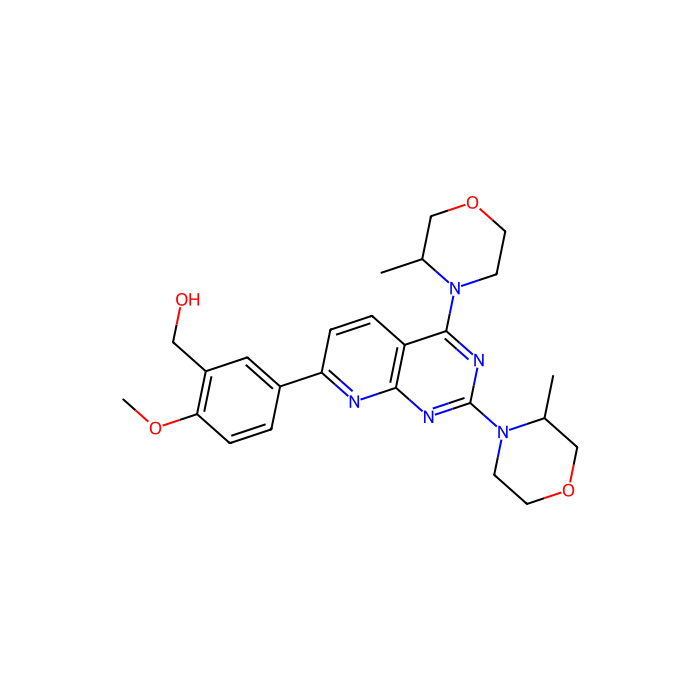
AZD8055 - Moligand™, 10mM in DMSO , Serine/threonine-protein kinase mTOR inhibitor, CAS No.1009298-09-2, Serine/threonine-protein kinase mTOR inhibitor

CAS: 1009298-09-2 Cat. No.: A408287 Fórmula: C25H31N5O4 Peso molecular: 465.56 Número EC: 836-652-5
Disponible para pedir
GRADE & PURITY Moligand™ ? Moligand™ — Aladdin's line of ligands and bioactive small molecules. Use for receptor, pathway, and binding studies needing defined small-molecule tools. 10mM in DMSO
Synonyms
(5-(2,4-bis((S)-3-methylmorpholino)pyrido[2,3-d]pyrimidin-7-yl)-2-methoxyphenyl)methanol
Storage
Store at -80°C
Shipped In
Dry ice packs + Cold packs
★
Size
Alemania (EU)
USA*
Price
Qty
1ml
A408287-1ml
—
1 Disponible

91,03€

131,81€
Guardar 40,78 € (30.94%)
Enter a quantity for the sizes you want to add.
🧪
Why this grade

Moligand™, 10mM in DMSO Moligand™ for sensitive chromatographic and analytical workflows requiring minimal baseline interference.

🌡

Storage & shipping

Store at -80°C Ships Dry ice packs + Cold packs Check lot-specific COA for exact specifications.

📋

Quality documents

SDS, COA, datasheet, and spec sheet available for download. Lot-specific COA accessible via lot number lookup.

📚

Literature proof

Cited in 0 peer-reviewed publications across chromatography, organic synthesis, and cross-coupling reactions.

Descripción general

Information

AZD8055 AZD8055 is a novel ATP-competitive mTOR inhibitor with IC50 of 0.8 nM in MDA-MB-468 cells with excellent selectivity (∼1,000-fold) against PI3K isoforms and ATM/DNA-PK. AZD8055 induces caspase-dependent apoptosis and also induces autophagy . Pha
In vitro

AZD8055 shows low activity (∼1,000-fold) against all PI3K isoforms (α, β, γ, δ) and other members of the PI3K-like kinase family (ATM and DNA-PK). AZD8055 inhibits the phosphorylation of mTORC1 (p70S6K and 4E-BP1) as well as phosphorylation of the mTORC2 (Akt) and downstream proteins. The rapamycin-resistant T37/46 phosphorylation sites on 4E-BP1 can be fully inhibited by AZD8055, resulting in significant inhibition of cap-dependent translation. AZD8055 potently inhibits proliferation in U87MG, A549 and H838 cells with IC50 of 53, 50 and 20 nM, respectively. AZD8055 also induces autophagy and increased LC3-II levels in H838 and A549 cells. AZD8055 decreases AML blast cell proliferation and cell cycle progression, reduces the clonogenic growth of leukemic progenitors and induces caspase-dependent apoptosis in leukemic cells but not in normal immature CD34+ cells. AZD8055 indicates inhibitory against the pediatric preclinical testing program (PPTP) cell lines with IC50 of 24.7\u2009nM and induces significant differences in EFS distribution.

In vivo

AZD8055 inhibits the pS6 and pAkt in U87MG and A549 xenografts at 2.5/10 mg/kg, which leads to tumor growth inhibition. AZD8055 shows significant antitumor activity in many xenografts, including U87MG, BT474c, A549, Calu-3, LoVo, SW620, PC3 and MES-SA at a dose of 10/20 mg/kg. AZD8055 induces ~40% reduction in tumour volume, accompanied by ablation of phosphorylation of Akt, S6K and SGK protein kinases. Administration of AZD8055 (5mg/kg, Bid) and SAHA (100 mg/kg/d) results in complete tumor growth inhibition in PTEN+/−LKB1+/hypo xenografts without side effects on mice by inhibition of mTORC1 and mTORC2 signaling.
Cell Data

cell lines:HCT116, A2780, ACHN, MCF7, HL-60, et al.

Concentrations:1 nM - 1 μM

Incubation Time:72 to 96 hours

Powder Purity:≥97%

Specifications

Sinónimos
(5-(2,4-bis((S)-3-methylmorpholino)pyrido[2,3-d]pyrimidin-7-yl)-2-methoxyphenyl)methanol
Especificaciones y pureza
Moligand™, 10mM in DMSO
Mecanismos bioquímicos y fisiológicos
AZD8055 is a novel ATP-competitive mTOR inhibitor with IC50 of 0.8 nM in MDA-MB-468 cells with excellent selectivity (∼1,000-fold) against PI3K isoforms and ATM/DNA-PK. AZD8055 induces caspase-dependent apoptosis and also induces autophagy. Phase 1.
Condiciones de almacenamiento de almacenamiento
Store at -80°C
Enviado en
Dry ice packs + Cold packs
Este producto requiere envío en cadena de frío. Los servicios terrestres y otros servicios económicos no están disponibles.
Grado
Moligand™
Tipo de acción
INHIBITOR
Mecanismo de acción
Serine/threonine-protein kinase mTOR inhibitor
Propiedades del producto
ALogP
2.6
Nombres e identificadores
Isómeros SMILES
C[C@H]1COCCN1C2=NC(=NC3=C2C=CC(=N3)C4=CC(=C(C=C4)OC)CO)N5CCOC[C@@H]5C
Peso molecular
465.56
Reaxy-Rn
26042191
Reaxys-RN_link_address
https://www.reaxys.com/reaxys/secured/hopinto.do?context=S&query=IDE.XRN=26042191&ln=

Documentation

📋 Safety Data Sheet (SDS)

Comprehensive hazard, handling, storage, and regulatory compliance document.

Download SDS →

✅ Certificate of Analysis (COA)

Lot-specific quality data. Enter your lot number to retrieve the exact COA.

Look up COA →

📊 Datasheet

Quick-reference summary of product specifications and applications.

View datasheet →

🔬 Specification Sheet

Full quality attributes and acceptance criteria for this grade.

View spec sheet →

Advanced Data

Objetivos asociados (humanos)
MTOR Tclin Serine/threonine-protein kinase mTOR (6 Activities)
Activity TypeActivity Value -log(M)Mechanism of ActionActivity ReferencePublications (PubMed IDs)
Certificados (CoA, COO, BSE/TSE y tabla de análisis)
C of A & Other Certificates(BSE/TSE, COO):
Analytical Chart:

Find and download the COA for your product by matching the lot number on the packaging.

1 results found

Lot NumberCertificate TypeFechaArticulo
L2214611Certificate of AnalysisJul 03, 2026 A408287
Preguntas frecuentes y artículos
Calculadoras de soluciones
Reseñas

Reseñas de cliente

Application Protocols

The Product Data do not provide validated, item-specific protocols for this SKU.

General starting points for small-molecule tool compounds (non-item-specific):

  • Stock preparation: dissolve in anhydrous DMSO to 10–50 mM; vortex and, if necessary, sonicate briefly. Filter through 0.22 µm PTFE if particulates persist.
  • Aliquoting: dispense single-use aliquots to minimize freeze–thaw. Label with concentration, solvent, and date.
  • Working solutions: dilute into pre-warmed assay medium or buffer to achieve the desired final concentration with constant vehicle percentage across controls.
  • Controls: include vehicle-only and, where possible, an orthogonal reference compound.
  • Documentation: record lot number, preparation date, and handling conditions for reproducibility.

For any assay-specific recommendations or positive-control conditions associated with this SKU, please refer to the CoA/Spec Sheet or contact Aladdin Scientific technical support.

Biological Roles

This product is a research-use-only small molecule supplied for biochemical and cellular studies. No clinical or therapeutic claims are made.

General, literature-based context (non-item-specific):

  • Small-molecule tool compounds targeting kinase pathways are widely used to interrogate signaling networks, evaluate pathway dependencies, and validate targets in discovery biology. They often function as ATP-competitive ligands with selectivity profiles determined by hinge-binding motifs and pocket interactions.
  • Such probes are used to benchmark assay performance, study dose–response relationships, and explore temporal pathway modulation in cellular systems.
  • Orthogonal confirmation is recommended: employ complementary chemotypes or genetic perturbations to minimize off-target or chemotype-specific artifacts.

Best practices:

  • Define solvent vehicle controls (e.g., DMSO only) at matched percentages.
  • Confirm compound stability over the assay window (light, temperature, medium composition), as degradation can confound readouts.
  • Where feasible, incorporate biochemical potency measurements alongside phenotypic endpoints to correlate target engagement with observed effects.

Item-specific biological targets, potency values, and selectivity panels are Not specified for this item; refer to CoA/Spec Sheet and primary literature for AZD8055.

Buffer Applications

AZD8055 is a bioactive small molecule, not a buffering agent. It is not used to establish or maintain pH.

Practical notes for assay buffers (general, non-item-specific):

  • Common assay vehicles: PBS, HBSS, HEPES, or Tris-based buffers. Maintain consistent ionic strength and pH across vehicle and treatment conditions.
  • Solvent carryover: keep DMSO or alcohol cosolvent at a constant, validated percentage across all wells/samples to avoid solvent-driven artifacts.
  • Filtration: 0.22 µm filtration of working solutions can reduce particulates; confirm no adsorption losses on filters for low-concentration work.

Item-specific buffering information: Not applicable; no buffer role is intended for this compound.

Green Alternatives

“Green alternatives” typically apply to solvent selection and process chemistry. For a research-grade screening compound like AZD8055 (used at milligram-to-microgram scales), the environmental leverage lies in solvent and consumable choices rather than replacing the compound itself.

Practical, greener handling strategies (general, non-item-specific):

  • Prefer aqueous assay buffers with minimal DMSO carryover (≤0.1–0.2% v/v) when assay tolerance allows.
  • If organic co-solvents are required, consider ethanol as a more benign alternative to DMF/ACN where compatible with solubility and assay performance.
  • Use micro-aliquoting to reduce freeze–thaw waste and prevent repeated solvent use.
  • Opt for recyclable glass vials and minimize single-use plastics when feasible.
  • Apply microscale analytics (UPLC, microscale UV) to reduce solvent consumption.

Illustrative comparison (general):

  • DMSO (high solvency, low volatility) vs ethanol (renewable, higher volatility): DMSO often achieves higher stock concentrations; ethanol can be greener but may limit achievable solubility and assay compatibility.
  • Aqueous + cyclodextrin carriers can reduce reliance on organic solvents but may introduce assay variables; validate carefully.

Item-specific environmental metrics (e.g., E-factor, solvent intensity) are not specified for this item.

Pharmaceutical Uses

This product is for research use only and is not intended for human or veterinary use, clinical diagnostics, or as an active pharmaceutical ingredient.

Formulation and excipient context (general, non-item-specific):

  • In preclinical research settings, small-molecule tool compounds are often formulated for in vitro and in vivo studies using vehicles such as DMSO, PEG 300/400, aqueous buffers, and surfactants (e.g., Tween-80) to achieve solubility. Such practices are outside the scope of this catalog item’s intended use and require institution-specific approvals.
  • No pharmacopeial status (USP/EP/JP) is claimed or implied for this grade.

Regulatory note:

  • No cGMP status is indicated. Use exclusively in laboratory research and discovery workflows.

Item-specific pharmaceutical/formulation specifications: Not specified for this item; refer to CoA/Spec Sheet if any supportive data are provided.

Physical Properties

Item-specific physicochemical data are not provided in the Product Data for this listing.

  • Item-specific values
    • Appearance: Not specified for this item; refer to CoA/Spec Sheet.
    • Molecular Weight: Not specified for this item; refer to CoA/Spec Sheet.
    • Molecular Formula: Not specified for this item; refer to CoA/Spec Sheet.
    • Melting point (MP): Not specified for this item; refer to CoA/Spec Sheet.
    • Boiling point (BP): Not applicable/unknown for a high-MW organic solid; refer to CoA/Spec Sheet.
    • Density: Not specified for this item; refer to CoA/Spec Sheet.
    • Solubility: Not specified for this item; refer to CoA/Spec Sheet.
    • LogP/logD, pKa, refractive index: Not specified for this item; refer to CoA/Spec Sheet.

General/literature guidance for handling similar kinase-inhibitor small molecules (non-item-specific):

  • Many heteroaromatic inhibitors are sparingly soluble in water at neutral pH but dissolve readily in DMSO (10–50 mM stock solutions are commonly prepared for screening).
  • Cosolvent strategies for aqueous work: DMSO (≤0.1–0.5% v/v in final assay), ethanol (≤1% v/v), or aqueous buffers aided by acid/base adjustment or cyclodextrin complexation (literature practice).
  • Solid form is commonly an amorphous or microcrystalline powder with a moderate-to-high melting range; exact transitions are compound- and lot-dependent.

Always consult the CoA/Spec Sheet for definitive, item-specific physical constants before designing formulations or assays.

Quality and Grades
  • Supplied grade: Moligand™ (from Product Data)
    • Moligand™ denotes a research-grade, screening-ready small molecule suitable for chemical biology, target validation, and medicinal-chemistry workflows.
    • Typical attributes of this grade (general, non-item-specific): identity confirmation by LC–MS and/or NMR; purity verification by HPLC/UPLC to a screening-appropriate threshold; packaging optimized for bioassay use (often small, aliquot-friendly units). Exact analytical criteria for this SKU are documented in the CoA/Spec Sheet.

What this means in practice:

  • Consistency and identity: batches are controlled to ensure consistent structure and minimal batch-to-batch variation important for SAR and phenotypic screening.
  • Purity and interference management: low levels of common assay interferents (e.g., high UV baseline drift, residual metal catalysts) are typically controlled for screening utility; however, numerical limits are item-specific and not stated here.
  • Documentation: For this SKU, item-specific specifications (e.g., purity %, residual solvents, water Karl Fischer, metal content) are Not specified for this item; refer to CoA/Spec Sheet.

Stabilizers/additives:

  • No stabilizer is listed in the Product Data. If an antioxidant or acid/base counter-ion is employed, it will be disclosed on the CoA/Spec Sheet. Absence of a listed stabilizer does not imply the compound is stabilizer-free; verify per lot documentation.
Reaction and Applications

This product is provided as a bioactive small molecule for screening and chemical biology rather than as a general synthetic reagent.

  • Laboratory applications (research use only):
    • Chemical biology: probe-based studies, target/pathway interrogation, and positive control benchmarking in cell-free or cellular assays (general use case; no medical claims).
    • Medicinal chemistry workflows: SAR comparisons, profiling in enzyme/kinase panels, and orthogonal assay validation.
  • Not typically used for: stoichiometric transformations, catalytic synthesis, cross-couplings, or bulk reaction media.

Good practices (general, non-item-specific):

  • Prepare DMSO stocks at validated concentrations (e.g., 10–50 mM) based on solubility; verify by visual inspection and, if needed, UV or HPLC for concentration.
  • Minimize freeze–thaw cycles via single-use aliquots to maintain integrity.
  • Confirm identity and purity for critical studies by independent LC–MS or NMR if required by your QC framework.
  • Light and oxidative sensitivity: many heteroaromatic bioactives benefit from amber vials, inert headspace, and storage cold/dry.

Item-specific manufacturer application notes were not provided beyond “For research use only.” For any specialized application recommendations for this SKU, consult the CoA/Spec Sheet or contact Aladdin Scientific technical support.

Reaction Conditions

Not typically applicable. AZD8055 is a research-use-only probe compound, not intended as a reagent for synthetic transformations.

If employing the compound in analytical or stability studies (general, non-item-specific):

  • Solvents: DMSO, ACN, MeOH, or buffered aqueous media, depending on the analytical technique.
  • Temperatures: ambient for solution prep; cold storage recommended for stability.
  • Atmosphere: protect from light and moisture; inert headspace (N2/Ar) can be beneficial for long-term stock stability.
  • Timescales: minimize solution residence time at room temperature to limit degradation; prepare fresh working solutions on the day of use.

Item-specific reaction or processing conditions are not applicable and are Not specified for this item.

Safety and Handling

Safety data specific to this item are not provided in the Product Data.

  • GHS information (from Product Data):
    • Signal Word: Not specified for this item; refer to SDS.
    • H-Statements: Not specified for this item; refer to SDS.
    • GHS Classification and Pictograms: Not specified for this item; refer to SDS.

General laboratory safety guidance for bioactive small molecules (non-item-specific):

  • Handle in a fume hood, avoid inhalation, ingestion, and skin/eye contact. Use appropriate PPE: lab coat, safety glasses, and disposable nitrile gloves. Consider double-gloving when handling DMSO solutions because DMSO can enhance dermal absorption of solutes.
  • Storage incompatibilities: segregate from strong oxidizers, strong acids/bases, and reactive reducing agents unless compatibility is known. Avoid prolonged exposure to light and moisture.
  • First aid overview: in case of eye/skin contact, rinse with plenty of water for at least 15 minutes and remove contaminated clothing. If inhaled, move to fresh air. If ingested, rinse mouth; do not induce vomiting; seek medical attention. Always follow your institution’s SOPs and the product SDS.
  • Spill response: absorb with inert material, collect in a chemical-waste container. Decontaminate surfaces with suitable organic solvent followed by detergent/water, observing compatibility.
  • Waste: dispose in accordance with local regulations for organic laboratory chemicals.

Authoritative safety information is provided in the SDS; always consult the SDS for this specific SKU prior to use.

Solvent Selection

AZD8055 is supplied as a research small molecule where dissolution for bioassays is the primary concern rather than use as a bulk reaction solvent.

Practical guidance (general, non-item-specific for kinase inhibitors):

  • Primary stock solvent: DMSO is the standard choice for preparing concentrated stocks (e.g., 10–50 mM) owing to high solvating power for heteroaromatic scaffolds. Filter stocks (0.22 µm PTFE) if particulate is observed.
  • Working solutions: Dilute DMSO stocks into aqueous assay buffers (e.g., HBSS, PBS, Tris, HEPES) maintaining final DMSO typically ≤0.1–0.5% v/v to minimize biological assay interference (optimize per system).
  • Alternative co-solvents: ethanol or methanol can aid solubilization for spectroscopic or physicochemical measurements; limit final alcohol content in biological assays as appropriate.
  • Solubility enhancers: consider hydroxypropyl-β-cyclodextrin, minimal amounts of non-ionic surfactants (e.g., Tween-80), or pH adjustment when chemically compatible (literature practice; confirm compound stability first).
  • Avoid: strong acids/bases or oxidants unless stability data support compatibility. Some kinase inhibitors undergo degradation under prolonged basic or oxidative conditions.

Comparison notes (general):

  • DMSO vs ethanol: DMSO provides superior solubility for polar heteroaromatics; ethanol offers faster drying and easier removal but lower solubility ceilings.
  • Aqueous-only systems: often insufficient for high-concentration stocks but can be used for final assay dilutions once a DMSO concentrate is prepared.

Item-specific solubility data are Not specified for this item; refer to CoA/Spec Sheet.

Storage and Reconstitution
  • Storage conditions (from Product Data): Store at -80°C. Shipments are made on dry ice packs + cold packs to maintain low temperature during transit.
  • Research Use Note: For research use only.

Reconstitution and handling (general, non-item-specific):

  • Upon receipt: keep frozen at -80°C until use. Allow the container to equilibrate to room temperature in a desiccated environment before opening to prevent moisture condensation on the solid.
  • Initial dissolution: prepare a concentrated DMSO stock (e.g., 10–50 mM) based on your assay needs. Use high-purity, anhydrous solvent. If required, warm gently to room temperature and vortex/sonicate briefly.
  • Aliquoting: divide into single-use, airtight aliquots in inert vials (preferably amber) to avoid repeated freeze–thaw cycles.
  • Short-term storage of solutions: store DMSO stocks at ≤ -20°C (ideally -80°C for long-term). Avoid repeated thawing; thaw quickly at room temperature, mix, and keep on ice during use.
  • Stability: avoid prolonged exposure to light, heat, and moisture. Discard solutions showing precipitation, discoloration, or unexpected assay behavior.

Item-specific shelf life, retest date, and solution stability: Not specified for this item; refer to CoA/Spec Sheet and SDS for definitive guidance.

Structure and Identity

Brief overview: AZD8055 is a research-grade, bioactive small molecule supplied in Aladdin’s Moligand™ format for screening and chemical biology.

  • Product identity (from Product Data)
    • SKU: A408287
    • Product Name: AZD8055
    • CAS: 1009298-09-2
    • PubChem CID: 25262965
    • Grade: Moligand™
  • Structure descriptors (item-specific):
    • Molecular Formula: Not specified for this item; refer to CoA/Spec Sheet.
    • Molecular Weight: Not specified for this item; refer to CoA/Spec Sheet.
    • SMILES: Not specified for this item; refer to CoA/Spec Sheet.
    • InChIKey: Not specified for this item; refer to CoA/Spec Sheet.
  • Structural features (general context, literature):
    • AZD8055 is widely referenced as a heteroaromatic, nitrogen-rich kinase-inhibitor chemotype designed for ATP-site engagement. It typically comprises fused or linked heterocycles and tertiary amine/heteroatom motifs that enable strong hinge-binding and favorable kinase-site interactions (literature, non-item-specific).
    • 2D-structure description (literature, general): a planar heteroaryl core bearing polar heteroatoms for H-bonding, appended with solubilizing side chains; no stereocenters are typically reported for this scaffold (literature, non-item-specific).

Note: Exact constitutive features, stereochemistry (if any), and identifiers used for this specific lot should be confirmed from the supplied CoA/Spec Sheet.

Synthetic Utility

AZD8055 is supplied as a finished bioactive screening compound rather than a synthetic building block, reagent, or catalyst.

  • Not typically used for: forming C–C/C–X bonds, redox transformations, or as a ligand/catalyst in organic synthesis.
  • Potential niche uses (general): analytical standards for method development/validation (e.g., LC–MS retention-time markers), or as a reference compound in assay qualification.

If using in analytical method development:

  • Prepare accurately weighed primary standards in volumetric-grade DMSO or ACN and back-calculate concentrations using high-purity balances and calibrated volumetrics.
  • Verify stability in the chosen solvent over the measurement window; use amber vials and refrigerated autosamplers when needed.

No item-specific functional-group reactivity guidance is provided for this SKU.

Target Specificity

Target specificity data must come from the Product Data. For this SKU, item-specific target, selectivity, and binding information are Not specified for this item; refer to CoA/Spec Sheet.

General note (non-item-specific): For bioactive small molecules used in pathway studies, researchers typically confirm on-target activity with orthogonal assays (e.g., enzymatic activity assays, target engagement assays) and evaluate off-target liabilities via panel screening. Consult primary literature for AZD8055 when designing experiments, and validate within your assay context.

Need help choosing the grade?

Our grade selection guide covers purity, stabilizer status, and application suitability for all variants in our catalog.

View Moligand™ grade guide →

Shall we send you a message when we have discounts available?

Remind me later

Thank you! Please check your email inbox to confirm.

Oops! Notifications are disabled.