
Solid Supports in Packed Gas Chromatography Columns: Definition, Mechanisms of Action, Classification, and Selection
Solid Supports in Packed Gas Chromatography Columns: Definition, Mechanisms of Action, Classification, and Selection
In gas–liquid packed columns used in gas chromatography (Gas Chromatography, GC), the solid support is a solid material used to retain and disperse the stationary liquid. After a sample enters the chromatographic column, it repeatedly partitions between the carrier gas and the stationary liquid. Different components exhibit different degrees of partitioning and therefore migrate through the column at different rates and have different retention times. Since the principal differences in component retention arise from the stationary liquid, why does the solid support, whose primary role is to provide physical support, still affect column efficiency, peak shape, and the repeatability of analytical results?
The reason is that chromatographic separation depends not only on the partition equilibrium of components between the gas phase and the stationary liquid, but also on interphase mass transfer and flow processes within the column. The specific surface area, pore structure, and surface properties of the support affect the distribution of the stationary-liquid film and the mass-transfer process of sample components. The particle size, particle-size distribution, and packing condition of the support affect flow paths and pressure drop within the packed bed. In addition, surfaces that have not been adequately deactivated or fully covered by the stationary liquid may cause additional adsorption of sample components. Therefore, in gas–liquid chromatography, the support is generally not the principal source of separation selectivity, but it affects whether the retention differences generated by the stationary liquid can be expressed as narrow, symmetrical, and highly reproducible chromatographic peaks.
1 Definition and Scope of Chromatographic Solid Supports
1.1 What Is a Chromatographic Solid Support?
The International Union of Pure and Applied Chemistry (IUPAC) defines a chromatographic solid support as a solid material, usually porous in structure, that is used to retain a liquid stationary phase. The particle-size range of the support affects chromatographic column efficiency as well as the pressure difference required to maintain a given flow rate [1].
The solid supports discussed in this article mainly refer to particulate solid supports used in packed columns for gas–liquid chromatography (Gas-Liquid Chromatography, GLC).
In this type of chromatographic column, the stationary liquid is first coated onto the surface of the support, after which the coated particles are packed into the column tubing. The sample is carried into the chromatographic column by the carrier gas and repeatedly partitions between the gas phase and the stationary liquid. Different components exhibit different degrees of partitioning and therefore migrate through the column at different rates, ultimately resulting in separation [1].
The basic process can be represented as follows:
Sample components in the carrier gas → contact the stationary liquid on the support surface → repeatedly partition between the carrier gas and the stationary liquid → elute from the chromatographic column at different retention times
1.2 Differences Among the Solid Support, Stationary Liquid, Stationary Phase, and Packing Material
These concepts are closely related in packed columns, but they have different meanings.
Concept | Meaning | Role in a Gas–Liquid Packed Column |
Solid support | Solid particles that carry the stationary liquid | Provide a surface for coating and form the packed bed |
Stationary liquid | Liquid coated onto the surface of the support | Partitions with sample components and produces differences in retention |
Stationary phase | The phase involved in component retention during chromatographic operation | In gas–liquid chromatography, primarily refers to the stationary liquid |
Packing material | Material actually packed into the column | May consist of “solid support plus stationary liquid” or a solid adsorbent |
Adsorbent | A solid stationary phase that directly adsorbs sample components | Achieves separation through differences in adsorption |
When molecular sieves, activated carbon, alumina, and certain porous polymers are used without being coated with a stationary liquid, they generally serve directly as solid stationary phases or adsorbents. Such separations belong to gas–solid chromatography, in which adsorption is the principal retention mechanism, and these materials should not be broadly referred to as solid supports. IUPAC recommends that when both solid-surface interactions and liquid-phase partitioning are present, the terminology may be determined according to the dominant separation mechanism [1].
2 Why Solid Supports Affect Chromatographic Separation
In gas–liquid packed columns, the stationary liquid is primarily responsible for differences in retention among components, whereas the support influences how these retention differences are manifested in practice by affecting the stationary-liquid film, interphase mass transfer, flow paths through the packed bed, and surface interactions. The figure below summarizes the principal pathways by which the support affects column efficiency, peak shape, retention-time reproducibility, and sample recovery.
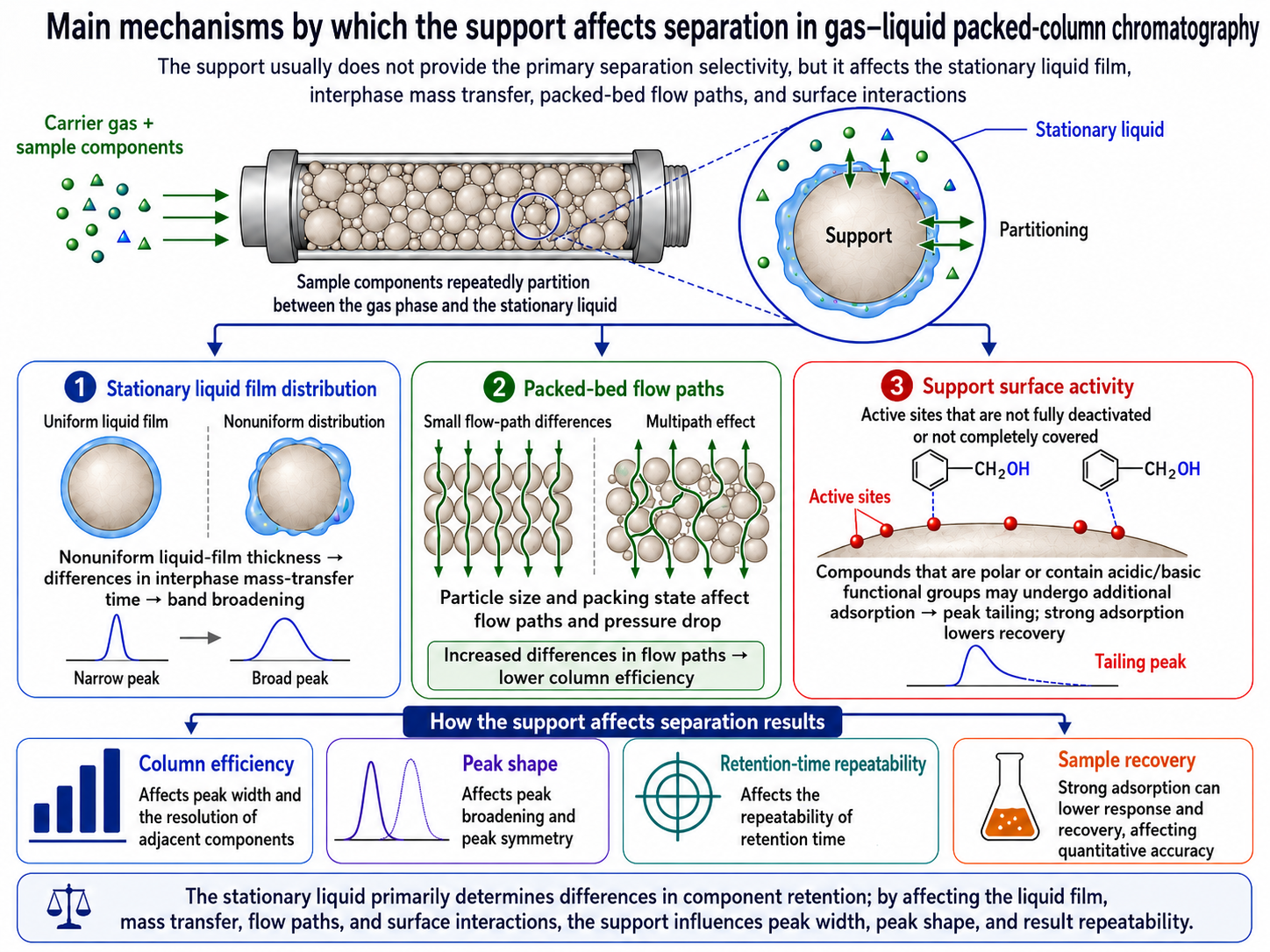
The effects of the support on separation can be summarized in three main aspects.
2.1 The Solid Support Affects Stationary-Liquid Distribution and Mass-Transfer Distance
The stationary liquid needs to form a relatively uniform liquid layer on the surface of the support. Without a suitable solid surface, the stationary liquid can readily accumulate locally, making it difficult to form a stable and continuous separation interface.
The specific surface area, pore structure, and wettability of the support affect the coating behavior of the stationary liquid:
① Surface area and pore structure determine how much stationary liquid the support can disperse and retain;
② Wettability affects whether the stationary liquid can uniformly cover the particle surfaces;
③ Stationary-liquid loading affects liquid-film thickness and column capacity.
For sample components to move from the carrier gas into the stationary liquid and then return from the stationary liquid to the carrier gas, diffusion processes are required. If the stationary liquid is distributed unevenly and the thickness of the liquid layer varies considerably from one location to another, the time required for sample molecules to complete interphase transfer will also vary. Some molecules return to the carrier gas earlier, while others remain in the stationary liquid, causing the chromatographic band to gradually broaden.
When the stationary-liquid loading is too high, the liquid layer becomes thicker and mass transfer within the liquid phase may become slower. When the loading is too low, column capacity decreases, and active sites on the surface of the support may not be sufficiently covered. Therefore, the specific surface area and stationary-liquid loading need to be appropriately matched rather than simply maximized independently.
2.2 Support Particles Determine the Flow Structure of the Packed Bed
After the support particles are introduced into the column tubing, they form a packed bed. The carrier gas flows through the voids between the particles, while sample molecules are transported with the carrier gas along different paths toward the column outlet.
If there are large differences in particle size, or if loose regions, densely packed regions, or voids are present within the column, sample molecules will experience different flow paths and migration velocities. This multipath effect leads to chromatographic band broadening.
Smaller particles with a narrower particle-size distribution generally help to:
① Shorten lateral diffusion distances in the mobile phase and reduce part of the mass-transfer resistance;
② Improve the uniformity of the packed bed;
③ Reduce differences among different flow paths;
④ Increase the separation efficiency provided per unit column length.
However, as particle size decreases, the channels between particles also become narrower, increasing the resistance encountered by the carrier gas as it passes through the packed bed. Classical chromatographic rate theory shows that multipath effects, longitudinal diffusion, and interphase mass-transfer resistance jointly contribute to chromatographic band broadening [2]. Therefore, the selection of support particle size requires a balance between column efficiency and pressure drop.
2.3 The Support Surface May Cause Additional Adsorption
Ideally, the support should have low surface activity toward the sample so that sample retention is controlled primarily by the stationary liquid. However, untreated inorganic support surfaces may contain silanol groups, metallic impurities, and acidic or basic active sites.
These sites may interact with sample components through:
① Hydrogen bonding;
② Acid–base interactions;
③ Dipole interactions;
④ Irreversible or slowly reversible adsorption;
⑤ Surface-catalyzed reactions.
When a sample undergoes additional adsorption on the support surface in addition to partitioning into the stationary liquid, the rates at which different molecules desorb from the surface may differ substantially. Some sample molecules may be released with a delay, resulting in peak tailing, reduced peak area, or poorer repeatability.
Alcohols, amines, organic acids, water, and other polar compounds or compounds with relatively strong surface activity are generally more susceptible to the effects of support-surface activity. Certain compounds with poor thermal stability may also decompose on active surfaces.
Therefore, the influence of the support on chromatographic results is not limited to physical support. Uncontrolled surface interactions can become an additional retention mechanism and alter the original separation behavior.
3 Classification of Chromatographic Solid Supports
Solid supports can be classified according to their base material and surface-treatment status. These two classification dimensions address different aspects:
① The base material determines the pore structure, specific surface area, mechanical properties, and fundamental chemical characteristics;
② Surface treatment determines the impurity content and degree of surface activity.
3.1 Classification by Support Base Material
3.1.1 Diatomaceous Earth Supports
Diatomaceous earth supports are prepared from natural diatomaceous earth through processes such as crushing, sieving, calcination, or flux calcination. They are among the most widely used types of support in packed gas chromatography columns.
Using traditional Chromosorb-series commercial supports as examples, common types include:
Type | Main Characteristics | Considerations During Selection |
P-type diatomaceous earth support | Relatively high surface area and stationary-liquid loading capacity, with good mechanical strength | Without deactivation treatment, adsorption and surface reactions involving polar compounds may be relatively pronounced |
W-type diatomaceous earth support | Flux-calcined, with a lower surface area and relatively weaker surface adsorption | Particles may be relatively fragile, and fines generated by particle breakage can affect pressure drop and column efficiency |
G-type diatomaceous earth support | Lower surface area, with good particle strength and packing characteristics | The amount of stationary liquid that can be supported is generally lower than that of high-surface-area supports |
The commercial names and properties of diatomaceous earth supports are not necessarily equivalent. Even when supports are based on the same material, differences in purification processes, calcination conditions, and surface treatments can lead to differences in specific surface area, loading capacity, and degree of inertness [4][5].
3.1.2 Polytetrafluoroethylene Supports
Polytetrafluoroethylene (Polytetrafluoroethylene, PTFE) supports have relatively low surface activity. With this relatively low surface activity, such supports can be used for certain highly polar components that tend to undergo significant adsorption on silica-based supports.
These supports also have corresponding limitations, including:
① The permissible operating temperature of some products is lower than that of inorganic supports;
② The particles readily accumulate static charge;
③ Packing and transfer can be more difficult;
④ The particles may become compacted under pressure, altering the structure of the packed bed.
Therefore, polytetrafluoroethylene supports are mainly used for specific analyses requiring a high degree of surface inertness. Their operating temperature and column-packing conditions should be determined according to the specifications of the particular product [4].
3.1.3 Other Specialty Supports
Materials such as graphitized carbon black and porous silica gel can also serve as solid supports when coated with a stationary liquid. However, when used without such a coating, these materials often function as adsorbents.
Whether these materials should be classified as “solid supports” or “solid stationary phases” should be determined according to the actual composition of the column packing and the principal retention mechanism, rather than solely on the basis of the material name.
3.2 Classification by Surface-Treatment Status
Treatment Status | Purpose of Treatment | Main Characteristics |
Untreated support | Retain the original surface | Simple processing, but the material may contain relatively high levels of inorganic impurities and active sites |
Acid-washed support | Remove some metallic and mineral impurities | Can reduce adsorption and catalytic effects caused by impurities |
Silanized support | Reduce active sites such as silanol groups | Helps reduce adsorption and peak tailing of polar compounds |
Comprehensively deactivated support | Combine purification, acid washing, silanization, and particle-size control | Generally exhibits lower surface activity and lower batch-to-batch variability, making it suitable for analyses with stringent requirements for peak shape and recovery |
Acid washing is mainly used to remove mineral impurities and metal ions, whereas silanization is primarily used to reduce the activity of silica-based surfaces. These two treatments serve different purposes: acid washing cannot replace silanization, and silanization cannot replace purification of the starting material.
The color of a support can reflect certain traditional manufacturing processes, but it does not directly indicate its degree of inertness. When selecting a product, it is more appropriate to consider factors such as the base material, surface treatment, particle size, specific surface area, and stationary-liquid loading capacity [4][5].
4 How to Select an Appropriate Chromatographic Solid Support
Selection of a support should be considered together with the separation mode, stationary liquid, sample properties, and column conditions. A relatively clear sequence for selection is as follows.
4.1 Confirm the Separation Mode of the Chromatographic Column
First, determine the function of the particles inside the column.
① For gas–liquid packed columns coated with a liquid stationary phase, a solid support is required;
② For gas–solid chromatographic columns packed with molecular sieves, activated carbon, or porous polymers, the primary consideration is the selection of the solid stationary phase or adsorbent;
③ Typical open-tubular capillary columns do not contain particulate supports. The stationary phase is located on the inner wall of the column or attached to a porous layer on the inner wall.
Packed columns are suitable for relatively large sample loads, certain gas analyses, and standard methods that specifically require packed columns. Capillary columns generally provide higher column efficiency and narrower chromatographic peaks [3].
4.2 Determine Surface-Inertness Requirements According to Sample Properties
The more readily a sample undergoes adsorption or surface reactions, the greater the requirement for support inertness generally becomes.
Sample Characteristics | Key Considerations for Support Selection |
Nonpolar or weakly polar compounds | Select a support with appropriate surface area and stationary-liquid loading capacity while taking column capacity into account |
Polar compounds such as alcohols, amines, organic acids, and water | Give priority to acid-washed, silanized, or comprehensively deactivated supports |
Compounds prone to decomposition or catalytic reactions | Pay attention to support purity, metallic impurities, and surface activity |
Trace analytes | Pay attention to low adsorption, recovery, and batch-to-batch consistency |
If peak tailing originates primarily from adsorption on the support surface, simply changing the stationary liquid may not solve the problem. In such cases, the support, column tubing, and solid surfaces in the injection system that come into contact with the sample should also be examined.
4.3 Match the Support Surface Area to the Stationary-Liquid Loading
A larger specific surface area can generally disperse a greater amount of stationary liquid, but it may also introduce more potentially active sites. A lower specific surface area can help reduce contact with the solid surface, but it may limit stationary-liquid loading and column capacity.
The following relationship should be considered during selection:
Stationary-liquid loading
→ determines liquid-film thickness and column capacity
→ needs to be matched with the support surface area and wettability
→ jointly affects mass-transfer rate, peak width, and the degree of surface coverage
Therefore, specific surface area should not be used as an independent indicator of superiority. A suitable support should form a uniform coating at the target stationary-liquid loading while maintaining acceptable surface inertness and mass-transfer efficiency.
4.4 Select Particle Size According to Column Efficiency and Pressure Conditions
Support particle size is commonly expressed as a mesh range. For example, 80/100 mesh indicates particles that can pass through an 80-mesh sieve but are retained by a 100-mesh sieve.
The following principles can be followed when selecting particle size:
① Smaller particles generally help improve column efficiency, but increase pressure drop within the column;
② Larger particles produce lower carrier-gas flow resistance, but mass-transfer distances and differences among flow paths may increase;
③ A narrower particle-size distribution helps form a more uniform packed bed;
④ For columns with smaller internal diameters, correspondingly greater requirements are placed on particle uniformity and packing quality.
The actual particle size also needs to be compatible with the column length, column internal diameter, carrier-gas flow rate, and the gas-supply pressure available from the instrument.
4.5 Check Mechanical Stability, Temperature, and Method Requirements
The support should maintain a stable particle structure during coating, drying, column packing, and operation. Fine particles generated by particle breakage may obstruct local flow paths, increase pressure drop, and expose new active surfaces.
The actual temperature range of a chromatographic column is jointly determined by the stationary liquid, support, column tubing, and connection components. The operating temperature should remain below the most restrictive allowable temperature among the individual components.
For pharmacopoeial methods, national standards, industry standards, or previously validated methods, attention should also be paid to the following parameters: support base material; surface-treatment method; particle-size range; type and loading of the stationary liquid; and the dimensions and material of the column tubing.
Together, these parameters determine chromatographic retention, column efficiency, and peak shape. After replacing the support or changing the particle size, analytical performance should be confirmed through system-suitability testing and method-equivalence evaluation.
5 Classification Tables of Solid Supports and Related Materials and Reagents for Packed Gas Chromatography Columns
Table 1. Solid Supports and Auxiliary Materials for Packed Columns
Category | CAS No. | Aladdin Cat. No. | Name | Specification or Purity | Product Features and Applications |
Flux-Calcined Diatomaceous Earth Material | 68855-54-9 | C141392 | Celite® 535RV Diatomaceous Earth | Filter aid, flux calcined | Features a porous siliceous framework and can be used to study stationary-liquid loading, surface treatment, wettability, and mass transfer in packed beds of flux-calcined diatomaceous earth. Suitable for packed-column support screening and packing-material preparation experiments. |
Diatomaceous Earth Support Material | 61790-53-2 | D304166 | Diatomaceous Earth | Filter aid | Features a naturally porous structure and can be used to study particle-size classification, stationary-liquid loading, surface activity, and packing performance of traditional diatomaceous earth supports. Suitable for evaluating support acid washing, deactivation, and coating conditions. |
Polymer Model and Composite Packing Research Material | 9002-84-0 | Polytetrafluoroethylene (PTFE) | Powder, average particle size: 200 μm | Features low surface energy and chemical resistance and can be used to study low-surface-activity supports, stationary-liquid wetting behavior, and composite packing preparation. Suitable for micron-scale powder dispersion, surface modification, and film-formation experiments. | |
Packed-Column Auxiliary Material | 65997-17-3 | Glass Wool | Reagent grade | Can be used to retain packing material at both ends of a packed column, prevent particle migration, and maintain the position of the packed bed. It can also be used in inlet liners for sample vaporization, droplet dispersion, and experiments involving the trapping of nonvolatile residues. | |
Specialty Inorganic Packing Model Material | 7631-86-9 | Silicon Dioxide | PrimorTrace™ ≥99.99% metals basis, 1–3 mm | Features a mesoporous structure and a large solid–liquid contact interface and can be used to study stationary-liquid loading, intrapore diffusion, silanol surface activity, and silanization deactivation. Suitable for specialty inorganic packing design and mass-transfer mechanism evaluation. |
Table 2. Reagents for Support Surface Treatment and Packing Preparation
Category | CAS No. | Aladdin Cat. No. | Name | Specification or Purity | Product Features and Applications |
Support Acid-Washing Reagent | 7647-01-0 | H485680 | Fuming Hydrochloric Acid, 37% (Regulated Precursor Chemical) | Guaranteed reagent, suitable for analysis, max. 0.001 ppm Hg | Can be used for acid washing and purification of inorganic supports such as diatomaceous earth and silica gel to remove certain metal ions and mineral impurities. Suitable for studies of support surface activity, peak tailing, and optimization of acid-washing conditions. |
Support Acid-Treatment and Oxidation Reagent | 7697-37-2 | N116238 | Nitric Acid (Explosives Precursor) | Guaranteed reagent, 65–68% | Can be used for acid treatment of inorganic supports, removal of metallic impurities, and surface oxidation of carbon materials. Suitable for studies on controlling surface oxygen-containing functional groups, wettability, and adsorption properties. |
Support Silanization Reagent | 75-78-5 | D104810 | Dimethyldichlorosilane | ≥98.5% (GC) | Can react with silanol groups on siliceous surfaces to reduce the polar activity of diatomaceous earth, silica gel, and glass surfaces. Suitable for deactivation of acid-washed supports, stationary-liquid coating, and studies on controlling peak tailing of polar compounds. |
Support Silanization Reagent | 75-77-4 | Trimethylchlorosilane (TMCS) | ≥99% (GC) | Can cap silanol groups on the surfaces of siliceous materials, reducing surface polarity and moisture adsorption. Suitable for hydrophobization and surface-deactivation experiments involving supports, glass wool, and glassware. | |
Support Silanization Reagent | 999-97-3 | H475794 | Hexamethyldisilazane | ≥99.9% | Can be used for silanization treatment of siliceous supports and glass surfaces to reduce hydrogen-bonding and acid–base interactions caused by silanol groups. Suitable for studies of surface inertness, wettability, and adsorption behavior. |
Stationary-Liquid Coating Solvent | 67-64-1 | A399711 | Acetone (Regulated Precursor Chemical) | UltraPureChrom™, HPLC grade, for HPLC, ≥99.9% | Features a relatively high evaporation rate and can be used for cleaning supports and laboratory vessels, preparing certain stationary-liquid coating solutions, and evaporation-induced film-formation experiments. Suitable for studies of coating uniformity and drying conditions. |
Stationary-Liquid Coating Solvent | 67-66-3 | C1519947 | Chloroform (Regulated Precursor Chemical) | Column chromatography eluent grade | Capable of dissolving a variety of nonpolar and moderately polar organic stationary liquids. Can be used for stationary-liquid coating, packing impregnation, and liquid-film formation experiments. Suitable for studies of coating concentration and stationary-liquid loading. |
Stationary-Liquid Coating Solvent | 75-09-2 | D1519839 | Dichloromethane | Column chromatography eluent grade | Provides good solubility for organic compounds and a relatively high evaporation rate. Can be used to prepare stationary-liquid coating solutions, homogenize supports, and remove solvents. Suitable for thin liquid-film preparation studies. |
Stationary-Liquid Coating Solvent | 108-88-3 | T1519906 | Toluene (Regulated Precursor Chemical) | Column chromatography eluent grade | Can be used to dissolve and dilute siloxane-based and hydrophobic stationary liquids. Suitable for studies of high-viscosity stationary-liquid coating, support impregnation, liquid-film homogenization, and solvent-evaporation processes. |
Stationary-Liquid Coating Solvent | 67-56-1 | Methanol | Column chromatography eluent grade | Highly polar and can be used with certain polyether stationary-liquid systems, for support cleaning, and for washing after surface treatment. Suitable for studies of polar coating systems and residual-solvent control. | |
Stationary-Liquid Coating Solvent | 110-54-3 | H431436 | Hexane, 98.5% | UltraPureChrom™, for HPLC plus | A nonpolar solvent that can be used to dilute and coat hydrophobic stationary liquids such as squalane and silicone oil and to impregnate supports. Suitable for studies of nonpolar liquid-phase loading and evaporation-induced film-formation conditions. |
Table 3. Representative Materials Related to Liquid Stationary Phases
Category | CAS No. | Aladdin Cat. No. | Name | Specification or Purity | Product Features and Applications |
Polyether-Type Polar Stationary Phase | 25322-68-3 | Polyethylene Oxide | Viscosity 65–115 cps | The polyether chain contains ether oxygen groups and can be used to study polar stationary-liquid coating, stationary-liquid loading, liquid-film viscosity, and liquid-phase mass transfer. Suitable for evaluating the partition behavior of oxygen-containing compounds and polar volatile compounds. | |
Siloxane-Type Stationary Phase | 63148-62-9 | Silicone Oil | Viscosity 10,000 cSt (25°C) | Features a polysiloxane structure and relatively high viscosity and can be used as a model for nonpolar to weakly polar stationary liquids and for studies of coating-film thickness, liquid-film stability, and stationary-phase bleed. Suitable for partition experiments involving hydrocarbons and aromatic compounds. | |
Hydrocarbon-Type Nonpolar Stationary Phase | 111-01-3 | Squalane | ≥98% | Its saturated hydrocarbon structure gives it nonpolar characteristics. It is a representative nonpolar stationary liquid in gas–liquid chromatography and can be used to study retention, partitioning, and selectivity of hydrocarbons, homologous series, and nonpolar volatile compounds. |
Table 4. Solid Adsorbents and Related Packing Materials
Category | CAS No. | Aladdin Cat. No. | Name | Specification or Purity | Product Features and Applications |
Inorganic Solid Adsorbent | 1344-28-1 | Activated Alumina Balls | General-purpose, for use as an adsorbent, particle size 1–3 mm | The surface contains polar adsorption sites and can be used for adsorption studies involving moisture, polar impurities, and certain volatile components. Suitable for adsorption beds, gas purification, and gas–solid chromatographic adsorption-mechanism experiments. | |
Mesoporous Carbon Adsorbent Material | 1333-86-4 | Carbon, Mesoporous | ≥99.95% metals basis, average pore diameter 100 ± 10 Å (typical) | Features a mesoporous structure, low metallic impurity content, and a carbonaceous surface. Can be used for studies of volatile organic compound adsorption, pore-size effects, gas enrichment, and the development of carbon-based packing materials. | |
Drying Adsorbent Material | 112926-00-8 | S743367 | Indicating Silica Gel Desiccant | Reagent grade | Can be used to monitor the dryness of storage environments for supports, packing materials, stationary liquids, and solvents, thereby reducing the effects of moisture on support surface activity and the peak shapes of polar components. Suitable for dry-storage and moisture-uptake control experiments. |
Molecular-Sieve Adsorbent Material | 1318-02-1 | Synthetic Zeolite | Particle size ≤10.0 μm | Features regular micropores and molecular-sieving characteristics and can be used for selective adsorption studies of permanent gases, small-molecule compounds, and moisture. Suitable for studies of pore-size selectivity, micropore mass transfer, and the development of composite molecular-sieve packing materials. | |
Carbonaceous Solid Adsorbent | 64365-11-3 | Activated Carbon | PharmPure™, ChP | Features a well-developed pore structure and a large adsorption interface and can be used for gas purification, volatile organic compound enrichment, and adsorption-bed experiments. Suitable for evaluating retention, desorption, and surface activity in gas–solid chromatography. | |
Crosslinked Polymer Particulate Material | 9003-70-7 | Polystyrene Resin | 100–200 mesh, 1% DVB | Features a crosslinked polystyrene particulate structure and a defined particle-size range. Can be used to study packed-bed packing, hydrophobic adsorption, swelling behavior, and the effects of crosslinking degree. Suitable for the development of porous-polymer chromatographic packing materials. |
Note: The products listed above are representative Aladdin products relevant to scientific research. Some are suitable only as raw materials, model materials, or auxiliary materials for the preparation of supports, stationary liquids, or adsorbent packings and are not finished GC packing materials or GC-specific stationary phases that have been validated for particle size, surface inertness, thermal stability, and chromatographic performance. Whether a product can be used directly in an analytical packed GC column should be determined based on its specifications, particle size and morphology, surface treatment, batch-specific COA, and method-validation results. Additional product specifications, grades, and COA information can be searched on the Aladdin website using the product name, CAS number, or catalog number.
References
[1] INTERNATIONAL UNION OF PURE AND APPLIED CHEMISTRY. Compendium of Chemical Terminology: Gold Book. 5th ed. Terms: Solid Support, Gas-Liquid Chromatography, Gas-Solid Chromatography, 2025.
[2] VAN DEEMTER J J, ZUIDERWEG F J, KLINKENBERG A. Longitudinal diffusion and resistance to mass transfer as causes of nonideality in chromatography[J]. Chemical Engineering Science, 1956, 5(6): 271-289.
[3] SHIMADZU CORPORATION. GC Column Types & Selection Guide[EB/OL].
[4] AGILENT TECHNOLOGIES. Chromosorb—Properties of the Most Used Support Material in Packed GC[EB/OL].
[5] RESTEK CORPORATION. A Brief Description of Several Common Solid Supports for Restek GC Packed Columns[EB/OL]. 2023-11-07.
More related articles are provided below:
HPLC-Grade Solvents for High-Performance Liquid Chromatography: From Concept to Practice
From Analyte to Chromatogram: Selecting “For HPLC Derivatization” Reagents
For Preparative Chromatography — A Detailed Guide
Ion-Pair Chromatography Grade: Definition and Practical Use
The Role of Chromatography Standard Grade Reagents in HPLC, GC, and Beyond