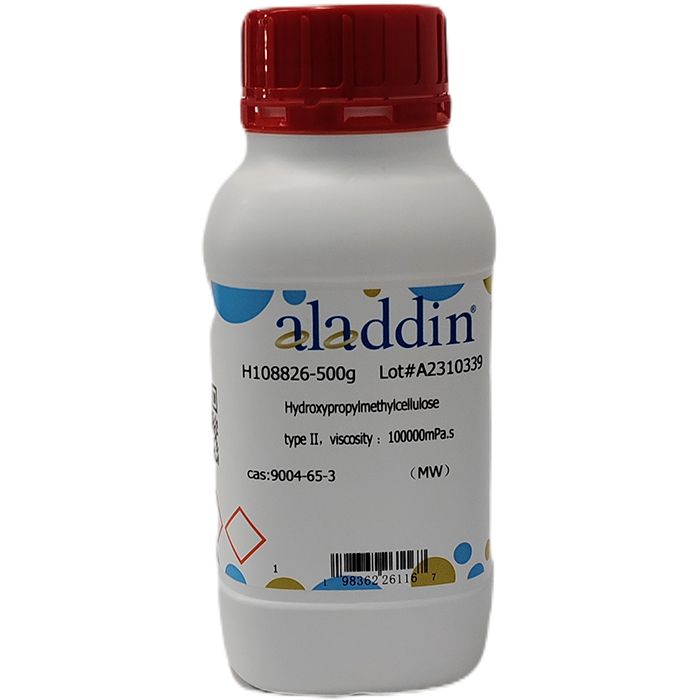
Hidroxipropilmetilcelulosa - tipo II,viscosidad :100000mPa.s , CAS No.9004-65-3

CAS: 9004-65-3 Cat. No.: H108826 Número EC: 618-389-6 PubChem CID: 206257985
Disponible para pedir
CALIDAD & PUREZA Substitution type 2208, viscosity: 100000mPa. s, methoxy group: 19-24%; Hydroxypropyl group: 4.0-12%
Synonyms
HPMC MHPC Hydroxypropyl Methyl Cellulose
Storage
Temperatura ambiente
Shipped In
Normal
★
Talla
Alemania (EU)
USA*
Precio
Cantidad
25g
H108826-25g
—
1 Disponible
8,59€
100g
H108826-100g
—
3 Disponible

21,61€

25,95€
Guardar 4,34 € (16.72%)
500g
H108826-500g
5 Disponible
Disponible ≥10

63,26€

86,69€
Guardar 23,43 € (27.03%)
Enter a quantity for the sizes you want to add.

Descripción general

la (hidroxipropil)metilcelulosa (HPMC) es un polímero hidrosoluble derivado de la celulosa. Este polisacárido forma coloides cuando se disuelve en agua. La HPMC es un hidrocoloide producido artificialmente a partir de sustancias naturales. Consta de un 28-30% de contenido de metoxilo y un 7-12% de contenido de hidroxipropoxilo.

Aplicación:

la (hidroxipropil)metilcelulosa (HPMC) se ha utilizado
como modificador de la viscosidad en la preparación de tinta imprimible
como viscosificador en la preparación de suspensión de hidroxiapatita (HAP)
en la preparación de geles y geles compuestos de HPMC
Espesante para sistemas acuosos y no acuosos, películas transparentes con resistencia a la grasa, aglutinantes, lubricantes, estabilizador estérico y ayuda a la retención de agua.

Especificaciones

Sinónimos
HPMC MHPC Hydroxypropyl Methyl Cellulose
Especificaciones y pureza
tipo II,viscosidad :100000mPa.s
Mecanismos bioquímicos y fisiológicos
(Hydroxypropyl)methylcelluloses (HPMCs) act as suspension aids, surfactants, lubricants, protective colloids, and emulsifiers. Additionally, solutions of these polymers show thermal gelation properties. They are generally used as binders, thickeners, film formers, and water retention agents. HPMC also elicits surface-active properties.
Condiciones de almacenamiento de almacenamiento
Temperatura ambiente
Enviado en
Normal
Nombres e identificadores
Pubchem Sid
Pubchem Sid Url
https://pubchem.ncbi.nlm.nih.gov/substance/508815931
WGK Alemania
1
PubChem CID
206257985

Datos avanzados

Certificados (CoA, COO, BSE/TSE y tabla de análisis)
C of A & Other Certificates(BSE/TSE, COO):
Analytical Chart:

Find and download the COA for your product by matching the lot number on the packaging.

29 results found

Lot NumberCertificate TypeFechaArticulo
A2310338A2310338Certificate of AnalysisSep 22, 2026 H108826
A2310339A2310339Certificate of AnalysisSep 22, 2026 H108826
C2627436C2627436Certificate of AnalysisFeb 03, 2026 H108826
C2627433C2627433Certificate of AnalysisFeb 03, 2026 H108826
B2625591B2625591Certificate of AnalysisFeb 03, 2026 H108826
B2625592B2625592Certificate of AnalysisFeb 03, 2026 H108826
C2603647C2603647Certificate of AnalysisFeb 03, 2026 H108826
C2627427C2627427Certificate of AnalysisFeb 03, 2026 H108826
C2627430C2627430Certificate of AnalysisFeb 03, 2026 H108826
H2512294H2512294Certificate of AnalysisJun 07, 2025 H108826
H2512295H2512295Certificate of AnalysisJun 07, 2025 H108826
H2512497H2512497Certificate of AnalysisJun 07, 2025 H108826
L2511094L2511094Certificate of AnalysisJun 07, 2025 H108826
L2423207L2423207Certificate of AnalysisDec 09, 2024 H108826
L2423208L2423208Certificate of AnalysisDec 09, 2024 H108826
L2423209L2423209Certificate of AnalysisDec 09, 2024 H108826
D2416301D2416301Certificate of AnalysisMar 14, 2024 H108826
H2321123H2321123Certificate of AnalysisNov 08, 2022 H108826
E2414025E2414025Certificate of AnalysisNov 08, 2022 H108826
D2507112D2507112Certificate of AnalysisNov 08, 2022 H108826
A2310328A2310328Certificate of AnalysisNov 08, 2022 H108826
A2310327A2310327Certificate of AnalysisNov 08, 2022 H108826
F2426235F2426235Certificate of AnalysisJul 28, 2022 H108826
I2202602I2202602Certificate of AnalysisJul 28, 2022 H108826
I2202637I2202637Certificate of AnalysisJul 28, 2022 H108826
I2405066I2405066Certificate of AnalysisJul 28, 2022 H108826
A2206761A2206761Certificate of AnalysisDec 13, 2021 H108826
A2206841A2206841Certificate of AnalysisDec 13, 2021 H108826
A2206768A2206768Certificate of AnalysisDec 13, 2021 H108826
Seguridad y peligros (GHS)
WGK Alemania
1
Preguntas frecuentes y artículos
A Practical Guide to Fragrance Compositions: Turning a Black-Box Formula into an Engineerable System—Compatibility, Stability, Controlled Release, Traceability, and Selection
Microcrystalline Cellulose (MCC): A Comprehensive Primer and Selection Guide—Structural Features, Key Performance Metrics, and Application Scenarios
Understanding Hydrophilic Polymers in Aqueous Systems: Hydration Mechanisms, Structural Knobs, and Task-Oriented Selection Guide (Including Tables 1–3)
Biomedical Polymer Insights: Role-Based Task Map, Six Key Material Levers, and a Risk-Driven Evidence Chain (including the Product Navigation Guide and Product Tables 1–3)
Functional Framework of Starch Metabolism-Related Enzymes in Food Science Research and Mechanistic Analysis of Quality Regulation
Injectable Thermosensitive Gels: Gelation Behavior, Rheological Properties, and Drug Release Characteristics
Waterborne Resin Technology Explained: Waterborne Forms, Performance Balance, and a Technology Map
Waterborne Resin Application Guide: Formulation Synergy, Troubleshooting, and Technology Development Trends
Why LABSA (Sulfonic Acid) Is Commonly Used in Household Cleaning Formulations: Neutralization Mechanism, Detergency Action, and Formulation Application Points
From Structure to Performance: Conditioning, Film-Forming, Thickening, and Chelating Applications of Functional Ingredients in Personal Care and Home Care
From Structure to Rheology: How Carbomer Forms Gel Structures and Enables Thickening, Suspension, and Auxiliary Emulsion Stabilization
Thickening, Suspension, Auxiliary Stabilization, and Agglomeration Mechanisms of Xanthan Gum in Personal Care Formulations: From Molecular Structure to Processing Applications
From Structure to Rheology: Thickening, Stabilization, and Selection Logic of Cellulose Ethers for Personal Care Applications
Structure, Properties, and Mechanisms of Powdered Fragrances and Fragrance Delivery Materials: Stability, Release Mechanisms, and Selection Logic
Analysis of the Production Process of Hydroxypropyl Methylcellulose (HPMC) for Putty: Understanding Differences in Substitution Structure and Gelation Temperature from High-Ratio and Low-Ratio Formulations
Why Are Daily Chemical Products Prone to Viscosity Thinning in Summer? Core Mechanisms, Troubleshooting Methods, and Solutions
Types, Mechanisms of Action, Key Quality Indicators, and Selection and Application of Common Cellulose Ethers in Wall Putty
Influencing Factors and Control Strategies for Blistering in Neutral Wall Putty: An Experimental Analysis Based on HPMC Dosage, Viscosity, and Ground Calcium Carbonate Fineness
How to Select Binding/Gel Materials for Neutral Wall Putty? A Comparison of Pregelatinized Starch, PVA, and Redispersible Polymer Powder Based on Four Application Trials
Causes and Mechanism Analysis of Delamination During Sanding of Water-Resistant Putty
What Are the Differences Between Polyvinyl Alcohol 1788, 2488, and 2699? Understanding Workability, Bonding Strength, and Relative Water Resistance from the Perspective of Degree of Polymerization and Degree of Hydrolysis
Why Do Rust Spots Appear on Neutral Wall Putty? Iron Sources, Moisture Migration, Oxidative Color Development, and Prevention Measures
Common Problems and Formulation Adjustment Strategies for Neutral Putty Under High Summer Temperatures
Differences and Application Selection of Cassava- and Corn-Based Pregelatinized Starch in Neutral Putty Formulations
The Role, Selection, Cracking Risk Analysis, and Dosage Control of Bentonite in Neutral Putty
What Is Direct Compression? Process Characteristics, Suitability Criteria, and Excipient Selection
Niacinamide Brightening Mechanisms and Formulation Design: Melanosome Transfer, pH Regulation, and Combination Strategies
Citations of This Product
Calculadoras de soluciones
Reseñas

Reseñas de cliente

¿Quieres que te enviemos un mensaje cuando tengamos descuentos disponibles?

Recordármelo más tarde

¡Gracias! Por favor, revisa tu bandeja de entrada de correo electrónico para confirmar.

¡Vaya! Las notificaciones están desactivadas.