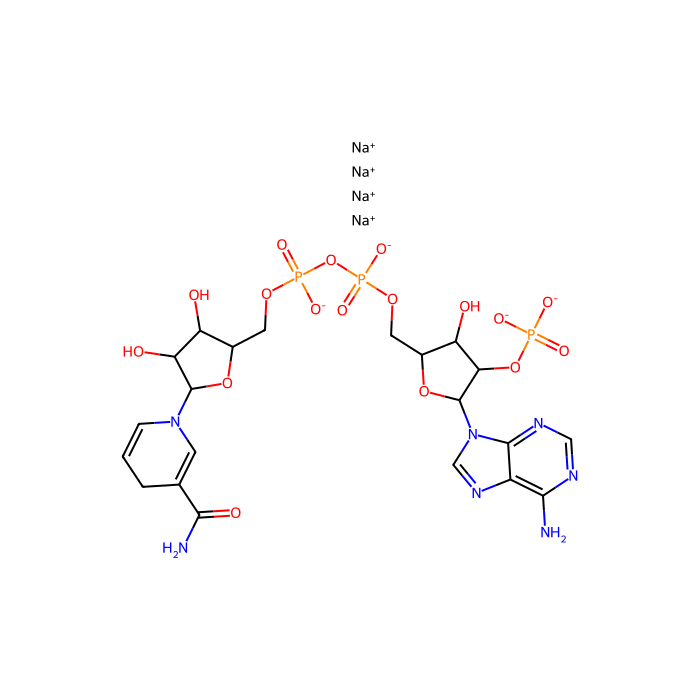
NADPH - ≥93% , CAS No.2646-71-1

CAS: 2646-71-1 Cat. No.: N276326 Fórmula: C21H26N7Na4O17P3 · xH2O Peso molecular: 833.35 (anhydrous basis) Número EC: 220-163-3
Disponible para pedir
GRADE & PURITY ≥93%
Synonyms
NADPH Na4 | TPNH2 Na4 | AS-10522 | C21H26N7O17P3Na4 | A-NADPH | HB4469 | C74369 | MFCD00036263 | Beta-Nicotinamida adenina dinucleótido fosfato reducido sal tetrasódica | NADPH sal tetrasódica (forma reducida) | Dihidronicotinamida-adenina dinucleótido p
Storage
Protegido de la luz,Almacenar a -20°C,Desecado
Shipped In
Hielera + almohadillas de hielo
★
Size
Alemania (EU)
USA*
Price
Qty
50mg
N276326-50mg
—
4 Disponible
22,47€
100mg
N276326-100mg
—
4 Disponible
37,23€
250mg
N276326-250mg
—
Disponible ≥10
78,01€
Enter a quantity for the sizes you want to add.
🧪
Why this grade

≥93% for sensitive chromatographic and analytical workflows requiring minimal baseline interference.

🌡

Storage & shipping

Protegido de la luz,Almacenar a -20°C,Desecado Ships Hielera + almohadillas de hielo Check lot-specific COA for exact specifications.

📋

Quality documents

SDS, COA, datasheet, and spec sheet available for download. Lot-specific COA accessible via lot number lookup.

📚

Literature proof

Cited in 92 peer-reviewed publications across chromatography, organic synthesis, and cross-coupling reactions.

Descripción general

Conservar a -20°C. Es importante tener en cuenta que este producto es sensible a la luz. Almacenar en la oscuridad. Almacenar en condiciones de desecación.

Specifications

Sinónimos
NADPH Na4 | TPNH2 Na4 | AS-10522 | C21H26N7O17P3Na4 | A-NADPH | HB4469 | C74369 | MFCD00036263 | Beta-Nicotinamida adenina dinucleótido fosfato reducido sal tetrasódica | NADPH sal tetrasódica (forma reducida) | Dihidronicotinamida-adenina dinucleótido p
Especificaciones y pureza
≥93%
Mecanismos bioquímicos y fisiológicos
Coenzima ubicua y agente reductor biológico que actúa como donante de electrones para muchas enzimas redox, incluida la óxido nítrico sintetasa. Se genera por reducción del aceptor de electrones NADP+.
Condiciones de almacenamiento de almacenamiento
Protegido de la luz,Almacenar a -20°C,Desecado
Enviado en
Hielera + almohadillas de hielo
Tipo de acción
INHIBITOR
Nota
Siempre que sea posible, prepare y utilice las soluciones el mismo día. Sin embargo, si necesita preparar soluciones madre con antelación, le recomendamos que almacene la solución como alícuotas en viales herméticamente cerrados a -20°C. Por lo general, podrán utilizarse durante un mes. Antes de su uso, y antes de abrir el vial, le recomendamos que deje que el producto se equilibre a temperatura ambiente durante al menos 1 hora. ¿Necesita más consejos sobre solubilidad, uso y manipulación? Visite nuestra página de preguntas frecuentes (FAQ) para obtener más información.
Pureza
≥93%
Nombres e identificadores
Pubchem Sid
Pubchem Sid Url
https://pubchem.ncbi.nlm.nih.gov/substance/488201525
Sonrisas canónicas
[Na+].[Na+].[Na+].[Na+].NC(=O)C1=CN(C=CC1)[C@H]2O[C@@H](COP([O-])(=O)OP([O-])(=O)OC[C@H]3O[C@H]([C@H](OP([O-])([O-])=O)[C@@H]3O)n4cnc5c(N)ncnc45)[C@H](O)[C@@H]2O
IUPAC Name
tetrasodium;[(2R,3R,4R,5R)-2-(6-aminopurin-9-yl)-5-[[[[(2R,3S,4R,5R)-5-(3-carbamoyl-4H-pyridin-1-yl)-3,4-dihydroxyoxolan-2-yl]methoxy-oxidophosphoryl]oxy-oxidophosphoryl]oxymethyl]-4-hydroxyoxolan-3-yl] phosphate
InChIKey
WYWWVJHQDVCHKF-ITGWJZMWSA-J
INCHI
1S/C21H30N7O17P3.4Na/c22-17-12-19(25-7-24-17)28(8-26-12)21-16(44-46(33,34)35)14(30)11(43-21)6-41-48(38,39)45-47(36,37)40-5-10-13(29)15(31)20(42-10)27-3-1-2-9(4-27)18(23)32;;;;/h1,3-4,7-8,10-11,13-16,20-21,29-31H,2,5-6H2,(H2,23,32)(H,36,37)(H,38,39)(H2,22,24,25)(H2,33,34,35);;;;/q;4*+1/p-4/t10-,11-,13-,14-,15-,16-,20-,21-;;;;/m1..../s1
Isómeros SMILES
C1C=CN(C=C1C(=O)N)[C@H]2[C@@H]([C@@H]([C@H](O2)COP(=O)([O-])OP(=O)([O-])OC[C@@H]3[C@H]([C@H]([C@@H](O3)N4C=NC5=C(N=CN=C54)N)OP(=O)([O-])[O-])O)O)O.[Na+].[Na+].[Na+].[Na+]
Peso molecular
833.35 (anhydrous basis)

Documentation

📋 Safety Data Sheet (SDS)

Comprehensive hazard, handling, storage, and regulatory compliance document.

Download SDS →

✅ Certificate of Analysis (COA)

Lot-specific quality data. Enter your lot number to retrieve the exact COA.

Look up COA →

📊 Datasheet

Quick-reference summary of product specifications and applications.

View datasheet →

🔬 Specification Sheet

Full quality attributes and acceptance criteria for this grade.

View spec sheet →

Advanced Data

Taxonomic Classification

Taxonomy Tree

KingdomOrganic compounds
SuperclassNucleosides, nucleotides, and analogues
Clase(5'->5')-dinucleotides
SubclassNot available
Intermediate Tree Nodes Not available
Direct Parent(5'->5')-dinucleotides
Alternative Parents Purine nucleotide sugars  Purine ribonucleoside diphosphates  Purine ribonucleoside 2',5'-bisphosphates  Nicotinamide nucleotides  Pentose phosphates  Glycosylamines  Monosaccharide phosphates  6-aminopurines  N-substituted nicotinamides  Organic pyrophosphates  Aminopyrimidines and derivatives  Dihydropyridines  Alkyl phosphates  Imidolactams  N-substituted imidazoles  Heteroaromatic compounds  Vinylogous amides  Oxolanes  Primary carboxylic acid amides  Secondary alcohols  Amino acids and derivatives  Enamines  Oxacyclic compounds  Azacyclic compounds  Organic oxides  Hydrocarbon derivatives  Organic zwitterions  Carbonyl compounds  Primary amines  Organic sodium salts  
Molecular FrameworkAromatic heteropolycyclic compounds
Substituents (5'->5')-dinucleotide - Purine nucleotide sugar - Purine ribonucleoside 2',5'-bisphosphate - Purine ribonucleoside bisphosphate - Purine ribonucleoside diphosphate - Nicotinamide-nucleotide - Pentose phosphate - Pentose-5-phosphate - Glycosyl compound - N-glycosyl compound - 6-aminopurine - Monosaccharide phosphate - N-substituted nicotinamide - Organic pyrophosphate - Imidazopyrimidine - Purine - Aminopyrimidine - Dihydropyridine - Imidolactam - Alkyl phosphate - Hydropyridine - Pyrimidine - Monosaccharide - N-substituted imidazole - Organic phosphoric acid derivative - Phosphoric acid ester - Vinylogous amide - Azole - Imidazole - Heteroaromatic compound - Oxolane - Carboxamide group - Primary carboxylic acid amide - Secondary alcohol - Amino acid or derivatives - Organoheterocyclic compound - Carboxylic acid derivative - Enamine - Organic alkali metal salt - Azacycle - Oxacycle - Alcohol - Organic zwitterion - Organic sodium salt - Organic salt - Organic oxygen compound - Primary amine - Carbonyl group - Organic oxide - Organooxygen compound - Amine - Organic nitrogen compound - Organonitrogen compound - Hydrocarbon derivative - Aromatic heteropolycyclic compound
DescripciónThis compound belongs to the class of organic compounds known as (5'->5')-dinucleotides. These are dinucleotides where the two bases are connected via a (5'->5')-phosphodiester linkage.
External Descriptors Not available
Estructura 3D
Modelo de Estructura Química Interactiva


Mecanismos de acción
Certificados (CoA, COO, BSE/TSE y tabla de análisis)
C of A & Other Certificates(BSE/TSE, COO):
Analytical Chart:

Find and download the COA for your product by matching the lot number on the packaging.

37 results found

Lot NumberCertificate TypeFechaArticulo
G2615099Certificate of AnalysisJul 31, 2026 N276326
C2613390Certificate of AnalysisMar 17, 2026 N276326
C2613386Certificate of AnalysisMar 17, 2026 N276326
C2613387Certificate of AnalysisMar 17, 2026 N276326
C2603036Certificate of AnalysisMar 11, 2026 N276326
F2528107Certificate of AnalysisMar 09, 2026 N276326
B2628181Certificate of AnalysisMar 07, 2026 N276326
G2423030Certificate of AnalysisMay 09, 2025 N276326
G2419065Certificate of AnalysisMay 09, 2025 N276326
G2419064Certificate of AnalysisMay 09, 2025 N276326
K2309008Certificate of AnalysisApr 18, 2025 N276326
G2403036Certificate of AnalysisApr 08, 2025 N276326
D2415019Certificate of AnalysisJan 09, 2025 N276326
A2305301Certificate of AnalysisDec 17, 2024 N276326
D2327021Certificate of AnalysisNov 13, 2024 N276326
D2327022Certificate of AnalysisNov 13, 2024 N276326
I2424105Certificate of AnalysisOct 09, 2024 N276326
H2331025Certificate of AnalysisJun 19, 2024 N276326
F2413087Certificate of AnalysisJun 18, 2024 N276326
F2404214Certificate of AnalysisJun 05, 2024 N276326
F2404215Certificate of AnalysisJun 05, 2024 N276326
F2404216Certificate of AnalysisJun 05, 2024 N276326
D2415018Certificate of AnalysisApr 19, 2024 N276326
D2415020Certificate of AnalysisApr 19, 2024 N276326
L2306104Certificate of AnalysisDec 08, 2023 N276326
J2316011Certificate of AnalysisOct 25, 2023 N276326
H2331024Certificate of AnalysisSep 07, 2023 N276326
D2327019Certificate of AnalysisMay 02, 2023 N276326
D2327018Certificate of AnalysisMay 02, 2023 N276326
D2327020Certificate of AnalysisApr 29, 2023 N276326
A2305299Certificate of AnalysisJan 12, 2023 N276326
A2305352Certificate of AnalysisJan 12, 2023 N276326
A2305351Certificate of AnalysisJan 12, 2023 N276326
J2220037Certificate of AnalysisNov 03, 2022 N276326
J2220038Certificate of AnalysisNov 03, 2022 N276326
C2212546Certificate of AnalysisJun 01, 2022 N276326
C2212542Certificate of AnalysisJun 01, 2022 N276326
Propiedades químicas y físicas
Solubilidad10 mM NaOH: soluble 50 mg/mL, clear
Sensibilidadlight sensitive;Heat sensitive
Peso molecular833.300 g/mol
XLogP3
Hydrogen Bond Donor Count5
Hydrogen Bond Acceptor Count22
Rotatable Bond Count12
Exact Mass833.019 Da
Monoisotopic Mass833.019 Da
Topological Polar Surface Area375.000 Ų
Heavy Atom Count52
Formal Charge0
Complexity1380.000
Isotope Atom Count0
Defined Atom Stereocenter Count8
Undefined Atom Stereocenter Count0
Defined Bond Stereocenter Count0
Undefined Bond Stereocenter Count0
The total count of all stereochemical bonds0
Covalently-Bonded Unit Count5
Preguntas frecuentes y artículos
Alcohol dehydrogenase (ADH)
NADH vs NADPH: Homologous coenzymes with distinct functional specialization
Small-Molecule Inhibitors: A Practical Guide for Research Selection — A Minimal Evidence Chain and Scenario-Based Validation Framework (Including a Selection Matrix, Case Cards, and Product Tables 1–4)
Niacin (Vitamin B3): Structural Features, Metabolic Roles, and Application Landscape
CCK-8 (WST-8) Colorimetric Cell Viability Assay: Principles, Experimental Design, and Typical Applications
Vitamins, Coenzymes, and Enzymes: A Metabolic Synergy Network and Its Disease Associations
NAD (Nicotinamide Adenine Dinucleotide): From a Metabolic Coenzyme to Homeostatic Regulation and Application Targets
Functions and Significance of Common Physiological and Biochemical Indices in Animals and Plants
Diaphorase: NAD(P)H-Dependent Electron-Transfer Activity and Its Applications in Detection and Research
Glutathione Reductase: A Flavin-Dependent Reductive System Maintaining GSH/GSSG Homeostasis, with Assays and Applications
Glucose Content Determination: A Systematic Review of Detection Principles, Method Validation, and Research Application Frameworks
A Panoramic Guide to Purines and Research Reagent Selection: Structural Hierarchy, Classification Map, Three Metabolic Pathways, and Typical Applications
Pyridine Research Selection Roadmap: Structural Features, Reaction Logic, and a Classification Navigator for Reagents/Building Blocks/Reference Standards (Tables 1–6)
Review of Glucose-6-phosphate Dehydrogenase (G6PD): Structural Features, Metabolic Functions, and Research Applications
Cellular Electron Transfer Networks and Mechanisms of Metabolism-Signaling Coupling
Roles of One-Carbon Metabolism Enzymes in Oxidative Stress and Epigenetic Regulation in Cardiovascular Diseases
Galactose-Related Precursor Conversion and Redox Regulation in Plant Ascorbate Biosynthesis
Coupling Mechanisms Between Terminal Reducing-Power Allocation in Photosynthetic Electron Transport and Metabolic Demand
Research Progress on the Moonlighting Functions of Carbohydrate-Metabolic Enzymes in Replication Programs, DNA Damage Repair, and Inflammatory Activation
Why Do Cancer Cells Synthesize Their Own Fatty Acids? From the De Novo Fatty Acid Synthesis Pathway to Experimental Assessment
Enzymatic Hydroxylation Mechanism of Salicylate Conversion to Catechol
What Is Synthetic Biology? The Industrialization Pathway from Upstream Reagent Toolchains to Biomanufacturing Applications
Experimental Evaluation of PGI, HK, PFK, and G6PDH in Glycolysis and Pentose Phosphate Pathway Branching Analysis
Regulation of Glycolytic Rate-Limiting Enzymes: Functional Comparison of Hexokinase, Phosphofructokinase, and Pyruvate Kinase
The Sebum-Regulating Potential of Zinc PCA and Its Relationship with Stratum Corneum Hydration
Design Logic of Fluorinated 3,3-Disubstituted Oxetane Building Blocks: Structural Construction and Modulation of Amine Basicity, Lipophilicity, and Metabolic Stability
1,8-Naphthyridine-Based Aldose Reductase Inhibitors: Scaffold Construction, In Vitro Inhibitory Activity, and Directions for Structural Optimization
Structural Characteristics of Ergothioneine, OCTN1-Mediated Uptake by Skin Cells, and Antioxidant Mechanisms
Structural and Functional Differences Between Idebenone and Coenzyme Q10: From Side-Chain Structure to Redox Cycling and Mitochondrial Electron Transport
Regio- and Stereoselectivity in Monolignol Oxidative Coupling: Single-Electron Oxidation, Radical Coupling, and Dirigent Proteins
Citations of This Product
Calculadoras de soluciones
Reseñas

Reseñas de cliente

Shall we send you a message when we have discounts available?

Remind me later

Thank you! Please check your email inbox to confirm.

Oops! Notifications are disabled.