Recombinant DDIT3 Antibody - Anticuerpo primario, specific to DDIT3, Rabbit IgG

Cat. No.: Ab099377
Disponible para pedir
GRADE & PURITY Recombinant ? Recombinant — produced via recombinant expression for defined sequence and consistency. Use for reproducible, animal-free proteins of known origin. ExactAb™ ? ExactAb™ — Aladdin's antibody line emphasizing precision and validated quality. Use for reliable, specificity-validated antibody applications. Validated ? Validated grade — performance confirmed in defined applications before release. Use when you want documented assurance the reagent works as stated. 0.3 mg/mL
Application
IHC, WB
Host species
Conejo
Reactive species
consejo, Humano, Ratón
Isotype
Rabbit IgG
Conjugation
Unconjugated
★
Size
Alemania (EU)
USA*
Price
Qty
10μl
Ab099377-10μl
—
7 Disponible
86,69€
50μl
Ab099377-50μl
—
1 Disponible
225,53€
100μl
Ab099377-100μl
Fabricado bajo pedido · 8–12 semanas
364,36€
1ml
Ab099377-1ml
Fabricado bajo pedido · 8–12 semanas
2.950,23€
Enter a quantity for the sizes you want to add.
🧪
Why this grade

ExactAb™, Validated, Recombinant, 0.3 mg/mL ExactAb™,Recombinant,Validated for sensitive chromatographic and analytical workflows requiring minimal baseline interference.

🌡

Storage & shipping

Store at -20°C,Avoid repeated freezing and thawing Ships Ice chest + Ice pads Check lot-specific COA for exact specifications.

📋

Quality documents

SDS, COA, datasheet, and spec sheet available for download. Lot-specific COA accessible via lot number lookup.

📚

Literature proof

Cited in 0 peer-reviewed publications across chromatography, organic synthesis, and cross-coupling reactions.

Descripción general

Rabbit anti Human DDIT3 Antibody, Recombinant, could be used for WB, IHC and so on.

Specifications

Product Name
Recombinant DDIT3 Antibody - Anticuerpo primario, specific to DDIT3, Rabbit IgG
Sinónimos
C/EBP zeta | C/EBP-homologous protein | C/EBP-homologous protein 10 | CCAAT/enhancer-binding protein homologous protein | CHOP | CHOP-10 | DDIT-3 | Growth arrest and DNA damage-inducible protein GADD153 | C/EBP-homologous protein 10 | C/EBP-homologous pro
Especificaciones y pureza
ExactAb™, Validated, Recombinant, 0.3 mg/mL
Mecanismos bioquímicos y fisiológicos
Inhibits the DNA-binding activity of C/EBP and LAP by forming heterodimers that cannot bind DNA.
Especies hospedadoras
Conejo
Especificidad
DDIT3
Inmunógeno
A synthetic peptide derived from human DDIT3 (AA 145-160)
Control positivo
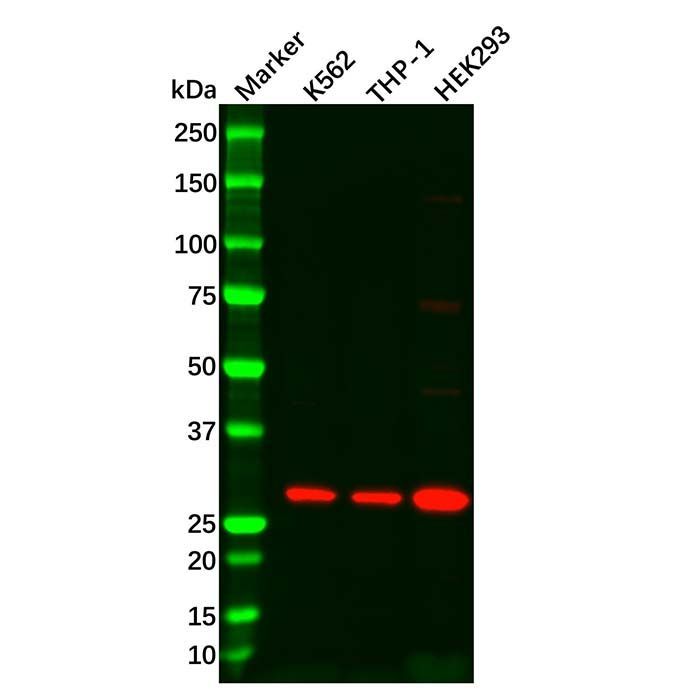
WB: K562, THP-1 and HEK293 cell lysates. IHC: Human breast cancer tissue.
Conjugación
Unconjugated
Grado
ExactAb™, Recombinant, Validated
Isotipo
Rabbit IgG
Tipo de cadena ligera
kappa
SDS-PAGE
150 kDa
Método de purificación
Protein A purified
Concentración
0.3 mg/mL
Product Line
Productos biológicos
Almacenamiento y envío
Forma
Liquid
Condiciones de almacenamiento de almacenamiento
Store at -20°C,Avoid repeated freezing and thawing
Enviado en
Ice chest + Ice pads
Estabilidad y almacenamiento
Store at 4°C short term (1-2 weeks). Store at -20°C long term (24 months). Upon receipt, it is recommended to aliquot. Avoid freeze/thaw cycle.
Imágenes

Recombinant DDIT3 Antibody (Ab099377) - Western Blot
All lanes: Recombinant DDIT3 Antibody (Ab099377) at 1/1000 dilution
Samples: Lysates at 20 µg per lane
Secondary: Goat Anti-Rabbit IgG H&L (HRP) (Ab170144) at 1/20000 dilution

Predicted band size: 19 kDa
Observed band size: 28 kDa
Exposure time: 7.6 s

Recombinant DDIT3 Antibody (Ab099377) - IHC
Immunohistochemistry analysis of paraffin-embedded Human breast cancer using Recombinant DDIT3 Antibody (Ab099377). High-pressure and temperature Sodium Citrate pH 6.0 was used for antigen retrieval.

Aplicación
Aplicación
Dilution info
WB

1/500-1/1000

IHC

1/50 - 1/100

Documentation

📋 Safety Data Sheet (SDS)

Comprehensive hazard, handling, storage, and regulatory compliance document.

Download SDS →

✅ Certificate of Analysis (COA)

Lot-specific quality data. Enter your lot number to retrieve the exact COA.

Look up COA →

📊 Datasheet

Quick-reference summary of product specifications and applications.

View datasheet →

🔬 Specification Sheet

Full quality attributes and acceptance criteria for this grade.

View spec sheet →

Advanced Data

Objetivos asociados (humanos)
DDIT3 Tbio DDIT3 upstream open reading frame protein (0 Activities)
Activity TypeActivity Value -log(M)Mechanism of ActionActivity ReferencePublications (PubMed IDs)
DDIT3 Tchem DNA damage-inducible transcript 3 protein (0 Activities)
Activity TypeActivity Value -log(M)Mechanism of ActionActivity ReferencePublications (PubMed IDs)
Mecanismos de acción
Certificados (CoA, COO, BSE/TSE y tabla de análisis)
C of A & Other Certificates(BSE/TSE, COO):
Analytical Chart:

Find and download the COA for your product by matching the lot number on the packaging.

3 results found

Lot NumberCertificate TypeFechaArticulo
ZJ25F0116669Certificate of AnalysisOct 09, 2026 Ab099377
ZJ24F0102405Certificate of AnalysisJan 10, 2024 Ab099377
ZJ24F0102406Certificate of AnalysisJan 10, 2024 Ab099377
Preguntas frecuentes y artículos
Calculadoras de soluciones
Reseñas

Reseñas de cliente

Application Protocols

Tested/validated applications, recommended dilutions, incubation times, and positive controls for this SKU are Not specified for this item; refer to CoA/Spec Sheet.

General protocol considerations (non-specific, literature-based):

  • Controls: include untreated vs ER-stressed samples (e.g., tunicamycin/thapsigargin treated) to benchmark DDIT3 induction; add isotype and no-primary controls.
  • Sample handling: keep lysates and antibody solutions cold; avoid proteolysis with inhibitor cocktails.
  • Signal detection: choose compatible secondary antibodies and detection chemistry (HRP/ECL for WB; fluorophore-conjugated secondaries for IF/IHC).

These are starting considerations only and do not constitute validated instructions for Ab099377.

Biological Roles

Target overview (DDIT3/CHOP; literature):

  • DDIT3 is a stress-inducible bZIP transcription factor upregulated during the unfolded protein response (UPR) downstream of PERK–eIF2α–ATF4 signaling. It modulates transcriptional programs governing protein homeostasis and integrated stress response.
  • Dimerization: forms heterodimers with C/EBP family members, altering their DNA-binding specificity and transcriptional output.
  • Cellular localization: predominantly nuclear upon induction; baseline expression low in many cell types.
  • Functional context: influences cell cycle arrest and stress adaptation pathways; widely used as a molecular marker of ER stress and UPR activation in research models.

Research utility of anti-DDIT3 antibodies:

  • Quantifying UPR engagement across perturbations (chemical chaperones, proteostasis inhibitors, hypoxia, nutrient stress).
  • Mapping spatiotemporal dynamics of DDIT3 accumulation and clearance.

Note: The above summarizes biological roles of the antigen (DDIT3) from literature and does not constitute validation claims for this specific antibody lot. Item-specific antigen affinity/epitope details are Not specified; refer to CoA/Spec Sheet.

Buffer Applications

Antibody handling depends critically on buffer selection (general guidance):

  • Storage/working buffers:

    • PBS, pH 7.2–7.4 or TBS, pH 7.4–7.6 for routine storage and dilutions. Include 0.01–0.05% Tween-20 for wash buffers in immunoassays.
    • Blocking buffers: 1–5% BSA, nonfat milk, casein, or fish gelatin to minimize nonspecific binding. Choice depends on detection chemistry (e.g., milk can interfere with biotin–avidin systems).
  • Additives and stability:

    • Glycerol (10–50%) can permit storage at −20°C without freezing, reducing freeze–thaw stress.
    • Sodium azide (0.02–0.05%) limits microbial growth but is incompatible with HRP in solution-phase assays and toxic to aquatic organisms; avoid when live-cell applications are planned.
  • pH and ionic strength:

    • Maintain near-neutral pH. Elevated salt (150–500 mM NaCl) can reduce nonspecific electrostatic interactions.
  • Sample preparation for DDIT3 detection:

    • Use protease/phosphatase inhibitors in lysis buffers; for nuclear proteins, consider nuclear extraction protocols.

Item-specific buffer composition for this SKU is Not specified; refer to CoA/Spec Sheet.

Green Alternatives

Sustainability considerations for antibody workflows (general guidance):

  • Shipping and storage:

    • Item ships with ice pads (per Product Data); consider consolidated shipments and reusable cold packs to reduce packaging waste.
    • Maintain cold-chain with energy-efficient freezers; -20°C is specified. Periodic defrost increases efficiency.
  • Buffer and preservative choices:

    • Prefer PBS/TBS prepared from concentrates to reduce plastic waste. Use CO2-neutral ultrapure water where available.
    • If biocompatible for your application, minimize sodium azide or switch to alternative preservation (sterile technique, 0.02% ProClin) to reduce acute aquatic toxicity; weigh biosafety and assay needs.
  • Process optimization:

    • Reduce repeat freeze–thaw by aliquoting upon receipt, limiting waste from activity loss.
    • Use low-binding, recyclable plastics; rinse and recycle outer containers when permissible.

Comparison (general):

  • Lyophilized format vs liquid: lyophilized reduces cold-chain burden and shipping mass but requires reconstitution resources; this item’s format is Not specified.
  • Glycerol-containing stocks lower freeze–thaw waste at the expense of increased shipping mass and carbon footprint. Balance stability needs with sustainability goals.
Pharmaceutical Uses

This product is designated For research use only and is not intended for human or veterinary use, diagnostics, or as a drug.

General, non-clinical roles of antibodies in pharmaceutical R&D/manufacturing:

  • Analytical reagents: used in ELISA/Western assays to monitor process-related impurities, stress-response markers, or product quality attributes in cell-based production systems (e.g., CHOP/DDIT3 as a cell stress indicator in upstream development).
  • In-process controls: immunoassays to qualify cell line health and bioreactor conditions.
  • Reference standards and method development: establishing specificity, accuracy, and precision for release/stability-indicating assays.

No pharmacopeial status, excipient role, or GMP qualification is specified for this item. Any use in regulated workflows requires independent qualification and documentation. Item-specific suitability for QC/lot release is Not specified; refer to CoA/Spec Sheet.

Physical Properties

Item-specific properties:

  • Appearance/formulation, concentration, buffer composition, protein concentration (mg/mL), excipients (e.g., glycerol, BSA, azide): Not specified for this item; refer to CoA/Spec Sheet.
  • Refractive index, pH, osmolality: Not specified for this item; refer to CoA/Spec Sheet.

General/literature context for antibodies:

  • Antibodies are globular proteins (~150 kDa for IgG; literature) typically supplied in aqueous buffers such as PBS or TBS with stabilizers (e.g., 10–50% glycerol) and preservatives (e.g., 0.02–0.05% sodium azide) to enhance stability during storage and shipping.
  • Solubility: fully water-soluble in neutral buffered saline; incompatible with strong organic solvents and extreme pH which denature proteins.
  • Thermal sensitivity: prolonged exposure above 4–25°C promotes aggregation and loss of binding activity; avoid repeated freeze–thaw cycles to preserve conformational integrity.
  • Adsorption: antibodies can adsorb to untreated plastic/glass at low concentrations; low-binding plastics or carrier proteins are commonly used to minimize loss (literature).
Quality and Grades

Item-specific quality statements:

  • Grade/Purity: Recombinant, ExactAb™, Validated (as provided).

What this generally implies (literature/industry definitions):

  • Recombinant antibodies: generated from defined DNA sequences, enabling lot-to-lot genetic identity, improved reproducibility, and reduced background relative to polyclonals; host and isotype can be engineered (specifics not provided for this item).
  • ExactAb™: denotes a proprietary recombinant format emphasizing sequence-defined production and validation. Exact performance parameters for this SKU are not specified; consult the CoA/Spec Sheet for assay-specific validation data.
  • Validated: indicates performance testing has been performed; however, supported applications, species reactivity, and positive-control materials are Not specified for this item; refer to CoA/Spec Sheet.

Batch documentation and traceability:

  • For rigorous workflows, request CoA including: clone/sequence identifier, concentration, buffer composition, preservative/stabilizer content, purity assessment method (e.g., SDS-PAGE, SEC-HPLC), and tested applications with acceptance criteria.
  • Lot-to-lot continuity: recombinant production typically minimizes drift in epitope affinity/avidity. Still, verify critical assays with in-lab controls upon lot change.
Reaction and Applications

As an antibody reagent, this product is not used in chemical synthesis reactions. Instead, its applications are immunoassay- and detection-focused.

General application landscape for anti-DDIT3 antibodies (literature; not a validation claim for this item):

  • Western blotting (WB): detection of DDIT3/CHOP in cell/tissue lysates following ER stress induction (e.g., tunicamycin, thapsigargin). Proper lysate preparation (RIPA with protease/phosphatase inhibitors) and transfer to PVDF recommended.
  • Immunofluorescence (IF/ICC): visualization of nuclear DDIT3 localization; requires fixation (paraformaldehyde) and permeabilization (0.1–0.5% Triton X‑100) optimization.
  • Immunohistochemistry (IHC): FFPE sections with heat-induced epitope retrieval (citrate pH 6.0 or Tris-EDTA pH 9.0) often beneficial. Blocking of endogenous peroxidase for HRP workflows.
  • ELISA/IP/ChIP: potential use to quantify DDIT3 or pull down associated chromatin complexes, provided epitope accessibility is appropriate.

Practical tips (general):

  • Include positive controls (cells treated with ER-stressors) and negative controls (untreated cells, isotype controls).
  • Titrate antibody and adjust antigen load to maintain linear detection range.
  • Validate species cross-reactivity for your samples; DDIT3 is conserved, but epitope mapping matters.

Note: Supported applications and conditions for this specific SKU are Not specified; consult the CoA/Spec Sheet.

Reaction Conditions

Not typically applicable to chemical reactions. For immunoassay workflows (general, literature-based guidance; not item-specific validation):

  • Western blot: typical blocking 30–60 min; primary incubation 1–16 h at 4–25°C; wash with TBST/PBST. Optimize load (e.g., 10–40 µg total protein per lane) and transfer to PVDF for nuclear proteins like DDIT3.
  • IF/IHC: fixation with 4% paraformaldehyde; permeabilization with 0.1–0.5% Triton X‑100; antigen retrieval for FFPE using citrate pH 6.0 or Tris‑EDTA pH 9.0. Incubations 1–16 h depending on protocol.
  • IP/ChIP: gentle, non-denaturing lysis buffers; include DNase/RNase as needed; maintain cold conditions to preserve complexes.

Note: Specific dilutions, incubation times, and validated applications for this SKU are Not specified; refer to CoA/Spec Sheet and SDS for authoritative guidance.

Safety and Handling

Item-specific hazard data:

  • GHS classification, signal word, pictograms, H-statements: Not specified for this item; refer to SDS.

General guidance for antibody reagents (non-hazard-specific; defer to SDS):

  • PPE: laboratory coat, gloves (nitrile), and eye protection when handling solutions and spill cleanup.
  • Avoid inhalation, ingestion, and skin/eye contact. Handle as a proteinaceous biological reagent; follow good microbiological practices if product contains preservatives such as sodium azide.
  • Incompatibilities: avoid strong oxidizers, extremes of pH, and organic solvents that denature proteins. Sodium azide (if present; not specified) is incompatible with lead/copper plumbing—collect waste accordingly.
  • Spill/cleanup: absorb with inert material, wash area with water/detergent. For preserved buffers, prevent entry into drains.
  • First aid (general): rinse skin/eyes with water for 15 minutes in case of contact; if inhaled, move to fresh air; if ingested, rinse mouth. Seek medical attention as needed. Always consult the SDS for authoritative, product-specific guidance.
  • Special risks: repeated freeze–thaw can cause aggregation and loss of binding; keep cold and minimize time at ambient temperature during handling.
Solvent Selection

This product is a protein antibody reagent; organic solvent selection as for small-molecule chemistry is not applicable.

Practical buffer choices (general guidance):

  • Working buffers: PBS (10 mM phosphate, 137 mM NaCl, 2.7 mM KCl, pH ~7.4) or TBS (25 mM Tris, 150 mM NaCl, pH 7.4–7.6) are commonly used to maintain antibody stability and function.
  • Detergents: 0.05–0.1% Tween-20 in PBST/TBST reduces nonspecific binding in immunoassays; avoid excessive detergents which can disrupt antigen–antibody interactions.
  • Additives: BSA (0.1–1%), casein, or fish gelatin for blocking; glycerol (10–50%) for freeze–thaw protection; azide (0.02–0.05%) to inhibit microbial growth. Presence/absence for this item is Not specified; refer to CoA/Spec Sheet.
  • Avoid: strong organic solvents (e.g., acetone, acetonitrile, DMF), extremes of pH (<5 or >9), and high ionic detergents (SDS) unless specifically required for denaturing protocols.

Compatibility considerations:

  • Metal chelators (EDTA) typically compatible. Reducing agents (DTT, β-mercaptoethanol) can disrupt disulfide bonds—avoid unless intended for denaturing applications.
  • Filtration: 0.22 µm filtration can be used for sterile handling; minimize shear by avoiding repeated syringe passes.
Storage and Reconstitution

Item-specific storage and shipping:

  • Storage Conditions: Store at −20°C. Avoid repeated freezing and thawing (per Product Data). Aliquot upon receipt to minimize freeze–thaw.
  • Shipped In: Ice chest + ice pads (per Product Data).

Additional guidance (general):

  • Short-term handling: keep on ice during use; limit time at room temperature.
  • Long-term storage: many antibodies remain stable at −80°C for extended periods; however, this item specifies −20°C. Follow label instructions for the supplied format.
  • Reconstitution: Format (liquid vs lyophilized) and diluent are Not specified for this item; refer to CoA/Spec Sheet. If lyophilized, gentle reconstitution with sterile PBS or water, followed by addition of carrier protein and glycerol, is commonly employed.
  • Thawing: thaw slowly on ice; mix gently by inversion—not vortexing—to reduce aggregation.
  • Light protection: protect from strong light if fluorophore-conjugated; conjugation status is Not specified for this item.

Always consult the product label and CoA/SDS for definitive storage and handling instructions for your specific lot.

Structure and Identity

Item-specific facts (from Product Data):

  • Product: Recombinant DDIT3 Antibody (SKU: Ab099377)
  • Grade/Purity: Recombinant, ExactAb™, Validated
  • SMILES / InChIKey / CAS / CID: Not specified for this item; refer to CoA/Spec Sheet.
  • Molecular formula / Molecular weight: Not specified for this item; refer to CoA/Spec Sheet.

General description (literature):

  • This product is a recombinant antibody directed against DDIT3 (DNA Damage-Inducible Transcript 3), also known as CHOP/GADD153.
  • Structural features of antibodies: typically Y‑shaped immunoglobulins consisting of two heavy chains and two light chains linked by disulfide bonds, with variable regions forming the antigen-binding site (paratope). The specific isotype (e.g., IgG1, IgG2) and species are not specified for this item.
  • Antigen (DDIT3/CHOP) overview: basic leucine zipper (bZIP) transcription factor of the C/EBP family that hetero/homodimerizes via its leucine zipper domain and binds DNA via the basic region (literature).
Synthetic Utility

Not typically applicable. As an antibody reagent, this product is not a building block or reagent for chemical synthesis and does not participate in named organic reactions. For users seeking chemistry-related content, see instead:

  • Reaction & Applications: outlines common immunoassay applications.
  • Biological Roles: summarizes the target protein’s function and research relevance.
Target Specificity

Item-specific details:

  • Antigen: DDIT3 (CHOP/GADD153) — product name indicates specificity to DDIT3.
  • Clone, epitope, isotype, host species, species reactivity, cross-reactivity, and affinity: Not specified for this item; refer to CoA/Spec Sheet.

Literature context for the antigen:

  • DDIT3 is a bZIP transcription factor induced by ER stress/UPR. Commonly detected in rodent and human cells. Epitope accessibility may vary with fixation and retrieval conditions.

To ensure accurate targeting in your system, verify species reactivity and application validation data for the specific lot before critical experiments.

Preguntas frecuentes

What does ExactAb? mean?
ExactAb? indicates the product has been validated for use in rigorous antibody validation workflows. Validation may include positive/negative control samples, signal-to-noise testing, and protocol-specific QC. Lot-specific test data is published on the Certificate of Analysis where available.
What does Recombinant mean?
Recombinant is a defined analytical purity tier suitable for workflows requiring a specific validated property. It specifies a minimum assay percentage, controlled limits on common impurities (water, heavy metals, residue on ignition), and lot-to-lot consistency. Recombinant is one of several purity tiers — choose based on the sensitivity and regulatory requirements of your method.
How should this product be stored?
Store at ?20 °C. Avoid repeated freeze–thaw cycles. Aliquot into single-use volumes before freezing.
How is this product shipped?
This product ships in an insulated container with ice pads. Unpack on arrival and transfer it to the storage condition stated above.
What documentation is provided?
Available product documentation, including Certificates of Analysis (COA), Safety Data Sheets (SDS), and specification sheets, is shown in the product document area. Document availability and access follow the current site policy.
Which species reactivity has this antibody been validated against?
Validated reactivity is listed on the PDP and on each lot's datasheet. We validate against the most commonly tested species for the target (Recombinant DDIT3 Antibody); cross-reactivity in untested species may exist but is not guaranteed. Contact technical support for specific species inquiries.

Need help choosing the grade?

Our grade selection guide covers purity, stabilizer status, and application suitability for all variants in our catalog.

View Recombinant grade guide → View Validated grade guide → View ExactAb™ grade guide →

Artículos relacionados

Goat Anti-Rabbit IgG H&L Antibody - Anticuerpo secundario, for ELISA,LF,GICA various applications, from Rabbit, generated in Goat
Goat Anti-Rabbit IgG H&L (AF594) - Anticuerpo secundario, IgG
Goat Anti-Rabbit IgG H&L (Biotin) - Anticuerpo secundario, IgG
Goat Anti-Rabbit IgG H&L (AF488) - Anticuerpo secundario, IgG
Goat Anti-Rabbit IgG H&L (AF405) - Anticuerpo secundario, IgG
Donkey Anti-Rabbit IgG H&L (AF647) - Anticuerpo secundario, specific to , IgG
Donkey Anti-Rabbit IgG H&L (Biotin) - Anticuerpo secundario, IgG
Goat Anti-Rabbit IgG H&L (HRP) - Anticuerpo secundario
Goat Anti-Rabbit IgG H&L Antibody - Anticuerpo secundario, Goat IgG
Goat Anti-Rabbit IgG H&L (Biotin) - Anticuerpo secundario
Goat Anti-Rabbit IgG H&L (Cy5) - Anticuerpo secundario
Goat Anti-Rabbit IgG H&L (FITC) - Anticuerpo secundario
Goat Anti-Rabbit IgG H&L (TRITC) - Anticuerpo secundario
Goat Anti-Rabbit IgG H&L (Biotin) - Anticuerpo secundario, Goat IgG
Goat Anti-Rabbit IgG H&L (HRP) - Anticuerpo secundario, Goat IgG
Goat Anti-Rabbit IgG H&L (Cy5) - Anticuerpo secundario, Goat IgG
Goat Anti-Rabbit IgG H&L (TRITC) - Anticuerpo secundario, Goat IgG
Goat Anti-Rabbit IgG H&L (FITC) - Anticuerpo secundario, Goat IgG
Goat Anti-Rabbit IgG H&L (PE) - Anticuerpo secundario, Goat IgG
Goat Anti-Rabbit IgG H&L (APC) - Anticuerpo secundario, Goat IgG
Goat Anti-Rabbit IgG H&L (AF647) - Anticuerpo secundario, Goat IgG
Goat Anti-Rabbit IgG H&L (AF405) - Anticuerpo secundario, Goat IgG
Goat Anti-Rabbit IgG H&L (AF555) - Anticuerpo secundario, Goat IgG
Goat Anti-Rabbit IgG H&L (AF546) - Anticuerpo secundario, specific to Rabbit IgG
Goat Anti-Rabbit IgG H&L (AF700) - Anticuerpo secundario, specific to Rabbit IgG
Goat Anti-Rabbit IgG H&L (AF488) - Anticuerpo secundario
Goat Anti-Rabbit IgG H&L (AF647) (Ready to use) - Anticuerpo secundario, specific to Rabbit IgG

¿Quieres que te enviemos un mensaje cuando tengamos descuentos disponibles?

Recordármelo más tarde

¡Gracias! Por favor, revisa tu bandeja de entrada de correo electrónico para confirmar.

¡Vaya! Las notificaciones están desactivadas.