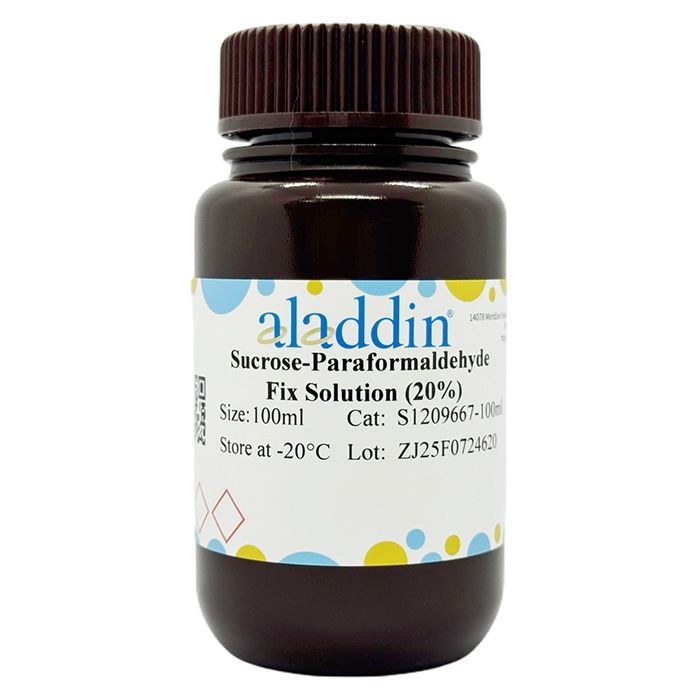
Sucrose-Paraformaldehyde Fix Solution (20%) - BioReagent, Suitable for Immunohistochemistry(IHC), ready-to-use, Suitable for Immunofluorescence(IF), 20%

Cat. No.: S1209667
Disponible para pedir
CALIDAD & PUREZA Suitable for Immunofluorescence(IF) ? IF grade — validated for immunofluorescence with low background staining. Use to localize targets in cells/tissue by fluorescence microscopy. BioReagent ? BioReagent grade — tested suitable for life-science and molecular-biology use. Use for cell culture, assays, and biochemical work needing biological compatibility. Ready-to-use ? Ready-to-use — supplied pre-formulated at working concentration, no prep needed. Use to save time and reduce pipetting/dilution errors. Suitable for Immunohistochemistry(IHC) ? IHC grade — validated for immunohistochemistry on tissue sections. Use to detect and localize antigens in fixed tissue. 20%
Synonyms
Sucrose-PFA Fix Solution | Sucrose-PFA Solution
Storage
Store at -20°C
Shipped In
Ice chest + Ice pads
Application
Flow Cytometry, IF/ICC, IHC
★
Talla
Alemania (EU)
USA*
Precio
Cantidad
100ml
S1209667-100ml
—
3 Disponible
25,95€
500ml
S1209667-500ml
Fabricado bajo pedido · 8–12 semanas
69,33€
Enter a quantity for the sizes you want to add.
🧪
Por qué esta calidad

BioReagent, Suitable for Immunohistochemistry(IHC), ready-to-use, Suitable for Immunofluorescence(IF), 20% BioReagent,Listo para usar,Suitable for Immunofluorescence(IF),Suitable for Immunohistochemistry(IHC) para flujos de trabajo cromatográficos y analíticos sensibles que requieren una interferencia mínima de la línea base.

🌡

Almacenamiento y envío

Store at -20°C Envío Ice chest + Ice pads. Consulte el COA específico del lote para conocer las especificaciones exactas.

📋

Documentos de calidad

SDS, COA, ficha técnica y hoja de especificaciones disponibles para descargar. COA específico del lote accesible mediante búsqueda por número de lote.

📚

Prueba documental

Citado en 0 publicaciones revisadas por pares sobre cromatografía, síntesis orgánica y reacciones de acoplamiento cruzado.

Especificaciones

Sinónimos
Sucrose-PFA Fix Solution | Sucrose-PFA Solution
Especificaciones y pureza
BioReagent, Suitable for Immunohistochemistry(IHC), ready-to-use, Suitable for Immunofluorescence(IF), 20%
Estabilidad y almacenamiento
Store at -20℃ (12 months).
Condiciones de almacenamiento de almacenamiento
Store at -20°C
Enviado en
Ice chest + Ice pads
Este producto requiere envío en cadena de frío. Los servicios terrestres y otros servicios económicos no están disponibles.
Grado
BioReagent, Listo para usar, Suitable for Immunofluorescence(IF), Suitable for Immunohistochemistry(IHC)
Product Line
Productos biológicos

Documentación

📋 Hoja de datos de seguridad (SDS)

Documento completo sobre peligros, manipulación, almacenamiento y cumplimiento normativo.

<<<<<<< HEAD Descargar SDS → ======= Descargar SDS → >>>>>>> release248-p3

✅ Certificado de análisis (COA)

Datos de calidad específicos del lote. Introduzca su número de lote para obtener el COA exacto.

Buscar COA →

📊 Ficha técnica

Resumen de referencia rápida de las especificaciones y aplicaciones del producto.

Ver ficha técnica →

🔬 Hoja de especificaciones

Atributos de calidad completos y criterios de aceptación para esta calidad.

Ver hoja de especificaciones →

Datos avanzados

Certificados (CoA, COO, BSE/TSE y tabla de análisis)
C of A & Other Certificates(BSE/TSE, COO):
Analytical Chart:

Find and download the COA for your product by matching the lot number on the packaging.

2 results found

Lot NumberCertificate TypeFechaArticulo
ZJ25F0724619ZJ25F0724619Certificate of AnalysisMay 19, 2026 S1209667
ZJ25F0724620ZJ25F0724620Certificate of AnalysisMay 19, 2026 S1209667
Preguntas frecuentes y artículos
Calculadoras de soluciones
Reseñas

Reseñas de cliente

Application Protocols

The following are general, literature-based protocols for aldehyde/sucrose fixatives aligned with the product’s stated suitability for IF and IHC. Adjust according to sample type and consult the CoA/Spec Sheet for any item-specific directions.

A. IF fixation of cultured cells

  1. Warm an aliquot of fixative to RT (protect from light if required by your assay).
  2. Remove culture medium; rinse cells once with warm PBS.
  3. Add enough fixative to cover cells; incubate 10–15 minutes at RT (5–10 minutes for fluorescent proteins).
  4. Aspirate; rinse 3× with PBS (5 minutes each).
  5. Optional: Quench with 50 mM glycine in PBS, 10 minutes.
  6. Proceed to permeabilization (e.g., 0.1–0.3% Triton X-100 in PBS, 5–10 minutes) if intracellular targets are probed, then block and stain.

B. IHC/IF on cryosections

  1. Equilibrate slides to RT; outline sections.
  2. Incubate with fixative 10–15 minutes at RT.
  3. Rinse 3× with PBS; optional aldehyde quench (50–100 mM glycine).
  4. Continue with antigen retrieval as required (often milder than FFPE), block, and immunostain.

C. Free-floating sections (30–100 µm)

  1. Gently agitate sections in fixative 15–60 minutes at RT or 4°C.
  2. Rinse 3–4× in PBS with agitation.
  3. Proceed to blocking/staining.

Notes: Avoid repeated freeze–thaw of the fixative; use fresh aliquots. Do not mix directly with primary antibodies or detection reagents. Dispose of aldehyde-containing waste per EHS guidelines.

Biological Roles

This product itself does not have a biological role; it is a laboratory fixative. The following describes how its components affect biological material during fixation (literature context):

  • Formaldehyde (from paraformaldehyde) crosslinks biomolecules primarily through formation of methylene bridges between nucleophilic residues (e.g., lysine, cysteine). This immobilizes proteins, preserves overall architecture, and stabilizes antigens for immunostaining. Nucleic acids can also be crosslinked indirectly via associated proteins.
  • Sucrose acts as an osmoprotectant/cryoprotectant. During fixation and subsequent washing, increased extracellular osmolality helps maintain cell volume and reduces swelling/shrinkage artifacts. In workflows involving freezing (e.g., cryosectioning), sucrose can mitigate ice crystal formation and preserve ultrastructure.
  • Effects on downstream assays: Crosslinking can mask epitopes; antigen retrieval (heat- or enzyme-mediated) is often employed post-fixation for IHC. In IF, shorter fixation times and controlled temperatures help maintain fluorescence of endogenous fluorophores and fluorescent proteins, though some quenching may occur depending on conditions.
  • Permeability: Aldehyde fixation alone may not permeabilize membranes completely; separate permeabilization with mild detergents is commonly used for antibody access to intracellular targets.

These effects are general properties of aldehyde/sucrose-containing fixatives and should be validated for each sample type and antigen.

Buffer Applications

This product is a fixative solution, not a buffering system. As such, classical buffer preparation and pH control for biochemical assays are not its primary purpose.

Practical buffer-related guidance (general):

  • Pre- and post-fix washes: Use isotonic buffers (e.g., PBS or TBS) matched to your staining workflow. Rinse 2–3 times after fixation to remove residual aldehyde and reduce background and autofluorescence.
  • Quenching residual aldehyde (optional): Glycine (e.g., 50–100 mM in PBS) or ammonium chloride (e.g., 50 mM) is commonly used after fixation to quench free aldehydes prior to blocking; optimize concentration and time for your system.
  • Avoid uncontrolled dilution: Diluting the fixative with buffer may reduce effective fixative strength and alter osmolarity; only dilute if recommended on the CoA/Spec Sheet or validated in-house.
  • Permeabilization: If needed, perform after fixation using a compatible buffer with a nonionic detergent (e.g., 0.1–0.5% Triton X-100 or saponin) tailored to your targets.

Item-specific pH and buffer composition: Not specified for this item; refer to CoA/Spec Sheet.

Green Alternatives

Formaldehyde-containing fixatives raise EHS concerns due to volatility, toxicity, and regulatory controls. When evaluating greener options, balance laboratory performance with hazard reduction.

Potential alternatives (literature; general comparison):

  • Glyoxal-based fixatives: Lower volatility and reduced hazard profile compared to formaldehyde; reported to preserve many epitopes with shorter fixation times. Trade-offs include epitope-specific variability and different crosslink chemistry that may require protocol re-optimization.
  • Alcohol-based fixatives (ethanol, methanol): Simpler hazard profile and easy disposal in some settings; act as coagulant fixatives (protein precipitation). Trade-offs include cellular shrinkage, extraction of lipids, and loss of some antigenicity, especially for membrane and cytoskeletal proteins.
  • Zinc-based or PFA-free buffered fixatives: Reduced formaldehyde exposure; performance is target dependent and often requires pilot testing.

Compact comparison (general; not item-specific):

  • Paraformaldehyde + sucrose: Crosslinking, good morphology, osmotic stabilization; higher hazard (formaldehyde), waste segregation required.
  • Glyoxal buffer: Crosslinking, lower volatility; may need altered antigen retrieval.
  • Ethanol/methanol: Coagulant, quick fixation; poorer ultrastructure, epitope loss in some cases.

Green practices with this product:

  • Minimize open handling; use closed containers and fume hoods to limit emissions.
  • Right-size aliquots to reduce waste from expired thawed material.
  • Collect aldehyde waste separately and neutralize per institutional environmental health and safety procedures.
Pharmaceutical Uses

This product is intended strictly for research use only and is not formulated, registered, or warranted for pharmaceutical manufacturing, clinical, or diagnostic applications.

Context (general information, not specific to this item):

  • Aldehyde fixatives are used in histology/pathology laboratories for tissue preservation prior to analytical procedures; such uses are part of laboratory workflows, not therapeutic formulations.
  • Sucrose is used pharmaceutically as an excipient in some formulations (sweetener, bulking agent), but its presence here is for laboratory fixation performance and osmotic stabilization, not for administration.

Regulatory/compendial status: Not specified for this item; refer to CoA/Spec Sheet if any compendial references apply.

Do not use this product in human or veterinary applications.

Physical Properties

Item-specific physical constants are not provided for this formulated solution. Where helpful, typical values for the pure components are given as literature context (not specifications of this item).

  • Appearance: Not specified for this item; refer to CoA/Spec Sheet.
  • Concentration/assay of constituents: Not specified for this item; refer to CoA/Spec Sheet.
  • Density, refractive index, pH, osmolality: Not specified for this item; refer to CoA/Spec Sheet.
  • Freezing point/MP and BP of the solution: Not specified for this item; refer to CoA/Spec Sheet.

Literature context (components; for general reference only):

  • Sucrose (solid): MW 342.30 g/mol (literature); highly water soluble; contributes substantially to solution osmolality.
  • Paraformaldehyde (solid): formaldehyde polymer; depolymerizes to formaldehyde in aqueous solution. Aqueous formaldehyde solutions are typically clear and have a characteristic pungent odor.

Practical notes (general):

  • Solutions containing sucrose have elevated viscosity and osmolality relative to water or simple buffers, which can aid in maintaining cellular morphology during fixation and handling.
  • Paraformaldehyde-based fixatives are typically near neutral pH for optimal antigen preservation; verify pH on the CoA/Spec Sheet before sensitive applications (e.g., IF/IHC on delicate epitopes).
Quality and Grades

Item-specific quality designations (per product data):

  • BioReagent grade
  • Suitable for Immunofluorescence (IF)
  • Suitable for Immunohistochemistry (IHC)
  • Ready-to-use

What these grades imply (general guidance):

  • BioReagent: Manufactured with attention to impurities that may interfere with biological assays. Typically filtered to reduce particulates and bioburden and prepared using reagent-grade components and water; exact QC metrics are product-specific. Not specified for this item; refer to CoA/Spec Sheet.
  • Suitable for IF/IHC: Optimized to preserve antigenicity and cellular/tissue morphology for fluorescence and chromogenic immunostaining workflows. This usually entails near-neutral pH, low autofluorescence background, and minimal fixative-induced fluorescence quenching.
  • Ready-to-use: Supplied at a working strength that does not require dilution or buffer adjustment prior to fixation under standard protocols. Always review the CoA/Spec Sheet for the recommended use conditions and any lot-specific instructions.

Typical QC attributes for such solutions (context; not item specifications): clarity (no precipitate), pH within a defined range, sterility or low bioburden, and performance verification in representative IF/IHC assays. For exact acceptance criteria, stabilizers, filtration/sterility status, and UV/absorbance characteristics, consult the CoA/Spec Sheet.

Reaction and Applications

As a laboratory fixative, this product is used for biological sample preparation rather than chemical synthesis.

Application scope (general; consistent with item’s IF/IHC suitability):

  • Cell culture IF: Fix adherent or suspension cells to preserve morphology and immobilize antigens prior to immunostaining. Sucrose can help maintain osmotic balance, reducing fixation-induced shrinkage.
  • Tissue IHC/IF (cryosections and vibratome sections): Crosslinking of proteins via formaldehyde-derived methylene bridges stabilizes tissue architecture. Sucrose is commonly used as a cryoprotectant/osmoprotectant and can reduce ice-crystal artifacts when used in workflows involving freezing.
  • Ultrastructure pre-fix (pre-EM workflows): As a preliminary aldehyde fixation step before postfixation (e.g., osmium tetroxide), noting that exact compatibility depends on composition; verify with CoA and protocol.

Mechanistic notes (literature):

  • Formaldehyde reacts predominantly with nucleophilic side chains (lysine, arginine, cysteine, tyrosine) forming reversible Schiff bases and then more stable methylene bridges, preserving antigen conformation while generally allowing epitope accessibility after antigen retrieval if needed.
  • Sucrose contributes to osmotic support, reducing extraction of soluble proteins and minimizing organelle collapse during fixation and washes.

Practical tips:

  • Use freshly thawed solution; avoid repeated freeze–thaw to maintain effective formaldehyde content.
  • Rinse samples in isotonic buffer before fixation to remove media components (e.g., amines) that can quench fixative.
  • Control time and temperature carefully; over-fixation can reduce antigen detectability, while under-fixation can compromise morphology.
Reaction Conditions

This section provides general fixation conditions relevant to immunofluorescence (IF) and immunohistochemistry (IHC). These are literature-based guidelines and not item-specific specifications. Optimize for your system.

Typical conditions (cells, IF):

  • Temperature: 20–25°C (room temperature) or 4°C for delicate structures.
  • Time: 10–20 minutes at RT; reduce to 5–10 minutes for sensitive epitopes or fluorescent proteins.
  • Volume: Sufficient to fully cover samples; avoid evaporation.
  • Post-fix: Rinse 3× in PBS or TBS; optional aldehyde quench (e.g., 50–100 mM glycine, 5–10 minutes).

Typical conditions (tissue sections, IHC/IF):

  • Cryosections (5–20 µm): 10–15 minutes at RT; rinse thoroughly.
  • Vibratome/free-floating sections (30–100 µm): 15–60 minutes at RT with gentle agitation; extend time for thicker sections, or fix at 4°C to reduce extraction.
  • Whole-mount embryos/organisms: 0.5–24 hours at 4°C depending on size and permeability; gentle rocking.

Notes on sucrose content (general):

  • Elevated osmolarity from sucrose can improve morphology but may slow fixative penetration; ensure adequate time for thicker samples.
  • After fixation, stepwise equilibration in sucrose (if cryoprotection is desired) is commonly used before freezing; consult protocol needs.

Exact working concentration and buffer of this product: Not specified for this item; refer to CoA/Spec Sheet.

Safety and Handling

Follow institutional chemical hygiene practices. This product is for research use only.

Item-specific hazard statements, GHS classification, and pictograms: Not specified for this item; refer to SDS.

General safety considerations (literature; for paraformaldehyde/formaldehyde-containing fixatives):

  • Hazards: Formaldehyde is toxic, volatile, a skin/respiratory sensitizer, and a suspected/known carcinogen in certain jurisdictions. Solutions may release formaldehyde vapors, especially at elevated temperature or during open handling.
  • PPE: Lab coat, nitrile gloves (change regularly), chemical splash goggles. Use in a certified chemical fume hood to control vapors.
  • Incompatibilities: Strong oxidizers, strong acids/bases (can accelerate decomposition/polymerization), ammonia (forms hexamethylenetetramine), and reactive amines that may consume fixative capacity.
  • First aid (overview; refer to SDS):
    • Inhalation: Move to fresh air; seek medical attention if symptoms persist.
    • Skin contact: Remove contaminated clothing; rinse with water for at least 15 minutes.
    • Eye contact: Rinse cautiously with water for 15 minutes; seek medical attention.
    • Ingestion: Rinse mouth; do not induce vomiting; seek medical attention.
  • Spill response: Absorb with inert material, collect in compatible container; ventilate area; decontaminate surfaces with excess water, then appropriate neutralizers per institutional protocol.

Storage per item data: Store at -20°C. Keep container tightly closed. Avoid repeated freeze–thaw cycles to maintain performance. Shipped in an ice chest with ice pads (per item data). Always defer to the product SDS and CoA for authoritative safety and handling guidance.

Solvent Selection

This product is an aqueous fixative solution rather than a solvent for extractions or reactions. Solvent selection is generally not applicable.

Practical compatibility notes (general):

  • Matrix: Water-based; typically compatible with common physiological buffers (e.g., PBS, TBS) used for rinsing before/after fixation. Avoid significant dilution unless validated, as it may alter fixative strength and osmolarity.
  • Organic solvent exposure: Concurrent use with alcohols (methanol/ethanol) can change fixation chemistry and antigen preservation; perform sequential, validated steps if a coagulant fix is required.
  • Detergents: Nonionic detergents (e.g., 0.1% Triton X-100) are often introduced after fixation for permeabilization; adding detergents directly to the fixative may alter performance and background—validate before use.

Selection versus alternatives (general):

  • Choose this sucrose-paraformaldehyde solution when osmotic stabilization during fixation is desired (e.g., to better preserve ultrastructure or delicate organelles), compared to standard paraformaldehyde alone.
  • Consider alcohol-based fixatives when antigen retrieval is problematic with crosslinking fixatives, recognizing trade-offs in morphology and epitope preservation.
Storage and Reconstitution
  • Storage temperature (item-specific): Store at -20°C.
  • Shipping conditions (item-specific): Shipped in an ice chest with ice pads.
  • Format: Ready-to-use aqueous solution. No reconstitution required.

Handling and aliquoting (general best practices):

  • Thaw on ice or at 2–8°C; mix gently to ensure homogeneity. Do not heat unless instructed on the CoA/Spec Sheet.
  • Aliquot upon first thaw into working volumes to avoid repeated freeze–thaw cycles, which can alter effective aldehyde content and performance.
  • Protect from contamination: Use sterile technique if sterility is required for your workflow; keep container tightly closed when not in use.
  • Short-term storage after thaw: Not specified for this item; refer to CoA/Spec Sheet. In general practice, many aldehyde fixatives are stored at 2–8°C for limited periods; verify for this product.
  • Shelf life/expiry: Not specified for this item; refer to CoA/Spec Sheet.

Compatibility cautions:

  • Do not store in metal containers; use original packaging. Avoid exposure to strong acids/bases.
  • Dispose of unused thawed material per institutional hazardous waste procedures for aldehyde-containing solutions.
Structure and Identity

This product is a formulated, ready-to-use aqueous fixative composed of sucrose and paraformaldehyde, supplied as a single solution for tissue and cell fixation.

  • Catalog identifier: SKU S1209667
  • Product type: Mixture/solution (not a single defined compound)
  • Components (general, literature):
    • Sucrose (disaccharide of glucose and fructose; neutral carbohydrate)
    • Paraformaldehyde (polymeric formaldehyde; depolymerizes in water to formaldehyde for crosslinking)
  • Exact composition and concentrations: Not specified for this item; refer to CoA/Spec Sheet.
  • Molecular formula, Molecular weight, SMILES, InChIKey, CAS: Not applicable to the mixture and not specified for this item; refer to CoA/Spec Sheet.
  • Structural features (descriptive, literature):
    • Sucrose: two saccharide rings linked via an acetal (α-D-glucopyranosyl-(1→2)-β-D-fructofuranoside), multiple hydroxyl groups conferring high hydrophilicity/osmolarity.
    • Paraformaldehyde: linear polymer of –CH2–O– repeating units; in aqueous buffer and mild heat it releases monomeric formaldehyde which forms methylene bridges between nucleophilic residues (e.g., lysine ε-NH2) in biomolecules.

Note: Because this is a prepared solution, structure identifiers for individual ingredients are not item-specific specifications unless provided on the CoA; use SDS/CoA for definitive identity details.

Synthetic Utility

Not applicable. This is a prepared biological fixative solution and is not typically used as a reagent for organic synthesis or materials synthesis.

General note (literature):

  • While formaldehyde is a common synthetic building block in organic chemistry (e.g., Mannich reaction, hydroxymethylation), this specialized, ready-to-use sucrose–paraformaldehyde solution is formulated for biological sample fixation, with unspecified stabilizers, pH, and concentrations that are not optimized for chemical synthesis.

Users seeking formaldehyde or paraformaldehyde for synthetic applications should select appropriately graded reagents with specified assay, stabilizers, and solvent system.

Target Specificity

Not applicable. This product is not an antibody or affinity reagent and does not possess target specificity in the immunological sense. It preserves overall tissue and cellular structures via chemical crosslinking rather than selective binding to a biomolecular target.

¿Quieres que te enviemos un mensaje cuando tengamos descuentos disponibles?

Recordármelo más tarde

¡Gracias! Por favor, revisa tu bandeja de entrada de correo electrónico para confirmar.

¡Vaya! Las notificaciones están desactivadas.