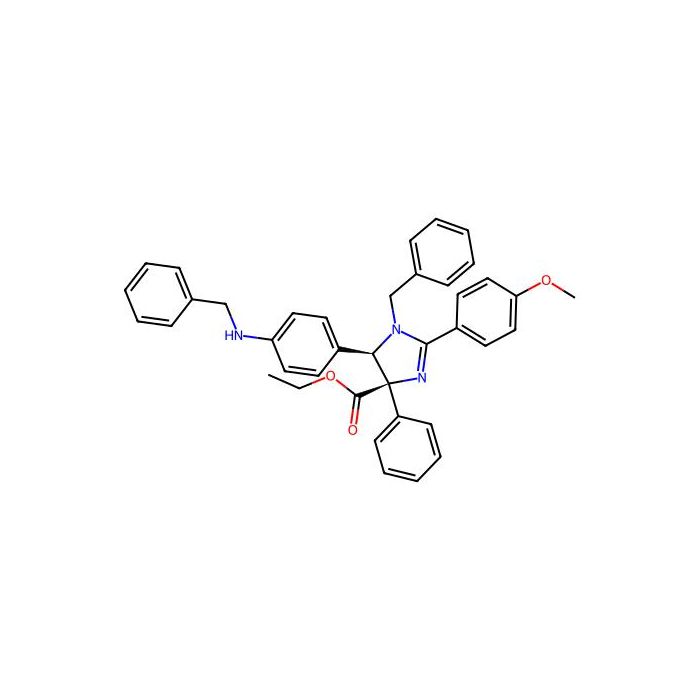
TCH-165 - Moligand™,≥99% , CAS No.1446350-60-2

CAS: 1446350-60-2 Cat. No.: T650057 Fórmula: C39H37N3O3 Peso molecular: 595.73
Disponible para pedir
CALIDAD & PUREZA Moligand™ ? Moligand™ — Aladdin's line of ligands and bioactive small molecules. Use for receptor, pathway, and binding studies needing defined small-molecule tools. ≥99%
Synonyms
rel-Ethyl (4R,5R)-1-benzyl-5-(4-(benzylamino)phenyl)-2-(4-methoxyphenyl)-4-phenyl-4,5-dihydro-1H-imidazole-4-carboxylate | Ethyl (4R,5R)-rel-1-benzyl-5-(4-(benzylamino)phenyl)-2-(4-methoxyphenyl)-4-phenyl-4,5-dihydro-1H-imidazole-4-carboxylate
Storage
Protected from light,Store at -20°C
Shipped In
Ice chest + Ice pads
★
Talla
Alemania (EU)
USA*
Precio
Cantidad
1mg
T650057-1mg
Fabricado bajo pedido · 8–12 semanas
29,42€
5mg
T650057-5mg
Fabricado bajo pedido · 8–12 semanas
69,33€
10mg
T650057-10mg
Fabricado bajo pedido · 8–12 semanas
130,07€
25mg
T650057-25mg
Fabricado bajo pedido · 8–12 semanas
277,59€
50mg
T650057-50mg
Fabricado bajo pedido · 8–12 semanas
468,49€
100mg
T650057-100mg
Fabricado bajo pedido · 8–12 semanas
694,10€
Enter a quantity for the sizes you want to add.

Descripción general

TCH-165 is a small molecule modulator of proteasome assembly , which increases 20S levels and facilitates 20S -mediated protein degradation

In Vitro

TCH-165 (0.01-10 μM; 72 hours; RPMI8226 and U87MG cells) treatment inhibits cell growth of RPMI8226 and U87MG cells with IC 50 of 1.6 μM and 2.4 μM, respectively. ?\nTCH-165 (0-10 μM; 24 hours; HEK293T cells) treatment enhances ODC degradation is blocked by BTZ indicated that this event is proteasome-mediated. TCH-165 enhances proteolytic degradation in a concentration-dependent manner. ?\nTCH-165 enhances the chymotrypsin-like (CT-L), trypsin-like (Tryp-L) and caspase-like (Casp-L) activities with EC 50 s of 4.2 μM, 3.2 μM and 4.7 μM, respectively. ?\nTCH-165 enhances 20S-mediated degradation of IDPs, α-syn, and tau in vitro, and does not induce the degradation of structured proteins such as GAPDH. ?\nTCH-165-treated cells display a decrease in the assembled 26S and an increase in the 20S proteasome. TCH-165 regulates the dynamic equilibrium between the 20S and 26S proteasome complexes, favoring 20S-mediated protein degradation. MCE has not independently confirmed the accuracy of these methods. They are for reference only. Cell Viability AssayCell Line: RPMI8226 and U87MG cells Concentration: 0.01-10 μM Incubation Time: 72 hours Result: Inhibited cell growth of RPMI8226 and U87MG cells with IC 50 of 1.6 μM and 2.4 μM, respectively. Western Blot AnalysisCell Line: HEK293T cells Concentration: 0 μM, 3 μM, 10 μM Incubation Time: 24 hours Result: Enhanced proteolytic degradation in a concentration-dependent manner.

Form:Solid

IC50& Target:Proteasome assembly

Especificaciones

Sinónimos
rel-Ethyl (4R,5R)-1-benzyl-5-(4-(benzylamino)phenyl)-2-(4-methoxyphenyl)-4-phenyl-4,5-dihydro-1H-imidazole-4-carboxylate | Ethyl (4R,5R)-rel-1-benzyl-5-(4-(benzylamino)phenyl)-2-(4-methoxyphenyl)-4-phenyl-4,5-dihydro-1H-imidazole-4-carboxylate
Especificaciones y pureza
Moligand™,≥99%
Mecanismos bioquímicos y fisiológicos
TCH-165 is a small molecule modulator of proteasome assembly , which increases 20S levels and facilitates 20S -mediated protein degradation.
Condiciones de almacenamiento de almacenamiento
Protected from light,Store at -20°C
Enviado en
Ice chest + Ice pads
Este producto requiere envío en cadena de frío. Los servicios terrestres y otros servicios económicos no están disponibles.
Grado
Moligand™
Tipo de acción
MODULATOR
Pureza
≥99%
Nombres e identificadores
Sonrisas canónicas
CCOC(=O)C1(C(N(C(=N1)C2=CC=C(C=C2)OC)CC3=CC=CC=C3)C4=CC=C(C=C4)NCC5=CC=CC=C5)C6=CC=CC=C6
IUPAC Name
ethyl (4R,5R)-3-benzyl-4-[4-(benzylamino)phenyl]-2-(4-methoxyphenyl)-5-phenyl-4H-imidazole-5-carboxylate
InChIKey
XXDLWRCUPASJGY-AEGYFVCZSA-N
INCHI
1S/C39H37N3O3/c1-3-45-38(43)39(33-17-11-6-12-18-33)36(31-19-23-34(24-20-31)40-27-29-13-7-4-8-14-29)42(28-30-15-9-5-10-16-30)37(41-39)32-21-25-35(44-2)26-22-32/h4-26,36,40H,3,27-28H2,1-2H3/t36-,39-/m1/s1
Isómeros SMILES
CCOC(=O)[C@]1([C@H](N(C(=N1)C2=CC=C(C=C2)OC)CC3=CC=CC=C3)C4=CC=C(C=C4)NCC5=CC=CC=C5)C6=CC=CC=C6
Peso molecular
595.73

Datos avanzados

Taxonomic Classification

Taxonomy Tree

KingdomOrganic compounds
SuperclassPhenylpropanoids and polyketides
ClaseStilbenes
SubclassNot available
Intermediate Tree Nodes Not available
Direct ParentStilbenes
Alternative Parents Phenylbenzamines  Alpha amino acids and derivatives  Anisoles  Phenylalkylamines  Phenoxy compounds  Benzylamines  Methoxybenzenes  Aniline and substituted anilines  Secondary alkylarylamines  Alkyl aryl ethers  Imidolactams  Imidazolines  Carboxylic acid esters  Carboximidamides  Carboxamidines  Propargyl-type 1,3-dipolar organic compounds  Monocarboxylic acids and derivatives  Azacyclic compounds  Carbonyl compounds  Hydrocarbon derivatives  Organic oxides  
Molecular FrameworkAromatic heteromonocyclic compounds
Substituents Phenylbenzamine - Stilbene - Alpha-amino acid or derivatives - Phenoxy compound - Anisole - Benzylamine - Phenol ether - Phenylmethylamine - Methoxybenzene - Phenylalkylamine - Aniline or substituted anilines - Alkyl aryl ether - Secondary aliphatic/aromatic amine - Aralkylamine - Imidolactam - Benzenoid - Monocyclic benzene moiety - 2-imidazoline - Amino acid or derivatives - Carboxylic acid ester - Organoheterocyclic compound - Propargyl-type 1,3-dipolar organic compound - Organic 1,3-dipolar compound - Carboximidamide - Amidine - Carboxylic acid amidine - Carboxylic acid derivative - Secondary amine - Ether - Azacycle - Monocarboxylic acid or derivatives - Amine - Organic oxide - Organic nitrogen compound - Carbonyl group - Organonitrogen compound - Organooxygen compound - Hydrocarbon derivative - Organic oxygen compound - Aromatic heteromonocyclic compound
DescripciónThis compound belongs to the class of organic compounds known as stilbenes. These are organic compounds containing a 1,2-diphenylethylene moiety. Stilbenes (C6-C2-C6 ) are derived from the common phenylpropene (C6-C3) skeleton building block. The introduction of one or more hydroxyl groups to a phenyl ring lead to stilbenoids.
External Descriptors Not available
Estructura 3D
Modelo de Estructura Química Interactiva


Mecanismos de acción
Certificados (CoA, COO, BSE/TSE y tabla de análisis)
C of A & Other Certificates(BSE/TSE, COO):
Analytical Chart:

Find and download the COA for your product by matching the lot number on the packaging.

6 results found

Lot NumberCertificate TypeFechaArticulo
I2617248I2617248Certificate of AnalysisApr 15, 2026 T650057
I2617249I2617249Certificate of AnalysisApr 15, 2026 T650057
I2617250I2617250Certificate of AnalysisApr 15, 2026 T650057
I2617251I2617251Certificate of AnalysisApr 15, 2026 T650057
I2617252I2617252Certificate of AnalysisApr 15, 2026 T650057
I2617253I2617253Certificate of AnalysisApr 15, 2026 T650057
Propiedades químicas y físicas
SolubilidadDMSO : 250 mg/mL (419.65 mM; Need ultrasonic)
SensibilidadLight sensitive
Peso molecular595.700 g/mol
XLogP37.500
Hydrogen Bond Donor Count1
Hydrogen Bond Acceptor Count5
Rotatable Bond Count12
Exact Mass595.283 Da
Monoisotopic Mass595.283 Da
Topological Polar Surface Area63.200 Ų
Heavy Atom Count45
Formal Charge0
Complexity937.000
Isotope Atom Count0
Defined Atom Stereocenter Count2
Undefined Atom Stereocenter Count0
Defined Bond Stereocenter Count0
Undefined Bond Stereocenter Count0
The total count of all stereochemical bonds0
Covalently-Bonded Unit Count1
Calculadoras de soluciones
Reseñas

Reseñas de cliente

Application Protocols

No manufacturer-validated application protocols are provided in the product data for this item. The following is general guidance for handling small-molecule screening compounds; it is not a substitute for item-specific instructions.

General protocol outline (discovery assays):

  • Stock preparation: Weigh quickly under low light, prepare a 10–20 mM DMSO stock. Record exact concentration.
  • Working dilutions: Prepare serial dilutions in DMSO, then dilute into assay buffer to the desired final concentrations, matching vehicle across controls.
  • Plate handling: Use low-binding plates; protect from light if photolabile. Mix gently to avoid foaming.
  • Data quality: Include positive/negative controls and vehicle-only wells. Assess compound interference (fluorescence/absorbance) as applicable.

Analytical confirmation:

  • Prior to critical experiments, confirm identity/purity by LC–MS and HPLC area %. Archive chromatograms and MS spectra linked to lot number.

If the manufacturer provides future protocols (e.g., recommended concentration ranges, assay windows, or instrument settings) for this exact CAS/CID, follow those item-specific instructions preferentially.

Biological Roles

No target, pathway, or mechanism of action is specified for this item in the provided data. The following notes describe general considerations for small-molecule ligands used in discovery research.

General roles for screening ligands:

  • Serve as chemical probes to interrogate protein function, modulate enzyme activity, or perturb signaling networks in cells.
  • Facilitate SAR campaigns by providing a starting scaffold for analog generation and optimization.
  • Enable target validation via dose–response profiling, orthogonal assay confirmation, and time-course studies.

Assay planning considerations (general):

  • Establish compound integrity (LC–MS purity, absence of reactive impurities) to avoid false positives/negatives.
  • Evaluate redox activity or PAINS-like substructures if/when the structure is available; apply counter-screens as appropriate.
  • Check photostability given the “protect from light” storage instruction; protect assay plates from strong illumination.

Biophysical assessments:

  • Binding confirmation via DSF/thermal shift, MST, SPR, NMR ligand-observed methods, provided solubility and stability are sufficient.
  • If ionizable, measure pKa and logD at assay pH to interpret cellular uptake or target engagement.

Important: Do not attribute specific biological activities, targets, or therapeutic implications to this product without explicit data from the CoA, literature tied to the exact CAS/CID, or internal validation. Research Use Only.

Buffer Applications

This product is a discrete small-molecule research ligand rather than a buffering reagent. Therefore, conventional buffer formulation guidance (e.g., phosphate, HEPES, Tris recipes and pH ranges) does not apply directly.

Practical notes for assay buffers (general, not item-specific):

  • Prepare compound stocks in DMSO and dilute into your chosen assay buffer (e.g., HEPES, PBS, or Tris-based) ensuring final DMSO content is compatible with the biology (commonly ≤0.1–1% v/v).
  • If precipitation occurs upon dilution, consider:
    • Increasing dilution steps, warming briefly, or adding a minimal co-solvent fraction (DMSO or ethanol) within assay limits.
    • Adjusting buffer ionic strength or pH if ionization is known from separate characterization.
  • Include vehicle controls matched to the highest DMSO percentage used in samples.

Buffer additives (as assay-appropriate):

  • 0.01–0.05% non-ionic surfactant (e.g., Tween-20) to reduce aggregation artifacts.
  • 0.1% BSA to mitigate non-specific adsorption in plates/tips.

Because no item-specific pKa, solubility, or stability data are available, any buffer optimization should be empirically determined and documented for reproducibility.

Green Alternatives

Green chemistry considerations mainly pertain to solvents and processing, since the compound’s structure and hazards are not specified.

Greener handling strategies (general guidance):

  • Prefer DMSO or ethanol over chlorinated solvents for stock solutions, where assay-compatible.
  • For LC–MS sample prep, favor acetonitrile-water systems over halogenated eluents.
  • Minimize solvent volumes via microscale weighing and high-concentration DMSO stocks.

Comparison of common options (general):

  • DMSO vs DMF/NMP: DMSO is typically less hazardous and more environmentally acceptable; DMF/NMP should be limited due to reproductive toxicity concerns.
  • MeCN vs MeOH: Both are common; MeOH is renewable-based but more viscous; MeCN provides lower backpressure and is readily recoverable.

Operational best practices:

  • Use amber vials to reduce photo-induced degradation, limiting waste from spoiled materials.
  • Adopt closed autosampler vials and low-evaporation caps to reduce VOC emissions.
  • Implement solvent recycling where compliant and feasible.

Because item-specific environmental metrics (e.g., degradability, aquatic toxicity) are not provided, prioritize institutional green lab policies and select greener solvents/co-solvents consistent with your assay’s needs.

Pharmaceutical Uses

This product is supplied strictly for research use only and is not intended for human or veterinary use, diagnostic procedures, or as an API.

Context for discovery research (general information, not specific to this item):

  • Small molecules in screening collections may serve as starting points (hits) for medicinal chemistry optimization, but they are not formulated for clinical use.
  • No pharmacopeial monograph, excipient designation, or GMP status is indicated.

Manufacturing/formulation relevance:

  • None specified. Do not use for formulation, scale-up, or drug product development without comprehensive requalification and regulatory-grade sourcing.

Documentation:

  • If you intend to use this material in preclinical research, request expanded analytical characterization (purity profile, salt/counterion identity, residual solvent content) for your internal records.

In summary, there are no pharmaceutical or excipient uses claimed or implied for this listing.

Physical Properties

Item-specific physicochemical properties are not provided in the current data package and should be obtained from the CoA/Spec Sheet.

Item-specific (from Product Data):

  • Appearance: Not specified for this item; refer to CoA/Spec Sheet.
  • Molecular weight: Not specified for this item; refer to CoA/Spec Sheet.

Typical small-molecule library compound handling notes (general guidance, not item-specific specifications):

  • State: Many Moligand™ compounds are supplied as off-white to light-colored solids or films, occasionally as DMSO stock solutions. Confirm for this item via CoA.
  • Solubility: Screening ligands are often soluble in DMSO at 10–50 mM. Aqueous solubility varies widely depending on ionizable groups and logP; evaluate experimentally.
  • Hygroscopicity: Some heteroatom-rich scaffolds can be mildly hygroscopic; minimize ambient exposure during weighing.
  • Thermal behavior: Without a reported melting point, avoid assumptions; use DSC/TGA if thermal processing is required.

Literature/computed properties: Not provided here due to absent structure. If you obtain the SMILES/InChI, you may predict:

  • cLogP, pKa, and polar surface area (e.g., ALOGPS, Marvin, or ChemAxon tools)
  • Aqueous solubility estimates at physiological pH
  • H-bond donor/acceptor counts and rotatable bonds

Important: Do not treat any estimates as product specifications. Always defer to the lot-specific CoA and your in-house measurements.

Quality and Grades

Grade/Purity designation: Moligand™.

What Moligand™ means (general program description):

  • Moligand™ compounds are curated small molecules intended for ligand discovery, screening, and chemical biology. The focus is on structural integrity and suitability for exploratory assays rather than chromatographic solvent grade specifications.

Implications for this item:

  • Purity: Not specified for this item; refer to CoA/Spec Sheet. Moligand™ lots typically include LC–MS and/or HPLC purity data in the CoA.
  • Identification: Expect supporting analytical data (e.g., MS, 1H NMR, and retention time). Confirm against your lab’s acceptance criteria.
  • Stabilizers: Not specified for this item; refer to CoA/Spec Sheet.
  • Residual solvents/inorganics: Not specified for this item; refer to CoA/Spec Sheet.

How to interpret the grade in practice:

  • Suitable for discovery screening, binding assays, and probe development under research-use-only conditions.
  • If you require additional documentation (elemental analysis, water content by KF, salt form confirmation), request lot-specific data prior to large-scale studies.

Quality control recommendations:

  • Upon receipt, document lot number and store per guidance. Run an incoming verification (LC–MS, HPLC area % at 220/254 nm) before critical assays.
  • For long-term programs, archive a reference spectrum and retain a reserve aliquot under inert, light-protected conditions.

Note: No contradictions with the product data are implied; where specifics are absent, consult the CoA.

Reaction and Applications

This product is supplied as a Moligand™ small-molecule entry for research screening and ligand discovery. It is not primarily intended as a synthetic reagent, catalyst, or solvent.

Applicable uses (general for Moligand-class items):

  • Assay development: Use as a test article in biochemical or cell-based assays to evaluate target engagement, pathway modulation, or phenotypic outcomes.
  • Orthogonal readouts: Pair with biophysical methods (DSF, ITC, SPR, MST) to assess binding in vitro, provided the compound’s identity and purity are confirmed.
  • Analytical reference: May serve as a qualitative reference standard in LC–MS method development after identity verification.

Not typically applicable for this item:

  • Named synthetic reactions (e.g., Grignard, cross-coupling) are not relevant unless the structure specifically suggests reactive handles; such details are not provided here.

Practical tips (general):

  • Prepare fresh DMSO stocks to minimize oxidative degradation; limit freeze–thaw cycles (see Storage & Reconstitution).
  • Record solvent lot, concentration, and dilution factors; many assay discrepancies trace to solubility/aggregation issues.
  • Evaluate potential compound aggregation (e.g., detergent controls, light scattering) at higher micromolar concentrations if assay signals are anomalous.

Please consult the CoA for any manufacturer-provided functional annotations before designing application studies.

Reaction Conditions

Not typically applicable. This product is not provided as a reagent for chemical synthesis but as a research small molecule for screening.

General handling conditions (non-synthetic, assay-oriented):

  • Stock solutions: Prepare in anhydrous DMSO at 10–20 mM; filter (0.22 µm PTFE) if particulate persists. Avoid extended heating and protect from light per storage guidance.
  • Assay dilutions: Dilute into the assay buffer maintaining consistent vehicle concentrations across controls and treated samples.
  • Adsorption mitigation: Use low-binding plasticware or glass vials; include carrier protein (e.g., 0.1% BSA) if non-specific loss is suspected.

If you intend to derivatize or immobilize the compound (advanced users):

  • Obtain the exact structure and functional groups from the CoA. Only then design reaction conditions with appropriate solvents, bases/acids, and temperatures. Without structure, no reliable conditions can be recommended.

Note: Do not extrapolate synthetic conditions from unrelated compounds. Verify stability experimentally under any proposed conditions before scale-up.

Safety and Handling

GHS and hazard statements are not specified for this item; consult the Safety Data Sheet (SDS) for authoritative information.

Product Data safety fields:

  • Signal word: Not specified for this item; refer to SDS.
  • H-statements: Not specified for this item; refer to SDS.
  • GHS classification/pictograms: Not specified for this item; refer to SDS.

General laboratory precautions for small organic molecules (non-item-specific):

  • PPE: Wear lab coat, safety glasses, and appropriate impermeable gloves (e.g., nitrile). Work in a fume hood to avoid inhalation of dust or solvent vapors.
  • Avoid contact with skin and eyes. Prevent ingestion and inhalation of powder.
  • Storage incompatibilities: Until structure is confirmed, segregate from strong oxidizers and strong acids/bases. Keep tightly closed, protected from light, at the specified temperature (see Storage tab).
  • Spill response: Collect solids by gentle sweeping with minimal dust generation; for solutions, absorb with inert material. Dispose according to local regulations.
  • First aid (general): Move to fresh air if inhaled; rinse eyes/skin with water for 15 minutes in case of contact; seek medical attention as needed.

Special risks (class-level considerations):

  • Unknown sensitization or acute toxicity: minimize exposure and evaluate on a micro-scale first.
  • If supplied in DMSO, remember DMSO enhances dermal absorption; enforce strict PPE.

Always defer to the SDS for this specific item and your institution’s EHS guidance.

Solvent Selection

Item-specific solubility is not provided; use the following general approach for small-molecule screening ligands.

Primary stock preparation (general guidance):

  • Start with anhydrous DMSO to 10–20 mM. If insoluble, warm gently (≤40 °C) and sonicate briefly.
  • For aqueous assays, dilute DMSO stocks into assay buffer, keeping final DMSO ≤0.1–1% v/v as assay permits.

Alternative solvents (general, choose empirically):

  • Polar aprotic: DMF, NMP (good solvency, higher toxicity; handle in hood).
  • Protic/aqueous: Add co-solvents (DMSO, ethanol) or surfactants (e.g., 0.01–0.1% Tween-20) if compatible with the assay.
  • Volatile organics for processing: Acetonitrile, methanol for LC compatibility.

Polarity and miscibility profile:

  • Without a structure, dielectric constant and logP cannot be asserted for this item. If you obtain the SMILES, compute cLogP, pKa, and pKa-dependent solubility to guide buffer selection (phosphate, HEPES, Tris).

Small comparison (general):

  • DMSO vs DMF: DMSO offers lower toxicity and better biocompatibility; DMF may solubilize more lipophilic scaffolds but is less assay-friendly.
  • ACN vs MeOH for LC: ACN often yields sharper peaks and lower backpressure; MeOH can improve ionization in ESI+ for certain analytes.

Always establish solvent compatibility with your biological or analytical system. Do not treat this guidance as item-specific specification.

Storage and Reconstitution

Item-specific storage and shipping (from Product Data):

  • Storage conditions: Protect from light; store at −20 °C.
  • Shipped in: Ice chest with ice pads.

Reconstitution guidance (general, not item-specific specification):

  • Solvent: Use anhydrous DMSO as the primary solvent unless the CoA specifies otherwise. Target 10–20 mM stock concentration.
  • Technique: Equilibrate vial to room temperature in a desiccated, light-protected environment before opening to prevent condensation. Add measured DMSO, vortex, and sonicate briefly if needed.
  • Filtration: If particulate remains, pass through a 0.22 µm PTFE filter into an amber vial.

Aliquoting and stability:

  • Aliquot stocks into small amber vials or low-bind tubes to avoid repeated freeze–thaw. Store aliquots at −20 °C, protected from light.
  • Working solutions in aqueous buffers are typically prepared fresh and used the same day. If storage is necessary, keep cold and protected from light; verify stability empirically by LC–MS.

Handling notes:

  • Avoid prolonged exposure to ambient humidity and light. Re-cap promptly after each use.
  • Label vials with concentration, solvent, date, and lot number for traceability.

For exact solubility limits, stability windows, and any stabilizers present, refer to the lot-specific CoA/Spec Sheet.

Structure and Identity

Overview for SKU T650057 (TCH-165). This listing is part of Aladdin Scientific's Moligand™ small-molecule/compound library collection.

  • Chemical name: Not specified for this item; refer to CoA/Spec Sheet.
  • CAS: 1446350-60-2 (catalog identifier)
  • PubChem CID: 71762768 (catalog cross-reference)
  • InChIKey: Not specified for this item; refer to CoA/Spec Sheet. (Product data lists "429636", which is not a standard-length InChIKey; consult CoA.)
  • SMILES: Not specified for this item; refer to CoA/Spec Sheet.
  • Molecular formula: Not specified for this item; refer to CoA/Spec Sheet.
  • Molecular weight: Not specified for this item; refer to CoA/Spec Sheet.

Structural features:

  • Item-specific functional groups, ring systems, and stereochemistry are not provided in the current product data. Please consult the Certificate of Analysis (CoA) or Spectral Data Sheet for a definitive structure assignment and identifiers (SMILES/InChI).

2D structure description (general guidance):

  • As a Moligand™ collection compound, TCH-165 is expected to be a discrete organic small molecule. Typical Moligand entries feature well-defined scaffolds (e.g., heteroaromatic cores, amide/urea linkages, or biaryl motifs). However, no structure is provided here; do not infer features without the CoA.

Identity best practices:

  • Verify identity by matching CAS and vendor lot number to the CoA.
  • If available, confirm by orthogonal methods (NMR, LC–MS, HRMS) against supplied reference spectra.
Synthetic Utility

This listing represents a finished small-molecule ligand for screening and is not positioned as a synthetic intermediate or reagent.

Non-applicability:

  • Without a disclosed structure, it is inappropriate to suggest named transformations (e.g., cross-coupling, amide couplings) or functional group interconversions involving this compound.

Potential utility in method development (general):

  • Analytical chemistry: Can be used to challenge LC–MS methods for retention time, ionization efficiency, and stability-indicating capability once the identity and UV profile are confirmed.
  • Stability studies: Subject to forced-degradation conditions (acid/base, oxidative, thermal, photolytic) to map degradation pathways—as part of assay robustness work, not as a synthetic process.

Retrosynthetic/value considerations:

  • If structural information becomes available, medicinal and synthetic chemists can assess scaffold amenability to diversification (e.g., positions for SAR, bioisosteres, linker installation). Until then, no specific claims can be made.

Conclusion:

  • Treat TCH-165 as a test article/probe candidate, not as a building block or reagent, unless the CoA discloses a structure that supports such use.
Target Specificity

No target, pathway, or binding partner is specified for this item in the provided product data.

Item-specific details (strictly from product data):

  • Target/epitope: Not specified for this item; refer to CoA/Spec Sheet.
  • Species reactivity/selectivity: Not specified for this item; refer to CoA/Spec Sheet.
  • Mechanism of action: Not specified for this item; refer to CoA/Spec Sheet.

Guidance:

  • If a target is indicated on a future revision of the CoA or data sheet (e.g., enzyme, receptor, or protein complex), verify with orthogonal assays (biochemical and biophysical) and include appropriate counter-screens to rule out artifacts.

Until target information is officially provided, treat TCH-165 as an unassigned screening compound.

Preguntas frecuentes

What is the purity of this product?
This product is supplied at ≥99% purity (chemical assay). Lot-specific values are stated on the Certificate of Analysis.
What is Moligand??
Moligand? is one of Aladdin Scientific's premium product lines, formulated for high-purity applications across multiple workflows. Compared to standard grades in the same workflow, Moligand? products typically offer tighter specifications, more rigorous QC, and stronger lot-to-lot consistency.
How should this product be stored?
Store at ?20 °C, protected from light. The material is light-sensitive — keep it in its original opaque or amber container.
How is this product shipped?
This product ships in an insulated container with ice pads. Unpack on arrival and transfer it to the storage condition stated above.
What are the CAS number, molecular formula and molecular weight?
The CAS Number is 1446350-60-2, the molecular formula is C39H37N3O3, and the molecular weight is 595.73 g/mol. InChIKey XXDLWRCUPASJGY-AEGYFVCZSA-N.
What documentation is provided?
Available product documentation, including Certificates of Analysis (COA), Safety Data Sheets (SDS), and specification sheets, is shown in the product document area. Document availability and access follow the current site policy.

¿Necesita ayuda para elegir la calidad?

Nuestra guía de selección de calidades cubre la pureza, el estado del estabilizador y la idoneidad de la aplicación para todas las variantes de nuestro catálogo.

Ver la guía de calidades Moligand™ →

¿Quieres que te enviemos un mensaje cuando tengamos descuentos disponibles?

Recordármelo más tarde

¡Gracias! Por favor, revisa tu bandeja de entrada de correo electrónico para confirmar.

¡Vaya! Las notificaciones están desactivadas.