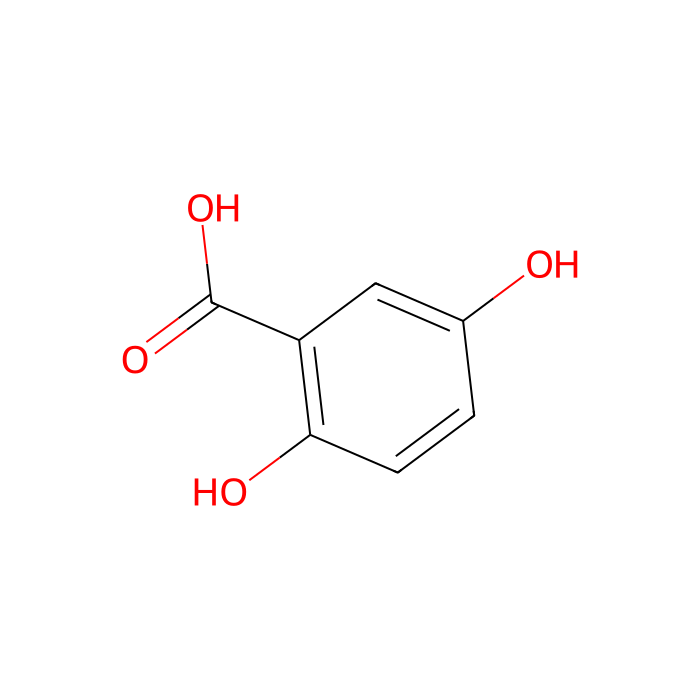
2,5-Dihydroxybenzoic acid - ≥98% , CAS No.490-79-9

CAS: 490-79-9 Cat. No.: D104393 Formula: C7H6O4 Peso molecolare: 154.12 Beilstein Registry Number: 10(4)1441 Numero EC: 207-718-5
Disponibile su ordine
QUALITÀ & PUREZZA ≥98%
Synonyms
Benzoic acid, 2,5-dihydroxy-|Casate sodium|Hydroquinonecarboxylic acid|Gentinatre|gentisic acid|Gentisinic acid|GENTISATE SODIUM|GENTISIC ACID [II]|gentisic acid (2,5-dihydroxybenzoic acid)|5-Hydroxysalicylic acid|5-hydroxy-Salicylic acid|Acido gentisico|Acidum gentisicum|Gentisan|GENTISIC ACID [MI]|Gentisinate|Gentisod|2,5dihydroxybenzoic acid|2,5-DIHYDROXYBENZOIC ACID|2,5-dihydroxy-benzoic acid|Sodium-Gent|Casate|3,6-dihydroxybenzoic acid|2,5-Dihydroxybenzoate, VI|GENOP|Kyselina gentisinova [Czech]|Nagentis|Gentidol|Gentisic acid [INN]|Kyselina 2,5-dihydroxybenzoova|2,5-Dioxybenzoate|Gentisate|3,6-Dihydroxybenzoate|Acidum gentisicum [INN-Latin]|Gentasol|Salicylic acid, 5-hydroxy-|Acido gentisico [INN-Spanish]|gentisicacid|Gensigon|2,5-Dioxybenzoic acid|MESALAZINE IMPURITY G [EP IMPURITY]|Nagent|2,5,dihydroxybenzoic acid|2,5-Dhba|Acide gentisique|Gabail|Legential|5-hydroxy-Salicylate|Acido 2,5-diidrossibenzoico|GENTISIC ACID [WHO-DD]|2,5-Dihydroxy benzoic acid|BENZOIC ACID,2,5-DIHYDROXY|Kyselina gentisinova|Carboxyhydroquinone|Dihydroxybenzoicacid|GTQ|Acido 2,5-diidrossibenzoico [Italian]|Acide gentisique [INN-French]|Kyselina 2,5-dihydroxybenzoova [Czech]|Gentalpin
Storage
Protected from light,Room temperature
Shipped In
Normal
★
Dimensione
Germania (EU)
USA*
Prezzo
Qtà
5g
D104393-5g
Su ordinazione · 8–12 settimane
8,59€
25g
D104393-25g
—
9 Disponibile
9,46€
100g
D104393-100g
—
5 Disponibile

30,28€

45,90€
Salva 15,62 € (34.03%)
250g
D104393-250g
—
2 Disponibile

66,73€

100,57€
Salva 33,84 € (33.65%)
500g
D104393-500g
1 Disponibile
3 Disponibile

120,53€

181,27€
Salva 60,74 € (33.51%)
Enter a quantity for the sizes you want to add.

Panoramica

2,5-Dihydroxybenzoic acid was used as a matrix in the MALDI time-of-flight mass spectrometry analysis of the poly(styrene-co-pentafluorostyrene) copolymers.

Specifiche

Sinonimi
Benzoic acid, 2,5-dihydroxy- | Casate sodium | Hydroquinonecarboxylic acid | Gentinatre | gentisic acid | Gentisinic acid | GENTISATE SODIUM | GENTISIC ACID [II] | gentisic acid (2,5-dihydroxybenzoic acid) | 5-Hydroxysalicylic acid | 5-hydroxy-Salicylic acid | Acido gentisico | Acidum gentisicum | Gentisan | GENTISIC ACID [MI] | Gentisina Mostra altro
Specifiche e purezza
≥98%
Condizioni di conservazione di stoccaggio
Protected from light,Room temperature
Spedito in
Normal
Purezza
≥98%
Nomi e identificatori
Pubchem Sid
Pubchem Sid Url
https://pubchem.ncbi.nlm.nih.gov/substance/488179771
SMILES
C1=CC(=C(C=C1O)C(=O)O)O
IUPAC Name
2,5-dihydroxybenzoic acid
InChIKey
WXTMDXOMEHJXQO-UHFFFAOYSA-N
InChI
1S/C7H6O4/c8-4-1-2-6(9)5(3-4)7(10)11/h1-3,8-9H,(H,10,11)
Isomeri SMILES
C1=CC(=C(C=C1O)C(=O)O)O
WGK Germania
3
RTECS
LY3850000
Peso molecolare
154.12
Beilstein
10(4)1441
Reaxys
2209119
Reaxys-RN_link_address
https://www.reaxys.com/reaxys/secured/hopinto.do?context=S&query=IDE.XRN=2209119&ln=

Dati avanzati

Taxonomic Classification

Taxonomy Tree

KingdomOrganic compounds
SuperclassBenzenoids
ClasseBenzene and substituted derivatives
SubclassBenzoic acids and derivatives
Intermediate Tree Nodes Not available
Direct ParentHydroxybenzoic acid derivatives
Alternative Parents Salicylic acids  Benzoic acids  Hydroquinones  Benzoyl derivatives  1-hydroxy-2-unsubstituted benzenoids  Vinylogous acids  Monocarboxylic acids and derivatives  Carboxylic acids  Organooxygen compounds  Organic oxides  Hydrocarbon derivatives  
Molecular FrameworkAromatic homomonocyclic compounds
Substituents Dihydroxybenzoic acid - Salicylic acid - Salicylic acid or derivatives - Hydroxybenzoic acid - Benzoic acid - Benzoyl - Hydroquinone - 1-hydroxy-2-unsubstituted benzenoid - Phenol - Vinylogous acid - Carboxylic acid derivative - Carboxylic acid - Monocarboxylic acid or derivatives - Organic oxygen compound - Hydrocarbon derivative - Organooxygen compound - Organic oxide - Aromatic homomonocyclic compound
DescrizioneThis compound belongs to the class of organic compounds known as hydroxybenzoic acid derivatives. These are compounds containing a hydroxybenzoic acid (or a derivative), which is a benzene ring bearing a carboxyl and a hydroxyl groups.
External Descriptors dihydroxybenzoic acid
Struttura 3D
Modello di struttura chimica interattiva


Obiettivi associati (umani)
F2 Tclin Thrombin (11687 Activities)
Activity TypeRelationActivity valueUnitsAction TypeJournalPubMed IddoiAssay Aladdin ID
CA2 Tclin Carbonic anhydrase II (17698 Activities)
Activity TypeRelationActivity valueUnitsAction TypeJournalPubMed IddoiAssay Aladdin ID
ESR1 Tclin Estrogen receptor alpha (17718 Activities)
Activity TypeRelationActivity valueUnitsAction TypeJournalPubMed IddoiAssay Aladdin ID
PGR Tclin Progesterone receptor (8562 Activities)
Activity TypeRelationActivity valueUnitsAction TypeJournalPubMed IddoiAssay Aladdin ID
CHRM2 Tclin Muscarinic acetylcholine receptor M2 (10671 Activities)
Activity TypeRelationActivity valueUnitsAction TypeJournalPubMed IddoiAssay Aladdin ID
HTR1A Tclin Serotonin 1a (5-HT1a) receptor (14969 Activities)
Activity TypeRelationActivity valueUnitsAction TypeJournalPubMed IddoiAssay Aladdin ID
ADRA2A Tclin Alpha-2a adrenergic receptor (9450 Activities)
Activity TypeRelationActivity valueUnitsAction TypeJournalPubMed IddoiAssay Aladdin ID
ALOX5 Tclin Arachidonate 5-lipoxygenase (6568 Activities)
Activity TypeRelationActivity valueUnitsAction TypeJournalPubMed IddoiAssay Aladdin ID
AR Tclin Androgen Receptor (11781 Activities)
Activity TypeRelationActivity valueUnitsAction TypeJournalPubMed IddoiAssay Aladdin ID
CHRM1 Tclin Muscarinic acetylcholine receptor M1 (12690 Activities)
Activity TypeRelationActivity valueUnitsAction TypeJournalPubMed IddoiAssay Aladdin ID
TYR Tclin Tyrosinase (717 Activities)
Activity TypeRelationActivity valueUnitsAction TypeJournalPubMed IddoiAssay Aladdin ID
MAOA Tclin Monoamine oxidase A (11911 Activities)
Activity TypeRelationActivity valueUnitsAction TypeJournalPubMed IddoiAssay Aladdin ID
DRD1 Tclin Dopamine D1 receptor (9720 Activities)
Activity TypeRelationActivity valueUnitsAction TypeJournalPubMed IddoiAssay Aladdin ID
ACHE Tclin Acetylcholinesterase (18204 Activities)
Activity TypeRelationActivity valueUnitsAction TypeJournalPubMed IddoiAssay Aladdin ID
PTGS1 Tclin Cyclooxygenase-1 (9233 Activities)
Activity TypeRelationActivity valueUnitsAction TypeJournalPubMed IddoiAssay Aladdin ID
SLC6A2 Tclin Norepinephrine transporter (10102 Activities)
Activity TypeRelationActivity valueUnitsAction TypeJournalPubMed IddoiAssay Aladdin ID
SLC6A4 Tclin Serotonin transporter (12625 Activities)
Activity TypeRelationActivity valueUnitsAction TypeJournalPubMed IddoiAssay Aladdin ID
ADRA1A Tclin Alpha-1a adrenergic receptor (8359 Activities)
Activity TypeRelationActivity valueUnitsAction TypeJournalPubMed IddoiAssay Aladdin ID
PTGS2 Tclin Cyclooxygenase-2 (13999 Activities)
Activity TypeRelationActivity valueUnitsAction TypeJournalPubMed IddoiAssay Aladdin ID
OPRM1 Tclin Mu opioid receptor (19785 Activities)
Activity TypeRelationActivity valueUnitsAction TypeJournalPubMed IddoiAssay Aladdin ID
DRD3 Tclin Dopamine D3 receptor (14368 Activities)
Activity TypeRelationActivity valueUnitsAction TypeJournalPubMed IddoiAssay Aladdin ID
SLC6A3 Tclin Dopamine transporter (10535 Activities)
Activity TypeRelationActivity valueUnitsAction TypeJournalPubMed IddoiAssay Aladdin ID
SLC18A2 Tclin Synaptic vesicular amine transporter (118 Activities)
Activity TypeRelationActivity valueUnitsAction TypeJournalPubMed IddoiAssay Aladdin ID
KCNH2 Tclin HERG (29587 Activities)
Activity TypeRelationActivity valueUnitsAction TypeJournalPubMed IddoiAssay Aladdin ID
PDE3A Tclin Phosphodiesterase 3A (3309 Activities)
Activity TypeRelationActivity valueUnitsAction TypeJournalPubMed IddoiAssay Aladdin ID
HTR2B Tclin Serotonin 2b (5-HT2b) receptor (10323 Activities)
Activity TypeRelationActivity valueUnitsAction TypeJournalPubMed IddoiAssay Aladdin ID
TBXA2R Tclin Thromboxane A2 receptor (5717 Activities)
Activity TypeRelationActivity valueUnitsAction TypeJournalPubMed IddoiAssay Aladdin ID
PDE4A Tclin Phosphodiesterase 4A (1943 Activities)
Activity TypeRelationActivity valueUnitsAction TypeJournalPubMed IddoiAssay Aladdin ID
ADORA3 Tchem Adenosine A3 receptor (15931 Activities)
Activity TypeRelationActivity valueUnitsAction TypeJournalPubMed IddoiAssay Aladdin ID
CA1 Tclin Carbonic anhydrase I (13240 Activities)
Activity TypeRelationActivity valueUnitsAction TypeJournalPubMed IddoiAssay Aladdin ID
HRH3 Tclin Histamine H3 receptor (10389 Activities)
Activity TypeRelationActivity valueUnitsAction TypeJournalPubMed IddoiAssay Aladdin ID
KDR Tclin Vascular endothelial growth factor receptor 2 (20924 Activities)
Activity TypeRelationActivity valueUnitsAction TypeJournalPubMed IddoiAssay Aladdin ID
CA14 Tclin Carbonic anhydrase XIV (1305 Activities)
Activity TypeRelationActivity valueUnitsAction TypeJournalPubMed IddoiAssay Aladdin ID
MMP3 Tchem Matrix metalloproteinase 3 (3433 Activities)
Activity TypeRelationActivity valueUnitsAction TypeJournalPubMed IddoiAssay Aladdin ID
MMP8 Tchem Matrix metalloproteinase 8 (1942 Activities)
Activity TypeRelationActivity valueUnitsAction TypeJournalPubMed IddoiAssay Aladdin ID
CA12 Tclin Carbonic anhydrase XII (6231 Activities)
Activity TypeRelationActivity valueUnitsAction TypeJournalPubMed IddoiAssay Aladdin ID
CA9 Tclin Carbonic anhydrase IX (8255 Activities)
Activity TypeRelationActivity valueUnitsAction TypeJournalPubMed IddoiAssay Aladdin ID
MMP1 Tchem Matrix metalloproteinase-1 (7046 Activities)
Activity TypeRelationActivity valueUnitsAction TypeJournalPubMed IddoiAssay Aladdin ID
HEK293 (82097 Activities)
Activity TypeRelationActivity valueUnitsAction TypeJournalPubMed IddoiAssay Aladdin ID
POLI Tchem DNA polymerase iota (116820 Activities)
Activity TypeRelationActivity valueUnitsAction TypeJournalPubMed IddoiAssay Aladdin ID
ABCB11 Tchem Bile salt export pump (2311 Activities)
Activity TypeRelationActivity valueUnitsAction TypeJournalPubMed IddoiAssay Aladdin ID
SLCO1B1 Tchem Solute carrier organic anion transporter family member 1B1 (2672 Activities)
Activity TypeRelationActivity valueUnitsAction TypeJournalPubMed IddoiAssay Aladdin ID
CBX1 Tbio Chromobox protein homolog 1 (92434 Activities)
Activity TypeRelationActivity valueUnitsAction TypeJournalPubMed IddoiAssay Aladdin ID
SLCO1B3 Tchem Solute carrier organic anion transporter family member 1B3 (2517 Activities)
Activity TypeRelationActivity valueUnitsAction TypeJournalPubMed IddoiAssay Aladdin ID
SLC26A4 Tbio Pendrin (86 Activities)
Activity TypeRelationActivity valueUnitsAction TypeJournalPubMed IddoiAssay Aladdin ID
Obiettivi associati (non umani)
Ca7 Carbonic anhydrase VII (3 Activities)
Activity TypeRelationActivity valueUnitsAction TypeJournalPubMed IddoiAssay Aladdin ID
Nos2 Nitric oxide synthase, inducible (3573 Activities)
Activity TypeRelationActivity valueUnitsAction TypeJournalPubMed IddoiAssay Aladdin ID
Mmp2 Matrix metalloproteinase-2 (12 Activities)
Activity TypeRelationActivity valueUnitsAction TypeJournalPubMed IddoiAssay Aladdin ID
Ptpn1 Protein-tyrosine phosphatase 1B (270 Activities)
Activity TypeRelationActivity valueUnitsAction TypeJournalPubMed IddoiAssay Aladdin ID
Mmp9 Matrix metalloproteinase 9 (38 Activities)
Activity TypeRelationActivity valueUnitsAction TypeJournalPubMed IddoiAssay Aladdin ID
Trypanosoma cruzi (99888 Activities)
Activity TypeRelationActivity valueUnitsAction TypeJournalPubMed IddoiAssay Aladdin ID
J774 (3120 Activities)
Activity TypeRelationActivity valueUnitsAction TypeJournalPubMed IddoiAssay Aladdin ID
lef Anthrax lethal factor (7585 Activities)
Activity TypeRelationActivity valueUnitsAction TypeJournalPubMed IddoiAssay Aladdin ID
Txnrd1 Thioredoxin reductase 1, cytoplasmic (45279 Activities)
Activity TypeRelationActivity valueUnitsAction TypeJournalPubMed IddoiAssay Aladdin ID
SARS-CoV-2 (38078 Activities)
Activity TypeRelationActivity valueUnitsAction TypeJournalPubMed IddoiAssay Aladdin ID
Meccanismi d'azione
Certificati (CoA, COO, BSE/TSE e tabella di analisi)
C of A & Other Certificates(BSE/TSE, COO):
Analytical Chart:

Find and download the COA for your product by matching the lot number on the packaging.

24 results found

Lot NumberCertificate TypeDataOggetto
J2126650J2126650Certificate of AnalysisAug 11, 2025 D104393
J2126659J2126659Certificate of AnalysisAug 11, 2025 D104393
J2126660J2126660Certificate of AnalysisAug 11, 2025 D104393
G2516287G2516287Certificate of AnalysisJul 24, 2025 D104393
G2516286G2516286Certificate of AnalysisJul 24, 2025 D104393
K2310456K2310456Certificate of AnalysisJul 29, 2023 D104393
J2524014J2524014Certificate of AnalysisJul 29, 2023 D104393
K2310455K2310455Certificate of AnalysisJul 29, 2023 D104393
E23291123E23291123Certificate of AnalysisMay 11, 2023 D104393
E2614079E2614079Certificate of AnalysisMay 11, 2023 D104393
E23291122E23291122Certificate of AnalysisMay 11, 2023 D104393
E23291121E23291121Certificate of AnalysisMay 11, 2023 D104393
E23291118E23291118Certificate of AnalysisMay 11, 2023 D104393
E23291115E23291115Certificate of AnalysisMay 11, 2023 D104393
E23291114E23291114Certificate of AnalysisMay 11, 2023 D104393
E23291079E23291079Certificate of AnalysisMay 11, 2023 D104393
K2607121K2607121Certificate of AnalysisMay 11, 2023 D104393
G2220542G2220542Certificate of AnalysisJun 28, 2022 D104393
G2220540G2220540Certificate of AnalysisJun 28, 2022 D104393
B2401023B2401023Certificate of AnalysisAug 30, 2021 D104393
I2410260I2410260Certificate of AnalysisAug 30, 2021 D104393
G2308196G2308196Certificate of AnalysisAug 30, 2021 D104393
B2401022B2401022Certificate of AnalysisAug 30, 2021 D104393
C23311643C23311643Certificate of AnalysisAug 30, 2021 D104393
Proprietà chimiche e fisiche
SolubilitàSoluble in Ether,Alcohol; Insoluble in Benzene,Chloroform
SensibilitàLight sensitive.
Punto di fusione (°C)200-205°C
Peso molecolare154.12
XLogP31.600
Hydrogen Bond Donor Count3
Hydrogen Bond Acceptor Count4
Rotatable Bond Count1
Exact Mass154.027 Da
Monoisotopic Mass154.027 Da
Topological Polar Surface Area77.800 Ų
Heavy Atom Count11
Formal Charge0
Complexity157.000
Isotope Atom Count0
Defined Atom Stereocenter Count0
Undefined Atom Stereocenter Count0
Defined Bond Stereocenter Count0
Undefined Bond Stereocenter Count0
The total count of all stereochemical bonds0
Covalently-Bonded Unit Count1
Sicurezza e pericoli (GHS)
Pictogrammi
Segnale
Warning
Indicazioni di pericolo

H302:Harmful if swallowed

H315:Causes skin irritation

H319:Causes serious eye irritation

H335:May cause respiratory irritation

Precauzioni

P261:Avoid breathing dust/fume/gas/mist/vapors/spray.

P264:Wash hands [and …] thoroughly after handling.

P270:Do not eat, drink or smoke when using this product.

P271:Use only outdoors or in a well-ventilated area.

P280:Wear protective gloves/protective clothing/eye protection/face protection.

P321:Specific treatment (see ... on this label).

P330:Rinse mouth.

P302+P352:IF ON SKIN: wash with plenty of water.

P304+P340:IF INHALED: Remove person to fresh air and keep comfortable for breathing.

P305+P351+P338:IF IN EYES: Rinse cautiously with water for several minutes. Remove contact lenses if present and easy to do - continue rinsing.

P362+P364:Take off contaminated clothing and wash it before reuse.

P405:Store locked up.

P403+P233:Store in a well-ventilated place. Keep container tightly closed.

P501:Dispose of contents/container to an approved waste disposal plant.

P264+P265:Wash hands [and …] thoroughly after handling. Do not touch eyes.

P301+P317:IF SWALLOWED: Get medical help.

P337+P317:If eye irritation persists: Get medical help.

P332+P317:If skin irritation occurs: Get medical help.

P319:Get medical help if you feel unwell.

WGK Germania
3
RTECS
LY3850000
Reaxys
2209119
Reaxys-RN_link_address
https://www.reaxys.com/reaxys/secured/hopinto.do?context=S&query=IDE.XRN=2209119&ln=
Indice Merck
4398
Citations of This Product
Calcolatori di soluzioni
Recensioni

Recensioni dei clienti

Application Protocols

No validated immunoassay protocols (WB, IHC, IF, FC) apply to this small-molecule reagent. For analytical usage as a MALDI matrix (literature context):

  • Prepare a fresh, saturated solution in 50–70% acetonitrile/water or ethanol/water containing ~0.1% TFA (or suitable acid).
  • Filter through a 0.2 µm PTFE or PVDF syringe filter.
  • Mix analyte and matrix (e.g., 1:1 to 1:10 v/v matrix:analyte solution), spot onto target plate, and allow to air dry.
  • Optimize solvent composition and ratios for specific analyte classes (peptides, lipids, glycans).

These steps are general literature practices and not item-specific validated protocols.

Biological Roles

Literature context (biochemistry; not medical/clinical claims):

  • Metabolite status: 2,5-Dihydroxybenzoic acid (gentisic acid) is a known metabolite of salicylic acid in plants and mammals and an intermediate in microbial gentisate pathway catabolism of aromatic compounds.
  • Enzymology: Gentisate 1,2-dioxygenase catalyzes ring cleavage of gentisate to maleylpyruvate in bacteria, a step in degrading phenolic pollutants.
  • Redox/antioxidant behavior: The dihydroxy motif can chelate metal ions and participate in radical scavenging, contributing to antioxidant capacity in vitro (mechanistic/chemical description).
  • Plant signaling: As a salicylate derivative, gentisic acid has been reported to occur in plants associated with stress responses and phenylpropanoid metabolism (general biochemical observation).
  • Protein/ligand interactions: The aromatic diacid can form hydrogen bonds and π–π contacts, and its anionic forms interact with cationic protein sites; these features underlie its suitability as a MALDI matrix co-crystallization partner.

Note: These roles describe biochemical pathways and physicochemical interactions. They do not imply therapeutic or diagnostic use of this product.

Buffer Applications

This compound is not a standard laboratory buffering agent. However, its acid–base properties inform limited, specialized uses.

  • Acid–base characteristics (literature):
    • pKa1 (carboxyl) ~3: buffering capacity near pH ~2–4 if both acid/base forms present.
    • pKa2 (phenolic) ~10: weak buffering possible near pH ~9–11 in systems tolerant of phenolates.
  • Practical notes:
    • Rarely used as a primary buffer due to color/UV absorbance and limited water solubility at neutral pH.
    • For analytical sample prep (e.g., MALDI), solutions are commonly made in water/organic with acid modifiers (e.g., 0.1% TFA) rather than relying on intrinsic buffering.
  • Recommendation: Use established buffer systems (e.g., citrate, acetate, phosphate, Tris) for general pH control, and use this compound primarily as a matrix or reagent as appropriate.
Green Alternatives

Greenness considerations focus on the processes in which 2,5-dihydroxybenzoic acid is employed (matrix preparation or derivatization), rather than replacement of the reagent itself.

  • Solvent choices (literature-leaning guidance):
    • Prefer ethanol or isopropanol over methanol or acetonitrile where compatible.
    • For aqueous workups, exploit its pH-dependent solubility to avoid chlorinated solvents (e.g., extract esters in ethyl acetate with aqueous bicarbonate washes).
  • Alternative matrices (use-case comparison; literature):
    • CHCA (α-cyano-4-hydroxycinnamic acid): Strong for peptides; sometimes requires acetonitrile.
    • Sinapinic acid: Suited for proteins; similar solvent demands.
    • DHB (this product) often allows operation with higher water content, potentially lowering VOC usage, but crystallization behavior must be optimized.

Comparison snapshot (qualitative):

  • DHB vs CHCA: DHB is generally more forgiving for heterogeneous samples and may tolerate greener solvent ratios; CHCA can offer higher sensitivity for small peptides but may need higher ACN.
  • Process greening:
    • Use enzyme-compatible buffers and aqueous-organic mixtures (EtOH/H2O) for matrix solutions where performance permits.
    • Apply microscale spotting to reduce solvent consumption and waste.
  • Waste management: Collect acidic organic wastes separately; neutralize aqueous basic rinses prior to disposal per regulations.
Pharmaceutical Uses

No therapeutic uses are claimed for this product. The following refer to formulation/analytical roles, not clinical applications.

  • Analytical role (literature): Frequently used as a MALDI-TOF MS matrix in biopharmaceutical analytics to profile peptides, glycoforms, lipids, and excipient-related species.
  • Excipient/antioxidant context (literature): Aromatic dihydroxybenzoic acids can act as antioxidants in certain formulations by metal chelation and radical quenching; specific acceptance and limits depend on pharmacopeial monographs, which should be consulted if formulation use is contemplated.
  • Regulatory note: Pharmacopeial status for 2,5-dihydroxybenzoic acid as an excipient is context-dependent; verify applicable USP/EP/JP references. This catalog item is supplied for research use only (per Product Data).
Physical Properties

Item-specific specifications (this catalog entry):

  • Grade/Purity: Not specified for this item; refer to CoA/Spec Sheet.
  • Appearance: Not specified for this item; refer to CoA/Spec Sheet.

Literature/general values (for reference only; not item specifications):

  • Molecular formula: C7H6O4 (literature)
  • Molecular weight: ~154.12 g/mol (literature)
  • Melting point: typically ~200–205 °C (literature; often reported with possible slight decomposition near mp)
  • Boiling point: not applicable (decomposes before boiling; literature)
  • Acid dissociation constants (pKa): pKa1 (carboxyl) ~3; pKa2 (phenolic) ~10 (literature ranges ~2.9–3.1 and ~9.8–10.2)
  • Solubility: sparingly to moderately soluble in water at neutral pH; readily soluble in polar organics such as methanol, ethanol, acetone, and DMSO; aqueous solubility increases markedly in basic media due to carboxylate/phenolate formation (literature, qualitative)
  • Partitioning: expected low logP due to dihydroxy and acid functionality; ionization reduces apparent logD at physiological pH (literature, qualitative)
  • UV–vis: phenolic aromatics typically show π→π* absorption in the near-UV; exact λmax depends on solvent/ionization state (literature).

Refractive index, density, water content, metal content, and UV cutoff: Not specified for this item; refer to CoA/Spec Sheet.

Quality and Grades
  • Item-specific grade/purity: Not specified for this item; refer to CoA/Spec Sheet.
  • Typical interpretations (general):
    • Analytical/AR grade: Controlled inorganic/organic impurities suitable for general analytical use.
    • HPLC grade (if offered): Low UV background and particulates for chromatography; often used to prepare MALDI or LC-MS sample matrices when purity is critical.
    • Bio/bioultra grade: Low bioburden/endotoxin; relevant when used as an analytical matrix or standard with biological samples.
  • Stabilizers: None indicated for this item. If stabilizers or anti-oxidants are present, they would be listed on the CoA; absence is generally preferred for spectrometric matrix applications.
  • Quality control expectations (general guidance):
    • Identity confirmation by 1H/13C NMR and MS; purity by HPLC or GC (if volatile derivatives) and titrimetric acid content.
    • Trace metals may influence certain analytical uses (e.g., MS matrix performance); refer to CoA if low-metal content is required.
  • Fit-for-use note: Select the grade based on end-use—e.g., higher purity/low-UV background for MALDI-TOF matrices, or standard reagent grade for synthetic transformations.
Reaction and Applications

Key application areas for 2,5-dihydroxybenzoic acid (DHB, gentisic acid):

  • Analytical matrix (literature):
    • Widely used MALDI-TOF MS matrix for peptides, lipids, glycans, and small metabolites. Forms fine co-crystals with analytes; hydrogen bonding and π–π interactions aid co-crystallization.
    • Often employed with additives (e.g., TFA, ammonium salts) to tune ionization.
  • Synthetic transformations (literature):
    • Esterification (Fischer or Steglich) to gentisate esters.
    • Acid chloride formation (SOCl2 or oxalyl chloride) enabling amide coupling to gentisamide derivatives.
    • O-alkylation/acylation of phenolic OH under basic conditions (NaH/K2CO3) to give mono- or di-protected ethers/esters.
    • Metal complexation via catechol-like chelation (2-OH and carboxylate/5-OH) for coordination studies.
  • Electrophilic aromatic substitution (literature):
    • The ring bears both activating (phenols) and deactivating (carboxyl) groups; regioselectivity is influenced by strong directing effects at positions 3 and 6. Protective group strategies may be required for selective substitution.
  • Practical tips:
    • For MALDI use, prepare fresh, filtered matrix solutions; minimize light exposure (Product Data) to maintain performance.
    • For synthetic use, dry solvents and exclude moisture when forming acid chlorides or using carbodiimide couplings to avoid hydrolysis.
Reaction Conditions

General literature guidance (not item specifications):

  • Esterification (Fischer):
    • Solvent/reagent: Excess MeOH or EtOH with catalytic H2SO4 or p-TsOH.
    • Conditions: Reflux 2–16 h; use Dean–Stark if using less volatile alcohols; typical isolated yields good to excellent after acid–base workup.
  • Steglich esterification:
    • Solvent: DCM or THF; reagents: DCC or EDC, catalytic DMAP.
    • Conditions: 0–25 °C, 2–24 h; urea byproduct removal via filtration.
  • Acid chloride formation:
    • Reagents: SOCl2 (0.5–3 eq) ± catalytic DMF; solvent-free or in DCM/THF.
    • Conditions: Reflux 1–4 h under anhydrous atmosphere; remove excess under reduced pressure; proceed in situ to amide/ester.
  • O-alkylation of phenols:
    • Base: K2CO3 or NaH; solvent: acetone, DMF, or MeCN.
    • Electrophiles: Alkyl halides/sulfates; 0–60 °C, 1–18 h. Monitor for di- vs mono-alkylation.
  • Electrophilic substitution (e.g., nitration):
    • Mixed acid at low temperature (0–5 °C) with careful control to avoid over-nitration; protection strategies often required.
  • MALDI matrix preparation (analytical use):
    • Typical solutions: Saturated water/organic (e.g., 50–70% acetonitrile or ethanol) with 0.1% TFA; filter (0.2 µm) prior to spotting. Co-crystallize by dried-droplet or thin-layer methods.

Note: Reaction times/yields depend on substrate and protection strategy. Always confirm conditions with small-scale trials.

Safety and Handling

Authoritative safety information must be taken from the product SDS. The following are general precautions for phenolic aromatic acids.

  • GHS classification, signal word, and pictograms: Not specified for this item; consult the SDS.
  • Anticipated hazards (general): May cause skin/eye irritation; dust may cause respiratory irritation. Phenolic compounds can cause defatting of skin on prolonged contact.
  • PPE: Use lab coat, nitrile gloves, and safety glasses. Handle powders in a fume hood to minimize dust inhalation.
  • First aid (general):
    • Skin/eye contact: Rinse with water for several minutes; remove contaminated clothing; seek medical attention if irritation persists.
    • Inhalation: Move to fresh air; seek medical attention if symptoms occur.
    • Ingestion: Rinse mouth; do not induce vomiting; seek medical attention.
  • Incompatibilities and stability (general):
    • Avoid strong oxidizers and strong bases unless intended for reaction (will deprotonate/oxidize). Forms salts with bases.
    • Protect from light (per Product Data) to minimize potential photo-degradation; aromatic dihydroxy compounds can slowly oxidize in air/light.
  • Handling tips:
    • Minimize exposure to humidity; cap tightly after use.
    • For solution prep, dissolve in alcohols or DMSO; adjust pH for aqueous solutions.
  • Waste disposal: Dispose of solutions/solids as organic acid waste per institutional and local regulations.
Solvent Selection

This product is a solid aromatic dihydroxycarboxylic acid, not a bulk solvent. Solvent choice pertains to its dissolution and use in reactions/analytical prep.

  • Polarity and ionization considerations (literature):
    • Neutral form is moderately polar; deprotonation (carboxylate/phenolate) greatly increases aqueous solubility.
  • Practical solvent options:
    • DMSO, DMF, methanol, ethanol, acetone: Good solvating power for stock solutions.
    • Water: Low to moderate solubility at neutral pH; high solubility in basic aqueous media (e.g., with NaOH) forming gentisate salts.
    • Acetonitrile/water with acid (e.g., 0.1% TFA): Common in MALDI/LC-MS sample preparation (literature practice).
  • When to choose which:
    • For spectrometric matrix uses, volatile organic/water mixtures (e.g., acetonitrile/water) facilitate rapid crystal formation upon drying.
    • For esterifications/derivatizations, use alcoholic solvents or aprotic polar solvents under dehydrating conditions.
  • Comparison (general):
    • Versus less polar aromatics, this compound benefits from hydrogen-bonding solvents.
    • In purely nonpolar solvents (hexanes, toluene), solubility is typically poor unless converted to esters or used with co-solvents.
  • Tip: Filter stock solutions (0.2 µm PTFE) for analytical applications to remove particulates prior to spotting/injection.
Storage and Reconstitution
  • Storage (from Product Data):
    • Protected from light, Room temperature.
    • Shipped: Normal conditions.
  • Container: Store in a tightly closed amber bottle with desiccant if available to limit moisture and photo-exposure.
  • Stability notes (general): Aromatic dihydroxy acids can slowly oxidize/discolor upon prolonged light/air exposure; minimize headspace oxygen and avoid prolonged sunlight.
  • Reconstitution/stock solutions (literature guidance):
    • Prepare concentrated stocks in DMSO, methanol, or ethanol. For aqueous use, dissolve with gentle heating or adjust to basic pH to form soluble salts; back-titrate as needed.
    • For MALDI matrix use, make fresh water/organic solutions (e.g., acetonitrile or ethanol with 0.1% TFA), filter (0.2 µm), and use the same day when possible.
  • Freeze–thaw: Solid is robust at room temperature when protected from light; avoid repeated freeze–thaw of solutions—aliquot and store at 2–8 °C or −20 °C depending on solvent if longer-term solution storage is necessary (literature practice).
  • Specifications such as water content, metals, residual solvents: Not specified for this item; refer to CoA/Spec Sheet.
  • Research use: For research use only (per Product Data).
Structure and Identity

A dihydroxy-substituted benzoic acid (gentisic acid) featuring one carboxylic acid and two phenolic hydroxyls on an aromatic ring (2- and 5-positions).

  • Item-specific identifiers (from Product Data):
    • Product name: 2,5-Dihydroxybenzoic acid
    • CAS: 490-79-9
    • CID (PubChem): 3469
    • InChIKey: 410795 (as provided)
    • SMILES: Not specified for this item; refer to CoA/Spec Sheet.
  • Structural features (general chemistry description):
    • Core scaffold: Benzene ring bearing a carboxyl (–CO2H) and two phenolic –OH groups.
    • Substitution pattern: Hydroxyls at the 2- and 5-positions relative to the carboxyl carbon (ortho and meta to –CO2H, respectively).
    • Functional groups: Aromatic ring, carboxylic acid, two phenols (capable of hydrogen bonding, metal chelation, and acid–base behavior).
  • Computed/literature identifiers (for reference; literature):
    • Molecular formula (literature): C7H6O4
    • Molecular weight (literature): ~154.12 g/mol
    • Representative SMILES (literature): O=C(O)c1cc(O)ccc1O (2,5-isomer)
  • 2D structure in words (general): A planar benzene ring with –CO2H at position 1; –OH groups at positions 2 (ortho) and 5 (meta) creating an O–H…O intramolecular H-bond possibility at the 2-position and a second phenol across the ring at 5.
Synthetic Utility

Functional group portfolio enables diverse derivatizations and coordination chemistry.

  • Carboxylic acid manifold:
    • Esterification (acid-catalyzed or carbodiimide-mediated) to tune lipophilicity and protect –CO2H.
    • Amide formation via acid chloride (SOCl2, oxalyl chloride) or coupling reagents (EDC/HOBt, HATU) to access gentisamide scaffolds.
  • Phenolic OH chemistry:
    • Selective O-alkylation/acylation under basic conditions (NaH, K2CO3) yields mono- or di-ethers/esters; orthogonal protection enables regioselective elaboration.
    • Silyl protection (TBS, TBDPS) to mask phenols during further transformations.
  • Aromatic substitution:
    • Directed electrophilic substitution possible at positions governed by the interplay of activating (–OH) and deactivating (–CO2H) groups; nitration/halogenation typically requires controlled, mild conditions to avoid overreaction.
  • Coordination/chelation:
    • Catechol-like donor set (adjacent phenol/carboxylate resonance contributors) supports metal complex formation for catalysis or materials.
  • As a building block:
    • Precursor to azo dyes, polyesters (via diester derivatives), and probes where phenolic responsiveness is leveraged.

Practical considerations:

  • Protect phenols when forming acyl chlorides to prevent side reactions.
  • Exploit pH-switchable solubility for purification (acid–base extraction), minimizing chlorinated solvent use.
Target Specificity

Not applicable. This product is a small-molecule reagent, not an antibody or affinity reagent. No target, epitope, species reactivity, clone, or isotype information applies.

Domande frequenti

What is the purity of this product?
This product is supplied at ≥98% purity (chemical assay). Lot-specific values are stated on the Certificate of Analysis.
How should this product be stored?
Store at room temperature, protected from light. The material is light-sensitive — keep it in its original opaque or amber container.
How is this product shipped?
This product ships under standard ambient conditions. No temperature-controlled packaging is required.
What are the CAS number, molecular formula and molecular weight?
The CAS Number is 490-79-9, the molecular formula is C7H6O4, and the molecular weight is 154.12 g/mol. InChIKey WXTMDXOMEHJXQO-UHFFFAOYSA-N.
What documentation is provided?
Available product documentation, including Certificates of Analysis (COA), Safety Data Sheets (SDS), and specification sheets, is shown in the product document area. Document availability and access follow the current site policy.

Prodotti correlati

3,4-Dihydroxybenzoic acid - ≥97% , CAS No.99-50-3
acido 5-bromo-2,4-diidrossibenzoico monoidrato - ≥98% , CAS No.160348-98-1
Methyl 5-bromo-2,3-dihydroxybenzoate - ≥98% , CAS No.105603-49-4
Methyl 2,3-Dihydroxybenzoate - ≥98% , CAS No.2411-83-8
Methyl 2,4-dihydroxybenzoate - ≥98% , CAS No.2150-47-2
Methyl 2,5-Dihydroxybenzoate - ≥98% , CAS No.2150-46-1
Methyl 2,6-dihydroxybenzoate - ≥98% , CAS No.2150-45-0
Methyl 3,5-dihydroxybenzoate - ≥98% , CAS No.2150-44-9
Methyl 3,4-Dihydroxybenzoate - ≥98% , CAS No.2150-43-8
Ethyl 3,5-dihydroxybenzoate - ≥97% , CAS No.4142-98-7
Ethyl 2,3-dihydroxybenzoate - ≥98% , CAS No.3943-73-5
Ethyl 2,4-dihydroxybenzoate - ≥97% , CAS No.4143-00-4
Ethyl 3,4-Dihydroxybenzoate - ≥98% , CAS No.3943-89-3
2,6-Dihydroxybenzoic acid - ≥98% , CAS No.303-07-1
2,4-Dihydroxybenzoic acid - ≥98% , CAS No.89-86-1
2,5-Dihydroxybenzoic Acid Butylamine Salt [Matrix for MALDI-TOF/MS] - ≥98%(HPLC)(T) , CAS No.666174-80-7
2,3-Dihydroxybenzoic Acid - ≥98%(HPLC) , CAS No.303-38-8
Ethyl 4-bromo-2,3-dihydroxybenzoate - ≥95% , CAS No.1312609-83-8
4-Bromo-3,5-dihydroxybenzoic acid - ≥99% , CAS No.16534-12-6
2,5-Dihydroxybenzoic acid - ≥99%(HPLC), matrix substance for MALDI-MS , CAS No.490-79-9
2-Hydroxyethyl 2,4-Dihydroxybenzoate - ≥97% , CAS No.145073-32-1
3,5-Dihydroxybenzoic acid - Moligand™, ≥97% , Agonist of HCA 1 receptor, CAS No.99-10-5
3-Bromo-2,6-dihydroxybenzoic Acid - ≥98% , CAS No.26792-49-4
Ethyl 2,5-dihydroxybenzoate - ≥96% , CAS No.3943-91-7
2,3-Dihydroxybenzoic Acid - 10mM in DMSO , CAS No.303-38-8
2,4-Dihydroxybenzoic acid - 10mM in DMSO , CAS No.89-86-1
2,5-Dihydroxybenzoic acid - 10mM in DMSO , CAS No.490-79-9
2,6-Dihydroxybenzoic acid - 10mM in DMSO , CAS No.303-07-1
3,5-Dihydroxybenzoic acid - Moligand™, 10mM in DMSO , Agonist of HCA 1 receptor, CAS No.99-10-5
Methyl 3,4-Dihydroxybenzoate - 10mM in DMSO , CAS No.2150-43-8
Protocatechuic acid - 10mM in DMSO , CAS No.99-50-3
Protocatechuic acid - analytical standard, ≥97%(HPLC) , CAS No.99-50-3
2,5-Dihydroxybenzoic acid - for synthesis , CAS No.490-79-9
3-Chloro-4,5-dihydroxybenzoic acid - ≥95% , CAS No.87932-49-8

Desidera che le inviamo un messaggio quando avremo sconti disponibili?

Ricordamelo più tardi

Grazie! Controlli la sua casella di posta per confermare.

Ops! Le notifiche sono disabilitate.