Determine the necessary mass, volume, or concentration for preparing a solution.
| Activity Type | Relation | Activity value | Units | Action Type | Journal | PubMed Id | doi | Assay Aladdin ID |
|---|

Taxonomy Tree
| Kingdom | Organic compounds |
|---|---|
| Superclass | Benzenoids |
| Classe | Benzene and substituted derivatives |
| Subclass | Aniline and substituted anilines |
| Intermediate Tree Nodes | Not available |
| Direct Parent | Aniline and substituted anilines |
| Alternative Parents | Primary amines Organopnictogen compounds Hydrocarbon derivatives |
| Molecular Framework | Aromatic homomonocyclic compounds |
| Substituents | Aniline or substituted anilines - Organic nitrogen compound - Organopnictogen compound - Hydrocarbon derivative - Primary amine - Organonitrogen compound - Amine - Aromatic homomonocyclic compound |
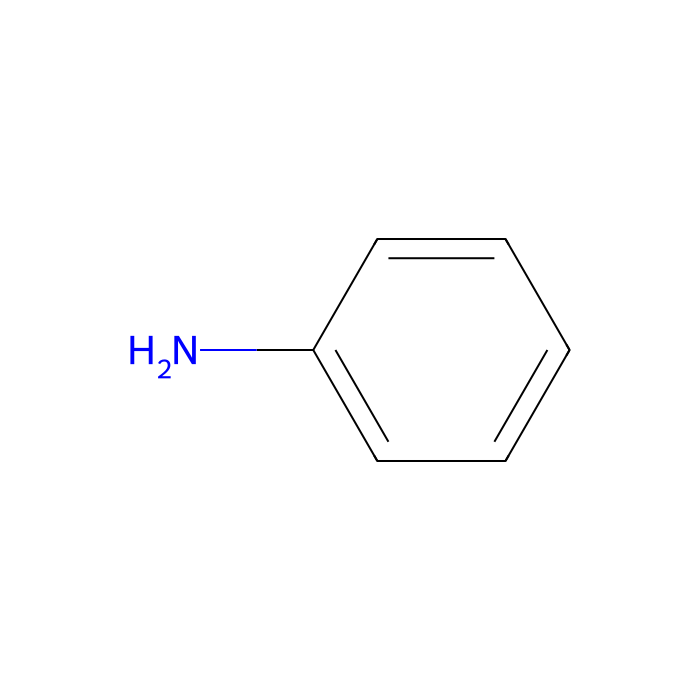
| Descrizione | This compound belongs to the class of organic compounds known as aniline and substituted anilines. These are organic compounds containing an aminobenzene moiety. |
| External Descriptors | an arylamine |
| Activity Type | Relation | Activity value | Units | Action Type | Journal | PubMed Id | doi | Assay Aladdin ID |
|---|
| Activity Type | Relation | Activity value | Units | Action Type | Journal | PubMed Id | doi | Assay Aladdin ID |
|---|
| Activity Type | Relation | Activity value | Units | Action Type | Journal | PubMed Id | doi | Assay Aladdin ID |
|---|
| Activity Type | Relation | Activity value | Units | Action Type | Journal | PubMed Id | doi | Assay Aladdin ID |
|---|
| Activity Type | Relation | Activity value | Units | Action Type | Journal | PubMed Id | doi | Assay Aladdin ID |
|---|
| Activity Type | Relation | Activity value | Units | Action Type | Journal | PubMed Id | doi | Assay Aladdin ID |
|---|
| Activity Type | Relation | Activity value | Units | Action Type | Journal | PubMed Id | doi | Assay Aladdin ID |
|---|
| Activity Type | Relation | Activity value | Units | Action Type | Journal | PubMed Id | doi | Assay Aladdin ID |
|---|
| Activity Type | Relation | Activity value | Units | Action Type | Journal | PubMed Id | doi | Assay Aladdin ID |
|---|
| Activity Type | Relation | Activity value | Units | Action Type | Journal | PubMed Id | doi | Assay Aladdin ID |
|---|
| Activity Type | Relation | Activity value | Units | Action Type | Journal | PubMed Id | doi | Assay Aladdin ID |
|---|
| Activity Type | Relation | Activity value | Units | Action Type | Journal | PubMed Id | doi | Assay Aladdin ID |
|---|
| Activity Type | Relation | Activity value | Units | Action Type | Journal | PubMed Id | doi | Assay Aladdin ID |
|---|
Find and download the COA for your product by matching the lot number on the packaging.
| Lot Number | Certificate Type | Data | Oggetto |
|---|---|---|---|
 H2604554 | Certificate of Analysis | Jun 08, 2026 | A112125 |
| H2604265 | Certificate of Analysis | Jun 08, 2026 | A112125 |
| H2604264 | Certificate of Analysis | Jun 08, 2026 | A112125 |
| K2616617 | Certificate of Analysis | Dec 18, 2025 | A112125 |
| A2606105 | Certificate of Analysis | Dec 18, 2025 | A112125 |
| A2606133 | Certificate of Analysis | Dec 18, 2025 | A112125 |
| A2606137 | Certificate of Analysis | Dec 18, 2025 | A112125 |
| A2606138 | Certificate of Analysis | Dec 18, 2025 | A112125 |
| D2624008 | Certificate of Analysis | Dec 18, 2025 | A112125 |
| A2508060 | Certificate of Analysis | Dec 26, 2024 | A112125 |
| J2520207 | Certificate of Analysis | Dec 26, 2024 | A112125 |
| A2508062 | Certificate of Analysis | Dec 26, 2024 | A112125 |
| A2508061 | Certificate of Analysis | Dec 26, 2024 | A112125 |
| A2508059 | Certificate of Analysis | Dec 26, 2024 | A112125 |
| E2331415 | Certificate of Analysis | May 18, 2023 | A112125 |
| E2331419 | Certificate of Analysis | May 18, 2023 | A112125 |
| E2331421 | Certificate of Analysis | May 18, 2023 | A112125 |
| E2331412 | Certificate of Analysis | May 18, 2023 | A112125 |
| I2403061 | Certificate of Analysis | May 18, 2023 | A112125 |
| C2310628 | Certificate of Analysis | Mar 17, 2023 | A112125 |
| K2224058 | Certificate of Analysis | Dec 01, 2022 | A112125 |
| J2227065 | Certificate of Analysis | Nov 03, 2022 | A112125 |
| G2219014 | Certificate of Analysis | Jul 06, 2022 | A112125 |
| G2219058 | Certificate of Analysis | Jul 06, 2022 | A112125 |
| G2219060 | Certificate of Analysis | Jul 06, 2022 | A112125 |
| Sensibilità | Light & Moisture sensitive |
|---|---|
| Indice di rifrazione | 1.5863 |
| Punto di infiammabilità (°C) | 76℃ |
| Punto di ebollizione (°C) | 184-186°C |
| Punto di fusione (°C) | -6°C |
| Peso molecolare | 93.13 |
| XLogP3 | 0.900 |
| Hydrogen Bond Donor Count | 1 |
| Hydrogen Bond Acceptor Count | 1 |
| Rotatable Bond Count | 0 |
| Exact Mass | 93.0578 Da |
| Monoisotopic Mass | 93.0578 Da |
| Topological Polar Surface Area | 26.000 Ų |
| Heavy Atom Count | 7 |
| Formal Charge | 0 |
| Complexity | 46.100 |
| Isotope Atom Count | 0 |
| Defined Atom Stereocenter Count | 0 |
| Undefined Atom Stereocenter Count | 0 |
| Defined Bond Stereocenter Count | 0 |
| Undefined Bond Stereocenter Count | 0 |
| The total count of all stereochemical bonds | 0 |
| Covalently-Bonded Unit Count | 1 |
H227:Combustible liquid
H317:May cause an allergic skin reaction
H318:Causes serious eye damage
H336:May cause drowsiness or dizziness
H341:Suspected of causing genetic defects
H351:Suspected of causing cancer
H373:May causes damage to organs through prolonged or repeated exposure
H301+H311+H331:Toxic if swallowed, in contact with skin or if inhaled
P201:Obtain special instructions before use.
P210:Keep away from heat, hot surface, sparks, open flames and other ignition sources. - No smoking.
P202:Do not handle until all safety precautions have been read and understood.
P235:Keep cool.
P260:Do not breathe dust/fume/gas/mist/vapors/spray.
P264:Wash hands [and …] thoroughly after handling.
P270:Do not eat, drink or smoke when using this product.
P271:Use only outdoors or in a well-ventilated area.
P272:Contaminated work clothing should not be allowed out of the workplace.
P280:Wear protective gloves/protective clothing/eye protection/face protection.
P281:Use personal protective equipment as required.
P310:Immediately call a POISON CENTER or doctor/physician.
P312:Call a POISON CENTER or doctor/... if you feel unwell.
P330:Rinse mouth.
P333:If skin irritation or rash occurs:
P361:Take off immediately all contaminated clothing.
P363:Wash contaminated clothing before reuse.
P301+P310:IF SWALLOWED: Immediately call a POISON CENTER/doctor/...
P302+P350:IF ON SKIN: Gently wash with plenty of soap and water.
P304+P340:IF INHALED: Remove person to fresh air and keep comfortable for breathing.
P305+P351+P338:IF IN EYES: Rinse cautiously with water for several minutes. Remove contact lenses if present and easy to do - continue rinsing.
P308+P311:IF exposed or concerned: Call a POISON CENTER/doctor/...
P501:Dispose of contents/container to an approved waste disposal plant.