
Gentiana Root Extract and Gentiopicroside: Chemical Composition, Antioxidant and Inflammation-Modulating Mechanisms, and Their Potential Effects on Skin Barrier Homeostasis
Gentiana Root Extract and Gentiopicroside: Chemical Composition, Antioxidant and Inflammation-Modulating Mechanisms, and Their Potential Effects on Skin Barrier Homeostasis
1 Source and Raw-Material Definition of Gentiana Root Extract
1.1 Botanical Sources of Medicinal Gentian
The traditional Chinese medicinal material Longdan consists of the dried roots and rhizomes of plants in the Gentianaceae family, including Gentiana manshurica, Gentiana scabra, Gentiana triflora, and Gentiana rigescens.
In traditional Chinese medicine, Longdan is described as having the functions of “clearing heat and drying dampness” and “purging fire from the liver and gallbladder.” It has traditionally been used for conditions such as damp-heat jaundice, eczema, and pruritus. This traditional medicinal use indicates that gentian has a long history of application.
1.2 Gentiana Root Extract in Cosmetics
The cosmetic ingredient name GENTIANA SCABRA ROOT EXTRACT refers specifically to an extract obtained from the roots of Gentiana scabra, a plant in the Gentianaceae family. Both the plant species and the plant part used are clearly defined.
When evaluating gentiana root extract, the following raw-material information should be confirmed:
Evaluation Item | Information to Be Clarified |
Botanical source | Latin scientific name and authentication method |
Plant part used | Root, rhizome, or both root and rhizome |
Extraction process | Water extraction, ethanol extraction, or hydroalcoholic extraction |
Raw-material form | Dry powder, concentrated liquid, or solvent-based extract |
Marker compound | Gentiopicroside content and analytical method |
Batch-to-batch consistency | Chromatographic fingerprint, characteristic peaks, and impurity control |
Raw materials bearing the same designation of gentiana root extract may differ in chemical composition because of variations in botanical source, geographical origin, harvest period, and extraction process.
It should also be noted that the inclusion and naming of an ingredient in CosIng are primarily intended for ingredient identification and cosmetic labeling. Such inclusion does not mean that the ingredient has been individually approved for use by the European Union, nor does it constitute regulatory recognition of antioxidant, soothing, or skin barrier-related efficacy.
2 Major Chemical Constituents of Gentiana Root Extract
2.1 Iridoid Glycosides and Secoiridoid Glycosides
Representative constituents of plants in the genus Gentiana include iridoid glycosides and secoiridoid glycosides.
Iridoids generally possess a cyclic skeleton derived from monoterpenes. Cleavage of the cyclopentane portion of this skeleton gives rise to secoiridoid structures. Gentiopicroside is a secoiridoid glycoside and is also an important chemical basis for the characteristic bitter taste of gentiana root. Studies have detected the following bitter glycosides in Gentiana scabra root extract:
English Name | Chemical Class |
Gentiopicroside or Gentiopicrin | Secoiridoid glycoside |
Loganic acid | Iridoid compound |
Trifloroside | Secoiridoid glycoside |
Rindoside | Iridoid glycoside |
Other medicinal materials derived from Gentiana species may also contain compounds such as swertiamarin and sweroside. The chemical profiles obtained from different plant species and extraction processes are not necessarily identical.
2.2 Structural Characteristics of Gentiopicroside
The molecular formula of gentiopicroside is C₁₆H₂₀O₉, and its relative molecular mass is 356.32.
The molecule contains a glycosyl group and multiple oxygen-containing functional groups, giving it relatively strong hydrophilic characteristics. This structure generally favors dissolution or dispersion in aqueous phases or systems containing polyols. However, its actual solubility, crystallization tendency, and formulation stability must still be determined experimentally. During topical application, the active molecule must also be released from the formulation and partition among the stratum corneum, viable epidermis, and formulation vehicle.
2.3 Distinction Between the Extract and Gentiopicroside
Gentiana root extract is a mixture composed of multiple plant metabolites, whereas gentiopicroside is one of its important marker compounds.
Research findings concerning the two should be interpreted separately:
1. Experiments using purified gentiopicroside evaluate the effects of a single compound.
2. Experiments using gentiana root extract reflect the combined effects of multiple constituents.
3. An effective concentration of purified gentiopicroside in an experimental model does not mean that a product containing gentiana root extract will produce the same effect. Actual product performance also depends on the gentiopicroside content, release from the formulation, and the amount deposited in the skin.
4. Other constituents in the extract may exert synergistic or antagonistic effects or may affect stability.
For raw-material quality control, high-performance liquid chromatography (HPLC) may be used to determine the gentiopicroside content, together with a multi-component fingerprint to evaluate the overall chemical composition.
The findings discussed in subsequent sections concerning signaling pathways such as Keap1–Nrf2, NF-κB, and JNK are primarily summaries of preclinical evidence obtained with purified gentiopicroside. They should not be directly equated with the actual efficacy of all gentiana root extract raw materials or cosmetic products containing such extracts.
3 How Skin Irritation Develops into Inflammation and Barrier Impairment
3.1 Biological Meaning of Skin Irritation
Skin irritation refers to localized cellular injury, inflammatory mediator release, and changes in barrier function caused by the direct action of chemicals, physical friction, or environmental factors on the skin.
Organisation for Economic Co-operation and Development (OECD) Test Guideline 439 uses reconstructed human epidermis models and tissue viability as the principal endpoint to identify and classify substances or mixtures that may cause skin irritation.
Skin irritation and skin sensitization arise through different mechanisms. Irritation is mainly caused by direct tissue injury and nonspecific inflammation, whereas sensitization involves an adaptive immune response directed against a specific substance.
In daily skincare, irritation may present as:
1. Stinging or burning;
2. Redness and itching;
3. Dryness, tightness, and scaling;
4. Reduced tolerance to cleansers, acids, or highly active ingredients;
5. Increased transepidermal water loss.
3.2 Core Processes Involved in Irritation
Skin irritation is not merely a superficial sensation of discomfort. It is a process involving the stratum corneum, keratinocytes, and local immune signaling.
Irritants such as cleansers, acids, ultraviolet radiation, and friction
↓
Disruption of stratum corneum lipids and cellular structures
↓
Increased reactive oxygen species (ROS) production
↓
Keratinocyte release of inflammatory mediators and danger-associated signals
↓
Activation of NF-κB, MAPK, and related pathways
↓
Increased inflammatory mediator expression and abnormal keratinocyte activation
↓
Disruption of cellular differentiation, lipid organization, and junctional structures
↓
Increased transepidermal water loss and greater sensitivity to subsequent irritation
Following epidermal barrier impairment, the skin initiates repair and immune responses. When appropriately controlled, these responses help restore tissue homeostasis. When inflammation persists for too long, however, it may further disrupt keratinocyte differentiation and barrier reconstruction.
Reactive oxygen species have a dual role in this process. Low levels of ROS participate in normal cellular signaling, whereas excessive ROS can oxidize lipids and proteins and promote inflammatory signaling. Studies have shown that irritants may induce ROS production in keratinocytes even at concentrations that do not cause marked cell death.
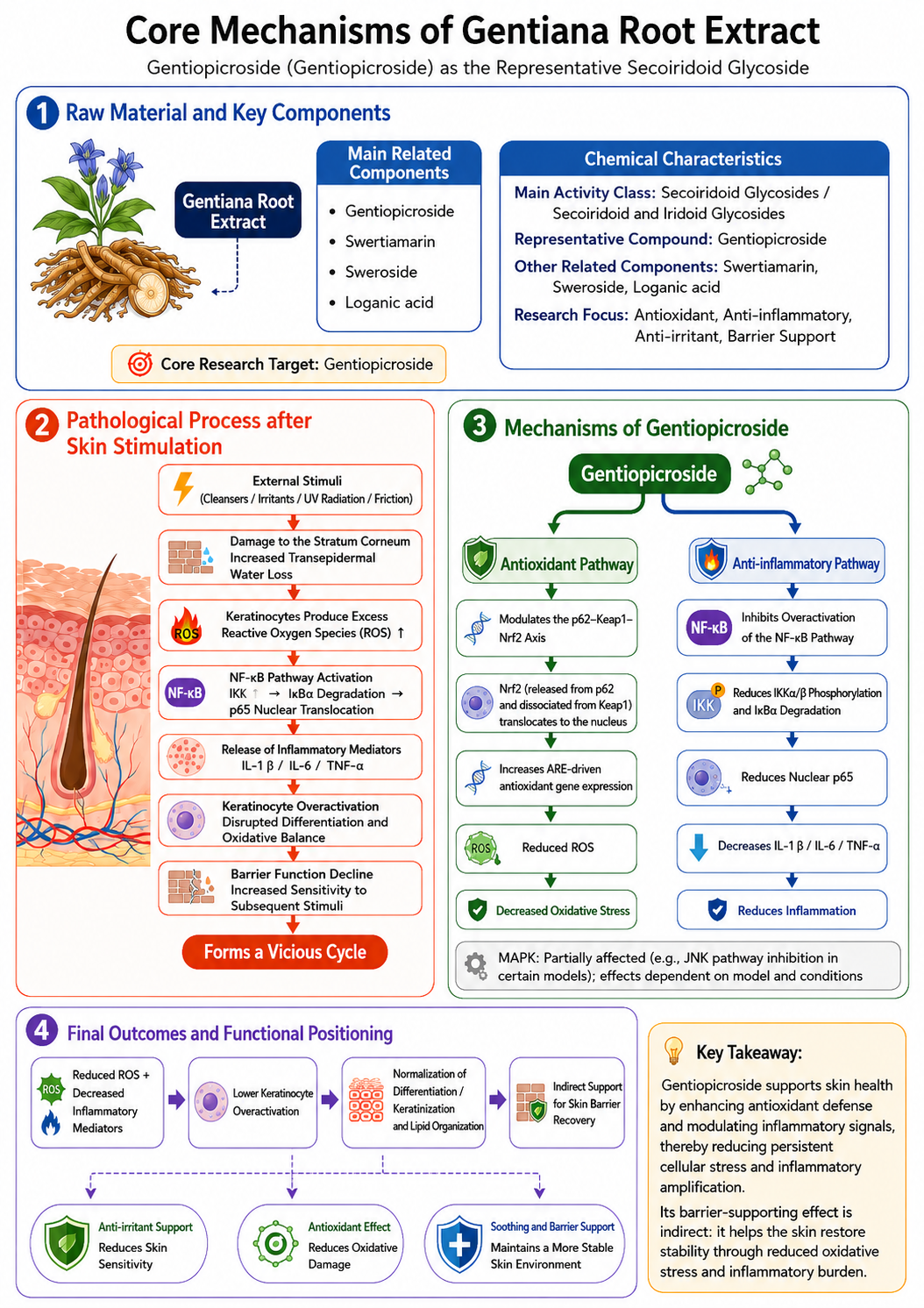
4 Antioxidant Mechanisms of Gentiopicroside
4.1 Fundamental Role of the Keap1–Nrf2 System
Nuclear factor erythroid 2-related factor 2 (Nrf2) is an important transcription factor that regulates genes involved in antioxidant defense and cellular stress responses.
Under normal conditions, Kelch-like ECH-associated protein 1 (Keap1) binds to Nrf2 and participates in its ubiquitination and proteasomal degradation.
The basic process can be represented as follows:
Keap1–Cul3 ubiquitin ligase complex + Nrf2 → Polyubiquitination of Nrf2 → Degradation of Nrf2 by the 26S proteasome→ Maintenance of low intracellular Nrf2 levels
During oxidative stress, Keap1-mediated degradation of Nrf2 is reduced. Stabilized Nrf2 then enters the nucleus and binds to antioxidant response elements (AREs), promoting the expression of genes involved in antioxidant defense, glutathione metabolism, and cellular protection.
4.2 Effects of Gentiopicroside on the p62–Keap1–Nrf2 Axis
A study published in 2025 examined the effects of purified gentiopicroside on HaCaT keratinocytes stimulated with TNF-α and IFN-γ, as well as on imiquimod-induced psoriasis-like skin lesions in mice.
The study found that gentiopicroside modulated the expression of p62 and Keap1, promoted the nuclear translocation of Nrf2, and increased the transcription of antioxidant genes downstream of Nrf2. Gentiopicroside also reduced abnormal keratinocyte activation induced by tumor necrosis factor-alpha (TNF-α) and interferon-gamma (IFN-γ).
In Nrf2-deficient keratinocytes, the antioxidant effects of gentiopicroside were markedly weakened. Similarly, in Nrf2-deficient mice, its protective effects against skin lesions were reduced. These findings indicate that Nrf2 plays a major role in the effects of gentiopicroside in these experimental models.
The proposed effects can be summarized as follows:
Gentiopicroside treatment → Changes in p62 and Keap1 protein status accompanied by increased Nrf2 nuclear translocation → Increased transcription of Nrf2 downstream antioxidant genes → Nrf2 binding to AREs → Enhanced endogenous antioxidant defense → Reduced ROS accumulation → Reduced cellular stress and abnormal keratinocyte activation
Existing studies have not conclusively demonstrated that gentiopicroside binds directly to Keap1, nor have they identified all upstream targets through which it affects p62 or Keap1. A more accurate interpretation is therefore that gentiopicroside modulates the p62–Keap1–Nrf2 system, rather than acting as a confirmed direct binder or selective inhibitor of a specific protein.
4.3 How Antioxidant Activity May Attenuate Inflammation
Reactive oxygen species can cause oxidative damage and also participate in inflammatory signal transduction. Persistent ROS accumulation may activate inflammation-related kinases and transcription factors, while inflammatory cells and stimulated keratinocytes can in turn generate additional ROS.
This process can form a self-reinforcing cycle:
Increased ROS → Activation of inflammatory signaling → Release of inflammatory mediators → Increased mitochondrial and cellular oxidative stress → Further ROS production
By enhancing Nrf2-associated defense, gentiopicroside may reduce the ability of ROS to drive inflammatory signaling. Its antioxidant activity and inflammation-modulating effects are therefore linked through a continuous causal relationship rather than representing two completely independent activities.
5 Regulation of Inflammatory Signaling by Gentiopicroside
5.1 How NF-κB Signaling Amplifies Inflammation
Nuclear factor kappa B (NF-κB) is a family of transcription factors that plays an important role in regulating inflammatory gene expression. In the canonical NF-κB pathway, the common p50/p65 heterodimer is bound to the inhibitory protein IκBα and retained in the cytoplasm.
Following inflammatory stimulation, the main process is:
Inflammatory stimulus → Activation of IκB kinase (IKK) → Phosphorylation and degradation of IκBα → Release of NF-κB p65 → Nuclear translocation of p65 → Increased transcription of inflammatory genes such as IL-1β, IL-6, and TNF-α
In primary macrophages stimulated with lipopolysaccharide (LPS) and IFN-γ, gentiopicroside reduced the phosphorylation of IKKα/β and p65, attenuated IκBα degradation, and decreased the nuclear translocation of p65. Levels of inflammatory mediators, including interleukin-1 beta (IL-1β), interleukin-6 (IL-6), and TNF-α, were also reduced.
These findings support the ability of gentiopicroside to attenuate NF-κB activation under specific experimental conditions. However, there is currently insufficient evidence to establish gentiopicroside as a selective direct inhibitor of IKK, IκBα, or p65. The available findings are more consistent with suppression of excessive NF-κB activation and inflammatory gene expression.
5.2 Does Gentiopicroside Inhibit MAPK Signaling?
The mitogen-activated protein kinase (MAPK) family includes several branches, including extracellular signal-regulated kinase, c-Jun N-terminal kinase, and p38. These pathways participate in cellular proliferation, differentiation, stress responses, and inflammation.
The effects of gentiopicroside on MAPK signaling vary among experimental models.
In an osteoclast model stimulated with receptor activator of nuclear factor-κB ligand, gentiopicroside inhibited c-Jun N-terminal kinase (JNK) and NF-κB signaling.
In a macrophage model stimulated with LPS and IFN-γ, gentiopicroside reduced NF-κB activation, but no significant effect on MAPK signaling was observed.
Gentiopicroside therefore does not inhibit MAPK signaling in every inflammatory model. Its effects may depend on:
1. Cell type;
2. Upstream stimulus;
3. Compound concentration and treatment duration;
4. The specific ERK, JNK, or p38 branch examined;
5. The pre-existing metabolic and inflammatory state of the cells.
6 Potential Anti-Irritation and Skin Barrier-Supporting Effects of Gentiopicroside
6.1 At Which Stage Could Anti-Irritation Effects Occur?
Skin anti-irritation effects may occur at different stages:
1. Reducing contact between the irritant and the skin;
2. Limiting structural damage to the stratum corneum;
3. Reducing ROS and danger-associated signals in keratinocytes;
4. Attenuating the amplification of inflammatory signaling;
5. Reducing sensory responses such as stinging, burning, and itching.
Existing preclinical studies suggest that gentiopicroside may participate in the regulation of oxidative stress and inflammatory responses during skin injury. Its reported effects mainly include enhancement of Nrf2-associated antioxidant defense, reduction of ROS accumulation, attenuation of abnormal keratinocyte activation, and suppression of NF-κB and other inflammatory signals in some noncutaneous inflammatory models.
It should be emphasized that the relevant evidence is derived mainly from psoriasis-like skin lesions, inflammatory cell models, and other disease models. Direct evidence from standardized skin irritation models and human studies remains limited. At present, gentiopicroside may therefore be considered to have a potential mechanistic basis for soothing and anti-irritation effects, while its actual anti-irritation efficacy requires further investigation.
6.2 How Gentiopicroside May Indirectly Support Skin Barrier Recovery
The skin barrier is composed of corneocytes, intercellular lipids, the cornified envelope, and intercellular junctions. Direct supplementation with ceramides, cholesterol, and fatty acids, or the formation of an occlusive film, can more directly reduce water loss.
Gentiopicroside is not a physiological skin lipid. Existing evidence is also insufficient to show that it directly replenishes stratum corneum lipids or directly increases ceramide and filaggrin synthesis under normal skincare conditions.
Its potential barrier-supporting effects may instead arise mainly from reducing persistent injury:
Gentiopicroside
├── Modulation of Nrf2 → Reduced ROS
└── Attenuation of selected inflammatory signals → Reduced inflammatory mediators
↓
Reduced stress on keratinocytes
↓
Possible alleviation of proliferation and differentiation imbalance
↓
More favorable conditions for the recovery of keratinization, lipid organization,
and intercellular junctions
↓
Indirect support for skin barrier recovery
Epidermal barrier impairment can activate inflammatory responses, while persistent inflammation can delay barrier recovery. These processes therefore influence each other bidirectionally. By reducing the persistent interference caused by oxidative stress and inflammation, gentiopicroside may make it easier for the skin’s intrinsic renewal processes to recover. This represents indirect support and should not be regarded as direct reconstruction of the stratum corneum.
In formulations, gentiana root extract may complement the following categories of ingredients:
1. Ceramides, cholesterol, and fatty acids: supplementation of barrier lipids;
2. Glycerol, hyaluronic acid, and amino acids: improvement of stratum corneum hydration;
3. Panthenol, allantoin, and related ingredients: support for soothing and overall skin condition;
4. Occlusive materials such as petrolatum: reduction of water loss; squalane: improvement of emollience and reduction of surface friction;
5. Mild emulsifiers and cleansing systems: reduction of irritation caused by the formulation itself.
7 Functional Positioning of Gentiana Root Extract
Gentiana root extract is a botanical extract characterized by the presence of secoiridoid glycosides, among which gentiopicroside is a representative marker compound. The principal evidence concerning its potential skincare-related effects can be summarized as follows:
Direction of Action | Available Evidence | Overall Assessment |
Nrf2-associated antioxidant activity | Keratinocyte and psoriasis-like mouse models | Relatively direct preclinical support is available for purified gentiopicroside, but these findings cannot yet be regarded as direct evidence of efficacy for gentiana root extract or finished cosmetic products. |
Reduction of abnormal keratinocyte activation | HaCaT cells, primary keratinocytes, and mouse models | Supported in psoriasis-related models; applicability to ordinary skin irritation remains to be verified. |
Modulation of NF-κB signaling | Primary macrophages and animal inflammation models | Inflammatory signaling is attenuated in some models, but evidence under topical skin-use conditions remains limited. |
Modulation of MAPK signaling | Inconsistent findings across experimental models | Effects appear to be model-dependent and cannot currently be generalized as universal inhibition of MAPK signaling. |
Potential soothing and anti-irritation effects | Mechanistic studies involving oxidative stress and inflammatory regulation | A mechanistic basis is suggested, but confirmation in standardized skin irritation models and human studies is still required. |
Direct improvement of the skin barrier | Lack of data on barrier lipids, barrier proteins, and functional endpoints | Direct evidence is currently lacking. |
Indirect support for barrier recovery | Mechanistic inference based on reduced oxidative stress and persistent inflammation | Biologically plausible, but further validation using transepidermal water loss and other skin barrier-related endpoints is required. |
The practical skincare value of gentiana root extract depends on its botanical source, gentiopicroside content, extraction process, formulation stability, skin deposition, and results from human efficacy studies. A complete research program may include raw-material authentication, quantitative analysis of active constituents, mechanistic validation, formulation delivery studies, and human evaluation.
8 Product Tables for Research on the Chemical Composition, Antioxidant and Anti-inflammatory Mechanisms, and Skin Barrier Effects of Gentiana Root Extract
Table 1. Reference Standards for Characteristic Constituents and Quality Control of Gentiana Root
Category | CAS No. | Aladdin Catalog No. | Name | Specification or Purity | Product Features and Applications |
Secoiridoid glycoside reference standard | 17388-39-5 | Swertiamarin | Analytical standard, Moligand™, ≥98% | A characteristic bitter glycoside of Gentiana species; used for multi-component quantification, liquid chromatographic fingerprinting, and evaluation of raw-material batch-to-batch consistency | |
Secoiridoid glycoside reference standard | 14215-86-2 | Sweroside | Analytical standard, ≥98% | A characteristic constituent associated with gentiana root; used for constituent identification, quantitative analysis, and comparison of constituent retention among different extraction processes | |
Core marker-compound reference standard | 20831-76-9 | Gentiopicroside | Analytical standard, ≥98% | A core quality marker of gentiana root extract; used for content determination, analytical method validation, and studies of antioxidant and inflammation-modulating mechanisms | |
Iridoid reference standard | 22255-40-9 | Loganic acid | Moligand™, ≥98% | A characteristic iridoid constituent of Gentiana species; used for liquid chromatographic quantification, fingerprint peak confirmation, and comparison of botanical sources | |
Gentiopicroside derivative reference standard | 115713-06-9 | 6′-O-β-D-Glucosylgentiopicroside | ≥99% | A glycosylated derivative of gentiopicroside; used for constituent identification in complex extracts, impurity analysis, and metabolite research | |
Xanthone reference standard | 437-50-3 | 1,7-Dihydroxy-3-methoxyxanthone | ≥98% | A characteristic xanthone constituent of Gentiana species; used for profiling non-iridoid constituents and improving raw-material chromatographic fingerprints | |
Xanthone reference standard | 491-64-5 | 1,3-Dihydroxy-7-methoxy-9H-xanthen-9-one | Moligand™, ≥95% | A xanthone isomer found in Gentiana species; used for chromatographic peak assignment, isomer differentiation, and investigation of raw-material chemical composition | |
Secoiridoid glycoside reference standard | 53823-10-2 | Trifloroside | ≥98% | A characteristic bitter glycoside of Gentiana species; used for comparison among plant species, constituent identification, and multi-marker quality control | |
Iridoid glycoside reference standard | 18524-94-2 | Loganin | ≥98% | An iridoid glycoside reference material; used for constituent-profile analysis, chromatographic quantification, and comparison of iridoid composition |
Table 2. Products for Antioxidant and Nuclear Factor Erythroid 2-Related Factor 2 Pathway Research
Category | CAS No. | Aladdin Catalog No. | Name | Specification or Purity | Product Features and Applications |
Oxidative stress inducer | 7722-84-1 | Hydrogen peroxide solution | Suitable for microbiology, 3% | Used to establish oxidative injury models in keratinocytes and to evaluate the effects of gentiopicroside on reducing reactive oxygen species and cellular damage | |
Endogenous antioxidant | 70-18-8 | Glutathione, reduced | PharmPure™, European Pharmacopoeia (Ph. Eur.) | An important component of the intracellular redox system; used for antioxidant-capacity evaluation, redox-status detection, and as a positive control | |
Reactive oxygen species-scavenging control | 616-91-1 | N-Acetyl-L-cysteine (NAC) | PharmPure™, USP, Moligand™, European Pharmacopoeia (Ph. Eur.), ≥98.5% | A reactive oxygen species scavenger and precursor for glutathione synthesis; used to distinguish antioxidant effects from regulation of inflammatory signaling | |
Nuclear factor erythroid 2-related factor 2 inhibitor | 846557-71-9 | ML385, Nrf2 inhibitor | Moligand™, ≥99% | Used to inhibit Nrf2 transcriptional activity and verify whether the antioxidant effects of gentiopicroside are dependent on this pathway | |
Nuclear factor erythroid 2-related factor 2 activation control | 4478-93-7 | Sulforaphane | Moligand™, ≥95% | A positive control for activation of the Nrf2 pathway; used in studies of antioxidant response elements and downstream defense genes | |
Antioxidant-pathway activation control | 1948-33-0 | tert-Butylhydroquinone (TBHQ) | ≥98% | Used to induce Nrf2-associated antioxidant responses and evaluate endogenous cellular defense capacity | |
Reactive oxygen species fluorescent probe | 4091-99-0 | 2′,7′-Dichlorodihydrofluorescein diacetate (DCFH-DA) | ≥97% | Used to detect intracellular reactive oxygen species levels and evaluate the extent to which gentiopicroside suppresses oxidative stress | |
Nuclear factor erythroid 2-related factor 2 functional-inhibition control | 14907-98-3 | Brusatol | ≥95% (HPLC) | Used for Nrf2 functional inhibition and pathway-dependence studies; may be combined with other inhibitors or genetic methods for validation |
Table 3. Products for Skin Irritation, Inflammation, and Signaling Pathway Research
Category | CAS No. | Aladdin Catalog No. | Name | Specification or Purity | Product Features and Applications |
Surfactant-induced irritation model | 151-21-3 | Sodium dodecyl sulfate (SDS) | Anhydrous grade, ACS, ≥99% | Used to establish stratum corneum damage and skin irritation models and to measure transepidermal water loss, inflammatory mediators, and barrier recovery | |
Sensory irritation model reagent | 404-86-4 | Natural capsaicin | Natural, Moligand™, ≥95% (HPLC), from Capsicum sp. | A transient receptor potential vanilloid 1 (TRPV1) agonist; used to investigate stinging, burning, and neurogenic irritation responses | |
Inflammatory-model inducer | 93572-42-0 | Lipopolysaccharide (LPS) | From Escherichia coli O55:B5, purified by trichloroacetic acid extraction | Used to establish innate immune inflammation models and investigate NF-κB and MAPK signaling and inflammatory mediator release | |
NF-κB pathway inhibition control | 20554-84-1 | Parthenolide | Analytical standard, Moligand™, ≥98% | Used as an NF-κB pathway inhibition control to evaluate inflammatory mediator expression and transcription factor activation | |
p38 pathway inhibitor | 152121-47-6 | SB-203580, p38 MAPK inhibitor | Moligand™, ≥98% (HPLC) | Used to verify the involvement of the p38 MAPK branch in inflammation and cellular stress responses | |
NF-κB pathway inhibitor | 19542-67-7 | BAY 11-7082, IκBα kinase inhibitor | Moligand™, ≥98% | Used to investigate IκBα-related signaling, p65 nuclear translocation, and inflammatory gene expression | |
Extracellular signal-regulated kinase pathway inhibitor | 109511-58-2 | U0126, MKK inhibitor | Moligand™, ≥98% | Used to inhibit mitogen-activated protein kinase kinase and verify the involvement of the extracellular signal-regulated kinase pathway in irritation responses | |
Pruritus and inflammation model reagent | 56-92-8 | Histamine dihydrochloride | Moligand™, ≥98% | Used to establish histamine-associated pruritus, vascular-response, and inflammation models and to evaluate soothing and anti-irritation effects | |
c-Jun N-terminal kinase inhibitor | 129-56-6 | Anthra[1,9-cd]pyrazol-6(2H)-one | Moligand™, ≥98% | Used to inhibit c-Jun N-terminal kinase and verify the involvement of this pathway in inflammatory amplification and cellular stress | |
Acid irritation and stinging model reagent | 50-21-5 | DL-Lactic acid | AR, 85–90% | Used to establish acid-irritation models and conduct lactic acid stinging assessments for studies of cutaneous sensory sensitivity and formulation tolerability | |
Anti-inflammatory positive control | 50-02-2 | Dexamethasone | ≥98% | A glucocorticoid anti-inflammatory positive control; used for comparison of inflammatory mediators, cellular activation, and tissue inflammatory responses |
Table 4. Products for Skin Barrier, Moisturization, and Soothing Formulation Research
Category | CAS No. | Aladdin Catalog No. | Name | Specification or Purity | Product Features and Applications |
Barrier fatty acid | 57-10-3 | Palmitic acid | BioReagent, ≥99% | Used to construct ceramide–cholesterol–fatty acid barrier-lipid systems and investigate lipid organization and barrier function | |
Humectant and formulation vehicle | 56-81-5 | Glycerol | Anhydrous grade, UltraBio™, molecular biology grade, ≥99.5% (GC) | Used in moisturizing formulations, solvent systems, and stratum corneum hydration controls, and to support evaluation of gentiana root extract formulation performance | |
Barrier lipid | 57-88-5 | Cholesterol | Animal-origin-free, low endotoxin, suitable for cell culture, ≥99% | A physiological lipid component of the stratum corneum; used for barrier-lipid reconstruction, lamellar-structure research, and cell culture experiments | |
Polymeric humectant | 9067-32-7 | Sodium hyaluronate | European Pharmacopoeia (Ph. Eur.) | Used to increase stratum corneum hydration, form a moisturizing film, and investigate synergistic effects in soothing formulations | |
Soothing and barrier-supporting ingredient | 81-13-0 | D-Panthenol | ≥98% | Used for skin moisturization, post-irritation recovery, and barrier-function assessment; may serve as a reference ingredient in soothing formulations | |
Occlusive barrier material | 8009-03-8 | White petrolatum | PharmPure™, Chinese Pharmacopoeia (ChP) | Used to form an occlusive film, reduce transepidermal water loss, and establish a positive control for barrier protection | |
Polymeric humectant | 9004-61-9 | Hyaluronic acid | Moligand™, from rooster comb | Used in moisturization, film formation, and skin-surface water-retention studies and to evaluate the soothing effects and sensory properties of combination systems | |
Structurally defined ceramide | 34354-88-6 | N-Stearoylphytosphingosine | ≥98% | Used to simulate stratum corneum ceramide structures and investigate barrier-lipid organization, membrane structure, and barrier-repair formulations | |
Soothing formulation ingredient | 97-59-6 | Allantoin | ≥98% | Used in studies of soothing effects, regulation of stratum corneum condition, and post-irritation skin recovery; may serve as a soothing ingredient in combination formulations | |
Emollient lipid | 111-01-3 | Squalane | ≥98% | Used to improve emollience, reduce friction, and construct stable oil phases, thereby helping maintain the skin-surface lipid environment | |
Ceramide blend raw material | 100403-19-8 | Ceramide mixture | ≥95% | Used for barrier-lipid supplementation, model-membrane construction, and studies of ceramide-containing barrier-repair systems |
Note: The products listed above are representative Aladdin products related to scientific research and formulation studies. Additional information on product specifications, grades, and certificates of analysis (COAs) can be retrieved from the Aladdin website using the product name, CAS number, or catalog number.
References
[1] Qingdao Municipal Health Commission. Materia Medica: Gentian[EB/OL]. 2021-10-20.
[2] European Commission. CosIng Ingredient Database: GENTIANA SCABRA ROOT EXTRACT[DB/OL].
[3] National Center for Biotechnology Information. PubChem Compound Summary for CID 88708, Gentiopicroside[DB/OL].
[4] Suh H W, Lee K B, Kim K S, et al. A bitter herbal medicine Gentiana scabra root extract stimulates glucagon-like peptide-1 secretion and regulates blood glucose in db/db mouse[J]. Journal of Ethnopharmacology, 2015, 172: 219–226. DOI: 10.1016/j.jep.2015.06.042.
[5] OECD. Test No. 439: In Vitro Skin Irritation: Reconstructed Human Epidermis Test Method[S]. OECD Guidelines for the Testing of Chemicals, Section 4. Paris: OECD Publishing, 2025. DOI: 10.1787/9789264242845-en.
[6] Segre J A. Epidermal barrier formation and recovery in skin disorders[J]. Journal of Clinical Investigation, 2006, 116(5): 1150–1158. DOI: 10.1172/JCI28521.
[7] Mehrotra P, Mishra K P, Raman G, Banerjee G. Differential regulation of free radicals (reactive oxygen and nitrogen species) by contact allergens and irritants in human keratinocyte cell line[J]. Toxicology Mechanisms and Methods, 2005, 15(5): 343–350. DOI: 10.1080/15376520500191490.
[8] Ren J, Chen X, Wang H Y, et al. Gentiopicroside ameliorates psoriasis-like skin lesions in mice via regulating the Keap1-Nrf2 pathway and inhibiting keratinocyte activation[J]. Acta Pharmacologica Sinica, 2025, 46: 1361–1374. DOI: 10.1038/s41401-024-01449-8.
[9] Wang Q, Zhou X, Yang L, et al. Gentiopicroside (GENT) protects against sepsis induced by lipopolysaccharide (LPS) through the NF-κB signaling pathway[J]. Annals of Translational Medicine, 2019, 7(23): 731. DOI: 10.21037/atm.2019.11.126.
[10] Chen F, Xie L, Kang R, et al. Gentiopicroside inhibits RANKL-induced osteoclastogenesis by regulating NF-κB and JNK signaling pathways[J]. Biomedicine & Pharmacotherapy, 2018, 100: 142–146. DOI: 10.1016/j.biopha.2018.02.014.
[11] Wang C, Xing X F, Ma L X, et al. Determination of gentiopicroside in different morphological types of cultivated Gentiana manshurica population[J]. Zhongguo Zhong Yao Za Zhi, 2004, 29(9): 841–844. PMID: 15575198.
[12] Zhao K, Pu S, Sun L, Zhou D. Gentiopicroside-loaded chitosan nanoparticles inhibit TNF-α-induced proliferation and inflammatory response in HaCaT keratinocytes and ameliorate imiquimod-induced dermatitis lesions in mice[J]. International Journal of Nanomedicine, 2023, 18: 3781–3800. DOI: 10.2147/IJN.S406649.
[13] Chinese Pharmacopoeia Commission. Pharmacopoeia of the People’s Republic of China: Volume I[S]. 2025 Edition. Beijing: China Medical Science Press, 2025.
[14] Vartanian S, Ma T P, Lee J, et al. Application of mass spectrometry profiling to establish brusatol as an inhibitor of global protein synthesis[J]. Molecular & Cellular Proteomics, 2016, 15(4): 1220–1231. DOI: 10.1074/mcp.M115.055509.
[15] Kalyanaraman B, Darley-Usmar V, Davies K J A, et al. Measuring reactive oxygen and nitrogen species with fluorescent probes: challenges and limitations[J]. Free Radical Biology and Medicine, 2012, 52(1): 1–6. DOI: 10.1016/j.freeradbiomed.2011.09.030.
For more related articles, see below:
Applicability Comparison of Vitronectin, Laminin and Fibronectin in Cell Culture Coating Systems
Antibody simulation experiments based on the framework of fibronectin type III structural domains
Ferulic Acid: Structural Features, Preparation Routes, and Key Points for Research Applications
Role of Sphingolipid Metabolic Remodeling in Apoptotic and Inflammatory Signaling
How to decipher the whitening code?
Niacin (Vitamin B3): Structural Features, Metabolic Roles, and Application Landscape
The "Six Key Checkpoints" of Skin Lightening
Tyrosinase: a key regulatory enzyme in melanin synthesis and its biological and applied significance
Enzymatic Hydroxylation Mechanism of Salicylate Conversion to Catechol