
What Is Glutathione Agarose?
What Is Glutathione Agarose?
Glutathione (GSH) is a tripeptide composed of glutamate, cysteine, and glycine. It is one of the most important small-molecule reductants in cells, helping maintain redox balance, scavenge reactive oxygen species, and protect biomacromolecules from oxidative damage. Glutathione S-transferases (GSTs) are a family of enzymes that use glutathione as a substrate and catalyze the conjugation of glutathione to electrophilic or oxidizing substrates, thereby promoting detoxification and transport.
In molecular biology and protein engineering, this “matched pair” is leveraged for affinity purification: when glutathione is immobilized on agarose microbeads, it yields a commonly used affinity chromatography medium—glutathione agarose. This resin selectively binds GST and GST-tagged fusion proteins and is widely used for protein purification and interaction studies.
I. Composition and Features of Glutathione Agarose
1.Matrix
Typically a polysaccharide agarose bead with good biocompatibility and a porous structure that offers large surface area for ligand coupling and protein binding.
2.Ligand—Glutathione
Glutathione is covalently coupled to the agarose backbone by chemical methods. The immobilized glutathione retains its ability to bind GST, conferring selective affinity to the beads.
When GST or GST-tagged fusion proteins are present in solution, they bind specifically to the immobilized glutathione, whereas proteins lacking the recognition motif do not form stable interactions with the resin. This “selective binding—nonselective washing” property underlies the use of glutathione agarose for affinity purification.
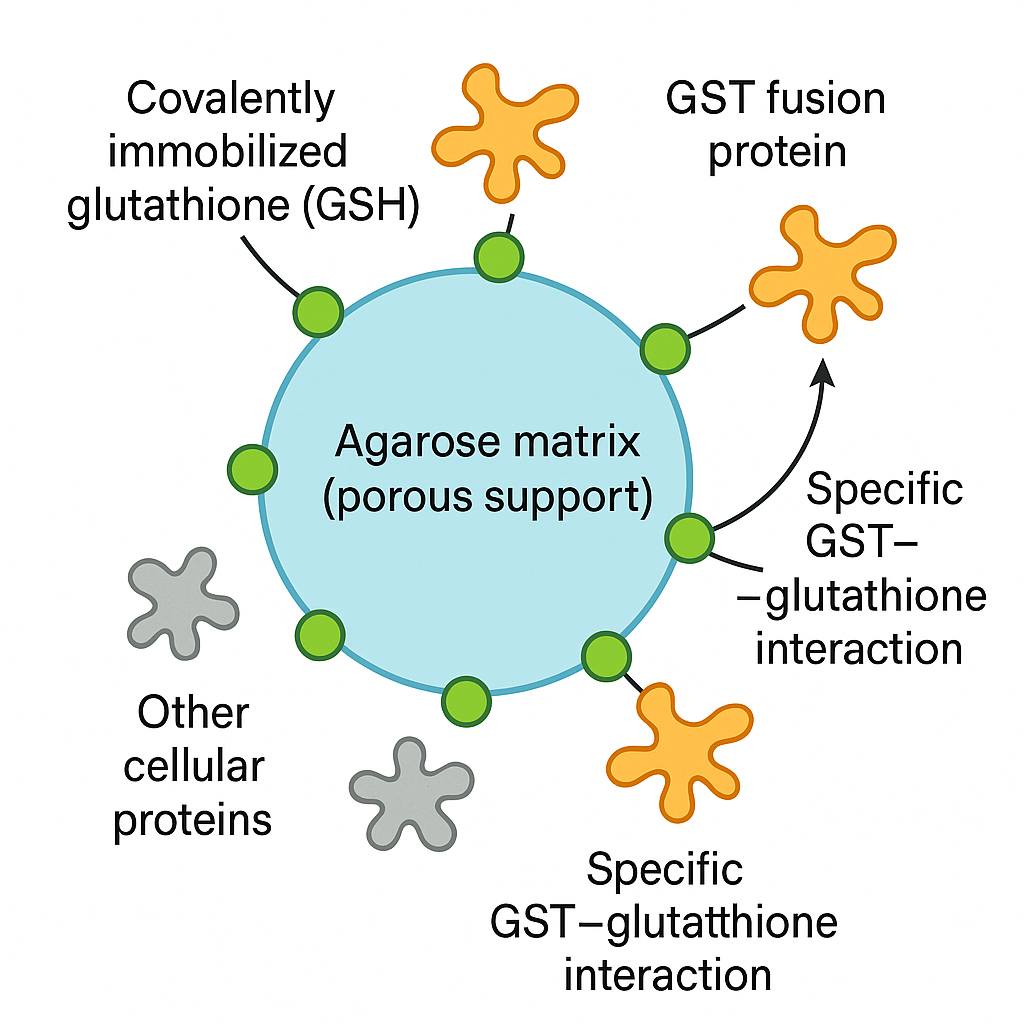
Figure 1. Structure and binding principle of glutathione agarose
II. GST Tag and Solubility Enhancement
In recombinant expression, GST functions not only as an affinity tag but also as a solubility tag. A typical design fuses GST to the N-terminus of the target protein, producing a GST–target fusion. This has two direct consequences:
1) The GST affinity enables specific purification on glutathione agarose.
2) The intrinsically high solubility of GST often increases the soluble expression fraction of the fusion in bacteria or other hosts, reducing inclusion-body formation.
Thus, glutathione agarose and GST tags commonly appear together and constitute a mature, widely used purification route.
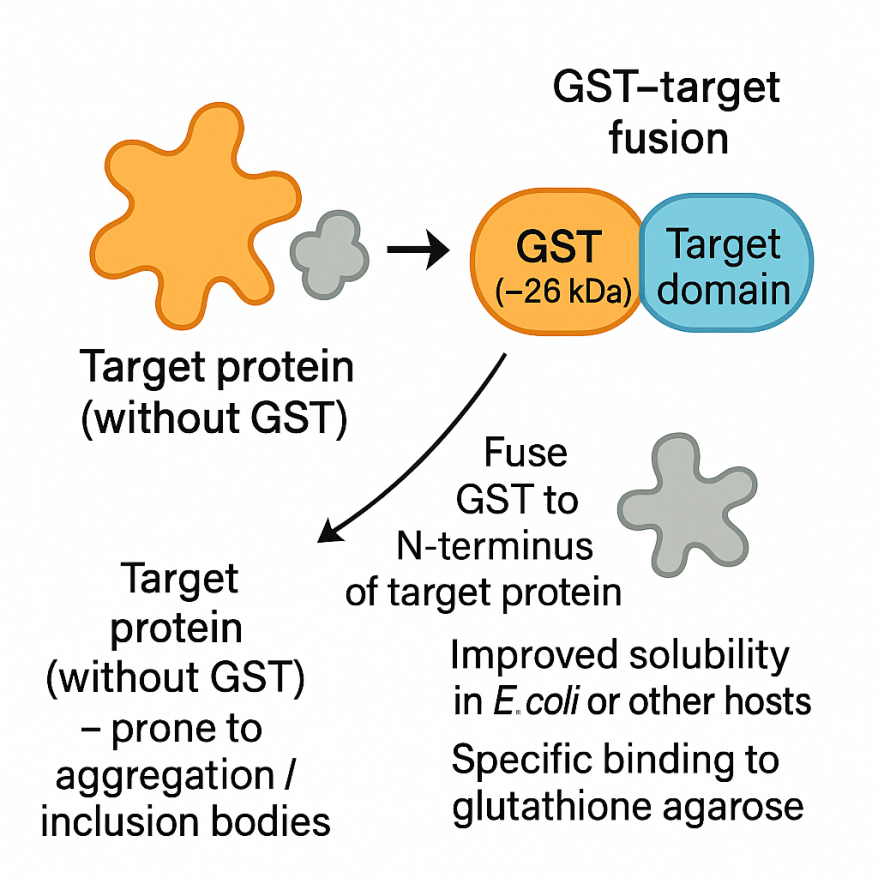
Figure 2. Dual roles of GST
III. Overview of Affinity Purification for GST-Tagged Proteins
1.Binding
1) Bring clarified lysate or other crude sample containing the GST fusion protein into contact with pre-equilibrated glutathione agarose.
2) Under suitable buffer conditions, GST binds specifically to immobilized glutathione.
2.Washing
1) Wash the resin with buffer to remove unbound or weakly bound contaminants.
2) Conditions should balance “removing contaminants” with “maintaining the GST–glutathione interaction.”
3.Elution
1) Elute competitively with reduced glutathione: include an appropriate concentration of reduced glutathione in the elution buffer to compete for GST binding sites on the resin.
2) The GST fusion protein dissociates from the solid phase into the eluate.
IV. Using the GST–Glutathione System for Pull-Down Assays
Beyond purification, glutathione agarose is frequently used to probe protein–protein interactions via GST pull-down assays.
1.Prepare the “bait” protein
1) Purify or prepare the GST-tagged target protein and bind it to glutathione agarose.
2) The GST–target complex is thus immobilized on the beads or in a column, forming a solid-phase bait.
2.Introduce potential “prey” molecules
1) Add complex samples (e.g., cell lysate) or candidate protein solutions to the bait-loaded resin.
2) Proteins that interact specifically or with high affinity with the target will be captured and co-retained on the resin.
3.Wash and analyze bound components
1) Wash to remove nonspecific binders.
2) Analyze proteins retained on the resin by SDS-PAGE, immunoblotting, or mass spectrometry to identify potential interaction partners.
Similar to classic co-IP, GST pull-down uses the GST–glutathione pair as a physical handle to create a controlled in-vitro interaction platform, well-suited for validating binary interactions or screening novel binders.
Glutathione agarose is a paradigmatic example of “externalizing” an essential intracellular small molecule onto a chromatography medium. By immobilizing glutathione on agarose microbeads, it preserves specific recognition of GST and provides a simple, efficient tool for affinity purification of GST-tagged proteins and for interaction studies. Thus, glutathione agarose is not merely a “purification material,” but a bridge connecting intracellular redox metabolism with in-vitro protein engineering—one that continues to hold fundamental and practical value across basic and applied research.
Aladdin: https://www.aladdinsci.com/