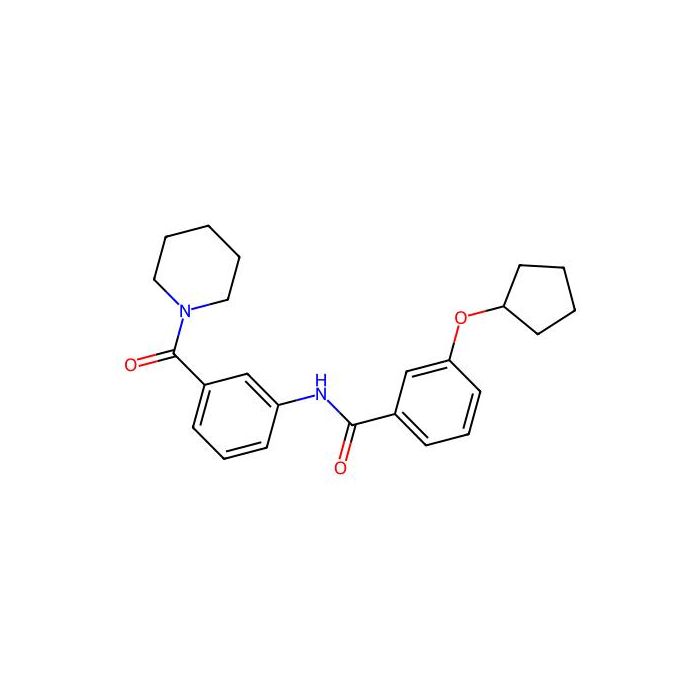
GLP-1R modulator L7-028 is an allosteric modulator enhancing GLP-1 binding to GLP-1R via a transmembrane site ( EC 50 11.01 ± 2.73 μM).
Form:Solid
Specifiche
Specifiche e purezza
≥98%
Meccanismi biochimici e fisiologici
GLP-1R modulator L7-028 is an allosteric modulator enhancing GLP-1 binding to GLP-1R via a transmembrane site ( EC 50 11.01 ± 2.73 μM).
Condizioni di conservazione di stoccaggio
Store at -20°C
Spedito in
Ice chest + Ice pads
Questo prodotto richiede spedizione a catena fredda. I servizi di terra e altri servizi economici non sono disponibili.
Tipo di azione
MODULATOR
Purezza
≥98%
Nomi e identificatori
Peso molecolare
392.49
Dati avanzati
Certificati (CoA, COO, BSE/TSE e tabella di analisi)
C of A & Other Certificates(BSE/TSE, COO):
Analytical Chart:
Calcolatori di soluzioni
Molarity Calculator
Determine the necessary mass, volume, or concentration for preparing a solution.
Dilution Calculator
Determine the dilution needed to prepare a stock solution.
Reconstitution Calculator
Recensioni
Recensioni dei clienti
Application Protocols
No product-validated protocols are provided in the product data. The following is general, literature-based guidance for small-molecule GLP-1R modulators (adapt as needed):
Example: cAMP accumulation assay (cell-based)
Seed GLP-1R-expressing cells in 96- or 384-well plates (24 h prior).
Prepare serial dilutions of the compound in DMSO, then dilute into assay buffer (final DMSO 0.1–0.5%).
Incubate 15–30 min at 37°C; stop reaction and quantify cAMP via HTRF or ELISA per kit protocol.
Include vehicle, positive control (GLP-1 peptide), and negative control wells.
Example: β-arrestin BRET
Transfect cells with GLP-1R–donor/β-arrestin–acceptor constructs.
Equilibrate with compound; measure BRET ratio over time to assess recruitment and kinetics.
Quality controls
Verify cell surface expression of GLP-1R (flow cytometry or ELISA on non-permeabilized cells).
Monitor compound solubility/aggregation via light scatter or detergent controls.
These protocols are illustrative only and not item-specific. Optimize parameters for your system and follow institutional SOPs.
Biological Roles
Background on the GLP-1 receptor (GLP-1R) target—provided as general scientific context; not item-specific performance claims.
Receptor class: GLP-1R is a class B (secretin family) GPCR predominantly coupling to Gs, elevating intracellular cAMP upon activation.
Endogenous ligand: Glucagon-like peptide-1 (GLP-1), derived from proglucagon, engages the receptor via a two-domain binding mode (ECD and transmembrane core).
Signaling pathways: Primary cAMP/PKA and Epac activation; secondary pathways can include β-arrestin recruitment, ERK1/2 phosphorylation, and receptor internalization/desensitization dynamics.
Tissue distribution: Expressed in pancreatic islets, brain regions, gastrointestinal tract, cardiovascular tissues, and peripheral nerves (distribution varies by species and detection method).
Pharmacology concepts: Allosteric modulation, probe dependence, and signaling bias are well-documented in class B GPCRs and may be relevant when profiling small-molecule GLP-1R modulators.
Assay implications: cAMP output is a sensitive readout for Gs-coupled activity; β-arrestin assays help characterize bias; binding assays with ECD or full-length receptor inform orthosteric vs allosteric engagement.
Note: This section summarizes literature knowledge of GLP-1R biology and does not constitute claims about the activity or selectivity of GLP-1R modulator L7-028, for which no item-specific biological data are provided in the product data.
Buffer Applications
This product is a small-molecule modulator and not a buffering agent. However, buffer selection is critical for reliable receptor assays.
Assay buffer guidance (general)
Composition: HEPES (10–25 mM) or PBS at pH 7.2–7.5; include 0.1% BSA to reduce compound adsorption and 2–5 mM MgCl2 where relevant for GPCR function in membrane assays.
Additives: 0.01–0.05% Pluronic F-127 or 0.02–0.1% Tween-20 may suppress aggregation. Use bacitracin or protease inhibitors in peptide co-agonist experiments.
Vehicle control: Maintain constant DMSO (e.g., 0.1–0.5% v/v) across all wells, including controls.
pH and temperature: Run at physiological pH; equilibrate plates to 25–37°C depending on assay design and maintain constant temperature for kinetic comparability.
Filtration/degassing: Filter (0.22 μm) and degas buffers to reduce bubbles that can interfere with optical readouts.
These recommendations are general literature practices; no item-specific buffer requirements are provided.
Green Alternatives
For a small-molecule screening tool, “green” considerations focus on solvent and assay design rather than replacing the compound itself.
Greener solvent and workflow options (general guidance)
Prefer aqueous assay buffers with minimal DMSO (≤0.1–0.5% v/v) where solubility allows; deploy surfactants or carrier proteins to reduce required organic content.
Evaluate ethanol (≤0.5–1%) as an alternative vehicle when compatible with the assay and compound solubility.
Employ microplate miniaturization (e.g., 384/1536-well formats) to reduce per-well solvent and compound use.
Consider cyclodextrin inclusion complexes to enable aqueous delivery of hydrophobes, balancing potential assay interference.
Illustrative comparison (general; not item-specific)
DMSO: High solvency; moderate environmental/health concerns; aim to minimize final %.
Aqueous with excipients (BSA, Pluronics): Reduced organic use; may introduce background or binding artifacts.
Operational tips
Consolidate dilutions to reduce waste, use inert-gas headspace to extend stock life, and adopt sealed low-dead-volume reservoirs to limit evaporation and VOC emissions.
Build “green QC” into workflows: track solvent consumption per plate and optimize pipetting schemes to minimize overages.
Pharmaceutical Uses
No pharmaceutical or clinical claims are made for this product. It is provided strictly for research use only (as stated in the product data).
Research and development context (general)
Discovery workflows: Small-molecule GLP-1R modulators are commonly used as tool compounds in target validation, SAR exploration, and mechanism-of-action studies in preclinical settings.
Formulation for studies: DMSO stock solutions with aqueous dilution are typical for in vitro work. For in vivo exploratory research (where permitted and following institutional approvals), co-solvent systems (e.g., PEG400/saline, Captisol, or cyclodextrin complexes) are sometimes used—compatibility must be established empirically. This product provides no item-specific formulation guidance.
Regulatory status: Not pharmacopeial grade; not intended for diagnostic, therapeutic, or human/clinical use.
Any incorporation into development programs should be preceded by comprehensive in-house characterization (identity, purity, stability, and off-target profiling).
Physical Properties
Item-specific physicochemical parameters are not provided in the product data.
Appearance: Not specified for this item; refer to CoA/Spec Sheet.
Melting point: Not specified for this item; refer to CoA/Spec Sheet.
Boiling point: Not specified for this item; refer to CoA/Spec Sheet.
Density: Not specified for this item; refer to CoA/Spec Sheet.
Solubility: Not specified for this item; refer to CoA/Spec Sheet. (General guidance below.)
logP/logD, pKa, refractive index: Not specified for this item; refer to CoA/Spec Sheet.
General laboratory guidance (literature/practice-based)
Stock solutions: For small-molecule screening tools, initial dissolution is typically attempted in anhydrous DMSO (e.g., 10–50 mM). If insoluble, consider DMF or co-solvent mixtures (DMSO:water or DMSO:buffer up to 1–2% v/v final in assays).
Solubility screening: Perform a small-scale assessment across DMSO, MeOH, EtOH, acetonitrile, PBS (±0.1% Tween-20 or 0.1–1% Pluronic F-127), and buffer with 0.1–0.5% BSA to mitigate surface adsorption.
Stability considerations: Unknown for this specific item; protect from moisture and repeated freeze–thaw. Evaluate freeze–thaw robustness and light sensitivity empirically by LC–MS area percent over time.
Analytical control: Establish a routine LC method (e.g., C18, water/acetonitrile + 0.1% formic acid) to monitor purity and potential hydrolysis/oxidation across storage intervals.
Always defer to the item’s CoA/Spec Sheet and SDS for authoritative values and handling notes.
Quality and Grades
Grade/Purity: Not specified for this item; refer to CoA/Spec Sheet.
Context and expectations for small-molecule library tools
Library compounds are typically provided at research grade with lot-specific analytical data (e.g., LC–MS purity, HRMS m/z, sometimes 1H NMR). Review the CoA for this batch to confirm assay suitability.
UV profile and residual solvent content may affect certain readouts (UV detection, MS ionization); when critical, verify by your own QC (e.g., GC for residual solvents, Karl Fischer for water). Item-specific limits are not provided here.
Stabilizers: Not specified for this item. If present in a particular lot (e.g., antioxidant, acid/base counterion), it will appear on the CoA and label.
Suitability for bioassays: For cell-based or biochemical assays, many labs target ≥95% peak area purity by HPLC for primary screening. Confirm purity thresholds with your internal SOPs.
Trace metals/UV cutoff/peroxide levels: Not specified for this item; refer to CoA/Spec Sheet.
Recommendations
Archive the lot CoA and SDS in your ELN. If comparative SAR is intended, standardize on one lot when possible.
If orthogonal confirmation is required, perform LC–MS purity check on receipt and after 3–6 months of storage to detect degradation.
Reaction and Applications
This product is provided as a small-molecule GLP-1 receptor modulator for research and screening; it is not typically used as a chemical reagent in synthetic transformations.
Research applications (general guidance for GLP-1R tool compounds)
Biochemical activity assays: Measure receptor activation or modulation using cAMP accumulation (HTRF, AlphaScreen, or ELISA-based) in membranes or overexpressing cell lines.
Cell-based functional assays: Monitor Gs-mediated cAMP, CRE-luciferase reporter, β-arrestin recruitment (BRET/PathHunter), or ERK phosphorylation as pathway readouts.
Binding studies: Perform radioligand displacement with labeled GLP-1 or small-molecule probes; alternatively, use fluorescent ligand competition or NanoBRET target engagement.
Kinetics and bias: Assess association/dissociation via SPR/BLI (using purified receptor ECD or stabilized constructs) and quantify signaling bias (G protein vs β-arrestin) with reference ligands.
Mechanistic profiling: Evaluate allosteric vs orthosteric behavior by Schild analysis, probe dependence, or modulator cooperativity with peptide agonists.
Controls and best practices
Include vehicle and reference ligands (e.g., GLP-1 peptide or a known small-molecule modulator) to anchor potency and efficacy.
Titrate DMSO to a single concentration across all wells; perform triplicates and at least 10-point CRCs.
Confirm on-target action using GLP-1R knockout/knockdown cells or selective antagonists.
Note: No item-specific potency/selectivity data are provided; establish assay conditions empirically.
Reaction Conditions
Chemical reaction conditions are not applicable; this product is intended as a receptor modulator, not as a synthetic reagent. The following refers to assay conditions for pharmacological evaluation (general literature guidance; not item-specific specifications):
cAMP assays: Use GLP-1R-expressing cells (e.g., HEK293, CHO). Dose 10-point half-log curves spanning 0.1 nM–30 μM depending on expected potency. Incubate 15–30 min at 37°C; detect with HTRF or ELISA kits. Maintain constant DMSO (0.1–0.5%).
β-arrestin recruitment: Perform BRET or enzyme complementation assays. Incubation 30–90 min; read luminescence/fluorescence per platform.
Binding assays: Conduct radioligand displacement using [125I]-exendin(9–39) or fluorescent GLP-1 analogs; equilibrium binding at 4–25°C for 1–2 h in HEPES-buffered saline with BSA.
Allosteric characterization: Evaluate shifts in agonist CRCs (probe dependence), assess cooperativity factors (α/β) via operational models.
Counterscreens: Test off-target GPCR panels or parental cells lacking GLP-1R to evaluate specificity.
Note: No potency, efficacy, or selectivity data are provided for GLP-1R modulator L7-028; users should determine appropriate concentration ranges and incubation times empirically.
Safety and Handling
Safety information specific to this item is not provided in the product data and must be obtained from the SDS.
GHS Classification: Not specified for this item; refer to SDS.
Signal Word / H-Statements / Pictograms: Not specified for this item; refer to SDS.
General laboratory precautions (good practice for small-molecule bioactives)
PPE: Lab coat, safety glasses, and appropriate chemically resistant gloves (e.g., nitrile). Handle powders/solutions in a fume hood or ventilated enclosure to avoid inhalation and aerosol formation.
Avoid exposure: Prevent ingestion, inhalation, and skin/eye contact. Use closed containers for stock solutions; wipe bench surfaces after use. Avoid generating dust.
Incompatibilities: Unknown for this specific item. As a precaution, avoid strong oxidizers and strong acids/bases until compatibility is known. Keep away from sources of ignition if organic solvents are present.
First aid (overview; defer to SDS): In case of skin contact, wash with soap and water; for eye exposure, rinse with water for several minutes; if inhaled, move to fresh air; if ingested, rinse mouth. Seek medical attention in all exposure cases and provide SDS.
Waste: Collect solutions and contaminated disposables as hazardous organic waste per institutional and local regulations.
Storage and shipping
Storage: Store at -20°C (per product data). Maintain dry, tightly sealed vials; minimize freeze–thaw.
Shipping: Shipped in ice chest with ice pads (per product data). Inspect immediately upon receipt for container integrity and condensation.
Solvent Selection
Item-specific solubility is not provided; start with biocompatible organic co-solvents and escalate as needed.
Primary solvent for stocks: Anhydrous DMSO is the default for small-molecule modulators; attempt 10–50 mM stocks. Warm gently (25–37°C) and vortex/sonicate to aid dissolution; avoid prolonged heating.
Secondary options: DMF or NMP (for stubborn cases), ethanol, or acetonitrile. For aqueous use, dilute DMSO stocks into buffer slowly with vigorous mixing to prevent precipitation.
Assay buffers: HEPES or PBS at pH 7.2–7.5 with 0.1% BSA can reduce nonspecific binding. Up to 0.1% nonionic surfactant (e.g., Tween-20 or 0.01–0.05% Pluronic F-127) may improve apparent solubility and reduce aggregation.
Final DMSO in assays: Commonly 0.1–1.0% v/v; match vehicle across controls.
Small comparison (general guidance)
DMSO: Highest solvency; excellent chemical compatibility; potential cellular effects >0.5–1%.
Ethanol: More biocompatible at low %; lower solvency for polar/heteroaromatic chemotypes.
DMF/NMP: Strong solvency; consider cytotoxicity and disposal requirements.
Aqueous with cyclodextrins: Can enhance solubility of hydrophobes; verify assay interference.
Tip: Prepare a solubility mini-panel (DMSO, DMF, EtOH, ACN; then DMSO→buffer titration) and record visual/LC–MS outcomes to select the cleanest vehicle for your assays.
Storage and Reconstitution
Storage conditions (from product data): Store at -20°C. Keep container tightly closed in a dry environment. Minimize exposure to ambient humidity and temperature.
Shipping (from product data): Shipped in ice chest with ice pads. Inspect upon arrival; return to -20°C storage promptly.
Reconstitution (general guidance; item-specific solubility not provided)
Solvent: Begin with anhydrous DMSO. Target 10–50 mM stock solutions where solubility permits.
Technique: Allow vial to equilibrate to room temperature in a desiccator before opening to avoid condensation. Add measured DMSO volume, vortex, and, if needed, brief sonication. Avoid prolonged heating.
Aliquoting: Dispense single-use aliquots (e.g., 10–50 μL) in low-bind tubes. Flush headspace with inert gas (N2/Ar) if long-term storage is planned.
Freeze–thaw: Avoid repeated freeze–thaw cycles; thaw on ice or at room temperature and immediately return unused aliquots to -20°C.
Light sensitivity: Not specified for this item; as a precaution, protect from light during storage and handling.
Aqueous dilution: Add DMSO stock to buffer slowly with vigorous mixing to minimize precipitation; keep final DMSO consistent across controls.
For authoritative, lot-specific instructions (e.g., exact solubility, purity, moisture content), refer to the CoA/Spec Sheet and SDS supplied for the item.
Structure and Identity
Research-use small-molecule GLP-1 receptor modulator (tool compound) for chemical biology and screening.
Molecular Formula: Not specified for this item; refer to CoA/Spec Sheet.
Molecular Weight: Not specified for this item; refer to CoA/Spec Sheet.
SMILES: Not specified for this item; refer to CoA/Spec Sheet.
InChIKey: Not specified for this item; refer to CoA/Spec Sheet.
Structural features
Item-specific structural details (ring systems, heteroatoms, stereochemistry) are not provided in the product data. As a GLP-1R modulator, the molecule is intended to engage the class B GPCR GLP-1 receptor; however, no assumptions should be made about chemotype without the structure.
2D structure (descriptive)
Not available in the provided data. If needed for informatics workflows, request the structure or import from an authenticated CoA/SDF provided with the lot.
Identity and tracking
For data integrity, include the CAS and SKU in ELN records and plate maps. Verify identity via provided CoA, and, if required, perform orthogonal verification (LC–MS, HRMS, 1H NMR) using reference conditions established in your lab.
Synthetic Utility
This item is supplied as a bioactive small molecule for receptor modulation and is not intended as a general synthetic reagent or building block.
Reagent role: Not typically used as a coupling partner, catalyst, or protecting group reagent.
Derivatization (general concept): Tool compounds are sometimes derivatized for chemical biology (e.g., linker installation for biotinylation, fluorophore tagging, photoaffinity probes). Without the disclosed structure of GLP-1R modulator L7-028, no specific derivatization chemistry can be recommended.
Analytical reference: May serve as an internal control or benchmark in GLP-1R-focused assay panels after in-lab qualification.
If synthetic modifications or conjugations are desired, obtain structural information and assess liability motifs (e.g., anilides, phenols, secondary amines) prior to route design. No item-specific functional groups or reactivity are provided in the product data.
Target Specificity
Intended target class: GLP-1 receptor (GLP-1R), class B GPCR (general target context).
Item-specific selectivity, Ki/EC50, or off-target profile: Not specified for this item; refer to CoA/Spec Sheet or internal testing.
Guidance for establishing specificity (general)
Use GLP-1R overexpression vs knockout/knockdown lines to confirm on-target effects.
Employ competitive binding with orthosteric peptides and evaluate rightward/leftward shifts in functional CRCs.
Run counterscreens on related class B GPCRs (e.g., GIPR, GCGR) to assess cross-reactivity.
No validated target specificity data are provided in the product data for GLP-1R modulator L7-028.
Domande frequenti
What is the purity of this product?
This product is supplied at ≥98% purity (chemical assay). Lot-specific values are stated on the Certificate of Analysis.
How should this product be stored?
Store at ?20 °C. Freezer storage is required to maintain the specified shelf life.
How is this product shipped?
This product ships in an insulated container with ice pads. Unpack on arrival and transfer it to the storage condition stated above.
What are the CAS number, molecular formula and molecular weight?
The CAS Number is 2648317-95-5, the molecular formula is C24H28N2O3, and the molecular weight is 392.49 g/mol.
What documentation is provided?
Available product documentation, including Certificates of Analysis (COA), Safety Data Sheets (SDS), and specification sheets, is shown in the product document area. Document availability and access follow the current site policy.
Utilizziamo i cookie per garantire il corretto funzionamento del sito web e, ove consentito, per migliorare la tua esperienza. Puoi gestire le tue preferenze in qualsiasi momento nelle Impostazioni. Per saperne di più, consulta la nostra Cookie Policy.
Desidera che le inviamo un messaggio quando avremo sconti disponibili?
Ricordamelo più tardi
Grazie! Controlli la sua casella di posta per confermare.
Products are supplied to verified businesses, institutions, and qualified professionals for research and development use only. Not for use in humans, animals, diagnosis, or therapy.