QUALITÀ & PUREZZAMoligand™?Moligand™ — Aladdin's line of ligands and bioactive small molecules. Use for receptor, pathway, and binding studies needing defined small-molecule tools.≥98%
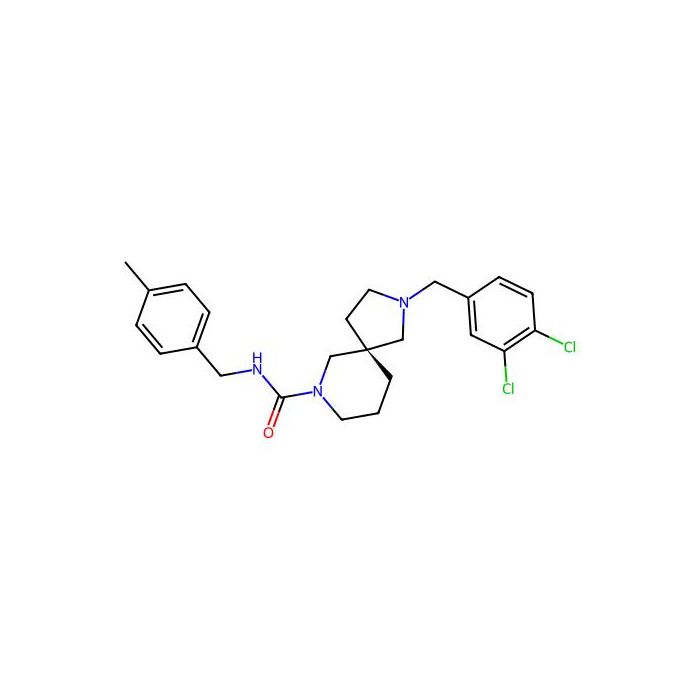
GSK2850163 is a novel inhibitor of inositol-requiring enzyme-1 alpha ( IRE1α ) which can inhibit IRE1α kinase activity and RNase activity with IC 50 s of 20 and 200 nM, respectively.
Condizioni di conservazione di stoccaggio
Store at -20°C
Spedito in
Ice chest + Ice pads
Questo prodotto richiede spedizione a catena fredda. I servizi di terra e altri servizi economici non sono disponibili.
This compound belongs to the class of organic compounds known as azaspirodecane derivatives. These are organic compounds containing a spirodecane moiety with at least one nitrogen atom.
External Descriptors
Not available
1. Djoumbou Feunang Y, Eisner R, Knox C, Chepelev L, Hastings J, Owen G, Fahy E, Steinbeck C, Subramanian S, Bolton E, Greiner R, and Wishart DS. ClassyFire: Automated Chemical Classification With A Comprehensive, Computable Taxonomy. Journal of Cheminformatics, 2016, 8:61.
Certificati (CoA, COO, BSE/TSE e tabella di analisi)
C of A & Other Certificates(BSE/TSE, COO):
Analytical Chart:
Proprietà chimiche e fisiche
Solubilità
DMSO : 67.5 mg/mL (151.21 mM; Need ultrasonic) Ethanol : 50 mg/mL (112.00 mM; Need ultrasonic)
Peso molecolare
446.400 g/mol
XLogP3
4.900
Hydrogen Bond Donor Count
1
Hydrogen Bond Acceptor Count
2
Rotatable Bond Count
4
Exact Mass
445.169 Da
Monoisotopic Mass
445.169 Da
Topological Polar Surface Area
35.600 Ų
Heavy Atom Count
30
Formal Charge
0
Complexity
583.000
Isotope Atom Count
0
Defined Atom Stereocenter Count
1
Undefined Atom Stereocenter Count
0
Defined Bond Stereocenter Count
0
Undefined Bond Stereocenter Count
0
The total count of all stereochemical bonds
0
Covalently-Bonded Unit Count
1
Calcolatori di soluzioni
Molarity Calculator
Determine the necessary mass, volume, or concentration for preparing a solution.
Dilution Calculator
Determine the dilution needed to prepare a stock solution.
Reconstitution Calculator
Recensioni
Recensioni dei clienti
Application Protocols
The product listing does not include validated protocols or application data for this compound.
Tested applications in this listing: Not specified for this item; refer to CoA/Spec Sheet.
General guidance for handling small-molecule ligands in assays
Stock preparation: dissolve in DMSO to a defined concentration (e.g., 10–50 mM), vortex and, if needed, sonicate briefly. Filter (0.2 µm) if particulates persist.
Dilution: add to assay buffer/media to reach target concentrations while keeping DMSO ≤0.5–1% v/v (or per assay tolerance). Mix thoroughly; inspect for precipitation.
Plate handling: use low-bind plastics for low-µM dosing; consider acoustic dispensing to minimize DMSO carryover.
Stability checks: confirm concentration by LC/UV or LC/MS at time 0 and end of assay; store working solutions on ice and protect from light if chromophores are present.
Documentation: capture lot number, preparation date, and dilution scheme in your ELN for traceability.
Biological Roles
Item-specific biological target, pathway, and mechanism for GSK2850163 are not disclosed in the Product Data.
Item-specific target/mechanism
Not specified for this item; refer to CoA/Spec Sheet and primary literature.
General context for GSK-coded ligands (informational)
GSK discovery codes typically denote small molecules explored in specific target classes (kinases, GPCRs, epigenetic enzymes, transporters, etc.). Without structural or pharmacology disclosure, no definitive biological role can be ascribed here.
Recommendations for users
If a target is known from your program or literature, document it alongside binding constants (Kd/Ki/IC50) and assay context (biochemical vs cellular) for reproducibility.
Evaluate off-target risk using panel screening if the compound is advanced as a reference tool in your lab.
Confirm permeability, efflux liability, and stability (microsomes/S9) experimentally if cellular use is intended.
Research use statement
For research use only; not for diagnostic, therapeutic, or in vivo applications.
Buffer Applications
This product is a discovery small molecule rather than a buffer reagent. It does not constitute a buffering system by itself.
Practical notes for buffer use with small-molecule ligands (general guidance)
Prepare ligand stocks in DMSO, then dilute into assay buffers (e.g., HEPES, PBS, Tris) keeping final DMSO ≤0.5–1% to maintain biological compatibility.
Evaluate precipitation upon dilution; include mild nonionic detergents (e.g., 0.01–0.05% Tween‑20) if aggregation is suspected.
Maintain buffer pH suited to the biological assay; adjust ionic strength to control nonspecific interactions.
Item-specific buffer parameters
Not specified for this item; refer to CoA/Spec Sheet and your assay SOPs.
Green Alternatives
The compound itself is the analyte/ligand; “green alternatives” considerations apply primarily to solvent choices and handling practices during stock preparation and assays.
Greener solvent options for preparation and cleanup (general guidance)
Prefer ethanol or isopropanol as cosolvents instead of DMF/NMP when solubility allows.
Use water/MeCN mixtures for LC analytics instead of chlorinated solvents.
For extractions/cleanup, consider ethyl acetate or 2‑MeTHF over dichloromethane where compatible.
DMSO considerations
DMSO remains a standard for discovery ligands due to high solvency and assay compatibility at low percentages. Minimize DMSO by performing a solubility screen to find the lowest workable concentration.
Process and waste minimization
Prepare concentrated master stocks and dispense via acoustic or pin tools to reduce solvent volumes.
Consolidate waste streams and avoid halogenated solvents where possible.
Trade-offs
Greener solvents may provide lower solubility for hydrophobic chemotypes. Balance environmental impact with assay robustness and compound integrity (precipitation risks, adsorption losses).
Pharmaceutical Uses
No excipient role, compendial status, or manufacturing specifications are provided for this item. It is supplied strictly for research use.
Item-specific pharmacopeial/compliance status
Not specified for this item; refer to CoA/Spec Sheet. This product is not supplied under GMP and is not intended for human or veterinary use.
Research formulation context (general guidance)
For in vitro and ex vivo studies, compounds like this are commonly formulated as DMSO concentrates and diluted into biological media.
For preclinical enabling chemistry (if applicable to your program), independently establish salt form, polymorph, and stability; such data are outside the scope of this listing and must be generated by the user.
Important limitation
No therapeutic or clinical claims are made or should be inferred from this listing.
Physical Properties
Item-specific specifications are not disclosed in the current listing. Where needed, verify against the CoA/SDS.
Appearance: Not specified for this item; refer to CoA/Spec Sheet.
Melting point: Not specified for this item; refer to CoA/Spec Sheet.
Boiling point: Not specified for this item; refer to CoA/Spec Sheet.
Density: Not specified for this item; refer to CoA/Spec Sheet.
Solubility:
Item-specific: Not specified for this item; refer to CoA/Spec Sheet.
General laboratory practice (guidance): prepare concentrated DMSO stocks (e.g., 10–50 mM) when structure is hydrophobic; dilute into assay buffer with ≤1% final DMSO.
LogP/logD: Not specified for this item; refer to CoA/Spec Sheet.
pKa(s): Not specified for this item; refer to CoA/Spec Sheet.
Refractive index/UV cutoff: Not specified for this item; refer to CoA/Spec Sheet.
Notes for professional users
In absence of a disclosed structure, determine solubility by a short solvent screen (DMSO, DMF, ethanol, isopropanol, acetonitrile, aqueous buffer with co-solvent or cyclodextrin). Document precipitation upon dilution.
If a UV chromophore is suspected (common for discovery ligands), verify spectral properties experimentally before LC/UPLC quantitation to set detection wavelength.
Record exact stock concentration gravimetrically (preferred) or volumetrically, and store aliquots at low temperature to minimize freeze–thaw cycles.
Quality and Grades
Item-specific grade
Grade/Purity: Moligand™ (as listed). This denotes a research ligand/screening compound grade intended for discovery workflows (e.g., target validation, biophysical assays, primary/secondary screening) rather than GMP or clinical use.
What Moligand™ implies (general description)
Emphasis on identity confirmation and suitability for medicinal chemistry and chemical biology experiments.
Typical deliverables (check CoA): structure confirmation (e.g., 1H NMR/HRMS), lot-specific purity (often by LC/UPLC-UV or HPLC), and storage guidance.
UV background and residual solvent levels are managed to support assay use, but exact thresholds for this item are Not specified for this item; refer to CoA/Spec Sheet.
Stabilizers/additives
None stated. If stabilizers/antioxidants are added for certain chemotypes, they will be noted on the CoA. For this item: Not specified for this item; refer to CoA/Spec Sheet.
Suitability notes
Recommended for in vitro research use only (as stated). Not intended for diagnostic, therapeutic, or in vivo use.
For bioassays, confirm lot-specific purity and area% assay to set dosing accurately; adjust for salt form or residual solvent if applicable (verify on CoA).
Reaction and Applications
This product is positioned as a small-molecule research ligand for discovery workflows rather than a reagent for synthetic transformations.
Intended research uses (per category and grade)
Assay development: tool compound in biochemical/biophysical binding assays (e.g., fluorescence polarization, SPR, ITC, DSF) and cell-based reporter assays.
Screening: inclusion in small-molecule libraries for HTS/HCS or focused target validation.
Reference/control: potential use as a positive/benchmark control once activity is established in a given assay (user-validated).
Probe development: starting point for SAR exploration, analog synthesis, or tagging (biotin/fluorophore) for pull-downs or imaging, contingent on known functional handles in the structure (consult CoA or literature for derivatization feasibility).
Not a general-purpose synthetic reagent
No specific named reactions or catalytic roles are associated in the item listing. If the structure contains reactive handles (e.g., amide, halide, anilide), derivatizations are possible but require structural confirmation first.
Practical notes
Verify compound identity and purity for your lot (LC/UPLC, MS). Confirm stability in your assay buffer over the assay timeframe (time-course LC or UV).
Establish concentration–response curves with attention to aggregation artifacts (include 0.01–0.05% nonionic detergent where appropriate).
Reaction Conditions
Not typically applicable. GSK2850163 is provided as a research ligand rather than a reagent for running chemical reactions.
Item-specific reaction parameters
Not specified for this item; refer to CoA/Spec Sheet.
If users pursue custom chemistry on this scaffold (general guidance)
Choose conditions based on the actual functional groups present once the structure is confirmed (e.g., palladium-catalyzed cross-coupling for aryl halides, amide couplings under HATU/EDC, or SNAr on activated heteroaryls).
Maintain anhydrous/oxygen-free conditions where sensitive motifs exist; monitor by LC/MS.
Ensure that residual metals and reagents are fully removed before biological testing; set acceptance criteria appropriate for screening use.
Safety and Handling
Safety information specific to this item is not provided in the listing. Treat as a novel research chemical of unknown toxicity.
Item-specific hazard information
Signal word: Not specified for this item; refer to SDS.
H-statements: Not specified for this item; refer to SDS.
GHS classification/pictograms: Not specified for this item; refer to SDS.
General laboratory precautions (good practice for discovery ligands)
PPE: lab coat, safety glasses, and appropriate chemically resistant gloves (e.g., nitrile). Work in a fume hood.
Avoid inhalation of dust/aerosols; prevent skin/eye contact. Do not pipette by mouth. Wash hands after handling.
Use dedicated balances or weigh boats to prevent cross-contamination of screening libraries.
Storage incompatibilities and stability
Store at −20°C (per Product Data). Protect from light and moisture; keep container tightly closed. Use desiccant if hygroscopicity is suspected.
Minimize freeze–thaw by aliquoting concentrates.
First-aid overview (refer to SDS for full guidance)
Inhalation: move to fresh air; seek medical advice if symptoms occur.
Skin/eye contact: rinse with water for several minutes; remove contaminated clothing; obtain medical attention if irritation persists.
Ingestion: rinse mouth; do not induce vomiting unless directed by medical personnel; seek medical advice.
Waste disposal
Collect as organic chemical waste; follow institutional and local regulations. Decontaminate surfaces with suitable solvents/detergents.
Solvent Selection
With structure and ionization state undisclosed in the listing, choose solvents empirically, starting from broadly compatible media for small-molecule ligands.
Practical starting points (general guidance)
Stock solutions: DMSO is first-line for discovery ligands; attempt 10–50 mM. If limited solubility, try DMF or NMP. For aqueous use, dilute into buffer with ≤0.5–1% final DMSO.
Aqueous enabling approaches: co-solvents (DMSO/MeCN/EtOH), surfactants (0.01–0.05% Tween-20), complexants (5–20% (2‑hydroxypropyl)-β-cyclodextrin), or pH adjustment if ionizable groups are identified from structure.
Polarity/miscibility (general properties by solvent)
DMSO: polar aprotic, fully miscible with water/most organics; strong solubilizing power for aromatic/heteroaromatic ligands.
DMF/NMP: stronger solvating power; use with caution in biological contexts; validate assay compatibility.
Ethanol/Isopropanol: good cosolvents for plate coating or rapid drying films.
Acetonitrile: LC-friendly; moderate solubilizer for less polar scaffolds.
Decision tips
If UV or MS detection is needed, prefer MeCN/H2O systems; avoid high background absorbers for UV quantitation.
Conduct a small solubility screen (e.g., turbidity or nephelometry) to select the lowest DMSO needed for your assay window.
Filter 0.2 µm when possible; assess adsorption to plastics by recovery checks at low µM.
Storage and Reconstitution
Item-specific storage and shipping
Storage conditions: Store at −20°C (as provided in Product Data).
Shipped in: Ice chest + ice pads (as provided).
Appearance: Not specified for this item; refer to CoA/Spec Sheet.
Reconstitution (general guidance for small-molecule ligands)
Allow container to equilibrate to room temperature in a desiccator before opening to prevent moisture condensation.
Prepare concentrated stock in an anhydrous solvent (commonly DMSO). Record exact mass and volume to determine concentration accurately. If salt form is known, adjust calculations accordingly.
If aqueous working solutions are required, dilute the DMSO stock into buffer with vigorous mixing; maintain final DMSO within assay tolerance. Inspect for haze/precipitation.
Aliquoting and stability
Aliquot stocks into single-use vials to minimize freeze–thaw cycles. Protect from light if the structure contains UV-absorbing motifs (common in discovery ligands).
For long-term storage, maintain at −20°C or below in tightly sealed containers with desiccant. Document any observed degradation by LC/MS over time.
Shelf-life
Not specified for this item; refer to CoA/Spec Sheet and monitor stability under your specific storage conditions.
Research use note
For research use only; not for diagnostic or therapeutic applications.
Structure and Identity
Concise identity summary for an exploratory small-molecule research ligand supplied in Moligand grade.
Item-specific (from Product Data)
Product name: GSK2850163 (SKU: G650135)
CAS: 2121989-91-9
PubChem CID: 73291790
InChIKey: 435692 (as provided)
SMILES: Not specified for this item; refer to CoA/Spec Sheet.
Molecular formula: Not specified for this item; refer to CoA/Spec Sheet.
Molecular weight: Not specified for this item; refer to CoA/Spec Sheet.
Interpreted chemical class and context
Category: Small molecule and compound library (screening/ligand-grade research compound).
Structural features: Not disclosed in the item listing. Without a SMILES/InChI, specific functional groups, ring systems, and stereochemistry cannot be detailed. Consult the CoA or supplier SDS for structural depiction.
2D structure description (general note)
The 2D structure is not provided in the current listing. If available on the CoA or public databases (e.g., via CID), use that reference for functional group recognition, heteroatom content, and substitution pattern assessment.
Nomenclature
“GSK2850163” reflects an internal discovery code naming convention for a GlaxoSmithKline-originated research compound; it is not an IUPAC name.
Synthetic Utility
The product is offered as a finished small-molecule ligand for research, not as a synthetic building block. Without the disclosed structure, specific functional handles and reactivity cannot be enumerated.
Item-specific functional groups/reactivity
Not specified for this item; refer to CoA/Spec Sheet for structure before planning derivatizations.
General considerations if derivatization is intended
Upon availability of a structure, identify positions amenable to modification (e.g., para-aryl substitution, amide N-alkylation, heteroaryl cross-coupling handles).
For probe development (biotin/fluorophore), select peripheral substituents distant from the pharmacophore to preserve activity; confirm with SAR.
Validate purity and identity of any derivatives by orthogonal methods (NMR, HRMS, LC).
Target Specificity
Only item-specific data may be reported here. The listing does not provide biochemical/biological target information for GSK2850163.
Target/Pathway: Not specified for this item; refer to CoA/Spec Sheet.
Species selectivity: Not specified for this item; refer to CoA/Spec Sheet.
Binding constants/IC50/Ki/Kd: Not specified for this item; refer to CoA/Spec Sheet.
Assay context (biochemical/cellular): Not specified for this item; refer to CoA/Spec Sheet.
Note: If you have program-specific data, report it in your records with assay conditions, replicates, and error metrics for reproducibility.
Domande frequenti
What is the purity of this product?
This product is supplied at ≥98% purity (chemical assay). Lot-specific values are stated on the Certificate of Analysis.
What is Moligand??
Moligand? is one of Aladdin Scientific's premium product lines, formulated for high-purity applications across multiple workflows. Compared to standard grades in the same workflow, Moligand? products typically offer tighter specifications, more rigorous QC, and stronger lot-to-lot consistency.
How should this product be stored?
Store at ?20 °C. Freezer storage is required to maintain the specified shelf life.
How is this product shipped?
This product ships in an insulated container with ice pads. Unpack on arrival and transfer it to the storage condition stated above.
What are the CAS number, molecular formula and molecular weight?
The CAS Number is 2121989-91-9, the molecular formula is C24H29Cl2N3O, and the molecular weight is 446.41 g/mol. InChIKey YFDASBFQKMHSSJ-XMMPIXPASA-N.
What documentation is provided?
Available product documentation, including Certificates of Analysis (COA), Safety Data Sheets (SDS), and specification sheets, is shown in the product document area. Document availability and access follow the current site policy.
Hai bisogno di aiuto per scegliere la qualità?
La nostra guida alla selezione delle qualità copre purezza, stato dello stabilizzatore e idoneità all'applicazione per tutte le varianti del nostro catalogo.
Utilizziamo i cookie per garantire il corretto funzionamento del sito web e, ove consentito, per migliorare la tua esperienza. Puoi gestire le tue preferenze in qualsiasi momento nelle Impostazioni. Per saperne di più, consulta la nostra Cookie Policy.
Desidera che le inviamo un messaggio quando avremo sconti disponibili?
Ricordamelo più tardi
Grazie! Controlli la sua casella di posta per confermare.
Products are supplied to verified businesses, institutions, and qualified professionals for research and development use only. Not for use in humans, animals, diagnosis, or therapy.