Determine the necessary mass, volume, or concentration for preparing a solution.
| Activity Type | Relation | Activity value | Units | Action Type | Journal | PubMed Id | doi | Assay Aladdin ID |
|---|

Suitable for molecular biology, ≥99.5% Suitable for molecular biology per flussi di lavoro cromatografici e analitici sensibili che richiedono un'interferenza minima della linea di base.
Room temperature,Argon charged,Desiccated Spedizione Normal. Consultare il COA specifico del lotto per le specifiche esatte.
SDS, COA, scheda tecnica e scheda delle specifiche disponibili per il download. COA specifico del lotto accessibile tramite ricerca per numero di lotto.
Citato in 434 pubblicazioni peer-reviewed su cromatografia, sintesi organica e reazioni di accoppiamento incrociato.
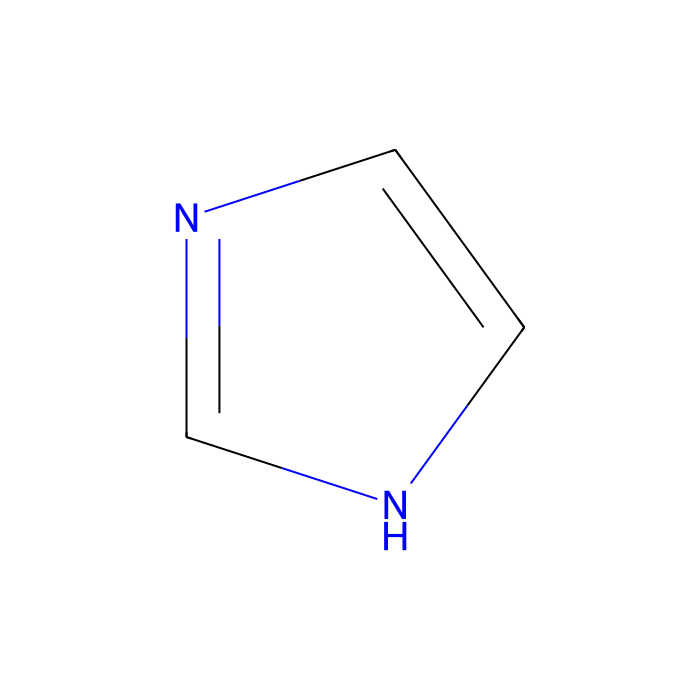
Imidazole, also known as Glyoxalin, is an aromatic heterocyclic diazole and a key biological buffer with a pH range of 6.2 to 7.8 at 25°C. It has a wide range of applications in molecular biology, biochemistry, and proteomics. In proteomics, imidazole is essential for eluting histidine-tagged proteins from IMAC columns. It is a strong chelator of divalent cations, such as nickel and zinc, which disrupts the interaction between the His-tag and the metal ions. This allows for the efficient elution of purified proteins.
Furthermore, imidazole is indispensable for enhancing protein purity. It is widely used in preparing buffer solutions optimized for downstream purification columns. Imidazole solutions are also effective elution and washing agents throughout protein purification processes. Additionally, imidazole can be used for assays of horseradish peroxidase (HRP) and reverse staining of SDS-PAGE gels for protein detection. Imidazole is a versatile and valuable reagent for a wide range of biological applications. It is an essential component of many buffers and is also used in protein purification and detection protocols.
Documento completo su pericoli, manipolazione, stoccaggio e conformità normativa.
<<<<<<< HEAD Scarica SDS → ======= Scarica SDS → >>>>>>> release248-p3Dati di qualità specifici del lotto. Inserisci il numero di lotto per recuperare il COA esatto.
Cerca COA →Riepilogo di riferimento rapido delle specifiche e applicazioni del prodotto.
Visualizza scheda tecnica →Attributi di qualità completi e criteri di accettazione per questa qualità.
Visualizza scheda delle specifiche →Taxonomy Tree
| Kingdom | Organic compounds |
|---|---|
| Superclass | Organoheterocyclic compounds |
| Classe | Azoles |
| Subclass | Imidazoles |
| Intermediate Tree Nodes | Not available |
| Direct Parent | Imidazoles |
| Alternative Parents | Heteroaromatic compounds Azacyclic compounds Organopnictogen compounds Organonitrogen compounds Hydrocarbon derivatives |
| Molecular Framework | Aromatic heteromonocyclic compounds |
| Substituents | Heteroaromatic compound - Imidazole - Azacycle - Organic nitrogen compound - Organopnictogen compound - Hydrocarbon derivative - Organonitrogen compound - Aromatic heteromonocyclic compound |
| Descrizione | This compound belongs to the class of organic compounds known as imidazoles. These are compounds containing an imidazole ring, which is an aromatic five-member ring with two nitrogen atoms at positions 1 and 3, and three carbon atoms. |
| External Descriptors | an aromatic compound |
| Activity Type | Relation | Activity value | Units | Action Type | Journal | PubMed Id | doi | Assay Aladdin ID |
|---|
| Activity Type | Relation | Activity value | Units | Action Type | Journal | PubMed Id | doi | Assay Aladdin ID |
|---|
| Activity Type | Relation | Activity value | Units | Action Type | Journal | PubMed Id | doi | Assay Aladdin ID |
|---|
| Activity Type | Relation | Activity value | Units | Action Type | Journal | PubMed Id | doi | Assay Aladdin ID |
|---|
| Activity Type | Relation | Activity value | Units | Action Type | Journal | PubMed Id | doi | Assay Aladdin ID |
|---|
| Activity Type | Relation | Activity value | Units | Action Type | Journal | PubMed Id | doi | Assay Aladdin ID |
|---|
| Activity Type | Relation | Activity value | Units | Action Type | Journal | PubMed Id | doi | Assay Aladdin ID |
|---|
| Activity Type | Relation | Activity value | Units | Action Type | Journal | PubMed Id | doi | Assay Aladdin ID |
|---|
| Activity Type | Relation | Activity value | Units | Action Type | Journal | PubMed Id | doi | Assay Aladdin ID |
|---|
| Activity Type | Relation | Activity value | Units | Action Type | Journal | PubMed Id | doi | Assay Aladdin ID |
|---|
| Activity Type | Relation | Activity value | Units | Action Type | Journal | PubMed Id | doi | Assay Aladdin ID |
|---|
| Activity Type | Relation | Activity value | Units | Action Type | Journal | PubMed Id | doi | Assay Aladdin ID |
|---|
| Activity Type | Relation | Activity value | Units | Action Type | Journal | PubMed Id | doi | Assay Aladdin ID |
|---|
| Activity Type | Relation | Activity value | Units | Action Type | Journal | PubMed Id | doi | Assay Aladdin ID |
|---|
| Activity Type | Relation | Activity value | Units | Action Type | Journal | PubMed Id | doi | Assay Aladdin ID |
|---|
| Activity Type | Relation | Activity value | Units | Action Type | Journal | PubMed Id | doi | Assay Aladdin ID |
|---|
| Activity Type | Relation | Activity value | Units | Action Type | Journal | PubMed Id | doi | Assay Aladdin ID |
|---|
| Activity Type | Relation | Activity value | Units | Action Type | Journal | PubMed Id | doi | Assay Aladdin ID |
|---|
| Activity Type | Relation | Activity value | Units | Action Type | Journal | PubMed Id | doi | Assay Aladdin ID |
|---|
| Activity Type | Relation | Activity value | Units | Action Type | Journal | PubMed Id | doi | Assay Aladdin ID |
|---|
| Activity Type | Relation | Activity value | Units | Action Type | Journal | PubMed Id | doi | Assay Aladdin ID |
|---|
Find and download the COA for your product by matching the lot number on the packaging.
| Lot Number | Certificate Type | Data | Oggetto |
|---|---|---|---|
 J2622517 | Certificate of Analysis | Sep 21, 2026 | I108706 |
| J2622511 | Certificate of Analysis | Sep 21, 2026 | I108706 |
| J2622509 | Certificate of Analysis | Sep 21, 2026 | I108706 |
| J2622506 | Certificate of Analysis | Sep 21, 2026 | I108706 |
| J2622490 | Certificate of Analysis | Sep 21, 2026 | I108706 |
| K2427484 | Certificate of Analysis | Sep 04, 2026 | I108706 |
| H2607647 | Certificate of Analysis | Jul 24, 2026 | I108706 |
| H2607644 | Certificate of Analysis | Jul 24, 2026 | I108706 |
| H2607643 | Certificate of Analysis | Jul 24, 2026 | I108706 |
| H2607642 | Certificate of Analysis | Jul 24, 2026 | I108706 |
| E2618346 | Certificate of Analysis | May 06, 2026 | I108706 |
| E2618345 | Certificate of Analysis | May 06, 2026 | I108706 |
| E2618324 | Certificate of Analysis | May 06, 2026 | I108706 |
| E2618323 | Certificate of Analysis | May 06, 2026 | I108706 |
| E2618347 | Certificate of Analysis | May 06, 2026 | I108706 |
| L2529336 | Certificate of Analysis | Dec 15, 2025 | I108706 |
| L2529337 | Certificate of Analysis | Dec 15, 2025 | I108706 |
| L2529340 | Certificate of Analysis | Dec 15, 2025 | I108706 |
| A2616684 | Certificate of Analysis | Dec 15, 2025 | I108706 |
| A2616683 | Certificate of Analysis | Dec 15, 2025 | I108706 |
| A2616685 | Certificate of Analysis | Dec 15, 2025 | I108706 |
| A2616686 | Certificate of Analysis | Dec 15, 2025 | I108706 |
| I2512370 | Certificate of Analysis | Aug 29, 2025 | I108706 |
| I2512373 | Certificate of Analysis | Aug 29, 2025 | I108706 |
| I2512366 | Certificate of Analysis | Aug 29, 2025 | I108706 |
| I2512360 | Certificate of Analysis | Aug 29, 2025 | I108706 |
| I2512202 | Certificate of Analysis | Aug 29, 2025 | I108706 |
| G2507416 | Certificate of Analysis | May 29, 2025 | I108706 |
| G2507470 | Certificate of Analysis | May 29, 2025 | I108706 |
| G2507471 | Certificate of Analysis | May 29, 2025 | I108706 |
| G2507479 | Certificate of Analysis | May 29, 2025 | I108706 |
| D2301432 | Certificate of Analysis | Feb 17, 2025 | I108706 |
| C2505604 | Certificate of Analysis | Jan 10, 2025 | I108706 |
| C2505603 | Certificate of Analysis | Jan 10, 2025 | I108706 |
| D2301444 | Certificate of Analysis | Jan 09, 2025 | I108706 |
| F2130284 | Certificate of Analysis | Jan 09, 2025 | I108706 |
| K2427486 | Certificate of Analysis | Nov 01, 2024 | I108706 |
| K2427485 | Certificate of Analysis | Nov 01, 2024 | I108706 |
| K2427483 | Certificate of Analysis | Nov 01, 2024 | I108706 |
| D2117181 | Certificate of Analysis | Oct 22, 2024 | I108706 |
| J2428330 | Certificate of Analysis | Sep 11, 2024 | I108706 |
| J2428331 | Certificate of Analysis | Sep 11, 2024 | I108706 |
| K2215885 | Certificate of Analysis | Aug 23, 2024 | I108706 |
| K2215887 | Certificate of Analysis | Aug 23, 2024 | I108706 |
| C2427204 | Certificate of Analysis | Apr 12, 2024 | I108706 |
| C2427196 | Certificate of Analysis | Apr 12, 2024 | I108706 |
| G2215534 | Certificate of Analysis | Apr 07, 2024 | I108706 |
| B2419373 | Certificate of Analysis | Jan 29, 2024 | I108706 |
| B2419374 | Certificate of Analysis | Jan 29, 2024 | I108706 |
| K2306348 | Certificate of Analysis | Oct 16, 2023 | I108706 |
| K2306336 | Certificate of Analysis | Oct 16, 2023 | I108706 |
| I2122201 | Certificate of Analysis | Jun 16, 2023 | I108706 |
| G2305891 | Certificate of Analysis | Jun 03, 2023 | I108706 |
| G2305842 | Certificate of Analysis | Jun 03, 2023 | I108706 |
| G2305840 | Certificate of Analysis | Jun 03, 2023 | I108706 |
| G2305892 | Certificate of Analysis | Jun 03, 2023 | I108706 |
| D2301445 | Certificate of Analysis | Feb 20, 2023 | I108706 |
| D2301443 | Certificate of Analysis | Feb 20, 2023 | I108706 |
| K2215884 | Certificate of Analysis | Aug 22, 2022 | I108706 |
| K2215883 | Certificate of Analysis | Aug 22, 2022 | I108706 |
| G2215536 | Certificate of Analysis | Mar 07, 2022 | I108706 |
| G2215537 | Certificate of Analysis | Mar 07, 2022 | I108706 |
| Sensibilità | Moisture sensitive,air sensitive |
|---|---|
| Punto di infiammabilità (°C) | 145℃ |
| Punto di ebollizione (°C) | 257°C |
| Punto di fusione (°C) | 90-91°C |
| Peso molecolare | 68.080 g/mol |
| XLogP3 | -0.100 |
| Hydrogen Bond Donor Count | 1 |
| Hydrogen Bond Acceptor Count | 1 |
| Rotatable Bond Count | 0 |
| Exact Mass | 68.0374 Da |
| Monoisotopic Mass | 68.0374 Da |
| Topological Polar Surface Area | 28.700 Ų |
| Heavy Atom Count | 5 |
| Formal Charge | 0 |
| Complexity | 28.100 |
| Isotope Atom Count | 0 |
| Defined Atom Stereocenter Count | 0 |
| Undefined Atom Stereocenter Count | 0 |
| Defined Bond Stereocenter Count | 0 |
| Undefined Bond Stereocenter Count | 0 |
| The total count of all stereochemical bonds | 0 |
| Covalently-Bonded Unit Count | 1 |
La nostra guida alla selezione delle qualità copre purezza, stato dello stabilizzatore e idoneità all'applicazione per tutte le varianti del nostro catalogo.
Visualizza la guida alle qualità Suitable for molecular biology →