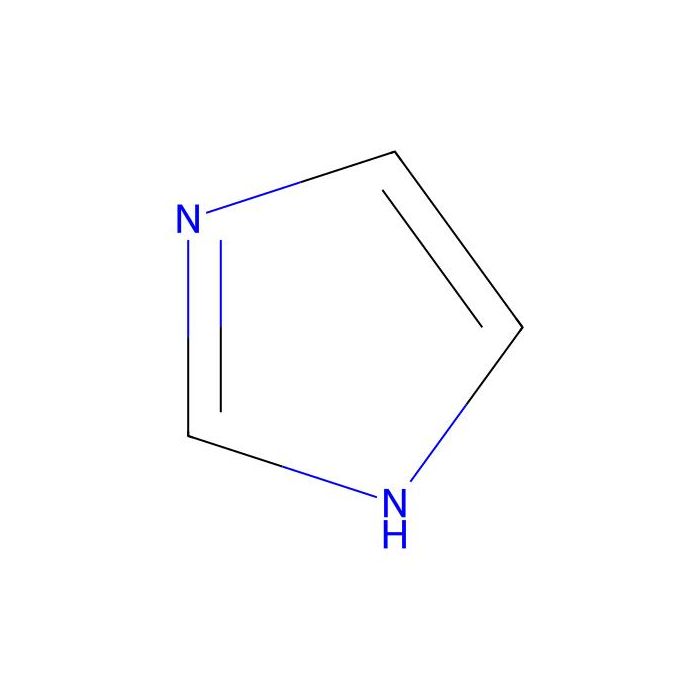
Imidazole - ≥99%(T), crystalline , CAS No.288-32-4

CAS: 288-32-4 Cat. No.: I755534 Formula: C3H4N2 Peso molecolare: 68.08 Beilstein Registry Number: 103853 Numero EC: 206-019-2
Disponibile su ordine
QUALITÀ & PUREZZA ≥99%(T) crystalline
Storage
Store at 2-8°C,Argon charged
Shipped In
Wet ice
★
Dimensione
Germania (EU)
USA*
Prezzo
Qtà
5g
I755534-5g
Su ordinazione · 8–12 settimane
43,30€
25g
I755534-25g
Su ordinazione · 8–12 settimane
164,78€
100g
I755534-100g
Su ordinazione · 8–12 settimane
433,78€
Enter a quantity for the sizes you want to add.

Panoramica

Excellent for buffers in the range of pH 6.2-7.8

Specifiche

Specifiche e purezza
≥99%(T), crystalline
Condizioni di conservazione di stoccaggio
Store at 2-8°C,Argon charged
Spedito in
Wet ice
Questo prodotto richiede spedizione a catena fredda. I servizi di terra e altri servizi economici non sono disponibili.
Purezza
≥99%(T)
Nomi e identificatori
PH
6.2-7.8 (25 °C)
Isomeri SMILES
C1=CN=CN1
WGK Germania
1
RTECS
NI3325000
Numero UN
2923
Peso molecolare
68.08
Beilstein
103853
Reaxys
103853
Reaxys-RN_link_address
https://www.reaxys.com/reaxys/secured/hopinto.do?context=S&query=IDE.XRN=103853&ln=

Dati avanzati

Certificati (CoA, COO, BSE/TSE e tabella di analisi)
C of A & Other Certificates(BSE/TSE, COO):
Analytical Chart:

Find and download the COA for your product by matching the lot number on the packaging.

3 results found

Lot NumberCertificate TypeDataOggetto
G2613454G2613454Certificate of AnalysisJun 13, 2026 I755534
G2613455G2613455Certificate of AnalysisJun 13, 2026 I755534
G2613456G2613456Certificate of AnalysisJun 13, 2026 I755534
Proprietà chimiche e fisiche
Solubilitàwater: 500 mg/mL, clear, colorless to very faintly yellow
Punto di infiammabilità (°C)145℃
Punto di ebollizione (°C)257°C
Punto di fusione (°C)90-91°C
Sicurezza e pericoli (GHS)
Pictogrammi
GHS05,   GHS07,   GHS08
Segnale
Danger
Indicazioni di pericolo

H302:Harmful if swallowed

H314:Causes severe skin burns and eye damage

H360D:May damage the unborn child

WGK Germania
1
RTECS
NI3325000
Reaxys
103853
Reaxys-RN_link_address
https://www.reaxys.com/reaxys/secured/hopinto.do?context=S&query=IDE.XRN=103853&ln=
Indice Merck
4912
Domande frequenti e articoli
Comparing Guanidine Hydrochloride and Urea for Inclusion-Body Solubilization
Why Did Nickel Agarose Beads Lose Their Color?
Why Did My Ni-Agarose Beads Turn Black or Brown?
How to Optimize Buffer Components for Ni-Agarose Beads
Stripping, Cleaning, and Metal Recharging Workflow for Ni²⁺–Agarose Resins
Obtaining soluble and biologically active recombinant proteins from inclusion bodies
How to Choose the Best Protein Purification Technique
His-Tagged Protein Purification
His-Tag Protein Purification: Common Troubleshooting Questions and Practical Solutions
Scientific Decision-Making for Chromatography Buffer Selection: Tris-HCl vs Phosphate Systems
OSF/ASF Dual-Channel Toolbox: Divergent Reactions of Four-Membered Ring Sulfonyl Fluorides, Condition “Knobs,” and Selection Navigation
Protein Tags Demystified: Classification, Properties, and Suitable Experimental Applications
Why Copper Develops Local Pinholes in Water Systems: The Film-Forming Protection Mechanism of Benzotriazole (BTA), Key Variables, and a Selection Guide (Tables 1–3)
Tuning Logic of Imidazole Heteroaromatic Building Blocks: How Dual Nitrogen Sites and Substitution / Salt Forms / Ring Fusion Modulate Charge, Hydrogen Bonding, and Coordination (with Tables A–E)
Invertebrate Oxygen Carrier Proteins in Immunology and Vaccine Research
Silicon Reagent-Assisted Peptide Synthesis: Research Progress and Methodological Value of Peptide Bond Formation from Unprotected Substrates
Decision Logic for Peptide Synthesis Routes: Applicability and Criteria for Choosing among SPPS, LPPS, and Recombinant Expression
DMAP Is More Than Just an Organic Base: Experimental Judgment from Nucleophilic Acyl Transfer to Esterification and Macrolactonization
Experimental Selection of SEM-Cl: From O/N-SEM Protection and Directed Functionalization of N-Heterocycles to the Introduction of Protected C1 Fragments
4-[(tert-Butyldimethylsilyl)oxy]butan-1-ol: Experimental Selection Logic as a Monoprotected 1,4-Butanediol Building Block and a Protected C4 Linker
Formulation Design and Selection of Amine Curing Agents in Epoxy Systems
Protein Structure Analysis: An Experimental Path from Defining the Question to Functional Validation
Understanding Amine Curing Agents: Structure, Types, and Application Selection
Adding a Temperature-Triggered Switch to NCO: How Blocked Isocyanates Affect the Storage, Curing, and Film Performance of 1K Baking Coatings
Epoxy Phenolic Coatings: Why Are They Commonly Used for Chemical Resistance, Solvent Resistance, Heat Resistance, and Internal Metal Surface Protection?
What Is Synthetic Biology? The Industrialization Pathway from Upstream Reagent Toolchains to Biomanufacturing Applications
Why Is the meta-Fluoropyridine Motif Difficult to Make? Understanding the Synthetic Logic of Stable Enamine Building Blocks from the Risks of the Balz–Schiemann Reaction
Structural Features, Property Modulation, and Typical Applications of Triazole Compounds
Synthetic Application Logic of Triazoles and Related Compounds: Structural Introduction, Reactive Sites, and Target Molecule Construction
One-Pot Arylation of the Piperidine α-C–H Bond: From Directed Lithiation and Li→Zn Transmetalation to Negishi Coupling
Overcoming the Electronic-Effect Limitations of Nucleophilic Aromatic Substitution in Fluoroarenes: Anion Activation, Concerted Substitution, and HF Capture by t-Bu-P4
What Is “Plant Collagen”? Distinguishing Ingredient Types, Structural Differences, Production Methods, and Skincare Effects
From 459,000 Recorded Ring Systems to 3,902 Candidate Ring Systems: Selection Patterns of Clinically Relevant Ring Systems
Citations of This Product
Calcolatori di soluzioni
Recensioni

Recensioni dei clienti

Domande frequenti

How should this product be stored?
Store at 2–8 °C under argon. It is supplied under an argon blanket; reseal under inert gas after each use.
How is this product shipped?
This product ships chilled on wet ice. Unpack on arrival and transfer it to the storage condition stated above.
What are the CAS number, molecular formula and molecular weight?
The CAS Number is 288-32-4, the molecular formula is C3H4N2, and the molecular weight is 68.08 g/mol.
What documentation is provided?
Available product documentation, including Certificates of Analysis (COA), Safety Data Sheets (SDS), and specification sheets, is shown in the product document area. Document availability and access follow the current site policy.

Desidera che le inviamo un messaggio quando avremo sconti disponibili?

Ricordamelo più tardi

Grazie! Controlli la sua casella di posta per confermare.

Ops! Le notifiche sono disabilitate.