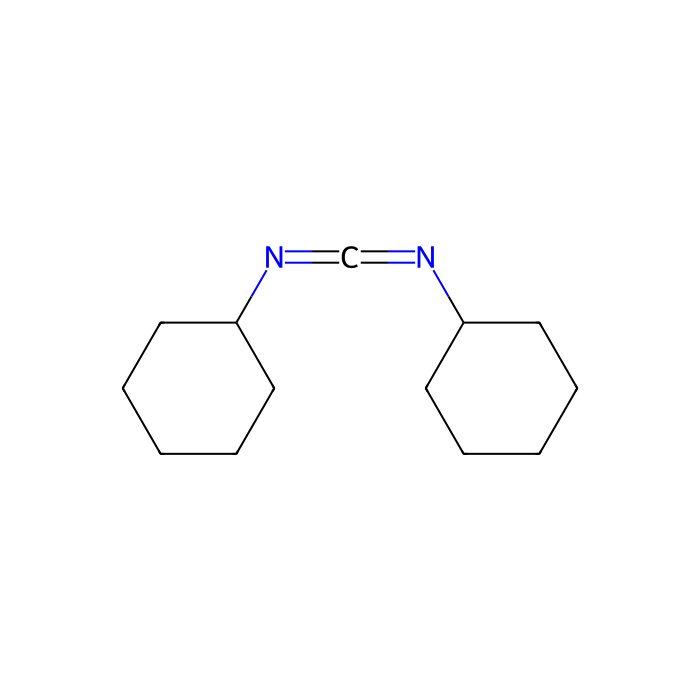
N,N′-Dicyclohexylcarbodiimide solution - 1.0 M in methylene chloride , CAS No.538-75-0

CAS: 538-75-0 Cat. No.: D432856 Formula: C13H22N2 Peso molecolare: 206.33 Beilstein Registry Number: 610662 Numero EC: 208-704-1
Disponibile su ordine
GRADE & PURITY 1.0 M in methylene chloride
Synonyms
DCC | EC 208-704-1 | STL089892 | 1,3-dicyclohexylcarbodimide | N,N'-Methanetetraylbiscyclohexaamine | US8815951, N/A | AI3-08191 | DCC | dicyclohexyl carbodimide | dicyclohexylcarbod iimide | NSC53373 | NSC-53373 | 1, 3-dicyclohexylcarbodiimide | DICYCLOH
Storage
Room temperature
★
Size
Germania (EU)
USA*
Price
Qty
100ml
D432856-100ml
—
1 Disponibile
77,14€
Enter a quantity for the sizes you want to add.
🧪
Why this grade

1.0 M in methylene chloride for sensitive chromatographic and analytical workflows requiring minimal baseline interference.

🌡

Storage & shipping

Room temperature Ships Check lot-specific COA for exact specifications.

📋

Quality documents

SDS, COA, datasheet, and spec sheet available for download. Lot-specific COA accessible via lot number lookup.

📚

Literature proof

Cited in 881 peer-reviewed publications across chromatography, organic synthesis, and cross-coupling reactions.

Panoramica

Application:

DCC ( N , N ′-Dicyclohexylcarbodiimide) is mainly used to mediate peptide coupling and also to activate carboxylic acids for esterification.

Specifications

Sinonimi
DCC | EC 208-704-1 | STL089892 | 1,3-dicyclohexylcarbodimide | N,N'-Methanetetraylbiscyclohexaamine | US8815951, N/A | AI3-08191 | DCC | dicyclohexyl carbodimide | dicyclohexylcarbod iimide | NSC53373 | NSC-53373 | 1, 3-dicyclohexylcarbodiimide | DICYCLOH
Specifiche e purezza
1.0 M in methylene chloride
Condizioni di conservazione di stoccaggio
Room temperature
Nomi e identificatori
Pubchem Sid
Sorrisi canonici
C1CCC(CC1)N=C=NC2CCCCC2
InChIKey
QOSSAOTZNIDXMA-UHFFFAOYSA-N
INCHI
1S/C13H22N2/c1-3-7-12(8-4-1)14-11-15-13-9-5-2-6-10-13/h12-13H,1-10H2
Isomeri SMILES
C1CCC(CC1)N=C=NC2CCCCC2
WGK Germania
1
RTECS
FF2160000
Numero UN
2811
Gruppo di imballaggio
I
Peso molecolare
206.33
Beilstein
610662
Reaxy-Rn
610662
Reaxys-RN_link_address
https://www.reaxys.com/reaxys/secured/hopinto.do?context=S&query=IDE.XRN=610662&ln=

Documentazione

📋 Safety Data Sheet (SDS)

Comprehensive hazard, handling, storage, and regulatory compliance document.

Download SDS →

✅ Certificate of Analysis (COA)

Lot-specific quality data. Enter your lot number to retrieve the exact COA.

Look up COA →

📊 Datasheet

Quick-reference summary of product specifications and applications.

View datasheet →

🔬 Specification Sheet

Full quality attributes and acceptance criteria for this grade.

View spec sheet →

Advanced Data

Taxonomic Classification

Taxonomy Tree

KingdomOrganic compounds
SuperclassOrganic nitrogen compounds
ClasseOrganonitrogen compounds
SubclassCarbodiimides
Intermediate Tree Nodes Not available
Direct ParentCarbodiimides
Alternative Parents Propargyl-type 1,3-dipolar organic compounds  Organopnictogen compounds  Hydrocarbon derivatives  
Molecular FrameworkAliphatic homomonocyclic compounds
Substituents Organic 1,3-dipolar compound - Propargyl-type 1,3-dipolar organic compound - Carbodiimide - Organopnictogen compound - Hydrocarbon derivative - Aliphatic homomonocyclic compound
DescrizioneThis compound belongs to the class of organic compounds known as carbodiimides. These are organic compounds containing a functional group consisting of the formula RN=C=NR.
External Descriptors a small molecule
Struttura 3D
Modello di struttura chimica interattiva


Obiettivi associati (umani)
EPHX1 Tchem Epoxide hydrolase 1 (1 Activities)
Activity TypeActivity Value -log(M)Mechanism of ActionActivity ReferencePublications (PubMed IDs)
ESR1 Tclin Estrogen receptor alpha (17718 Activities)
Activity TypeRelationActivity valueUnitsAction TypeJournalPubMed IddoiAssay Aladdin ID
EPHX1 Tchem Epoxide hydrolase 1 (644 Activities)
Activity TypeRelationActivity valueUnitsAction TypeJournalPubMed IddoiAssay Aladdin ID
AR Tclin Androgen Receptor (11781 Activities)
Activity TypeRelationActivity valueUnitsAction TypeJournalPubMed IddoiAssay Aladdin ID
VDR Tclin Vitamin D receptor (26531 Activities)
Activity TypeRelationActivity valueUnitsAction TypeJournalPubMed IddoiAssay Aladdin ID
PPARG Tclin Peroxisome proliferator-activated receptor gamma (15191 Activities)
Activity TypeRelationActivity valueUnitsAction TypeJournalPubMed IddoiAssay Aladdin ID
KCNH2 Tclin HERG (29587 Activities)
Activity TypeRelationActivity valueUnitsAction TypeJournalPubMed IddoiAssay Aladdin ID
RXRA Tclin Retinoid X receptor alpha (3637 Activities)
Activity TypeRelationActivity valueUnitsAction TypeJournalPubMed IddoiAssay Aladdin ID
CXCL8 Tchem Interleukin-8 (642 Activities)
Activity TypeRelationActivity valueUnitsAction TypeJournalPubMed IddoiAssay Aladdin ID
NR1H4 Tclin Bile acid receptor FXR (6228 Activities)
Activity TypeRelationActivity valueUnitsAction TypeJournalPubMed IddoiAssay Aladdin ID
TP53 Tchem Cellular tumor antigen p53 (48468 Activities)
Activity TypeRelationActivity valueUnitsAction TypeJournalPubMed IddoiAssay Aladdin ID
MT4 (17854 Activities)
Activity TypeRelationActivity valueUnitsAction TypeJournalPubMed IddoiAssay Aladdin ID
Lymphoblastoid cell (5959 Activities)
Activity TypeRelationActivity valueUnitsAction TypeJournalPubMed IddoiAssay Aladdin ID
HIF1A Tchem Hypoxia-inducible factor 1 alpha (6027 Activities)
Activity TypeRelationActivity valueUnitsAction TypeJournalPubMed IddoiAssay Aladdin ID
Obiettivi associati (non umani)
Ppard Peroxisome proliferator-activated receptor delta (358 Activities)
Activity TypeRelationActivity valueUnitsAction TypeJournalPubMed IddoiAssay Aladdin ID
Mycobacterium tuberculosis (203094 Activities)
Activity TypeRelationActivity valueUnitsAction TypeJournalPubMed IddoiAssay Aladdin ID
Mycolicibacterium smegmatis (8003 Activities)
Activity TypeRelationActivity valueUnitsAction TypeJournalPubMed IddoiAssay Aladdin ID
Human immunodeficiency virus 1 (70413 Activities)
Activity TypeRelationActivity valueUnitsAction TypeJournalPubMed IddoiAssay Aladdin ID
lef Anthrax lethal factor (7585 Activities)
Activity TypeRelationActivity valueUnitsAction TypeJournalPubMed IddoiAssay Aladdin ID
Nfe2l2 Nuclear factor erythroid 2-related factor 2 (214 Activities)
Activity TypeRelationActivity valueUnitsAction TypeJournalPubMed IddoiAssay Aladdin ID
Rorc Nuclear receptor ROR-gamma (89407 Activities)
Activity TypeRelationActivity valueUnitsAction TypeJournalPubMed IddoiAssay Aladdin ID
Meccanismi d'azione
Certificati (CoA, COO, BSE/TSE e tabella di analisi)
C of A & Other Certificates(BSE/TSE, COO):
Analytical Chart:

Find and download the COA for your product by matching the lot number on the packaging.

3 results found

Lot NumberCertificate TypeDataOggetto
J2417657Certificate of AnalysisOct 18, 2024 D432856
J2417658Certificate of AnalysisOct 18, 2024 D432856
J2417678Certificate of AnalysisOct 18, 2024 D432856
Proprietà chimiche e fisiche
Peso molecolare206.330 g/mol
XLogP34.700
Hydrogen Bond Donor Count0
Hydrogen Bond Acceptor Count2
Rotatable Bond Count2
Exact Mass206.178 Da
Monoisotopic Mass206.178 Da
Topological Polar Surface Area24.700 Ų
Heavy Atom Count15
Formal Charge0
Complexity201.000
Isotope Atom Count0
Defined Atom Stereocenter Count0
Undefined Atom Stereocenter Count0
Defined Bond Stereocenter Count0
Undefined Bond Stereocenter Count0
The total count of all stereochemical bonds0
Covalently-Bonded Unit Count1
Domande frequenti e articoli
A Complete Guide to Choosing Resins for SPPS (Solid-Phase Peptide Synthesis): Fmoc/Boc Routes, C-Terminal Acid/Amide, and a Key-Parameter Navigator
A Practical Guide to Small-Molecule Chemical Probes: Concept Clarification, Causal Validation, and Experimental Selection (with Product Navigation and Tables A–D)
β-Acyloxy Alkenyl Amides (AAAs): A New Approach to Amide Bond and Peptide Bond Construction Worth Attention
DAST-Mediated Amidation at Room Temperature: Method Features, Practical Value, and Scope of Applicability
From High Reactivity to Comprehensive Evaluation: Using CTSOAt as an Example to Understand the Design Logic of New Coupling Reagents
From Analytical Instrument to Synthetic Platform: A New Strategy for Reconstructing Automated Flow Solid-Phase Peptide Synthesis with Standard Analytical HPLC
TCFH–NMI Amidation in Highly Aqueous Media: Research Value, Methodological Understanding, and Experimental Insights
A New Balance in Coupling Reagents: How DMT-TU Balances Reactivity, Racemization Control, and Thermal Hazard
The Positioning of TBTU in Practice: Racemization Risk, Extended Uses, and Selection Criteria
From “High Yield” to “Configuration Retention”: Activation-Stage Risks, Route Differences, and Selection Principles for Coupling Systems
The Methodological Value of HATU in Difficult Couplings: Reactivity Advantages, Stereochemical Retention, and Condition Management
The Methodological Value of Boc-Oxyma: Low-Racemization Coupling, Route Continuity, and Extended Applications
Low Racemization in Peptide Synthesis Is Not Just About Reagent Choice: Stereochemical Risk During the Activation Stage and Practical Strategies for Experimental Control
The Methodological Value of DSC: Building NHS-Type Activated Intermediates and Deciding When to Use Them
The Methodological Value of TPS-Cl: The Logic of Selective Activation and Representative Transformations in Nucleoside and Nucleotide Chemistry
The Methodological Value of TCFH: Advantages in Challenging Amidation and the Switching Logic of Carboxylic Acid Activation Pathways
Ynamide Coupling Reagents: From Low-Epimerization Activation Pathways to More Practically Usable N→C Inverse Peptide Synthesis
Decision Logic for Peptide Synthesis Routes: Applicability and Criteria for Choosing among SPPS, LPPS, and Recombinant Expression
Decision Logic for Selecting Coupling Reagents in Amide Bond Formation: Activation Pathways, Side Reactions, Epimerization, Workup, and Safety
DMAP Is More Than Just an Organic Base: Experimental Judgment from Nucleophilic Acyl Transfer to Esterification and Macrolactonization
Experimental Assessment of HOPO in Carbodiimide-Mediated Amide Coupling: Low-Racemization Control, Application Scenarios, and Process Considerations
Experimental Selection Logic for Pentafluorophenyl-Based Systems: Practical Judgment from Active Esters and Pre-Activated Monomers to Downstream Transformations
Experimental Judgment in Oxyma Coupling Systems: Coupling Efficiency, Racemization Control, and the HCN Risk in DIC-Based Systems
Experimental Judgment for CMPI in Carboxylic Acid Activation: Applicable Tasks, Base Matching, and Workup Burden
Experimental Judgment for TFPN in Carboxylic Acid Activation: Suitable Scenarios, Intermediate Distribution, and Nucleophile Compatibility
Reaction Selection in Small-Molecule Synthesis: From Transformation-Type Assessment to Experimental Route Screening
How to Determine Whether a Protein Is Suitable for Targeted Degradation: From Degradation Pathway and Molecular Design to Mechanism Validation
How to Troubleshoot Abnormal Impurities in Peptide Synthesis? Locating Process Issues Through Amino-Related Side Reactions
AITF-Mediated Carboxylic Acid Activation for the Synthesis of Amides, Peptides, and Esters: Activation Mechanism and Applicable Scenarios
Formation and Control of Carboxyl- and Hydroxyl-Related Impurities in Peptide Synthesis — Using Asp/Glu and Ser/Thr Residue Side Reactions as Examples
Synthesis Strategy of Pentafluorothio Group - Synthesis of Aliphatic Compounds Containing SF₅
CTSOBt Benzotriazole–Sulfonate Coupling Reagent: Carboxylic Acid Activation and Synthetic Application Value
Logic for Selecting Amidation Reagents in Aqueous Media: Competing Reactions, Activated Intermediates, and Substrate Effects
Copper Tripeptide GHK-Cu and Skin Repair: From Copper Coordination Chemistry to Extracellular Matrix Remodeling
Citations of This Product
Calcolatori di soluzioni
Recensioni

Recensioni dei clienti

Desidera che le inviamo un messaggio quando avremo sconti disponibili?

Ricordamelo più tardi

Grazie! Controlli la sua casella di posta per confermare.

Ops! Le notifiche sono disabilitate.