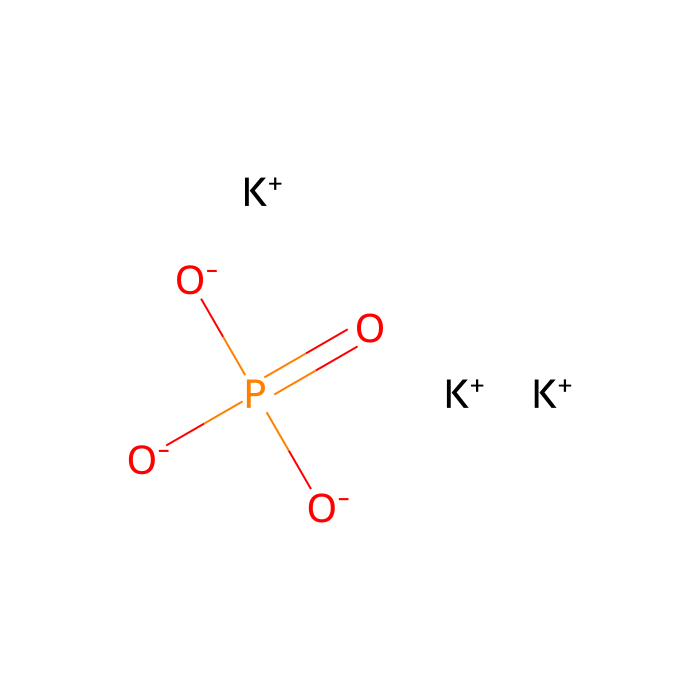
Potassium phosphate tribasic - anhydrous, ≥98% , CAS No.7778-53-2

CAS: 7778-53-2 Cat. No.: P434005 Formula: K3PO4 Peso molecolare: 212.27 Numero EC: 231-907-1
Disponibile su ordine
QUALITÀ & PUREZZA Anhydrous Grade ? Anhydrous grade — water removed and packaged dry for moisture-sensitive chemistry. Use in reactions where even trace water would interfere or quench. ≥98%
Synonyms
potassium phosphate, tribasic, n-hydrate|potassium-phosphate|POTASSIUM PHOSPHATE, TRIBASIC ANHYDROUS|Tripotasium phosphate|Tripotassium orthophosphate|tri-Potassium orthophosphate
Storage
Room temperature,Argon charged,Desiccated,Cool
Shipped In
Normal
★
Dimensione
Germania (EU)
USA*
Prezzo
Qtà
500g
P434005-500g
—
Disponibile ≥10
60,65€
Enter a quantity for the sizes you want to add.

Panoramica

Potassium phosphate tribasic exhibits high catalytic property in trans esterification reactions. It has bactericidal activity.

Specifiche

Sinonimi
potassium phosphate, tribasic, n-hydrate | potassium-phosphate | POTASSIUM PHOSPHATE, TRIBASIC ANHYDROUS | Tripotasium phosphate | Tripotassium orthophosphate | tri-Potassium orthophosphate
Specifiche e purezza
anhydrous, ≥98%
Condizioni di conservazione di stoccaggio
Room temperature,Argon charged,Desiccated,Cool
Spedito in
Normal
Grado
Anhydrous Grade
Purezza
≥98%
Product Line
P434005-500g
Nomi e identificatori
Pubchem Sid
Pubchem Sid Url
https://pubchem.ncbi.nlm.nih.gov/substance/504753863
SMILES
[O-]P(=O)([O-])[O-].[K+].[K+].[K+]
IUPAC Name
tripotassium;phosphate
InChIKey
LWIHDJKSTIGBAC-UHFFFAOYSA-K
InChI
1S/3K.H3O4P/c;;;1-5(2,3)4/h;;;(H3,1,2,3,4)/q3*+1;/p-3
Isomeri SMILES
[O-]P(=O)([O-])[O-].[K+].[K+].[K+]
CAS alternativo
115281-28-2
Peso molecolare
212.27
Reaxys
11343346
Reaxys-RN_link_address
https://www.reaxys.com/reaxys/secured/hopinto.do?context=S&query=IDE.XRN=11343346&ln=

Dati avanzati

Taxonomic Classification

Taxonomy Tree

KingdomInorganic compounds
SuperclassMixed metal/non-metal compounds
ClasseAlkali metal oxoanionic compounds
SubclassAlkali metal phosphates
Intermediate Tree Nodes Not available
Direct ParentAlkali metal phosphates
Alternative Parents Inorganic salts  Inorganic oxides  
Molecular FrameworkNot available
Substituents Alkali metal phosphate - Inorganic oxide - Inorganic salt
DescrizioneThis compound belongs to the class of inorganic compounds known as alkali metal phosphates. These are inorganic compounds in which the largest oxoanion is phosphate, and in which the heaviest atom not in an oxoanion is an alkali metal.
External Descriptors Not available
Struttura 3D
Modello di struttura chimica interattiva


Certificati (CoA, COO, BSE/TSE e tabella di analisi)
C of A & Other Certificates(BSE/TSE, COO):
Analytical Chart:

Find and download the COA for your product by matching the lot number on the packaging.

35 results found

Lot NumberCertificate TypeDataOggetto
J2610711J2610711Certificate of AnalysisSep 30, 2026 P434005
J2610728J2610728Certificate of AnalysisSep 30, 2026 P434005
J2610729J2610729Certificate of AnalysisSep 30, 2026 P434005
F2615282F2615282Certificate of AnalysisMay 09, 2026 P434005
F2615281F2615281Certificate of AnalysisMay 09, 2026 P434005
F2615280F2615280Certificate of AnalysisMay 09, 2026 P434005
C2626590C2626590Certificate of AnalysisMar 03, 2026 P434005
C2613363C2613363Certificate of AnalysisMar 03, 2026 P434005
C2613357C2613357Certificate of AnalysisMar 03, 2026 P434005
I2516482I2516482Certificate of AnalysisAug 15, 2025 P434005
I2516481I2516481Certificate of AnalysisAug 15, 2025 P434005
I2516474I2516474Certificate of AnalysisAug 15, 2025 P434005
E2506401E2506401Certificate of AnalysisApr 10, 2025 P434005
E2506428E2506428Certificate of AnalysisApr 10, 2025 P434005
K2425522K2425522Certificate of AnalysisNov 14, 2024 P434005
K2425521K2425521Certificate of AnalysisNov 14, 2024 P434005
I2412578I2412578Certificate of AnalysisAug 26, 2024 P434005
I2412547I2412547Certificate of AnalysisAug 26, 2024 P434005
I2412536I2412536Certificate of AnalysisAug 26, 2024 P434005
E2410398E2410398Certificate of AnalysisApr 25, 2024 P434005
E2410414E2410414Certificate of AnalysisApr 25, 2024 P434005
E2410399E2410399Certificate of AnalysisApr 25, 2024 P434005
I2402477I2402477Certificate of AnalysisJan 17, 2024 P434005
A2425237A2425237Certificate of AnalysisJan 17, 2024 P434005
A2425200A2425200Certificate of AnalysisJan 17, 2024 P434005
A2425211A2425211Certificate of AnalysisJan 17, 2024 P434005
A2425201A2425201Certificate of AnalysisJan 17, 2024 P434005
L2327149L2327149Certificate of AnalysisOct 10, 2023 P434005
J2318659J2318659Certificate of AnalysisOct 10, 2023 P434005
J2318658J2318658Certificate of AnalysisOct 10, 2023 P434005
J2318657J2318657Certificate of AnalysisOct 10, 2023 P434005
H2315344H2315344Certificate of AnalysisJun 29, 2023 P434005
G2307113G2307113Certificate of AnalysisJun 29, 2023 P434005
G2307098G2307098Certificate of AnalysisJun 29, 2023 P434005
G2307094G2307094Certificate of AnalysisJun 29, 2023 P434005
Proprietà chimiche e fisiche
Solubilitàwater: 100mg/mL, clear, colorless
SensibilitàHygroscopic
Peso molecolare212.27
XLogP3
Hydrogen Bond Donor Count0
Hydrogen Bond Acceptor Count4
Rotatable Bond Count0
Exact Mass211.845 Da
Monoisotopic Mass211.845 Da
Topological Polar Surface Area86.300 Ų
Heavy Atom Count8
Formal Charge0
Complexity36.800
Isotope Atom Count0
Defined Atom Stereocenter Count0
Undefined Atom Stereocenter Count0
Defined Bond Stereocenter Count0
Undefined Bond Stereocenter Count0
The total count of all stereochemical bonds0
Covalently-Bonded Unit Count4
Sicurezza e pericoli (GHS)
Pictogrammi
GHS05,   GHS07
Segnale
Danger
Indicazioni di pericolo

H315:Causes skin irritation

H318:Causes serious eye damage

H319:Causes serious eye irritation

H335:May cause respiratory irritation

Precauzioni

P261:Avoid breathing dust/fume/gas/mist/vapors/spray.

P264:Wash hands [and …] thoroughly after handling.

P271:Use only outdoors or in a well-ventilated area.

P280:Wear protective gloves/protective clothing/eye protection/face protection.

P321:Specific treatment (see ... on this label).

P302+P352:IF ON SKIN: wash with plenty of water.

P304+P340:IF INHALED: Remove person to fresh air and keep comfortable for breathing.

P305+P351+P338:IF IN EYES: Rinse cautiously with water for several minutes. Remove contact lenses if present and easy to do - continue rinsing.

P362+P364:Take off contaminated clothing and wash it before reuse.

P405:Store locked up.

P403+P233:Store in a well-ventilated place. Keep container tightly closed.

P501:Dispose of contents/container to an approved waste disposal plant.

P264+P265:Wash hands [and …] thoroughly after handling. Do not touch eyes.

P305+P354+P338:IF IN EYES: Immediately rinse with water for several minutes. Remove contact lenses if present and easy to do. Continue rinsing.

P317:Get emergency medical help.

P337+P317:If eye irritation persists: Get medical help.

P332+P317:If skin irritation occurs: Get medical help.

P319:Get medical help if you feel unwell.

Reaxys
11343346
Reaxys-RN_link_address
https://www.reaxys.com/reaxys/secured/hopinto.do?context=S&query=IDE.XRN=11343346&ln=
Domande frequenti e articoli
Bis(pinacolato)diboron, B2pin2
Diethoxymethylsilane, DEMS
The Guide to Anhydrous Grade for Reagents
One-Stop Handbook for Palladium-Catalyzed Reactions: Catalytic Cycles, Deactivation Troubleshooting, Ligand/Precatalyst Selection, and an Aladdin Reference List
Selection of Common Research Salts: A Task Map for Alkali Metal Salts & Alkaline Earth Metal Salts (with Product Tables 1–6)
Make “Aryl Chlorides + Low Pd Loading + Scale-Up Reproducibility” Reliable: The Initiation and Durability Logic of Pd–NHC (Palladium–N-Heterocyclic Carbene) Cross-Coupling (with Selection Navigation and Product Tables)
Choosing Boron Sources to Make Reactions Robust: How Boronic Acids, Boronate Esters, BF₃K Salts, and MIDA Improve Suzuki–Miyaura Start-Up and Scale-Up Reproducibility (with Product Tables 1–5)
How to Make the Suzuki–Miyaura Reaction Robust: Pinpoint the Bottleneck and Lock in a Reproducible Operating Window (with Selection Navigation and Product Tables 1–5)
Haloheterocycles and Cross-Coupling: A Research-Oriented Selection Framework from Substrate Identification to Bond-Forming Routes (Including Product Navigation and Tables 1–5)
Experimental Decision-Making for Cross-Coupling Reactions: Target Bond Type, Substrate Combination, and Catalytic System Selection
Deoxyfluorination of Hydroxyalkyl-Substituted Aryl/Alkenyl Boronates: C–F Bond Construction and C–B Bond Retention via a BF3K Intermediate
Aladdin® Plant Research Related Products
Overcoming the Electronic-Effect Limitations of Nucleophilic Aromatic Substitution in Fluoroarenes: Anion Activation, Concerted Substitution, and HF Capture by t-Bu-P4
Air Decomposition of Solid Sodium Methoxide and Sodium Ethoxide—Effects on Cross-Coupling Reaction Optimization and Reproducibility
From Temporary Covalent Assembly to Intramolecular Smiles Aryl Migration: DCPDC-Mediated Phenol–Primary Amine C–N Cross-Coupling
Aminative Suzuki–Miyaura Coupling: Bond-Formation Order and Chemoselectivity Control in the Transformation from Ar–Ar′ to Ar–NH–Ar′
Citations of This Product
Calcolatori di soluzioni
Recensioni

Recensioni dei clienti

Desidera che le inviamo un messaggio quando avremo sconti disponibili?

Ricordamelo più tardi

Grazie! Controlli la sua casella di posta per confermare.

Ops! Le notifiche sono disabilitate.