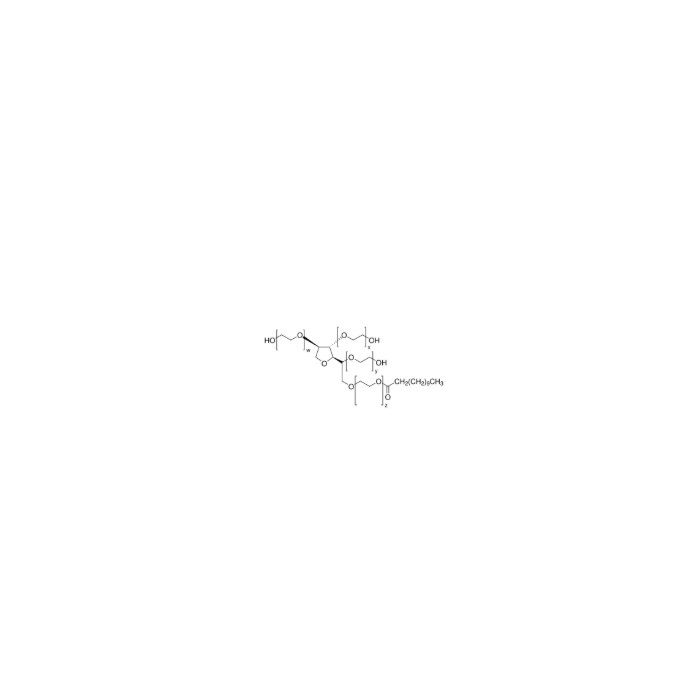
TWEEN® 20 - non-ionic, aqueous solution, 10% (w/v) , CAS No.9005-64-5

CAS: 9005-64-5 Cat. No.: T476411 Formula: C58H114O26(for n = 20) Peso molecolare: 1228 (for n= 20) Numero EC: 500-018-3
Disponibile su ordine
GRADE & PURITY non-ionic, aqueous solution, 10% (w/v)
Synonyms
POE (6) sorbitol monolaurate | Tween(R) 20 | 2-{2-[3,4-bis(2-hydroxyethoxy)oxolan-2-yl]-2-(2-hydroxyethoxy)ethoxy}ethyl dodecanoate | SCHEMBL118527 | Tween 40 (TN) | 1052273-76-3 | 2-(2-(3,4-bis(2-hydroxyethoxy)tetrahydrofuran-2-yl)-2-(2-hydroxyethoxy)eth
Storage
Store at 2-8°C
Shipped In
Wet ice
★
Size
Germania (EU)
USA*
Price
Qty
10ml
T476411-10ml
—
3 Disponibile
45,04€
5×10ml
T476411-5×10ml
Su ordinazione · 8–12 settimane
154,37€
Enter a quantity for the sizes you want to add.
🧪
Why this grade

non-ionic, aqueous solution, 10% (w/v) for sensitive chromatographic and analytical workflows requiring minimal baseline interference.

🌡

Storage & shipping

Store at 2-8°C Ships Wet ice Check lot-specific COA for exact specifications.

📋

Quality documents

SDS, COA, datasheet, and spec sheet available for download. Lot-specific COA accessible via lot number lookup.

📚

Literature proof

Cited in 494 peer-reviewed publications across chromatography, organic synthesis, and cross-coupling reactions.

Panoramica

Tween 20, also referred to as poly(oxyethylene)n-sorbitan-monolaurate, is a non-ionic surfactant. It is mainly used in membrane research.
Application
Tween 20 is used for:
solubilizing membrane proteins during isolation of membrane-protein complexes.
a subsequent protein detection by UV light absorption, due to its low UV absorbance.
ELISA (enzyme-linked immunosorbent assay) and immunoblots.

Specifications

Sinonimi
POE (6) sorbitol monolaurate | Tween(R) 20 | 2-{2-[3,4-bis(2-hydroxyethoxy)oxolan-2-yl]-2-(2-hydroxyethoxy)ethoxy}ethyl dodecanoate | SCHEMBL118527 | Tween 40 (TN) | 1052273-76-3 | 2-(2-(3,4-bis(2-hydroxyethoxy)tetrahydrofuran-2-yl)-2-(2-hydroxyethoxy)eth
Specifiche e purezza
non-ionic, aqueous solution, 10% (w/v)
Informazioni legali
TWEEN is a registered trademark of Croda International PLC
Condizioni di conservazione di stoccaggio
Store at 2-8°C
Spedito in
Wet ice
Questo prodotto richiede spedizione a catena fredda. I servizi di terra e altri servizi economici non sono disponibili.
Nota
For life science research only. Not for use in diagnostic procedures.', '
Nomi e identificatori
Sorrisi canoniciCCCCCCCCCCCC(=O)OCCOCC(C1C(C(CO1)OCCO)OCCO)OCCO
IUPAC Name2-[2-[3,4-bis(2-hydroxyethoxy)oxolan-2-yl]-2-(2-hydroxyethoxy)ethoxy]ethyl dodecanoate
InChIKeyHMFKFHLTUCJZJO-UHFFFAOYSA-N
INCHI1S/C26H50O10/c1-2-3-4-5-6-7-8-9-10-11-24(30)34-19-18-31-20-22(32-15-12-27)26-25(35-17-14-29)23(21-36-26)33-16-13-28/h22-23,25-29H,2-21H2,1H3
Isomeri SMILES CCCCCCCCCCCC(=O)OCCOCC(C1C(C(CO1)OCCO)OCCO)OCCO
WGK Germania 1
RTECS TR7400000
Peso molecolare 1228 (for n= 20)

Documentazione

📋 Safety Data Sheet (SDS)

Comprehensive hazard, handling, storage, and regulatory compliance document.

Download SDS →

✅ Certificate of Analysis (COA)

Lot-specific quality data. Enter your lot number to retrieve the exact COA.

Look up COA →

📊 Datasheet

Quick-reference summary of product specifications and applications.

View datasheet →

🔬 Specification Sheet

Full quality attributes and acceptance criteria for this grade.

View spec sheet →

Advanced Data

Taxonomic Classification

Taxonomy Tree

KingdomOrganic compounds
SuperclassLipids and lipid-like molecules
ClasseFatty Acyls
SubclassFatty acid esters
Intermediate Tree Nodes Not available
Direct ParentFatty acid esters
Alternative Parents Tetrahydrofurans  Carboxylic acid esters  Oxacyclic compounds  Monocarboxylic acids and derivatives  Dialkyl ethers  Primary alcohols  Organic oxides  Hydrocarbon derivatives  Carbonyl compounds  
Molecular FrameworkAliphatic heteromonocyclic compounds
Substituents Fatty acid ester - Tetrahydrofuran - Carboxylic acid ester - Carboxylic acid derivative - Dialkyl ether - Ether - Monocarboxylic acid or derivatives - Organoheterocyclic compound - Oxacycle - Organic oxide - Carbonyl group - Alcohol - Organooxygen compound - Primary alcohol - Hydrocarbon derivative - Organic oxygen compound - Aliphatic heteromonocyclic compound
DescrizioneThis compound belongs to the class of organic compounds known as fatty acid esters. These are carboxylic ester derivatives of a fatty acid.
External Descriptors a small molecule
Struttura 3D
Modello di struttura chimica interattiva


Certificati (CoA, COO, BSE/TSE e tabella di analisi)
C of A & Other Certificates(BSE/TSE, COO):
Analytical Chart:

Find and download the COA for your product by matching the lot number on the packaging.

3 results found

Lot NumberCertificate TypeDataOggetto
H2611486Certificate of AnalysisAug 18, 2026 T476411
A2627691Certificate of AnalysisFeb 03, 2026 T476411
F2513001Certificate of AnalysisJun 13, 2025 T476411
Proprietà chimiche e fisiche
Indice di rifrazione1.4685-1.4715
Punto di infiammabilità (°C)>149℃
Punto di ebollizione (°C)100°C
Punto di fusione (°C)-14 °C
Domande frequenti e articoli
Tween 20 and Tween 80 as Non-Ionic Surfactants: Structure, Properties, and Applications
Enzyme Protectants and Common Methods to Prolong Enzymatic Activity
Common Issues for Western Blot (WB)
How to Choose Between Tween 20, Tween 60, and Tween 80?
Buffer Additives to Prevent Protein Precipitation
Common Protectants and Formulations for Protein Storage
11 Common Methods for Protein Concentration Determination
Differences Among Antibodies for WB/FC/IP/ChIP/IF/IHC
Principles and Application Strategies of Common PCR Enhancers
NPE (NP-n) Selection Guide: How EO Number Affects Solubility, HLB, Cloud Point, and CMC | With an Aladdin Product Reference Table
A Practical Guide to Fragrance Compositions: Turning a Black-Box Formula into an Engineerable System—Compatibility, Stability, Controlled Release, Traceability, and Selection
A Panoramic Guide to Surfactants: Definitions & Mechanisms, Key Metrics, Application Scenarios, and Selection Navigation (Tables 1–3)
Protein Tags Demystified: Classification, Properties, and Suitable Experimental Applications
Why Acridine Can Turn “Trace Molecules” into a Measurable Light Signal: A Mechanistic, Selection, and Troubleshooting Guide to Acridinium Ester Chemiluminescent Immunoassays (Including Product Tables 1–4)
Acid Phosphatase: Dephosphorylation Reactions in Acidic Microenvironments and Their Research, Assay, and Detection Applications
Diaphorase: NAD(P)H-Dependent Electron-Transfer Activity and Its Applications in Detection and Research
Haptoglobin (Hp): A Key Carrier in the Free Hemoglobin Clearance–Detoxification Axis, with Assays and Applications
Urinary Follicle-Stimulating Hormone (uFSH): Source Attributes, Molecular Properties, and Research Application Frameworks
Cholesterol Esterase: Mechanistic Insights and Application Frameworks Driven by Interfacial Hydrolysis
Angiotensin-Converting Enzyme (ACE): A Review of Molecular Features, Catalytic Functions, and Research and Translational Applications
Hemicellulases: A Review of Substrate Specificity, Catalytic Systems, and Research and Industrial Applications
Phytase: Enzymological Properties, Mechanism of Action, and Applications in Feed and Food
Chitinases: Substrate-Specific Degradation Mechanisms, Enzymatic Properties, and Application Directions
Review of the Principles, Common Methods, and Key Application Considerations for the Determination of Glycerol and Triglyceride Contents
Glycoprotein Hormone Family: Molecular Features, Signaling Bias, and In Vivo Pharmacokinetics
Tyramide Signal Amplification in In Situ Fluorescence Detection
Selection Strategy for PBS, TBS, PBST, and TBST Washing Systems in IHC
Preparation Methods and Precautions for Silane Coupling Agent Primer Solutions
Solvents, Co-solvents, and Solubilization Systems in Home and Personal Care Formulations: Classification, Functions, and Selection Guide
Practical Guide to TSA Tyramide Signal Amplification: How to Select Reagents, Optimize the Workflow, and Reduce Background When Detection Signals Are Weak for Low-Abundance Targets
Signal Transduction Mechanism of Graphene Biosensors: From Molecular Recognition to Electrical/Optical Signal Readout and Materials Selection
Why Limonene Can Soften Greasy Soils Yet Is Difficult to Dissolve in Water: Understanding the Cleaning Mechanism and Formulation Applications of Naturally Derived Solvents from Molecular Structure
Interfacial Mechanism and Formulation Applications of AEO-9 (Fatty Alcohol Polyoxyethylene Ether): An Analysis of Emulsification, Wetting, Oil Soil Removal, and Co-Formulation Compatibility
Analysis of the Foaming Performance Differences Between K12 and AOS: Structure, Acid–Base Stability, and Formulation Selection
Structural Characteristics, Low-Temperature Flowability, and Home-Care Cleaning Applications of Palm-Derived Isomeric Alcohol Polyoxyethylene Ether PLE-S9
Structural Logic of Nonionic Surfactants: Mechanisms of Action, Classification Features, and Selection Principles
Why Are Daily Chemical Products Prone to Viscosity Thinning in Summer? Core Mechanisms, Troubleshooting Methods, and Solutions
Understanding the Four Classes of Surfactants Through Molecular Charge: Application Logic of Anionic, Cationic, Amphoteric and Zwitterionic, and Nonionic Surfactants in Personal Care and Home Care
Comparison of Bilirubin Detection Methods: Application Selection of the Diazo Method, Vanadate Oxidation Method, Bilirubin Oxidase Method, and HPLC
Antioxidant Mechanisms of Ferulic Acid in Skincare, Vitamin C/E Synergy, and Stable Delivery Applications
Bacterial Cell Wall Degradation Technology
Applications of Cell Permeabilization Technology in Immunofluorescence and Flow Cytometry Detection
Mechanisms of Action, Formulation Screening, and Safety Evaluation of Solubilizers, Hydrotropes, and Cosolvents in Drug-Delivery Systems
Citations of This Product
Calcolatori di soluzioni
Recensioni

Recensioni dei clienti

Domande frequenti

How should this product be stored?
Store at 2–8 °C. Refrigerated storage is required to maintain the specified shelf life.
How is this product shipped?
This product ships chilled on wet ice. Unpack on arrival and transfer it to the storage condition stated above.
What are the CAS number, molecular formula and molecular weight?
The CAS Number is 9005-64-5, the molecular formula is C58H114O26(for n = 20), and the molecular weight is 1228 (for n= 20) g/mol. InChIKey HMFKFHLTUCJZJO-UHFFFAOYSA-N.
What documentation is provided?
Available product documentation, including Certificates of Analysis (COA), Safety Data Sheets (SDS), and specification sheets, is shown in the product document area. Document availability and access follow the current site policy.

Shall we send you a message when we have discounts available?

Remind me later

Thank you! Please check your email inbox to confirm.

Oops! Notifications are disabled.