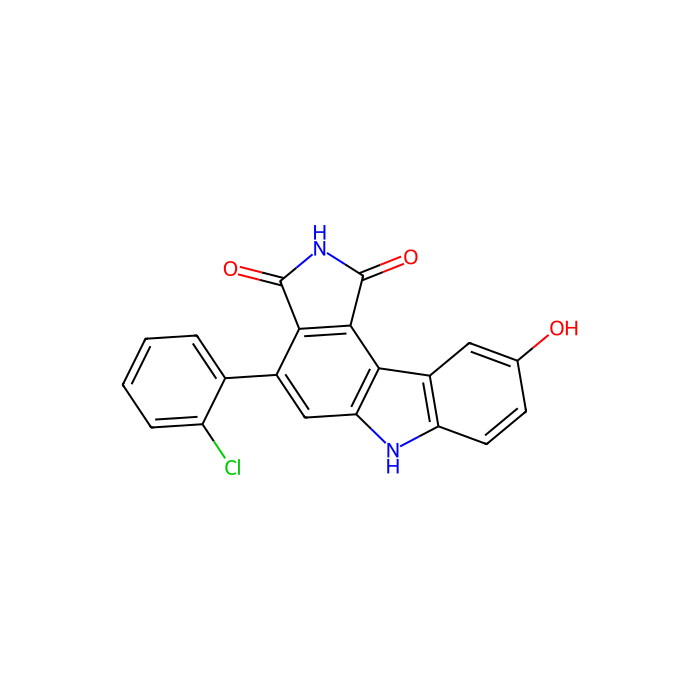
Wee1 inhibitor , CAS No.622855-37-2

CAS: 622855-37-2 Cat. No.: W342954 Formula: C20H11ClN2O3 Peso molecolare: 362.77 PubChem CID: 10384072
Disponibile su ordine
Synonyms
Wee1 Inhibitor I|Wee1-Inhibitor-I|Wee1 Inhibitor-I|Wee1 Inhibitor|Kinome_3672|4-(2-chlorophenyl)-9-hydroxy-6H-pyrrolo[3,4-c]carbazole-1,3-dione|Wee1-Inhibitor I|4-(2-Chlorophenyl)-9-hydroxypyrrolo[3,4-c]carbazole-1,3-(2H,6H)-dione|4-(2-chlorophenyl)-9-hydroxypyrrolo[3,4-c]carbazole-1,3(2H,6H)-dione
Storage
Store at -20°C
Shipped In
Ice chest + Ice pads
★
Dimensione
Germania (EU)
USA*
Prezzo
Qtà
1mg
W342954-1mg
Su ordinazione · 8–12 settimane
202,10€
Enter a quantity for the sizes you want to add.

Panoramica

Wee1 Inhibitor is a pyrrolocarbazole compound that acts as a potent, ATP-binding site-targeting inhibitor of Wee1 (IC|50|= 11 nM) in an ATP-competitive manner and displays ~40-fold selectivity over the related checkpoint kinase Chk1 (IC|50|= 440 nM).

Specifiche

Sinonimi
Wee1 Inhibitor I | Wee1-Inhibitor-I | Wee1 Inhibitor-I | Wee1 Inhibitor | Kinome_3672 | 4-(2-chlorophenyl)-9-hydroxy-6H-pyrrolo[3,4-c]carbazole-1,3-dione | Wee1-Inhibitor I | 4-(2-Chlorophenyl)-9-hydroxypyrrolo[3,4-c]carbazole-1,3-(2H,6H)-dione | 4-(2-chlorophenyl)-9-hydroxypyrrolo[3,4-c]carbazole-1,3(2H,6H)-dione
Condizioni di conservazione di stoccaggio
Store at -20°C
Spedito in
Ice chest + Ice pads
Questo prodotto richiede spedizione a catena fredda. I servizi di terra e altri servizi economici non sono disponibili.
Nomi e identificatori
SMILES
C1=CC=C(C(=C1)C2=CC3=C(C4=C(N3)C=CC(=C4)O)C5=C2C(=O)NC5=O)Cl
IUPAC Name
4-(2-chlorophenyl)-9-hydroxy-6H-pyrrolo[3,4-c]carbazole-1,3-dione
InChIKey
DPEXRCOBPACFOO-UHFFFAOYSA-N
InChI
1S/C20H11ClN2O3/c21-13-4-2-1-3-10(13)11-8-15-16(18-17(11)19(25)23-20(18)26)12-7-9(24)5-6-14(12)22-15/h1-8,22,24H,(H,23,25,26)
Isomeri SMILES
C1=CC=C(C(=C1)C2=CC3=C(C4=C(N3)C=CC(=C4)O)C5=C2C(=O)NC5=O)Cl
PubChem CID
10384072
Peso molecolare
362.77

Dati avanzati

Taxonomic Classification

Taxonomy Tree

KingdomOrganic compounds
SuperclassOrganoheterocyclic compounds
ClasseIndoles and derivatives
SubclassCarbazoles
Intermediate Tree Nodes Not available
Direct ParentPyrrolocarbazoles
Alternative Parents Phthalimides  Hydroxyindoles  Indoles  Chlorobenzenes  1-hydroxy-2-unsubstituted benzenoids  Aryl chlorides  Pyrroles  N-unsubstituted carboxylic acid imides  Heteroaromatic compounds  Azacyclic compounds  Organooxygen compounds  Organonitrogen compounds  Organochlorides  Organic oxides  Hydrocarbon derivatives  
Molecular FrameworkAromatic heteropolycyclic compounds
Substituents Pyrrolocarbazole - Phthalimide - Hydroxyindole - Isoindolone - Indole - Isoindoline - Isoindole or derivatives - 1-hydroxy-2-unsubstituted benzenoid - Chlorobenzene - Halobenzene - Phenol - Aryl chloride - Aryl halide - Monocyclic benzene moiety - Benzenoid - Carboxylic acid imide - Heteroaromatic compound - Pyrrole - Carboxylic acid imide, n-unsubstituted - Azacycle - Carboxylic acid derivative - Organooxygen compound - Organic oxygen compound - Organic nitrogen compound - Hydrocarbon derivative - Organonitrogen compound - Organic oxide - Organohalogen compound - Organochloride - Aromatic heteropolycyclic compound
DescrizioneThis compound belongs to the class of organic compounds known as pyrrolocarbazoles. These are compounds containing a pyrrolocarbazole moiety, which is a tetracyclic heterocycle which consists of a pyrrole ring fused to a carbazole.
External Descriptors Not available
Struttura 3D
Modello di struttura chimica interattiva


Obiettivi associati (umani)
STK17A Tchem Serine/threonine-protein kinase 17A (1 Activities)
Activity TypeActivity Value -log(M)Mechanism of ActionActivity ReferencePublications (PubMed IDs)
STK3 Tchem Serine/threonine-protein kinase 3 (1 Activities)
Activity TypeActivity Value -log(M)Mechanism of ActionActivity ReferencePublications (PubMed IDs)
MINK1 Tchem Misshapen-like kinase 1 (1 Activities)
Activity TypeActivity Value -log(M)Mechanism of ActionActivity ReferencePublications (PubMed IDs)
SYK Tclin Tyrosine-protein kinase SYK (1 Activities)
Activity TypeActivity Value -log(M)Mechanism of ActionActivity ReferencePublications (PubMed IDs)
MAP4K5 Tchem Mitogen-activated protein kinase kinase kinase kinase 5 (1 Activities)
Activity TypeActivity Value -log(M)Mechanism of ActionActivity ReferencePublications (PubMed IDs)
WEE1 Tchem Wee1-like protein kinase (5 Activities)
Activity TypeActivity Value -log(M)Mechanism of ActionActivity ReferencePublications (PubMed IDs)
MAP2K1 Tclin Dual specificity mitogen-activated protein kinase kinase 1 (1 Activities)
Activity TypeActivity Value -log(M)Mechanism of ActionActivity ReferencePublications (PubMed IDs)
ABL1 Tclin Tyrosine-protein kinase ABL (18331 Activities)
Activity TypeRelationActivity valueUnitsAction TypeJournalPubMed IddoiAssay Aladdin ID
PDGFRB Tclin Platelet-derived growth factor receptor beta (5195 Activities)
Activity TypeRelationActivity valueUnitsAction TypeJournalPubMed IddoiAssay Aladdin ID
IGF1R Tclin Insulin-like growth factor I receptor (8605 Activities)
Activity TypeRelationActivity valueUnitsAction TypeJournalPubMed IddoiAssay Aladdin ID
DAPK3 Tchem Death-associated protein kinase 3 (2108 Activities)
Activity TypeRelationActivity valueUnitsAction TypeJournalPubMed IddoiAssay Aladdin ID
MAPK11 Tchem MAP kinase p38 beta (2785 Activities)
Activity TypeRelationActivity valueUnitsAction TypeJournalPubMed IddoiAssay Aladdin ID
LCK Tclin Tyrosine-protein kinase LCK (9212 Activities)
Activity TypeRelationActivity valueUnitsAction TypeJournalPubMed IddoiAssay Aladdin ID
MAPK14 Tchem MAP kinase p38 alpha (12866 Activities)
Activity TypeRelationActivity valueUnitsAction TypeJournalPubMed IddoiAssay Aladdin ID
GSK3B Tclin Glycogen synthase kinase-3 beta (11785 Activities)
Activity TypeRelationActivity valueUnitsAction TypeJournalPubMed IddoiAssay Aladdin ID
FGFR1 Tclin Fibroblast growth factor receptor 1 (9149 Activities)
Activity TypeRelationActivity valueUnitsAction TypeJournalPubMed IddoiAssay Aladdin ID
STK3 Tchem Serine/threonine-protein kinase MST2 (3069 Activities)
Activity TypeRelationActivity valueUnitsAction TypeJournalPubMed IddoiAssay Aladdin ID
SRC Tclin Tyrosine-protein kinase SRC (10310 Activities)
Activity TypeRelationActivity valueUnitsAction TypeJournalPubMed IddoiAssay Aladdin ID
AURKB Tchem Serine/threonine-protein kinase Aurora-B (6805 Activities)
Activity TypeRelationActivity valueUnitsAction TypeJournalPubMed IddoiAssay Aladdin ID
ROCK1 Tclin Rho-associated protein kinase 1 (4723 Activities)
Activity TypeRelationActivity valueUnitsAction TypeJournalPubMed IddoiAssay Aladdin ID
PIM1 Tchem Serine/threonine-protein kinase PIM1 (9629 Activities)
Activity TypeRelationActivity valueUnitsAction TypeJournalPubMed IddoiAssay Aladdin ID
PKN2 Tchem Protein kinase N2 (1991 Activities)
Activity TypeRelationActivity valueUnitsAction TypeJournalPubMed IddoiAssay Aladdin ID
CSK Tchem Tyrosine-protein kinase CSK (2395 Activities)
Activity TypeRelationActivity valueUnitsAction TypeJournalPubMed IddoiAssay Aladdin ID
JAK3 Tclin Tyrosine-protein kinase JAK3 (8349 Activities)
Activity TypeRelationActivity valueUnitsAction TypeJournalPubMed IddoiAssay Aladdin ID
RPS6KA5 Tchem Ribosomal protein S6 kinase alpha 5 (3355 Activities)
Activity TypeRelationActivity valueUnitsAction TypeJournalPubMed IddoiAssay Aladdin ID
PRKD3 Tchem Protein kinase C nu (2315 Activities)
Activity TypeRelationActivity valueUnitsAction TypeJournalPubMed IddoiAssay Aladdin ID
SYK Tclin Tyrosine-protein kinase SYK (7372 Activities)
Activity TypeRelationActivity valueUnitsAction TypeJournalPubMed IddoiAssay Aladdin ID
RPS6KA1 Tchem Ribosomal protein S6 kinase alpha 1 (2796 Activities)
Activity TypeRelationActivity valueUnitsAction TypeJournalPubMed IddoiAssay Aladdin ID
JAK2 Tclin Tyrosine-protein kinase JAK2 (12915 Activities)
Activity TypeRelationActivity valueUnitsAction TypeJournalPubMed IddoiAssay Aladdin ID
FLT1 Tclin Vascular endothelial growth factor receptor 1 (6262 Activities)
Activity TypeRelationActivity valueUnitsAction TypeJournalPubMed IddoiAssay Aladdin ID
KDR Tclin Vascular endothelial growth factor receptor 2 (20924 Activities)
Activity TypeRelationActivity valueUnitsAction TypeJournalPubMed IddoiAssay Aladdin ID
GSK3A Tclin Glycogen synthase kinase-3 alpha (3764 Activities)
Activity TypeRelationActivity valueUnitsAction TypeJournalPubMed IddoiAssay Aladdin ID
MAP2K2 Tclin Dual specificity mitogen-activated protein kinase kinase 2 (1262 Activities)
Activity TypeRelationActivity valueUnitsAction TypeJournalPubMed IddoiAssay Aladdin ID
MAPK13 Tchem MAP kinase p38 delta (2605 Activities)
Activity TypeRelationActivity valueUnitsAction TypeJournalPubMed IddoiAssay Aladdin ID
MAPKAPK2 Tchem MAP kinase-activated protein kinase 2 (4814 Activities)
Activity TypeRelationActivity valueUnitsAction TypeJournalPubMed IddoiAssay Aladdin ID
MAPKAPK5 Tchem MAP kinase-activated protein kinase 5 (2831 Activities)
Activity TypeRelationActivity valueUnitsAction TypeJournalPubMed IddoiAssay Aladdin ID
ROCK2 Tclin Rho-associated protein kinase 2 (6206 Activities)
Activity TypeRelationActivity valueUnitsAction TypeJournalPubMed IddoiAssay Aladdin ID
PTK2 Tclin Focal adhesion kinase 1 (4730 Activities)
Activity TypeRelationActivity valueUnitsAction TypeJournalPubMed IddoiAssay Aladdin ID
PRKAA1 Tclin AMP-activated protein kinase, alpha-1 subunit (2493 Activities)
Activity TypeRelationActivity valueUnitsAction TypeJournalPubMed IddoiAssay Aladdin ID
MST1R Tchem Macrophage-stimulating protein receptor (2327 Activities)
Activity TypeRelationActivity valueUnitsAction TypeJournalPubMed IddoiAssay Aladdin ID
MAPK9 Tchem c-Jun N-terminal kinase 2 (4655 Activities)
Activity TypeRelationActivity valueUnitsAction TypeJournalPubMed IddoiAssay Aladdin ID
MAP2K1 Tclin Dual specificity mitogen-activated protein kinase kinase 1 (4127 Activities)
Activity TypeRelationActivity valueUnitsAction TypeJournalPubMed IddoiAssay Aladdin ID
MET Tclin Hepatocyte growth factor receptor (10718 Activities)
Activity TypeRelationActivity valueUnitsAction TypeJournalPubMed IddoiAssay Aladdin ID
CAMK2D Tchem CaM kinase II delta (2813 Activities)
Activity TypeRelationActivity valueUnitsAction TypeJournalPubMed IddoiAssay Aladdin ID
CDK9 Tchem Cyclin-dependent kinase 9 (2495 Activities)
Activity TypeRelationActivity valueUnitsAction TypeJournalPubMed IddoiAssay Aladdin ID
PRKCA Tchem Protein kinase C alpha (5923 Activities)
Activity TypeRelationActivity valueUnitsAction TypeJournalPubMed IddoiAssay Aladdin ID
CDK2 Tchem Cyclin-dependent kinase 2 (9050 Activities)
Activity TypeRelationActivity valueUnitsAction TypeJournalPubMed IddoiAssay Aladdin ID
CSNK1A1 Tchem Casein kinase I alpha (2581 Activities)
Activity TypeRelationActivity valueUnitsAction TypeJournalPubMed IddoiAssay Aladdin ID
FYN Tclin Tyrosine-protein kinase FYN (5308 Activities)
Activity TypeRelationActivity valueUnitsAction TypeJournalPubMed IddoiAssay Aladdin ID
NTRK1 Tclin Nerve growth factor receptor Trk-A (7922 Activities)
Activity TypeRelationActivity valueUnitsAction TypeJournalPubMed IddoiAssay Aladdin ID
PRKACA Tchem cAMP-dependent protein kinase alpha-catalytic subunit (3475 Activities)
Activity TypeRelationActivity valueUnitsAction TypeJournalPubMed IddoiAssay Aladdin ID
DYRK1A Tchem Dual-specificity tyrosine-phosphorylation regulated kinase 1A (6484 Activities)
Activity TypeRelationActivity valueUnitsAction TypeJournalPubMed IddoiAssay Aladdin ID
MAPK8 Tchem c-Jun N-terminal kinase 1 (5038 Activities)
Activity TypeRelationActivity valueUnitsAction TypeJournalPubMed IddoiAssay Aladdin ID
CAMK2A Tchem CaM kinase II alpha (1938 Activities)
Activity TypeRelationActivity valueUnitsAction TypeJournalPubMed IddoiAssay Aladdin ID
PDGFRA Tclin Platelet-derived growth factor receptor alpha (5682 Activities)
Activity TypeRelationActivity valueUnitsAction TypeJournalPubMed IddoiAssay Aladdin ID
PRKCQ Tchem Protein kinase C theta (3319 Activities)
Activity TypeRelationActivity valueUnitsAction TypeJournalPubMed IddoiAssay Aladdin ID
AKT1 Tchem Serine/threonine-protein kinase AKT (9192 Activities)
Activity TypeRelationActivity valueUnitsAction TypeJournalPubMed IddoiAssay Aladdin ID
Obiettivi associati (non umani)
Escherichia coli (133304 Activities)
Activity TypeRelationActivity valueUnitsAction TypeJournalPubMed IddoiAssay Aladdin ID
H4 (48 Activities)
Activity TypeRelationActivity valueUnitsAction TypeJournalPubMed IddoiAssay Aladdin ID
Meccanismi d'azione
Certificati (CoA, COO, BSE/TSE e tabella di analisi)
C of A & Other Certificates(BSE/TSE, COO):
Analytical Chart:
Proprietà chimiche e fisiche
SolubilitàDMSO and ethanol
Peso molecolare362.8
XLogP34.100
Hydrogen Bond Donor Count3
Hydrogen Bond Acceptor Count3
Rotatable Bond Count1
Exact Mass362.046 Da
Monoisotopic Mass362.046 Da
Topological Polar Surface Area82.200 Ų
Heavy Atom Count26
Formal Charge0
Complexity614.000
Isotope Atom Count0
Defined Atom Stereocenter Count0
Undefined Atom Stereocenter Count0
Defined Bond Stereocenter Count0
Undefined Bond Stereocenter Count0
The total count of all stereochemical bonds0
Covalently-Bonded Unit Count1
Sicurezza e pericoli (GHS)
Precauzioni

P264:Wash hands [and …] thoroughly after handling.

Calcolatori di soluzioni
Recensioni

Recensioni dei clienti

Application Protocols

This section lists only protocols or tested applications provided in the Product Data. No such protocols are provided for SKU W342954.

Item-specific (from Product Data):

  • Manufacturer Applications: Not specified beyond “For research use only.”

General example workflows (for planning only; not product-validated):

  • Biochemical kinase inhibition assay: Prepare a DMSO stock of the inhibitor. Titrate into a Wee1 enzyme reaction containing ATP and substrate. Incubate under assay SOP conditions (e.g., ADP-Glo or radiometric readout). Fit dose–response to determine IC50, considering ATP concentration.
  • Cellular pathway engagement: Dose cultured cells with vehicle or inhibitor for 1–6 h. Harvest lysates and immunoblot for phospho-CDK1 (Tyr15) and total CDK1. Include cell-cycle profiling where appropriate.
  • Combination perturbation: Apply defined replication stress (e.g., hydroxyurea) with or without the inhibitor to examine checkpoint dynamics.

Note: The above are generic planning notes and are not validated protocols for this specific product. For validated, product-specific procedures and recommended concentrations, consult the CoA/Spec Sheet or contact technical support.

Biological Roles

Context (general, not item-specific):

  • Wee1 is a nuclear serine/threonine kinase that negatively regulates the G2/M cell-cycle transition by phosphorylating CDK1 (Cdc2) on Tyr15, thereby inhibiting CDK1–cyclin B activity. This checkpoint allows cells to repair DNA prior to mitosis.
  • Wee1 activity integrates with ATR–CHK1 signaling and the CDC25 phosphatase to finely tune CDK1 activation. Under replication stress or DNA damage, Wee1 upregulation sustains G2 arrest; dephosphorylation of CDK1 Tyr15 by CDC25 promotes mitotic entry.

Role of Wee1 inhibitors as research tools:

  • Pharmacological Wee1 inhibition reduces CDK1 Tyr15 phosphorylation, advancing CDK1 activity and promoting G2 checkpoint abrogation in susceptible contexts. This enables studies of checkpoint adaptation, DNA damage tolerance, replication origin firing, and mitotic catastrophe pathways in cell biology.
  • In kinase biochemistry, Wee1 inhibitors are used to assess ATP-competitive binding, kinase selectivity profiles, and mechanistic relationships between ATP concentration and inhibitor potency.
  • In systems biology, these inhibitors assist in dissecting network dependencies across DNA damage response nodes (Wee1–CHK1–CDC25–CDK1 axis), often combined with defined stressors (e.g., hydroxyurea, aphidicolin) to probe pathway wiring.

Assay readouts commonly paired with Wee1 modulation (examples):

  • Western blotting for phospho-CDK1 (Tyr15) and downstream markers of mitotic entry (e.g., phospho-histone H3 Ser10).
  • Flow cytometric DNA-content profiling (PI/DAPI) to quantify G2/M perturbation.
  • EdU/BrdU incorporation to monitor S-phase dynamics under checkpoint modulation.

Item-specific target parameters (Kd/IC50, selectivity): Not specified for this item; refer to CoA/Spec Sheet or primary literature associated with CAS 622855-37-2.

Buffer Applications

This product is a small-molecule inhibitor rather than a buffering agent; it is not used to establish or maintain solution pH.

Practical assay buffer considerations (general guidance):

  • For biochemical Wee1 kinase assays, typical assay buffers include HEPES or Tris (pH 7.0–7.5), Mg2+ for ATP-dependent phosphorylation, and DTT or TCEP to maintain reducing conditions. Detergents (e.g., 0.01–0.05% Tween-20) can reduce nonspecific sticking.
  • For cell-based assays, use culture medium appropriate to the cell line. Maintain constant vehicle percentages (e.g., 0.1% DMSO across all wells) to control for solvent effects.
  • Solubilization: Pre-dissolve the inhibitor in DMSO, then dilute into buffer/media with mixing to avoid precipitation. Verify compatibility of any co-solvents with enzymes/cells.

Item-specific buffer recipes, pKa, and ionization data: Not specified for this item; refer to CoA/Spec Sheet and your assay SOPs.

Note: If precipitation or adsorption to plastics is observed, consider low-bind plastics, small amounts of carrier protein (e.g., BSA 0.01%), or cyclodextrin complexes after confirming they do not interfere with the assay.

Green Alternatives

Because this item is a discrete bioactive small molecule, the concept of a “green alternative” pertains primarily to solvent/vehicle choice and assay workflow rather than to the inhibitor itself.

Greener vehicle considerations (general):

  • Prefer DMSO over DMF/NMP when feasible due to lower toxicity and better compatibility with biological systems.
  • Explore aqueous formulation strategies to minimize organic solvent content: pH adjustment within protein tolerance, use of cyclodextrins (HP-β-CD), or serum-containing media that can aid solubilization at low compound loadings.
  • Employ microdosing strategies in screening (low-volume acoustics/inkjet transfer) to reduce total solvent use.

Illustrative comparison (generic, not item-specific):

  • DMSO: Broad solvency, miscible with water, relatively benign in small percentages; still requires careful waste management.
  • DMF/NMP: Strong solvency but higher EHS concerns; reserve for cases where DMSO fails, and limit final assay concentration to the lowest workable level.
  • Ethanol/PEG400: Potential alternatives for certain applications; assess biological compatibility.

Operational greening:

  • Use amber microplates/tubes to reduce photodegradation, extending solution life and reducing waste.
  • Store concentrated aliquots to minimize repeated freeze–thaw and compound loss, improving material efficiency.

Note: No greener “substitute” compound can be recommended without altering target selectivity/potency. If your driver is EHS rather than pharmacology, optimize solvent systems and handling rather than replacing the inhibitor.

Pharmaceutical Uses

This material is supplied strictly for research use only and is not intended for human or veterinary use, diagnostics, or therapeutic applications.

Formulation context in research (general, non-clinical):

  • As a tool compound, Wee1 inhibitors are commonly formulated as DMSO stock solutions for in vitro biochemical assays or cell-based experiments. For in vivo exploratory research, investigators sometimes evaluate solubilizing vehicles (e.g., DMSO/PEG400/saline mixtures) per institutional protocols; such uses are outside the scope of this product listing.
  • No pharmacopeial monograph is implied for this item. Excipients, residual solvents, and stability-indicating methods (if any) are governed by internal research specifications and are reported on the CoA where applicable.

Manufacturing/quality remarks:

  • Batch-specific purity, identity, and residual solvent levels (where reported) are intended to support research workflows, screening, and mechanism-of-action studies rather than GMP manufacturing.

Any clinical indications, dosage forms, or regulatory statuses are not applicable to this research reagent and are not provided. For detailed formulation compatibility in your research setting, consult your institution’s preclinical formulation guidelines and the product CoA.

Physical Properties

Item-specific physical constants (as supplied):

  • Appearance: Not specified for this item; refer to CoA/Spec Sheet.
  • Molecular weight: Not specified for this item; refer to CoA/Spec Sheet.
  • Molecular formula: Not specified for this item; refer to CoA/Spec Sheet.
  • Melting/boiling point, density, refractive index, pKa/logP, UV cutoff: Not specified for this item; refer to CoA/Spec Sheet.

General laboratory handling characteristics for small-molecule kinase inhibitors (literature/generic guidance):

  • Physical state: Commonly solid powders (off-white to yellow), often lipophilic and sparingly soluble in water; exact appearance varies by scaffold.
  • Solubility profile: Frequently soluble in polar aprotic organic solvents such as DMSO and DMF; aqueous solubility may require co-solvents, pH adjustment, or additives (e.g., 0.1–1% DMSO in buffer; cyclodextrins). These are general expectations; verify lot-specific solubility experimentally.
  • Stability: Many heteroaromatic inhibitors exhibit acceptable bench stability when protected from moisture, light, and heat. Long-term storage at -20°C is typical (see Storage tab for item-specific instruction).
  • Hygroscopicity/photosensitivity: Scaffold-dependent; keep tightly closed under dry, inert atmosphere if feasible. Use amber vials for long light exposure.

Notes on solution handling (generic):

  • Prepare concentrated DMSO stocks (e.g., 10–50 mM) and dilute freshly into assay buffers; filter sterilize if needed. Confirm compatibility with your bioassay to avoid vehicle effects.

Always defer to the SDS and CoA for authoritative physical-chemical parameters of the exact item.

Quality and Grades

Item-specific quality grade and purity are not provided in the Product Data for SKU W342954.

Item-specific (from Product Data):

  • Grade/purity: Not specified for this item; refer to CoA/Spec Sheet.
  • Appearance: Not specified for this item; refer to CoA/Spec Sheet.

General interpretation of grades for small-molecule screening reagents (context only):

  • Research/BioReagent grade typically indicates suitability for in vitro biochemical and cellular assays, with identity confirmed by NMR/HRMS and purity commonly ≥95% by HPLC/LC–MS (literature norms). UV/fluorescence background may be reported for high-throughput screening.
  • Stabilizers/salts: Some kinase inhibitors are supplied as free bases, hydrochloride salts, or solvates to enhance stability/handling; stabilizers (if any) would be listed on the CoA. Presence of residual solvents, counterions, or water of crystallization may affect potency on a mass basis; correct for salt form when preparing stock solutions.
  • Batch-specific analytics: CoA commonly includes chromatographic purity, identity (NMR, MS), water content (KF), and residual solvents as per internal specifications.

Recommendation:

  • For precise assay work, verify salt form and purity from the CoA and adjust molar calculations accordingly. If LC–MS or HPLC purity thresholds are critical for your platform, request the latest CoA and analytical chromatograms for the specific lot shipped.
Reaction and Applications

This product is a bioactive small-molecule Wee1 kinase inhibitor intended for biochemical/cellular research rather than as a synthetic reagent.

Applicability to synthetic chemistry:

  • Not typically used as a reagent, catalyst, or solvent in preparative organic synthesis. Consequently, classic reaction families (e.g., Grignard, cross-coupling) are not relevant to its end use.

Research applications (non-clinical, general guidance):

  • Chemical biology tool for interrogating G2/M checkpoint regulation by modulating Wee1 activity.
  • Enables studies of CDK1 (Cdc2) Tyr15 phosphorylation status, checkpoint adaptation, and DNA damage response pathways in cell-based models.
  • Useful in target engagement assays (e.g., biochemical kinase assays, CETSA/thermal shift, NanoBRET) and pathway validation via Western blotting of phospho-substrates.
  • Employed in combination with genotoxic stressors or replication stress paradigms to probe checkpoint robustness (ensure appropriate controls for vehicle and stressor).

Assay considerations (generic):

  • Determine potency window in your system (EC50/IC50 shift can vary with ATP concentration and cell context).
  • Control for DMSO vehicle effects and confirm on-target activity with orthogonal readouts (e.g., phospho-CDK1 Tyr15 levels, cell-cycle profiling by flow cytometry).

Item-specific manufacturer application notes: None provided beyond “For research use only.”

Reaction Conditions

Not typically applicable. This item is a bioactive inhibitor for biochemical/cellular assays rather than a reagent for chemical transformations.

Assay condition considerations (general, non-product-specific):

  • Biochemical Wee1 kinase assays: Often run at 25–30°C in HEPES or Tris buffers, with Mg2+, ATP (variable, e.g., Km-scale or fixed high), and substrate peptides/proteins. Inhibitor is introduced from concentrated DMSO stock (common final DMSO ≤0.5%). Incubation times range from minutes to 1 hour depending on endpoint (radiometric, ADP-Glo, TR-FRET, etc.).
  • Cellular assays: Dosing durations from 1–24 h are typical for acute checkpoint studies; longer exposures may be used in proliferation readouts. Confirm vehicle control and monitor cytotoxicity independently of target engagement.
  • Thermal shift/CETSA: Stabilization/destabilization upon inhibitor binding can be profiled across a temperature gradient to corroborate target engagement in lysates or intact cells.

Expected outcomes (generic):

  • Decrease in CDK1 Tyr15 phosphorylation and corresponding pathway effects when Wee1 is effectively inhibited; magnitude depends on cellular context and assay design.

Item-specific reaction/assay conditions, potency, or selectivity data: Not specified for this item; consult CoA/Spec Sheet and relevant literature for CAS 622855-37-2.

Safety and Handling

Authoritative safety information (GHS/CLP) specific to this item is not provided in the Product Data and may vary by lot/formulation.

Item-specific (from Product Data):

  • Signal word: Not specified for this item; refer to SDS.
  • Hazard (H-) statements: Not specified for this item; refer to SDS.
  • GHS classification and pictograms: Not specified for this item; refer to SDS.
  • Storage: Store at -20°C.

General laboratory safety guidance for small-molecule bioactive inhibitors (not product-specific):

  • Handle in a chemical fume hood with appropriate PPE: lab coat, safety glasses, and nitrile gloves. Avoid inhalation of dust or aerosols and contact with skin/eyes.
  • Incompatibilities: Avoid strong oxidizers and strong acids/bases unless compatibility is known. Protect from moisture and prolonged light if the scaffold is photosensitive.
  • First aid (overview; follow institutional SOPs): If inhaled—move to fresh air; if on skin—wash with soap and water; if in eyes—rinse cautiously with water for several minutes; if ingested—rinse mouth and seek medical attention. Provide the SDS to medical personnel.
  • Spill/accidental release: Avoid dust generation. Absorb with inert material, collect in chemical waste. Decontaminate area with suitable solvent/detergent per your EHS guidance.
  • Waste disposal: Treat as hazardous organic chemical waste; dispose in accordance with local regulations.

Always consult the product’s SDS for definitive hazard classifications, exposure limits, and emergency procedures. For research use only.

Solvent Selection

This Wee1 inhibitor is a small, heteroaromatic drug-like molecule. Item-specific solubility is not provided; select solvents based on general behavior of kinase inhibitors and your assay constraints.

Typical solvent choices (general guidance):

  • DMSO: Primary vehicle for stock solutions due to broad solvency for lipophilic heteroaromatics and biological compatibility at low final % (often ≤0.1–0.5% v/v in assays).
  • DMF or NMP: Strong polar aprotic alternatives; consider cytotoxicity and assay compatibility when used as vehicles.
  • Aqueous buffers: Often require co-solvent (DMSO 0.1–1%) or pH adjustment for adequate solubility; avoid precipitation upon dilution by pre-mixing with buffer and adding slowly with agitation.
  • Alcohols (EtOH, MeOH): Intermediate solvency; evaluate impact on enzyme/cell assays.

Polarity and miscibility (general, not product-specific):

  • Polar aprotics (DMSO, DMF) are fully miscible with water and ideal for generating homogeneous assay dilutions. Pre-warm and vortex to ensure complete dissolution.

Comparison considerations:

  • DMSO vs DMF: DMSO is usually preferred in bioassays for lower volatility and better biological tolerance. DMF/NMP may enhance solubility for particularly stubborn compounds but can introduce assay artifacts.

Practical tips:

  • Prepare concentrated DMSO stocks (e.g., 10–50 mM) and store aliquots to minimize freeze–thaw.
  • Validate solubility at the highest working concentration and verify absence of precipitate by visual inspection or light scattering.

Item-specific solubility and solvent recommendations: Not specified for this item; refer to CoA/Spec Sheet.

Storage and Reconstitution

Item-specific storage and logistics (from Product Data):

  • Storage Conditions: Store at -20°C.
  • Shipped In: Ice chest + Ice pads.

Reconstitution and handling (item-specific):

  • Reconstitution solvent, concentration, and diluent compatibility: Not specified for this item; refer to CoA/Spec Sheet.
  • Appearance or stability of solutions: Not specified for this item; refer to CoA/Spec Sheet.

General reminders (read alongside the CoA/SDS):

  • Upon receipt, return to -20°C storage. Keep container tightly closed to limit moisture uptake.
  • Before first use, allow container to equilibrate to room temperature in a desiccator to minimize condensation.
  • Prepare working solutions immediately before use whenever feasible to maintain potency.

For any lot-specific guidance on stock solution preparation (e.g., recommended DMSO concentration, maximum freeze–thaw cycles, or light sensitivity), consult the Certificate of Analysis or contact Aladdin Scientific Technical Support.

Structure and Identity

Overview: This listing is a small-molecule Wee1 kinase inhibitor intended as a research tool compound. Item-specific structural identifiers are limited in the provided Product Data.

Item-specific (from Product Data):

  • CAS: 622855-37-2
  • PubChem CID: 10384072
  • InChIKey: 69275 (truncated/incomplete as provided)
  • Molecular formula: Not specified for this item; refer to CoA/Spec Sheet.
  • Molecular weight: Not specified for this item; refer to CoA/Spec Sheet.
  • SMILES: Not specified for this item; refer to CoA/Spec Sheet.

General notes (context, not product-specific):

  • “Wee1 inhibitors” are typically heteroaromatic, drug-like kinase inhibitors that target the ATP-binding site of the Wee1 serine/threonine kinase. Many representatives feature nitrogen-rich heterocycles (e.g., imidazoles, aza-arenes) designed to engage hinge-region H-bonding and hydrophobic pockets.
  • Structural features often include: planar heteroaromatic cores, H-bond donor/acceptor arrays for kinase hinge binding, and lipophilic substituents for pocket occupancy. Stereocenters are uncommon but not excluded depending on scaffold.

2D structural description (generic class insight):

  • A fused or single-ring heteroaromatic “headgroup” capable of making two-center H-bonds to the kinase hinge region.
  • One or more lipophilic aryl/alkyl appendages occupying hydrophobic pockets.
  • Occasional basic center (pKa often in the 3–8 range for ionizable nitrogens; literature, scaffold-dependent) to balance solubility/permeability.

Important: For exact structural identifiers (SMILES, full InChI/InChIKey, formula, and accurate MW) of the specific compound supplied under CAS 622855-37-2 (CID 10384072), consult the Certificate of Analysis (CoA) or Specification Sheet supplied with the lot.

Synthetic Utility

This product is a finished small-molecule Wee1 kinase inhibitor used as a research tool, not a building block or reagent for synthetic chemistry.

Non-applicability:

  • It is not typically employed as a substrate, catalyst, ligand, or reagent in preparative organic synthesis. Therefore, discussions of functional group interconversions, protecting group strategies, or named-reaction participation are not relevant to its intended use.

For investigators interested in medicinal chemistry optimization (general perspective):

  • Structure–activity relationship (SAR) campaigns around Wee1 often explore heteroaromatic hinge-binding motifs, modulation of basicity/ionization for solubility and permeability, and substituent effects for kinase selectivity versus CDK- and CHK-family kinases.
  • If derivatization is desired for probe development (e.g., biotinylated or fluorescent tracers), confirm which vector(s) on the scaffold tolerate substitution without ablating Wee1 affinity; this requires primary literature or in-house SAR data specific to the CAS 622855-37-2 scaffold.

Item-specific functional groups and reactivity: Not specified for this item; refer to the CoA/structure if available. Absent explicit structural information, no synthetic guidance is provided.

Target Specificity

Only product-data-sourced specificity information may be listed here. The Product Data for SKU W342954 does not provide target potency values, off-target profiles, or selectivity panels.

Item-specific details:

  • Primary target: Not specified for this item (listed generally as a “Wee1 inhibitor”);
  • Potency (IC50/Ki/Kd): Not specified for this item; refer to CoA/Spec Sheet.
  • Kinome selectivity: Not specified for this item; refer to CoA/Spec Sheet or supplier profiling data.

General note (context, not product-specific):

  • Wee1 inhibitors classically target the ATP-binding pocket of Wee1 kinase. Selectivity across related kinases (e.g., Myt1, CDKs, CHK1) is scaffold-dependent and must be established empirically via biochemical panels. Researchers should corroborate on-target effects with orthogonal readouts (e.g., phospho-CDK1 Tyr15) and, where feasible, genetic perturbations.

For definitive specificity data of the compound associated with CAS 622855-37-2 (CID 10384072), consult the product CoA or primary literature.

Domande frequenti

What documentation is provided?
Available product documentation, including Certificates of Analysis (COA), Safety Data Sheets (SDS), and specification sheets, is shown in the product document area. Document availability and access follow the current site policy.

Desidera che le inviamo un messaggio quando avremo sconti disponibili?

Ricordamelo più tardi

Grazie! Controlli la sua casella di posta per confermare.

Ops! Le notifiche sono disabilitate.