Determine the necessary mass, volume, or concentration for preparing a solution.
Dilution Calculator
Determine the dilution needed to prepare a stock solution.
Reconstitution Calculator
Revisões
Avaliações dos Clientes
Application Protocols
No assay or bioanalytical application protocols are specified for this item. As a synthetic reagent, procedures are reaction-specific.
Practical guidance (general):
For cross-couplings, dry glassware and degassed solvents are recommended. Pre-catalyst activation and ligand selection strongly influence haloselectivity (I > Br).
Monitor reactions by TLC/UPLC with UV detection; aryl ketones absorb in near-UV, aiding visualization.
Typical workup: aqueous quench, extraction with EtOAc or DCM, brine wash, drying over Na2SO4, and silica chromatography. Protect from strong light during prolonged operations to minimize deiodination.
Refer to peer-reviewed procedures for substrate- and catalyst-specific parameters.
Biological Roles
This compound is a synthetic, dihalogenated aromatic ketone without known natural biological function.
General context (literature):
Aryl ketones can interact with biological membranes due to hydrophobicity and aromaticity but this behavior is nonspecific and context-dependent.
The molecule is primarily used as a chemical building block; any biological testing would be exploratory and outside the scope of intended use.
Research Use Note (Product Data): For research use only.
No clinical, diagnostic, or therapeutic roles are claimed or implied. Any bioassays involving this compound should follow institutional safety and waste protocols for halogenated organics.
Buffer Applications
Not typically applicable. 1-(3-Bromo-4-iodophenyl)ethanone is a hydrophobic organic building block and is not used to prepare aqueous buffer systems.
Practical note: If aqueous handling is necessary (e.g., biphasic couplings), employ miscibility aids (co-solvents such as EtOH, MeCN) or surfactant micellar media. Control pH with standard buffers (phosphate, carbonate) suitable for the catalytic system, not with the substrate itself.
Green Alternatives
While the substrate is a halogenated aryl ketone (inherent EHS burden from Br/I), greener choices can be made around solvent systems, bases, and activation modes.
Solvent alternatives (literature guidance):
Replace DMF/DMAc/NMP with 2-MeTHF, CPME, EtOAc, or propylene carbonate where compatible with catalyst/base and solubility.
Use water/EtOH biphasic Suzuki couplings with phase-transfer catalysts for selected boronic acids.
Greener bases and additives:
Favor K2CO3 or K3PO4 over NaOtBu where feasible; minimize halide waste by using catalytic halide scavengers judiciously.
Energy and activation:
Micellar catalysis (TPGS-750-M or similar) enables aqueous Suzuki reactions at lower temperatures.
Traditional: Pd(PPh3)4 in DMF, 100–120 °C; good rates but higher EHS footprint.
Greener: Pd/SPhos in 2-MeTHF or water–EtOH with K2CO3, 60–90 °C; reduced solvent hazard and energy use, sometimes with ligand-enabled haloselectivity.
Trade-offs: Greener solvents may reduce substrate solubility or catalyst longevity; screening is recommended. Waste minimization via telescoped steps (e.g., in situ oxime formation then coupling) can further improve process mass intensity.
Pharmaceutical Uses
No excipient or pharmacopeial role is specified for this item.
Context (general):
Dihalogenated acetophenones like this are commonly employed as synthetic intermediates in discovery and process chemistry to access biaryl/heteroaryl motifs and to modulate lipophilicity via stepwise cross-coupling.
Any incorporation into drug substance routes would be as an intermediate only, not as an active or excipient. GMP status, residual metals, and impurity profiles would need to be established separately for regulated use.
Item-specific: Grade/Purity not specified; refer to CoA/Spec Sheet. No pharmacopeial monograph is implied.
Physical Properties
Item-specific (Product Data):
Appearance: Not specified for this item; refer to CoA/Spec Sheet.
Molecular Formula: Not specified for this item; refer to CoA/Spec Sheet.
Molecular Weight: Not specified for this item; refer to CoA/Spec Sheet.
Literature/computed (for context; not specifications):
Volatility: low; heavy aryl halides exhibit high boiling points and low vapor pressures (qualitative, literature)
Solubility profile (qualitative, literature):
Good solubility in polar aprotic organic solvents (e.g., DMF, DMSO, acetone, acetonitrile)
Soluble in chlorinated solvents (e.g., DCM, chloroform) and aromatic solvents (toluene)
Poorly soluble in water
Not provided (do not infer; check CoA):
Melting point
Boiling point
Density
LogP/logD
Refractive index
UV/Vis cutoffs
Water/peroxide/metal impurity limits
Note: For exact numerical values and release specifications, consult the product CoA/Spec Sheet.
Quality and Grades
Item-specific (Product Data):
Grade/Purity: Not specified for this item; refer to CoA/Spec Sheet.
Interpreting grade (general guidance):
Research-grade fine chemicals are typically suitable for synthesis, method development, and SAR library construction. Where “≥98%” or higher is specified, such materials support cross-coupling and metal-catalyzed reactions with minimal pre-purification.
If HPLC-grade or “low-UV” grades are designated (not specified here), expect stricter UV-absorbing impurity limits beneficial for photochemical or analytical use.
Stabilizers: None indicated for this item. If a stabilizer were used, it would be declared on the label/CoA; stabilizers can influence metal-catalyzed couplings and should be removed if problematic.
Lot-specific documentation:
For exact assay, residual solvents, ash/metals, water content, and chromatographic identity, consult the Certificate of Analysis/Specification Sheet supplied per lot.
Reaction and Applications
This dihalogenated acetophenone is a versatile bifunctional building block enabling orthogonal aryl–halide cross-coupling alongside classical carbonyl transformations.
Cross-coupling (literature):
Suzuki–Miyaura, Sonogashira, Heck, and Negishi couplings proceed preferentially at the aryl iodide (C–I) under milder conditions, leaving C–Br intact for a second-stage diversification.
Conditions enabling C–Br selectivity include elevated temperature, more electron-rich/bulky phosphines (e.g., SPhos/XPhos) or NHC ligands, and polar aprotic solvents (DMF/DMAc) with strong bases (K3PO4, Cs2CO3).
Reductions: NaBH4 or catalytic hydrogenation to secondary alcohol; Wolff–Kishner or Clemmensen for deoxygenation to ethyl substituent.
Alpha-functionalization: enolate formation (LDA, NaHMDS) followed by alkylation or halogenation; carbonyl is ortho/para-directing for lithiation strategies on certain rings, though deactivation by –COCH3 should be considered.
Halogen–metal exchange and directed metalation:
Rapid exchange at aryl iodide with i-PrMgCl·LiCl (Turbo Grignard) or n-BuLi at low temperature permits trapping with electrophiles while preserving the bromide for subsequent steps.
Library and SAR workflows:
Stepwise diversification (first at I, then at Br) streamlines parallel synthesis of biaryl, aryl–alkyne, or aryl–amine motifs while maintaining the acetyl handle for late-stage oxidation/reduction toggles.
Application areas include medicinal chemistry intermediates, materials precursors, and methodology development (no clinical use; for research only).
Reaction Conditions
Typical literature conditions for representative transformations (guidance only; optimize per substrate):
Reagent: i-PrMgCl·LiCl (1.1–1.5 equiv), THF, −78 to −20 °C; quench with electrophile
Carbonyl reductions:
NaBH4, MeOH/THF, 0–25 °C to give secondary alcohol; or H2, Pd/C for hydrogenolysis/reduction (monitor for potential dehalogenation under forcing conditions).
Expected yields vary with partners and conditions; many literature examples report 60–90% for selective couplings at aryl iodides.
Safety and Handling
Item-specific (Product Data):
GHS Classification, Signal Word, H-Statements, Pictograms: Not specified for this item; refer to SDS.
Storage Conditions: Protected from light; Room temperature; Desiccated
Shipped In: Normal
General safety guidance (literature/good practice; consult SDS for authoritative details):
Likely hazards for aryl halide ketones include eye/skin irritation and harm if swallowed or inhaled. Avoid dust/aerosol formation; handle in a fume hood.
Personal protective equipment: lab coat, safety glasses or face shield, and appropriate chemical-resistant gloves (e.g., nitrile). For weighing or charging, consider double-gloving and using a spatula in a ventilated enclosure.
Incompatibilities: Strong bases/nucleophiles (may cause halogen exchange or carbonyl addition), strong oxidizers or reducers, and reactive metals. Avoid prolonged exposure to strong light; aryl iodides can undergo photolysis/dehalogenation.
First aid overview:
Inhalation: move to fresh air; seek medical attention if symptoms persist.
Skin/eye contact: rinse with water for at least 15 minutes; remove contaminated clothing; seek medical advice if irritation continues.
Ingestion: rinse mouth; do not induce vomiting; obtain medical attention.
Spills: Collect solids by gentle sweeping to minimize dust; for solutions, absorb with inert material. Dispose in accordance with local regulations.
Fire-fighting: Use CO2, dry chemical, or foam. Combustion may produce CO/CO2 and hydrogen halides (HBr/HI); firefighters should wear SCBA.
Always defer to the product-specific SDS for complete hazard and response information.
Solvent Selection
As a hydrophobic, dihalogenated aryl ketone, this compound dissolves best in polar aprotic or moderately nonpolar organic media.
Practical solvent choices (literature guidance):
Polar aprotic: DMF, DMAc, NMP, DMSO — excellent for Pd-catalyzed cross-couplings and nucleophilic substitutions; enhance solubility of inorganic bases.
Chlorinated: DCM, chloroform — good for workup, chromatography, and preparative handling; avoid strong base in DCM.
Aromatic/aliphatic: Toluene, THF, MeTHF, EtOAc, MTBE — suitable for metal-catalyzed couplings or carbonyl transformations; THF/MeTHF favored for reductions and organometallic steps.
Poorly soluble in water; biphasic methods (e.g., toluene/K2CO3/H2O with phase-transfer catalyst) can be used when needed.
Selection tips:
Cross-coupling at C–I: toluene, dioxane, or THF with mild bases (Cs2CO3/K3PO4) often sufficient.
Carbonyl chemistry (oxime/hydrazone formation): EtOH/MeOH or acetic acid/water mixtures facilitate condensation; remove water to drive equilibrium.
Small comparison (qualitative):
DMF vs toluene: DMF maximizes solubility/base compatibility; toluene simplifies workup and enables higher reflux temperatures for halide selectivity control.
THF vs MeTHF: MeTHF offers greener profile and water-immiscibility; THF offers broader catalyst literature and lower viscosity.
Storage and Reconstitution
Item-specific (Product Data):
Storage Conditions: Protected from light; Room temperature; Desiccated
Shipped In: Normal
Practical storage guidance (general best practice):
Store in an amber, tightly sealed container with a desiccant. Limit headspace and avoid repeated air/moisture exposure.
For multi-month storage, consider inert-atmosphere backfill (N2/Ar), especially if opening frequently.
Avoid prolonged light exposure; aryl iodides can undergo slow photodehalogenation.
Reconstitution/handling:
Prepare stock solutions in dry, oxygen-poor solvents (e.g., anhydrous THF, toluene, DMF, DMSO) immediately before use. Filter if necessary through PTFE (0.2 µm).
If weighing sticky/low-melting solids, pre-cool vial and spatula; minimize bench time.
Stability notes:
No stabilizer is indicated for this item. Do not store solutions for extended periods; if necessary, keep refrigerated in the dark and verify integrity by HPLC/LC–MS prior to use.
Always refer to the product label and lot-specific CoA for definitive storage and handling instructions.
Structure and Identity
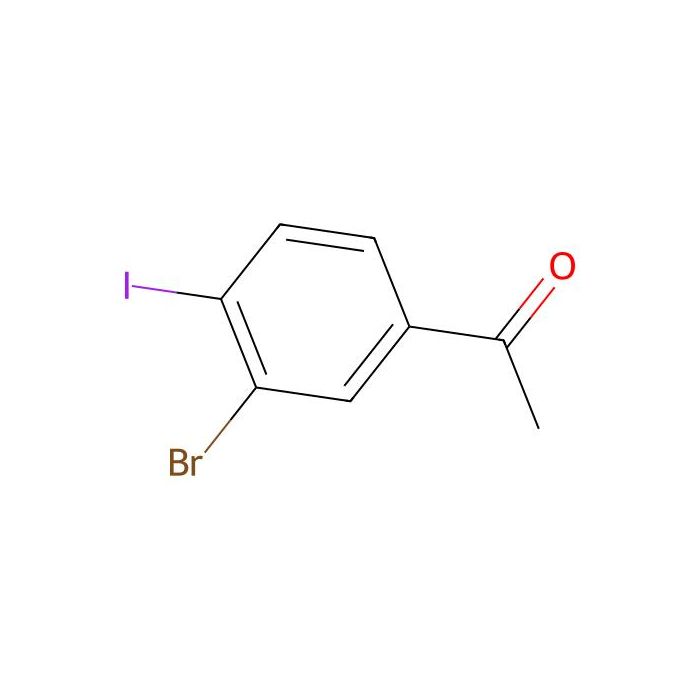
Brief: 1-(3-Bromo-4-iodophenyl)ethanone is a dihalogenated acetophenone building block combining an aryl ketone with orthogonal aryl–iodide and aryl–bromide handles for selective cross-coupling.
Item-specific (Product Data):
CAS: 945907-32-4
CID: 91828093
InChIKey: 393379 (as provided)
SMILES: Not specified for this item; refer to CoA/Spec Sheet.
Literature/computed identifiers and features (for reference; not item specifications):
Suggested molecular formula (from name): C8H6BrIO
Approximate molecular weight: ~324.94 g/mol (computed from C8H6BrIO)
Aryl ketone (acetophenone) framework: –COCH3 directly bonded to a phenyl ring
Vicinal ring substituents: meta-bromo (3-Br) and para-iodo (4-I) relative to the acyl carbon
Planar, conjugated aromatic system; no stereocenters
2D description: A benzene ring bearing three substituents: one carbonyl–methyl (acetyl) group at C1, an iodine at C4 (para to acetyl), and a bromine at C3 (meta to acetyl). The carbonyl is conjugated with the aromatic ring, imparting deactivation toward electrophilic aromatic substitution and directing effects for metalation/coupling.
General notes:
Orthogonal reactivity: C–I is typically more reactive than C–Br under Pd-catalyzed cross-couplings, enabling stepwise functionalization.
Synthetic Utility
Key functional groups and handles:
Aryl halides (I, Br): orthogonal reactivity allows sequential functionalization. C–I couples first under Pd catalysis; C–Br reserved for second-stage diversification. Useful in constructing biaryl, aryl–alkynyl, aryl–vinyl, and aryl–amine linkages.
Ketone (acetyl): supports reversible protection (oximes/hydrazones), reductive manipulation (to alcohol or ethyl), and alpha-functionalization via enolates.
Strategic uses (literature):
Divergent libraries: Couple the iodide with boronic acids (Suzuki) to set core scaffold, then aminate/alkynylate at the bromide.
Halogen–metal exchange at I (Turbo Grignard or n-BuLi, ≤−78 °C) followed by electrophile quench (DMF for aldehyde, CO2 for acid, B(OMe)3 then oxidative workup for boronate), preserving Br.
Late-stage carbonyl edits: oxime formation as a traceless handle for Beckmann-like rearrangements or as an IR/NMR tag.
Directed ortho metalation is generally disfavored adjacent to –COCH3 compared with more strongly directing amides; prefer halide handles for regiocontrol.
Protecting-group compatibility: The aryl ketone tolerates many cross-coupling conditions; avoid strong nucleophiles/bases that could induce aldol-type chemistry at the methyl or halogen–lithium exchange at undesired sites.
Outcome: This substrate is a robust node for convergent assembly of multifunctional arenes with controllable regiochemistry.
Target Specificity
Not applicable. This product is a small-molecule building block and is not an antibody, enzyme, or biological probe with defined molecular targets. No antigen, epitope, species reactivity, clone, or isotype information applies.
We use cookies to ensure the website functions properly and, where permitted, to improve your experience. You can manage your preferences at any time in Settings. Learn more in our Cookie Policy.
Shall we send you a message when we have discounts available?
Remind me later
Thank you! Please check your email inbox to confirm.
Products are supplied to verified businesses, institutions, and qualified professionals for research and development use only. Not for use in humans, animals, diagnosis, or therapy.