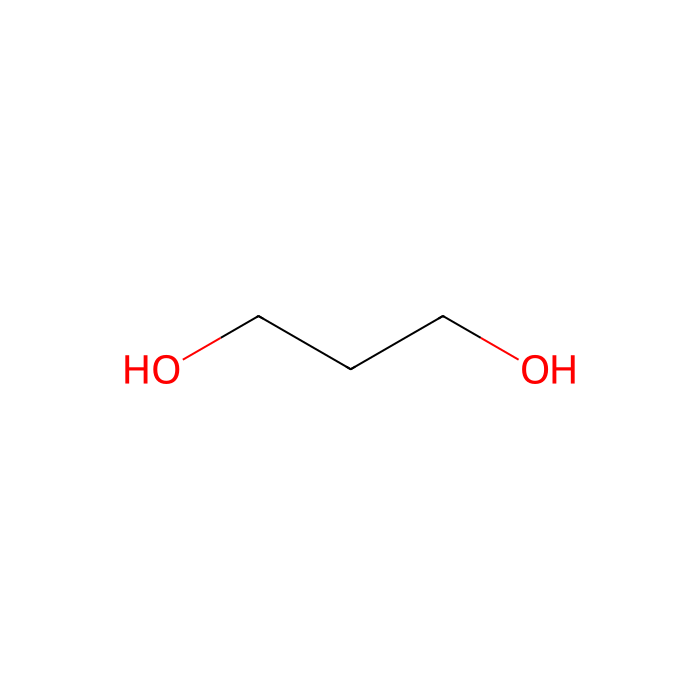
1,3-Propanediol - Standard for GC, ≥99.5%(GC) , CAS No.504-63-2

CAS: 504-63-2 Cat. No.: P108206 Fórmula: C3H8O2 Peso molecular: 76.09 Beilstein Registry Number: 969155 Número CE: 207-997-3
Disponível para encomenda
GRADE & PURITY Standard for GC ? GC reference standard — characterized compound for calibrating GC methods. Use to build calibration curves and verify GC quantitation. ≥99.5%(GC)
Synonyms
2-Deoxyglycerol | HSDB 8263 | J-503943 | CAS-504-63-2 | DTXCID6021246 | 1,3-PROPANEDIOL | 1,3-propane-diol | propan-1,3-diol | (HOCH2)2CH2 | CHEBI:16109 | InChI=1/C3H8O2/c4-2-1-3-5/h4-5H,1-3H | 1,3-PROPANDIOL | propane 1.3-diol | 1.3-propanediol | C02457
Storage
Room temperature,Desiccated
Shipped In
Normal
★
Size
Alemanha (EU)
USA*
Price
Qty
5ml
P108206-5ml
—
1 Em stock

23,34€

27,68€
Gravar 4,34 € (15.67%)
Enter a quantity for the sizes you want to add.
🧪
Why this grade

Standard for GC, ≥99.5%(GC) Standard for GC for sensitive chromatographic and analytical workflows requiring minimal baseline interference.

🌡

Storage & shipping

Room temperature,Desiccated Ships Normal Check lot-specific COA for exact specifications.

📋

Quality documents

SDS, COA, datasheet, and spec sheet available for download. Lot-specific COA accessible via lot number lookup.

📚

Literature proof

Cited in 179 peer-reviewed publications across chromatography, organic synthesis, and cross-coupling reactions.

Specifications

Sinónimos
2-Deoxyglycerol | HSDB 8263 | J-503943 | CAS-504-63-2 | DTXCID6021246 | 1,3-PROPANEDIOL | 1,3-propane-diol | propan-1,3-diol | (HOCH2)2CH2 | CHEBI:16109 | InChI=1/C3H8O2/c4-2-1-3-5/h4-5H,1-3H | 1,3-PROPANDIOL | propane 1.3-diol | 1.3-propanediol | C02457
Especificações e pureza
Standard for GC, ≥99.5%(GC)
Condições de armazenamento de armazenamento
Room temperature,Desiccated
Enviado em
Normal
Grau
Standard for GC
Pureza
≥99.5%(GC)
Nomes e identificadores
Pubchem Sid508807009
Sorrisos canónicosC(CO)CO
IUPAC Namepropane-1,3-diol
InChIKeyYPFDHNVEDLHUCE-UHFFFAOYSA-N
INCHI1S/C3H8O2/c4-2-1-3-5/h4-5H,1-3H2
SMILES isoméricas C(CO)CO
WGK Alemanha 1
RTECS TY2010000
Peso molecular 76.09
Beilstein 969155
Reaxy-Rn 969155
Reaxys-RN_link_address https://www.reaxys.com/reaxys/secured/hopinto.do?context=S&query=IDE.XRN=969155&ln=

Documentation

📋 Safety Data Sheet (SDS)

Comprehensive hazard, handling, storage, and regulatory compliance document.

Download SDS →

✅ Certificate of Analysis (COA)

Lot-specific quality data. Enter your lot number to retrieve the exact COA.

Look up COA →

📊 Datasheet

Quick-reference summary of product specifications and applications.

View datasheet →

🔬 Specification Sheet

Full quality attributes and acceptance criteria for this grade.

View spec sheet →

Advanced Data

Taxonomic Classification

Taxonomy Tree

KingdomOrganic compounds
SuperclassOrganic oxygen compounds
ClasseOrganooxygen compounds
SubclassAlcohols and polyols
Intermediate Tree Nodes Not available
Direct ParentPrimary alcohols
Alternative Parents Hydrocarbon derivatives  
Molecular FrameworkAliphatic acyclic compounds
Substituents Hydrocarbon derivative - Primary alcohol - Aliphatic acyclic compound
DescriçãoThis compound belongs to the class of organic compounds known as primary alcohols. These are compounds comprising the primary alcohol functional group, with the general structure RCOH (R=alkyl, aryl).
External Descriptors a small molecule
Estrutura 3D
Modelo de Estrutura Química Interativa


Mecanismos de ação
Certificados(CoA,COO,BSE/TSE e Mapa de Análise)
C of A & Other Certificates(BSE/TSE, COO):
Analytical Chart:

Find and download the COA for your product by matching the lot number on the packaging.

6 results found

Lot NumberCertificate TypeDataItem
L2413596Certificate of AnalysisSep 07, 2026 P108206
C2302981Certificate of AnalysisSep 01, 2026 P108206
F2605551Certificate of AnalysisApr 24, 2026 P108206
J2509517Certificate of AnalysisSep 24, 2025 P108206
J2520004Certificate of AnalysisSep 24, 2025 P108206
H2231756Certificate of AnalysisAug 19, 2022 P108206
Propriedades químicas e físicas
Índice de refração1.44
Ponto de inflamação (°F)165 °F
Ponto de inflamação (°C)74 °C
Ponto de ebulição (°C)214°C
Ponto de fusão (°C)-27°C
Peso molecular76.090 g/mol
XLogP3-1.000
Hydrogen Bond Donor Count2
Hydrogen Bond Acceptor Count2
Rotatable Bond Count2
Exact Mass76.0524 Da
Monoisotopic Mass76.0524 Da
Topological Polar Surface Area40.500 Ų
Heavy Atom Count5
Formal Charge0
Complexity12.400
Isotope Atom Count0
Defined Atom Stereocenter Count0
Undefined Atom Stereocenter Count0
Defined Bond Stereocenter Count0
Undefined Bond Stereocenter Count0
The total count of all stereochemical bonds0
Covalently-Bonded Unit Count1
FAQs e artigos
Standard for GC: A Practical Guide
Bio-based Chemicals: From Platform Molecules to Application Scenarios — Trend Insights and Aladdin’s Product Portfolio
A Practical Guide to Fragrance Compositions: Turning a Black-Box Formula into an Engineerable System—Compatibility, Stability, Controlled Release, Traceability, and Selection
Experimental Evaluation of Triphosgene in Organic Synthesis: Understanding Its Selection Logic Through Reaction Tasks
Understanding Polyester Resins for Coatings: Structure Design, Key Indicators, and Coating Film Performance
Failure Mechanisms, Application Limitations, and Systematic Improvement Directions for Polyester Coatings
Solvents, Co-solvents, and Solubilization Systems in Home and Personal Care Formulations: Classification, Functions, and Selection Guide
Why Do Alcohols Differ in Function: Why Is Glycerol Mainly Moisturizing, Propylene Glycol Mainly Solubilizing, and Isopropyl Alcohol Fast-Drying? — Understanding Personal Care Formulation Functions from Structural Differences
Thickening, Suspension, Auxiliary Stabilization, and Agglomeration Mechanisms of Xanthan Gum in Personal Care Formulations: From Molecular Structure to Processing Applications
Why Limonene Can Soften Greasy Soils Yet Is Difficult to Dissolve in Water: Understanding the Cleaning Mechanism and Formulation Applications of Naturally Derived Solvents from Molecular Structure
What Is Synthetic Biology? The Industrialization Pathway from Upstream Reagent Toolchains to Biomanufacturing Applications
Analysis of Structural Differences in Diols: Moisturization, Co-solvency, Skin Feel, and Formulation Selection for Propylene Glycol, Butylene Glycol, and Medium- to Long-Chain 1,2-Alkanediols
Performance Sources and Formulation Applications of Enzyme-Based Ingredients in Daily Chemical Products: Fermentation Transformation, Enzymatic Reactions, and Application Principles
Mechanistic Analysis of Topical Glutathione in Skincare: Cellular Redox Regulation, Skin Delivery Challenges, and SLN-Based Delivery Strategies
Structure, Degradation Behavior, and Applications of Poly(trimethylene carbonate) (PTMC) in Flexible Absorbable Materials
Antioxidant Mechanisms of Ferulic Acid in Skincare, Vitamin C/E Synergy, and Stable Delivery Applications
Structure, Stratum Corneum Distribution, and Stratum Corneum Conditioning Mechanism of Capryloyl Salicylic Acid: Barrier Effects and Safety Evaluation
Differences Between Cast CPU and Thermoplastic TPU in Structure, Processing, Performance, and Applications
Citations of This Product
Calculadoras de soluções
Revisões

Avaliações dos Clientes

Shall we send you a message when we have discounts available?

Remind me later

Thank you! Please check your email inbox to confirm.

Oops! Notifications are disabled.