1-Methoxy-2-propanol(PGME) - Grade4, Single metal impurity≤ 100ppt , CAS No.107-98-2

CAS: 107-98-2 Cat. No.: M1523992 Fórmula: C4H10O2 Peso molecular: 90.12 Beilstein Registry Number: 1(4)2471 Número CE: 203-539-1
Disponível para encomenda
GRADE & PURITY Grade4(G4) ? Single metal impurity≤ 100ppt
Storage
Protected from light,Room temperature,Argon charged
Shipped In
Normal
★
Size
Alemanha (EU)
USA*
Price
Qty
500ml
M1523992-500ml
Sob encomenda · 8–12 semanas
1127,97€
Enter a quantity for the sizes you want to add.
🧪
Why this grade

Grade4, Single metal impurity≤ 100ppt Grade4(G4) for sensitive chromatographic and analytical workflows requiring minimal baseline interference.

🌡

Storage & shipping

Protected from light,Room temperature,Argon charged Ships Normal Check lot-specific COA for exact specifications.

📋

Quality documents

SDS, COA, datasheet, and spec sheet available for download. Lot-specific COA accessible via lot number lookup.

📚

Literature proof

Cited in 42 peer-reviewed publications across chromatography, organic synthesis, and cross-coupling reactions.

Specifications

Especificações e pureza
Grade4, Single metal impurity≤ 100ppt
Condições de armazenamento de armazenamento
Protected from light,Room temperature,Argon charged
Enviado em
Normal
Grau
Grade4(G4)
Nomes e identificadores
Sorrisos canónicos
CC(COC)O
IUPAC Name
1-methoxypropan-2-ol
InChIKey
ARXJGSRGQADJSQ-UHFFFAOYSA-N
INCHI
1S/C4H10O2/c1-4(5)3-6-2/h4-5H,3H2,1-2H3
SMILES isoméricas
CC(COC)O
RTECS
UB7700000
Número UN
3092
Grupo de embalagem
III
Peso molecular
90.12
Beilstein
1(4)2471
Reaxy-Rn
1718942
Reaxys-RN_link_address
https://www.reaxys.com/reaxys/secured/hopinto.do?context=S&query=IDE.XRN=1718942&ln=

Documentation

📋 Safety Data Sheet (SDS)

Comprehensive hazard, handling, storage, and regulatory compliance document.

Download SDS →

✅ Certificate of Analysis (COA)

Lot-specific quality data. Enter your lot number to retrieve the exact COA.

Look up COA →

📊 Datasheet

Quick-reference summary of product specifications and applications.

View datasheet →

🔬 Specification Sheet

Full quality attributes and acceptance criteria for this grade.

View spec sheet →

Advanced Data

Taxonomic Classification

Taxonomy Tree

KingdomOrganic compounds
SuperclassOrganic oxygen compounds
ClasseOrganooxygen compounds
SubclassAlcohols and polyols
Intermediate Tree Nodes Not available
Direct ParentSecondary alcohols
Alternative Parents Dialkyl ethers  Hydrocarbon derivatives  
Molecular FrameworkAliphatic acyclic compounds
Substituents Secondary alcohol - Ether - Dialkyl ether - Hydrocarbon derivative - Aliphatic acyclic compound
DescriçãoThis compound belongs to the class of organic compounds known as secondary alcohols. These are compounds containing a secondary alcohol functional group, with the general structure HOC(R)(R') (R,R'=alkyl, aryl).
External Descriptors Not available
Certificados(CoA,COO,BSE/TSE e Mapa de Análise)
C of A & Other Certificates(BSE/TSE, COO):
Analytical Chart:
Propriedades químicas e físicas
SolubilidadeStrong solubility, low toxicity, and can be miscible with water and various organic solvents; Strong coupling properties; Low surface tension; Low viscosity; High evaporation rate.
SensibilidadeHygroscopic;Sensitive to light;Air sensitive
Índice de refração1.4
Ponto de inflamação (°C)34 °C
Ponto de ebulição (°C)118-120 °C(lit.)
Ponto de fusão (°C)-97℃
Peso molecular90.120 g/mol
XLogP3-0.200
Hydrogen Bond Donor Count1
Hydrogen Bond Acceptor Count2
Rotatable Bond Count2
Exact Mass90.0681 Da
Monoisotopic Mass90.0681 Da
Topological Polar Surface Area29.500 Ų
Heavy Atom Count6
Formal Charge0
Complexity28.700
Isotope Atom Count0
Defined Atom Stereocenter Count0
Undefined Atom Stereocenter Count1
Defined Bond Stereocenter Count0
Undefined Bond Stereocenter Count0
The total count of all stereochemical bonds0
Covalently-Bonded Unit Count1
Citations of This Product
Calculadoras de soluções
Revisões

Avaliações dos Clientes

Application Protocols

Not applicable. No tested biological assay protocols (e.g., WB, IHC, IF, FC) are provided for this chemical solvent. For laboratory use, follow general solvent-handling protocols appropriate to your application (reaction setup, drying, purification), and consult the SDS and CoA for item-specific guidance.

Biological Roles

This product is a laboratory/industrial solvent rather than a biochemical reagent. It does not have a defined physiological “role” in cells or organisms. Any discussion below is general literature context, not specific to this item and not for clinical use.

  • General/literature context:
    • Glycol ethers like PGME can partition into aqueous and lipid phases due to mixed polarity; they are used industrially as coupling solvents and cleaning agents.
    • In biochemical laboratories, PGME is occasionally used as a process solvent for extraction or as a co-solvent to dissolve polar/medium-polarity compounds when purely aqueous systems are inadequate.
  • Not typically used as:
    • A metabolite, buffer component, or biochemical cofactor.

For life-science workflows requiring biocompatibility, consider well-characterized aqueous buffers or biocompatible co-solvents (e.g., ethanol, glycerol) and verify cytotoxicity independently.

Buffer Applications

PGME is not a buffering agent and does not form conventional biological buffer systems. It can be used as a co-solvent to adjust solvent polarity in aqueous buffers for certain analytical or preparative procedures (e.g., extraction, solubilization), but it does not provide pH control.

  • If used as a co-solvent:
    • Prepare the buffer at the desired pH in water first, then add PGME while monitoring pH (co-solvents can shift apparent pKa values and electrode responses).
    • Verify compatibility with enzymes/cells—PGME is generally not biocompatible at significant volume fractions.

For true buffering capacity, select established systems (e.g., phosphate, HEPES, Tris) based on the pH range needed.

Green Alternatives

Context: PGME is widely used as a “safer glycol ether” relative to older ethylene glycol ethers (e.g., EGME) due to a more favorable toxicological profile (literature). From a green chemistry standpoint, solvent selection balances safety, renewability, energy use (bp/evaporation), and process efficiency.

Comparison (literature, qualitative):

| Solvent | Key attributes | Pros | Trade-offs | | --- | --- | --- | --- | | PGME (this product) | Protic, water-miscible, bp ~120 °C | Good solvency for polar substrates; water miscible; moderate evaporation | Flammable; peroxide risk (ether); protic –OH incompatible with strong bases | | 2-MeTHF | Bio-derived option; aprotic, bp ~80 °C | Greener sourcing; lower peroxide tendency than THF; good for organometallics | Lower water miscibility; different polarity; odor | | CPME | Aprotic, bp ~106 °C | Broad reaction compatibility; low peroxide formation; easy phase-separation | Less hydrophilic; solvency differs; cost | | Water/Alcohol blends | Aqueous ethanol/isopropanol | Low toxicity, easy disposal (context-dependent) | Limited solvency for hydrophobes; azeotrope management |

Greener-use strategies with PGME:

  • Use as co-solvent to reduce or replace higher-toxicity glycol ethers or chlorinated solvents.
  • Recycle via fractional distillation; its mid bp aids recovery at reasonable energy cost.
  • Employ molecular sieves for reuse (drying) and monitor peroxide levels to extend solvent life.

Note: Ultimate selection should use a solvent selection guide (e.g., CHEM21/ACS GCI) and process-specific EHS data.

Pharmaceutical Uses

No pharmacopeial or formulation grade information is provided for this item. PGME (as a chemical class: glycol ether) may function as a process solvent in pharmaceutical manufacturing under validated conditions, but such use requires strict control of residuals and compliance with regulatory guidance.

  • This product is designated “For research use only.” It is not intended for human or veterinary applications.
  • If considering PGME in development contexts (general/literature):
    • Role: Process solvent or cleaning solvent; occasionally a crystallization co-solvent due to mixed polarity.
    • Considerations: Residual solvent limits (ICH Q3C), extractables/leachables, and solvent recovery/reuse strategies.

Always confirm grade, impurity profile, and regulatory acceptability for pharmaceutical manufacturing separately; these aspects are Not specified for this item and must be verified on the CoA/Spec Sheet.

Physical Properties

Item-specific specifications are not provided in the Product Data; consult the CoA/Spec Sheet for release specifications. The following are typical literature values for 1-methoxy-2-propanol (PGME) and are provided for general guidance only.

  • Appearance: Not specified for this item; refer to CoA/Spec Sheet. (Literature: colorless liquid, mild ether-like odor)
  • Boiling point: ~120–124 °C at 1 atm (literature)
  • Melting point: ~−95 to −97 °C (literature)
  • Density: ~0.92 g/mL at 20 °C (literature)
  • Refractive index: n20/D ~1.400–1.404 (literature)
  • Vapor pressure: ~2–6 mmHg at 20 °C (varies by source; literature)
  • Flash point (closed cup): ~31–33 °C (literature)
  • Dielectric constant: ~16–17 at 20–25 °C (literature)
  • Viscosity: ~2–3 mPa·s at 20 °C (literature)
  • Solubility: Miscible with water and many organics (alcohols, ketones, esters, many hydrocarbons) (literature)
  • Partition coefficient (logP): approximately −0.7 to −0.4 (literature, method-dependent)
  • Henry’s law/volatility: Moderate; slower evaporation than acetone and Et2O, faster than glycols (literature)

Practical notes (general):

  • Hygroscopicity: Moderately hygroscopic; water content can rise upon air exposure.
  • Drying: Molecular sieves (3 Å/4 Å) effectively reduce water; distillation from CaH2 less common due to acid/base sensitivity of ether–alcohol mixtures.
  • Peroxide formation: As an ether-containing solvent, can form peroxides over time; see Safety & Handling.
Quality and Grades
  • Grade/Purity: UPSS grade (as provided). Detailed impurity limits, assay method, water/peroxide content, metals, and UV cutoffs are Not specified for this item; refer to CoA/Spec Sheet.

Context and implications:

  • UPSS grade (manufacturer designation): While not a standardized global term (e.g., ACS, AR, HPLC), a dedicated grade label typically indicates defined internal specifications suited to the intended application domain (here categorized under Materials Science). Users should review the accompanying CoA for quantitative criteria (assay, moisture, residue on evaporation, acidity/alkalinity, peroxide value, UV absorbance) relevant to sensitive applications (e.g., microelectronics, polymer processing, or surface treatments).
  • Stabilizers: Not specified for this item; refer to CoA/Spec Sheet. PGME is often supplied unstabilized; some suppliers may add trace inhibitors to manage peroxide formation—verify before sensitive catalysis or polymerizations.
  • UV/Chromatography use: If using for spectroscopic or chromatographic work, verify UV absorbance profile and fluorescence background on the CoA. If HPLC/UV-grade is required, ensure explicit low-UV absorbance specification.
  • Trace metals/ionic cleanliness: For electronic or catalytic uses, request ionic and metal content data (Na, K, Ca, Fe, Cu, etc.) if those are critical. Not specified for this item; refer to CoA/Spec Sheet.

Recommendation: Match the solvent grade to the application’s tolerance for water, nonvolatile residue, and UV/metal background; consult the Aladdin CoA to confirm suitability.

Reaction and Applications

PGME’s combination of an ether oxygen and a secondary alcohol makes it a versatile solvent and process aid in synthesis and materials processing.

Representative uses (general/literature):

  • Reaction solvent/co-solvent:
    • Nucleophilic substitutions where partial protic character assists leaving-group departure while maintaining organic solubility.
    • Base-catalyzed condensations/aldolizations at moderated rates (–OH buffers basicity vs fully aprotic media).
    • Transition-metal catalysis that tolerates protic media (e.g., certain Pd-catalyzed couplings with water/PGME mixtures).
  • Reagent handling:
    • Dissolution of polar monomers/resins in polymerizations and crosslinking processes (e.g., acrylics, epoxies) with controlled evaporation for film uniformity.
    • Lithography/cleaning (materials science) where water miscibility aids residue removal.
  • Derivatization/transformation (substrate role):
    • Under strong base, deprotonation gives the corresponding alkoxide (PM-alkoxide), usable as a hindered base/nucleophile or for transetherification.
    • The –OH allows esterification (e.g., to PGMEA) and carbonate formation for protecting-group strategies.

Practical tips:

  • Drying and oxygen control: Product is supplied argon charged. Maintain inert headspace during moisture-sensitive reactions.
  • Peroxides: Screen aged solvent before concentration/distillation; add peroxide scavengers if necessary.
  • Workup advantages: Water miscibility enables convenient aqueous washes and phase manipulations; salt-out with brine if needed.
  • Compatibility: Avoid strong acylating agents (acyl chlorides/anhydrides) unless PGME is intended to be consumed; the alcohol will react.
Reaction Conditions

General, literature-based guidance when using PGME as a reaction medium (not item-specific; adjust per substrate and catalyst):

  • Solvent role: Protic, polar solvent; miscible with water. Useful temperatures from 0 °C up to near its bp (~120 °C). Reflux at ~120 °C enables moderately high-temperature transformations without pressure.

  • Typical applications and conditions:

    • Nucleophilic substitutions: 20–80 °C; bases such as K2CO3/Na2CO3 for haloalkanes or sulfonates; PGME often paired with water for phase-continuous reactions; reaction times 1–24 h depending on leaving group.
    • Metal-catalyzed couplings (tolerant systems): Pd-catalyzed C–C couplings in H2O/PGME (e.g., 1:1 to 1:4 v/v), bases like K3PO4 or Cs2CO3; 60–100 °C; inert atmosphere advised (argon headspace aligns with Product Data).
    • Condensations/esterifications where PGME is a bystander solvent: Use Dean–Stark alternatives are limited due to water miscibility; remove water by molecular sieves or reduced pressure.
  • Drying/inerting:

    • Dry over 3 Å/4 Å sieves to ≤ low-ppm water (target according to process need; item-specific water spec is Not specified for this item; refer to CoA/Spec Sheet).
    • Maintain argon/nitrogen blanket to limit moisture and peroxide formation, consistent with the item’s argon-charged supply.
  • Workup notes:

    • Quench basic/organometallic residues cautiously (PGME’s –OH may exothermically protonate reactive species).
    • Water miscibility allows direct dilution and extractions; salting-out can aid phase separation when needed.

Expected yields are substrate- and catalyst-dependent; consult reaction-specific literature.

Safety and Handling

Safety information specific to this item (grade-specific hazards, exact classifications) is not provided in the Product Data. Always consult the Aladdin SDS for authoritative information. The following are general, literature-based cautions for 1-methoxy-2-propanol (PGME):

  • GHS classification (typical literature):
    • Flammable liquid, Category 3; Eye irritation, Category 2A; STOT SE Category 3 (narcotic effects). Exact classification may vary by supplier/region.
  • Common H/P statements (literature examples; not item-specific):
    • H226 Flammable liquid and vapor; H319 Causes serious eye irritation; H336 May cause drowsiness or dizziness. Use corresponding P-statements for prevention/response.
  • Pictograms (literature): GHS02 (flame), GHS07 (exclamation mark).

Handling and PPE:

  • Use in a fume hood; avoid inhalation of vapors and skin/eye contact.
  • Wear safety glasses or chemical splash goggles, lab coat, and compatible gloves (e.g., nitrile). Change gloves regularly due to solvent permeation.

Storage and incompatibilities:

  • Product Data specifies: Protected from light; Room temperature; Argon charged. Keep tightly closed to limit moisture uptake and peroxide formation. Store away from ignition sources.
  • Incompatibilities (general): Strong oxidizers, strong acids/bases (may catalyze ether/alcohol cleavage or transetherification), reactive metals (forms alkoxides), acid chlorides/anhydrides (acylation of –OH).

Special risks and first aid (general):

  • Ethers may form peroxides during storage; test periodically if aged or concentrated to dryness. Avoid distilling to dryness.
  • In case of eye/skin contact: Rinse with water for ≥15 min; remove contaminated clothing. If inhaled: Move to fresh air. If ingested: Do not induce vomiting; seek medical advice. Refer to SDS for full guidance.
Solvent Selection

PGME is a mid-polar, water-miscible ether–alcohol solvent with both hydrogen-bond donor (–OH) and acceptor sites, offering a balance between protic solvation and organic compatibility.

  • Polarity and miscibility (literature):
    • Dielectric constant ~16–17 (20–25 °C), miscible with water, alcohols, ketones, esters, many aromatics; good solvency for resins and salts that benefit from H-bonding.
  • When to choose PGME:
    • Need for a single-phase water/organic medium with reduced volatility vs acetone/MeOH.
    • Solubilizing moderately polar substrates (salts, zwitterions, polar monomers) where pure ethers or hydrocarbons fail.
    • Co-solvent to tune proticity and viscosity in coupling, substitution, and base-catalyzed reactions.
  • When to consider alternatives:
    • For aprotic conditions, prefer 2-MeTHF, THF, DME, CPME, acetonitrile, or DMF/DMSO.
    • For very fast evaporation or very low bp, acetone/Et2O may be better.
    • For strong base/metalation chemistry (e.g., BuLi), use strictly aprotic ethers/hydrocarbons; PGME’s –OH will be deprotonated.

Comparison snapshot (literature, qualitative):

  • PGME (PM): Protic, bp ~120 °C, water-miscible, good resin solvency.
  • PGMEA (acetate): Aprotic ester, bp ~145 °C, slower evaporation, lower polarity.
  • 2-MeTHF: Aprotic ether, bp ~80 °C, partial water miscibility, greener profile.
  • THF: Aprotic ether, bp ~66 °C, strong solvator; forms peroxides more readily.

Practical tips:

  • Dry with 3 Å/4 Å sieves for moisture-sensitive work.
  • Verify compatibility with bases/acylating agents due to free –OH.
  • In coatings/ink applications, leverage its balanced evaporation rate for film formation.
Storage and Reconstitution
  • Storage conditions (from Product Data):

    • Protected from light
    • Room temperature
    • Argon charged
    • Shipped in: Normal
  • Container and headspace:

    • Keep tightly closed under inert gas to minimize moisture uptake and peroxide formation. Use septum-sealed bottles where feasible; backfill with argon after each use.
  • Shelf life and monitoring:

    • For ethers, periodic peroxide testing is prudent, especially after prolonged storage or before concentration/distillation. Store away from heat/ignition sources.
  • Reconstitution:

    • Not applicable; product is supplied as a ready-to-use liquid solvent. If drying is required for moisture-sensitive work, treat with activated molecular sieves (3 Å/4 Å) and verify water content by Karl Fischer as needed (item-specific water specification is Not specified for this item; refer to CoA/Spec Sheet).
  • Compatibility and segregation:

    • Segregate from strong oxidizers, acids/anhydrides, acid chlorides, and reactive metals.
    • Use amber or light-protective secondary containment to satisfy the “protected from light” requirement.

Always consult the Aladdin SDS and CoA for item-specific handling and quality details. For research use only (as stated in Product Data).

Structure and Identity

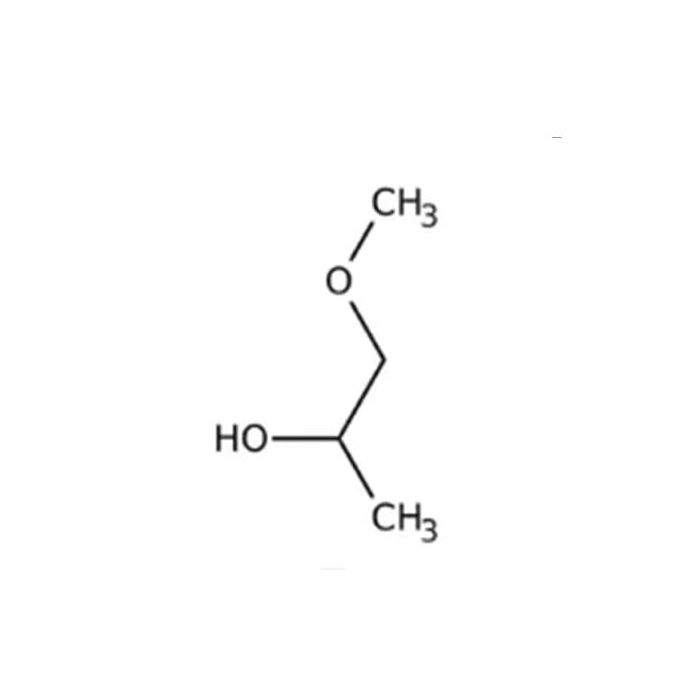
Brief description: 1-Methoxy-2-propanol (PGME, also known as propylene glycol monomethyl ether, “PM”) is a secondary alcohol bearing a methoxy ether substituent on the adjacent carbon. It is a polar, hydrogen-bonding, ether–alcohol solvent.

  • Product identifiers (from Product Data):
    • SKU: M1523992
    • CAS: 107-98-2
    • PubChem CID: 7900
    • InChIKey: 13361 (as provided)
  • Names and synonyms (general/literature):
    • 1-Methoxy-2-propanol; Propylene glycol monomethyl ether; PGME; PM
  • Empirical data:
    • Molecular formula: Not specified for this item; refer to CoA/Spec Sheet. (Literature: C4H10O2)
    • Molecular weight: Not specified for this item; refer to CoA/Spec Sheet. (Literature: ~90.12 g/mol)
  • Structural descriptors (literature/computed):
    • SMILES: COCC(C)O (one common representation; literature)
    • 2D structural features: A three-carbon backbone with a secondary alcohol at C2 (–CHOH–) and a methoxy substituent (–OCH3) on C1. Functional groups: one ether (alkyl–O–alkyl) and one alcohol (secondary –OH). No rings, no stereocenter in the neat commercial mixture (typically racemic at C2 if chiral).
  • Functional group implications:
    • Hydrogen-bond donor (–OH) and acceptors (ether O and alcohol O)
    • Moderate coordinating ability toward Lewis acids/metal cations via oxygen lone pairs
    • Potential for intramolecular/protic solvation effects in reactions

Note: Structural/literature values are provided for context; for item-specific identity parameters, consult the Aladdin CoA/Spec Sheet.

Synthetic Utility

Functional-group perspective:

  • Alcohol (secondary –OH):
    • Can be deprotonated to form the corresponding alkoxide (base/nucleophile) for transesterification/transetherification or as a hindered base.
    • Convertible to esters (e.g., acetate, carbonate) for volatility or protection tuning (PGMEA is a common derivative).
  • Ether (–O–):
    • Provides coordinating ability as solvent; supports cation stabilization without the strong basicity of amines.

Utility as solvent/co-solvent (literature):

  • Polar, protic environment for SN1/SN2 reactions where some hydrogen-bonding aids solubility of salts and stabilizes transition states.
  • Medium for base-catalyzed condensations and for certain metal-catalyzed couplings tolerant of protic media (e.g., Mizoroki–Heck or Suzuki couplings in mixed aqueous/organic systems).
  • Facilitates dissolution of polyfunctional substrates (diols, polyacids) that are poorly soluble in aprotic ethers.

Operational advantages:

  • Water miscibility simplifies workups and phase manipulation (salt-out with brine if necessary).
  • Moderated evaporation rate enables controlled film formation in coatings and polymer processing (materials science workflows).

Caveats:

  • The –OH reacts with strong bases, acid chlorides/anhydrides, and reactive organometallics—use aprotic solvents if the –OH would interfere.
  • Ethers may slowly form peroxides—monitor when concentrating or distilling, and avoid distilling to dryness.
Target Specificity

Not applicable. This product is a chemical solvent (1-methoxy-2-propanol), not a biological targeting reagent (e.g., antibody, enzyme inhibitor, ligand). No antigen/epitope specificity applies.

Shall we send you a message when we have discounts available?

Remind me later

Thank you! Please check your email inbox to confirm.

Oops! Notifications are disabled.