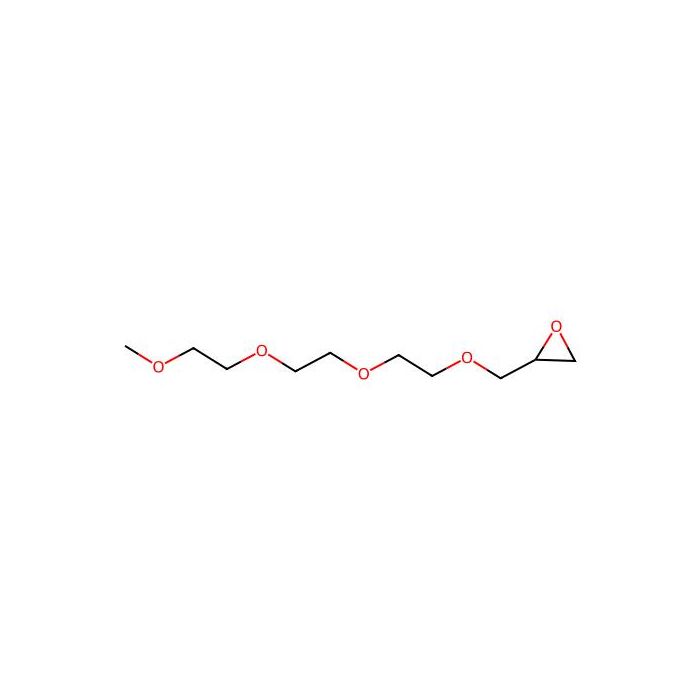
This compound belongs to the class of organic compounds known as epoxides. These are compounds containing a cyclic ether with three ring atoms(one oxygen and two carbon atoms).
External Descriptors
Not available
1. Djoumbou Feunang Y, Eisner R, Knox C, Chepelev L, Hastings J, Owen G, Fahy E, Steinbeck C, Subramanian S, Bolton E, Greiner R, and Wishart DS. ClassyFire: Automated Chemical Classification With A Comprehensive, Computable Taxonomy. Journal of Cheminformatics, 2016, 8:61.
Determine the necessary mass, volume, or concentration for preparing a solution.
Dilution Calculator
Determine the dilution needed to prepare a stock solution.
Reconstitution Calculator
Revisões
Avaliações dos Clientes
Application Protocols
Item-specific tested applications and conditions: Not specified for this item; refer to CoA/Spec Sheet.
General example procedures (literature; for research use only)
Amine coupling (small molecule): Dissolve amine (1.0 equiv) in dry MeCN (0.1–0.3 M), add this glycidyl-PEG reagent (1.3 equiv) and DIPEA (1.0 equiv). Stir at 40 C for 6 h under N2. Monitor by LC/MS. Evaporate solvent, purify by RP-HPLC.
Thiol coupling (peptide side chain, research): Dissolve peptide containing a free cysteine in phosphate buffer (pH 7.8) with 20–30% ACN. Add reagent (3–5 equiv relative to thiol). Stir gently at RT for 1–2 h. Desalt via RP-cartridge, analyze by LC/MS. Avoid buffers with primary amines.
Surface modification (glass): Clean glass slides, dry at 120 C, cool under N2. Immerse in 1–5% (w/v) solution in dry DMF, heat 80 C for 2 h. Rinse with DMF, then IPA, then water; dry at 80 C. Evaluate contact angle and XPS for surface oxygen/carbon signal changes.
Caveats
Optimize equivalents, pH, and temperature for your substrate. Validate product identity by NMR/MS.
No claims are made about suitability for clinical/diagnostic applications.
Biological Roles
Applicability
This compound is a synthetic, small-molecule PEG linker bearing a terminal epoxide. It does not have a known intrinsic biological role or endogenous metabolic function.
General context (literature/general)
PEG spacers: Poly(ethylene glycol) segments are widely used in research to modulate hydrophilicity, reduce nonspecific adsorption, and increase aqueous compatibility of conjugates and surfaces.
Epoxide handle: Provides a chemoselective electrophile for covalent attachment to nucleophiles (amines, thiols) under mild conditions, producing stable β-substituted alcohol linkages.
Research utilities:
Surface passivation and functionalization in biosensors and microfluidic devices (reduced protein fouling, improved wettability).
Assembly of affinity probes, fluorescent tags, or small-molecule libraries with defined PEG3 linkers to tune spacing and solubility.
Clarifications
No medical or clinical claims are made or implied for this product. Any use in biological experiments should be strictly for in vitro or ex vivo research purposes.
Biological activity, toxicity, or cell compatibility will depend on the final conjugate and context; users should perform their own biocompatibility assessments for research applications.
Buffer Applications
Not typically applicable
This reagent is not a buffering agent and does not form defined buffer systems.
Practical notes for labs (general)
When performing epoxide ring-opening in aqueous media (e.g., with amines or thiols on biomolecules), select buffers that minimize side reactions:
Avoid strong acids/bases; maintain near-neutral pH (7–9) for amines, slightly basic for thiols (pH 7.5–8.5) to enhance nucleophilicity while limiting hydrolysis.
Use buffers lacking primary amines or competing nucleophiles (e.g., avoid Tris, glycine). Prefer phosphate, HEPES, or borate as appropriate, recognizing each can influence reaction rates.
Minimize buffer concentration and exposure time to limit epoxide hydrolysis; consider organic cosolvents (ACN, DMF) to increase solubility and control rates if compatible with the system.
Item-specific data
No buffer recipes, pKa values, or ionic strength guidance are specified for this item; consult your experimental requirements.
Green Alternatives
Context
This product is a functional reagent rather than a solvent. Green considerations focus on solvent choice for reactions, safer catalysts, and process minimization rather than replacing the reagent itself (the PEG3 spacer is often required by design).
Greener process choices (literature/general)
Solvent selection: Prefer bio-derived or lower-toxicity polar solvents when compatible with kinetics and selectivity.
ACN/EtOAc mixtures instead of chlorinated solvents for extractions where feasible.
Cyrene, propylene carbonate, or ethanol as greener media for certain epoxide openings (verify solubility and rates).
Catalysts: Use organic bases (DIPEA, DBU) or benign Lewis acids (bismuth salts, scandium triflates in catalytic loadings) instead of strong mineral acids/bases when possible.
Energy: Conduct at ambient temperature when nucleophile is sufficiently reactive (thiols, primary amines) to lower energy footprint.
Waste minimization: Employ solvent recovery; design telescoped sequences where the glycidyl coupling medium is compatible with subsequent steps.
Comparison snapshot (general)
DMF vs. alternatives: DMF is effective but flagged for reproductive toxicity; consider acetonitrile, 2-MeTHF (with co-solvent), or propylene carbonate when reactivity allows.
DCM vs. EtOAc/IPA: Replace chlorinated solvents in workup with EtOAc/IPA or MeTHF to reduce halogenated waste.
Notes
Epoxide reagents can be sensitizers; engineering controls and closed transfers reduce operator exposure.
Any solvent/reagent substitutions should be validated for your specific substrates to ensure conversion, selectivity, and product quality.
Pharmaceutical Uses
Not a drug; research use only
Research Use Note (from Product Data): For research use only.
Formulation/manufacturing context (general)
Glycidyl-terminated PEGs may be explored in research settings as reactive intermediates to prepare materials and excipients (e.g., hydrophilic surface modifiers, crosslinkable coatings). They are not, by themselves, compendial excipients.
Any consideration for GMP or clinical manufacturing would require full impurity profiling (epichlorohydrin/glycidol residuals, halides), stability studies, and pharmacopeial alignment—none of which are specified for this item.
Guidance
If using in pre-formulation or device-coating research, ensure removal of unreacted epoxide and low-molecular-weight byproducts. Validate extractables/leachables for the finished material if progressing beyond bench-scale research.
Item-specific status
Pharmacopeia listing, excipient grade, and regulatory status: Not specified for this item; refer to CoA/Spec Sheet.
Physical Properties
Item-specific (from Product Data)
Appearance: Not specified for this item; refer to CoA/Spec Sheet.
Grade/Purity: Not specified for this item; refer to CoA/Spec Sheet.
Literature/computed values for the described structure (non-specification guidance)
Expected physical state: liquid at ambient conditions is typical for short PEG glycidyl ethers (literature trend).
Miscibility/solubility (literature): miscible with polar organic solvents (MeOH, EtOH, acetone, acetonitrile, DMF, DMSO); high water miscibility is likely due to the PEG3 segment, though epoxides can slowly hydrolyze in aqueous media under acidic/basic conditions.
Polarity: polar, hydrogen-bond acceptor; no ionizable groups in neutral range; epoxide is moderately electrophilic.
LogP (estimate, literature/computed): low to moderate hydrophilicity expected for PEG3 chains (typical cLogP < 1 for analogous PEG3 ethers).
Refractive index and density: Not broadly tabulated for this exact structure; expect values comparable to short PEG ethers (nD ~1.43–1.46; ρ ~1.05–1.12 g/mL at 20–25 C) — literature ranges for context only.
Boiling point/viscosity: Data for this exact compound are scarce; PEG3 ethers display elevated boiling points and low volatility; viscosity modestly higher than common solvents.
Important
Do not treat the above as item specifications. For exact lot-specific values (water content, residuals, metals, UV cutoff, etc.), consult the product CoA/Spec Sheet.
Quality and Grades
Item-specific (from Product Data)
Grade/Purity: Not specified for this item; refer to CoA/Spec Sheet.
Stabilizers: Not specified for this item; refer to CoA/Spec Sheet.
General guidance (literature/general)
Typical offerings: Glycidyl-functional PEG reagents are commonly supplied as neat liquids with assay reported by NMR/GC and with limits on epichlorohydrin, glycidol, and related epoxide/halide residuals. Water content is often controlled (Karl Fischer) to preserve epoxide integrity.
Implications of grade:
Research/bioconjugation grade: Emphasis on low residual metals/halides, low water, and narrow oligomer distribution (for defined n). Useful for surface functionalization and linker chemistry.
Industrial/technical grade: May have broader impurity specifications and color; adequate for bulk coatings/adhesives where ultra-low impurities are not critical.
UV/LC suitability: If HPLC/UV transparency is required (monitoring conjugations), confirm low UV background of the neat reagent or use validated diluents.
Stabilizers/antioxidants: Some epoxides are shipped without stabilizers; others may contain trace acid scavengers or inhibitors. Presence/absence affects reactivity, shelf life, and analytical background. Confirm on CoA.
Recommendations
Verify assay method (1H/13C NMR integration of epoxide methine and methylene signals; epoxide value by titration).
Check water specification and storage history; moisture accelerates ring-opening.
For sensitive syntheses, request CoA including residual epichlorohydrin/glycidol, halide content, and metals by ICP if relevant.
Reaction and Applications
Scope (general for glycidyl-PEG reagents)
Nucleophilic epoxide opening: The terminal oxirane is an electrophile that undergoes regioselective ring opening by:
Primary/secondary amines → β-amino alcohols (useful for introducing PEG3 spacers onto amines in ligands, dyes, and resins).
Thiols → β-thio alcohols (rapid at mild pH; valuable for cysteine-directed modification in peptide chemistry under non-clinical, research settings).
Alcohols/phenols → β-alkoxy alcohols (acid- or base-catalyzed; slower with aliphatic alcohols).
Surface/polymer functionalization: Epoxide reacts with surface hydroxyls (e.g., silica, cellulose, glass) or with amine-bearing polymers to create hydrophilic coatings and reduce fouling.
Crosslinking/curing: Acts as mono-epoxide diluent or reactive modifier to tune network density and hydrophilicity in epoxy formulations.
Practical tips (literature)
Water control: Trace moisture promotes side reactions and lowers coupling efficiency. Dry solvents and glassware; add molecular sieves if compatible.
Catalysis: Lewis acids (BF3·OEt2), bases (tertiary amines), or phase-transfer catalysts can accelerate ring opening; choose to balance selectivity and substrate stability.
Temperature: Many amine/thiol openings proceed at 20–60 C; phenolic openings often require 50–100 C or acid catalysis.
Stoichiometry: Use slight excess (1.2–1.5 equiv) of the glycidyl reagent to drive completion for amine/thiol couplings; remove excess by aqueous workup or chromatography.
Monitoring: 1H NMR disappearance of epoxide signals (~2.5–3.2 ppm region, literature) and appearance of β-substituted alcohol protons; LC/MS for small-molecule adducts.
The short PEG3 spacer provides hydrophilicity and flexibility, useful for constructing focused small-molecule libraries, tuning linker length in conjugates, and modifying surface polarity in materials R&D.
Reaction Conditions
General guidance for epoxide ring opening (literature; not item specifications)
Aminolysis (β-amino alcohol formation):
Solvent: dry DMF, DMSO, or MeCN.
Conditions: 20–60 C, 1–16 h; base such as DIPEA/Et3N (0.5–1.0 equiv) or no added base for primary amines.
Typical stoichiometry: 1.2–1.5 equiv epoxide to amine; monitor by LC/MS or 1H NMR.
Thiolysis (β-thio alcohol formation):
Solvent: MeCN, DMF, or aqueous buffer (pH 7.5–8.5) with organic cosolvent.
Conditions: 0–30 C for sensitive substrates; minutes to hours; mild base (NaHCO3, TEA) to generate thiolate.
Often high conversions at room temperature.
Alcoholysis/phenolysis:
Solvent: toluene, CH2Cl2, or MeCN with catalytic acid (e.g., TsOH, BF3·OEt2 5–10 mol%).
Conditions: 50–100 C (for aliphatic alcohols); 20–60 C may suffice for phenols.
Surface modification (glass/silica, cellulose):
Apply neat or in minimal DMF; cure 60–120 C for 1–4 h; rinse thoroughly to remove unreacted reagent.
Workup/purification
Quench excess nucleophile/acid/base; partition between water and EtOAc or n-BuOH depending on polarity. For PEGylated products, reverse-phase chromatography (C18) or ion-exchange (if charged) often outperforms silica gel.
Notes
Control moisture rigorously for selective small-molecule couplings.
Side reactions: diol formation via hydrolysis, oligomerization under acid/base; keep reaction times reasonable and avoid strong catalysts unless necessary.
Safety and Handling
Item-specific (from Product Data)
GHS classification, signal word, pictograms, H-statements: Not specified for this item; refer to the SDS.
Storage conditions: Room temperature.
General safety considerations for glycidyl ethers/epoxides (literature/general)
Hazards: Many low-molecular-weight epoxides and glycidyl ethers are skin/eye irritants and can be skin sensitizers. Avoid inhalation of vapors/mists and prolonged skin contact.
PPE: Use lab coat, chemical-resistant gloves (nitrile or equivalent), and splash goggles. Handle in a fume hood to minimize inhalation exposure.
Incompatibilities: Avoid strong acids and bases (can catalyze epoxide ring-opening and polymerization), strong nucleophiles, oxidizers, and reactive metals. Moisture can promote hydrolysis over time.
Stability: Epoxides may undergo exothermic polymerization if contaminated with acids/bases. Keep containers tightly closed; use clean, dry glassware.
First aid (overview; defer to SDS):
Skin contact: Wash with plenty of water and soap; remove contaminated clothing.
Eye contact: Rinse cautiously with water for several minutes; remove contact lenses if present and easy; seek medical attention.
Inhalation: Move to fresh air; seek medical advice if symptoms occur.
Ingestion: Rinse mouth; do not induce vomiting; seek medical attention.
Spill/cleanup: Contain with inert absorbent, collect for disposal. Ventilate area. Prevent entry into drains.
Waste
Dispose in accordance with local regulations. Epoxide-bearing waste is often treated as hazardous organic waste.
Always consult the SDS for authoritative, product-specific safety guidance.
Solvent Selection
Applicability
This product is a reactive liquid reagent (glycidyl-functional PEG). Solubility behavior and solvent choice are relevant for handling and for ring-opening reactions.
Highly soluble in polar protic and aprotic solvents: MeOH, EtOH, i-PrOH, acetone, acetonitrile, THF, MTBE (moderate), DCM (moderate), DMF, DMSO.
Water: PEG3 backbone confers substantial water miscibility; however, aqueous media can promote epoxide hydrolysis and side reactions, especially under acidic/basic conditions.
Selection guidance
For nucleophilic ring-opening with amines/thiols/alcohols: use dry polar aprotic solvents (DMF, DMSO, acetonitrile) or alcohol cosolvents; exclude water to control selectivity and rate.
For heterogeneous systems (surfaces, polymers): employ a minimal amount of a high-boiling polar solvent (DMF/DMSO) or neat application, then cure under controlled temperature.
For workup/purification: dissolve residue in minimal MeOH/ACN and precipitate modified polymers into cold ether or hexanes; for small molecules, normal-phase silica may retain PEGylated products—use reverse-phase chromatography if needed.
Quick comparison (general)
DMSO: maximum solubilizing power; may require extensive drying; can participate in Pummerer-type side reactivity at high T—generally safe here.
DMF/ACN: good balance of solubility and volatility; easy removal in vacuo.
Alcohols (MeOH/EtOH): can act as nucleophiles; may compete with intended nucleophile during epoxide opening.
Note
Item-specific solvent limits/UV cutoffs are not specified for this item; refer to CoA/Spec Sheet if chromatography-grade performance is required.
Storage and Reconstitution
Item-specific (from Product Data)
Storage conditions: Room temperature.
Shipped in: Not specified for this item; refer to CoA/Spec Sheet.
General handling guidance (literature/general for epoxides)
Container: Store tightly closed in amber glass to limit light exposure; use PTFE-lined caps.
Atmosphere: Keep under dry inert gas (N2/Ar) after opening to minimize moisture uptake and hydrolysis.
Stability: Epoxides can slowly ring-open under acidic/basic contamination or with moisture. Check epoxide integrity (1H NMR) before critical couplings if the bottle has been open for extended periods.
Freeze/thaw: Not typically required; moderate cooling (2–8 C) can extend shelf life but is not mandated here. Avoid repeated temperature cycling that may draw in moisture.
Reconstitution
This is supplied neat (typical for such reagents). If a stock solution is desired, prepare in dry solvent (ACN, DMF, DMSO, or MeOH) under anhydrous conditions. Store aliquots in sealed vials at 2–8 C or −20 C if long-term, and warm to ambient before use to prevent moisture condensation.
Disposal
Treat as organic hazardous waste. Epoxide-containing residues should be collected and disposed of according to institutional and local regulations.
Notes
Any item-specific stabilizers, inhibitors, or solution formulations: Not specified for this item; refer to CoA/Spec Sheet.
Example SMILES (literature/computed): COCCOCCOCCOCH2C1CO1
Structural features (general chemistry)
Functional groups: terminal epoxide (oxirane), poly(ethylene glycol) chain (three ethylene oxide units), terminal methoxy capping group at the PEG end, internal ether linkages.
Connectivity (2D description): An oxirane ring substituted at C2 by a methylene group (–CH2–) that is bound to an oxygen atom leading into a triethylene glycol chain terminated by a methoxy group: –CH2–(oxirane)–CH2–O–CH2–CH2–O–CH2–CH2–O–CH2–CH2–O–CH3.
Stereochemistry: No defined stereocenters in the named structure; the oxirane is achiral as drawn but may form chiral centers upon ring opening depending on nucleophile and conditions.
Motif: Hydrophilic PEG spacer with a single reactive electrophilic handle (epoxide) suitable for nucleophilic ring-opening couplings to introduce a short PEG3 linker.
Notes
Where exact identifiers (e.g., definitive SMILES/InChIKey) are critical, please confirm against the CoA/SDS or spectral data for this specific lot.
Synthetic Utility
Functional logic
Electrophile: The terminal oxirane is an activated three-membered ring that undergoes nucleophilic substitution with ring opening. The adjacent PEG3 chain imparts solubility and reduces aggregation in polar media.
Transformations (literature/general)
Nucleophilic additions:
Amines → β-amino alcohols (often favored at the less substituted epoxide carbon; catalyzed by bases or Lewis acids).
Thiols → β-thio alcohols (fast under mild base, e.g., NaHCO3–aq/ACN biphasic or in DMF with Et3N).
Alcohols/phenols → β-alkoxy alcohols (acid-catalyzed conditions such as catalytic TsOH in aprotic solvent).
Further derivatizations after opening:
Convert the secondary alcohol to esters/carbonates (e.g., coupling with NHS-activated acids) to introduce new functional handles.
Oxidation to ketones (Dess–Martin, Swern) depending on substitution after opening.
Formation of quaternary ammonium or thioether linkages for materials or ligand design.
Retrosynthetic value
Serves as a modular PEG3 spacer introducing hydrophilicity without adding ionizable groups, useful where constant charge is desired across pH 3–10.
Practical notes
Control regioselectivity by choice of catalyst/solvent: basic conditions and hard nucleophiles often attack the less substituted carbon; Lewis acids can invert preferences.
Monitor for competing polymerization/hydrolysis, especially in the presence of acids/bases or water. Use freshly opened material or verify epoxide content by NMR/titration before critical couplings.
Target Specificity
Not applicable
This product is a small-molecule reagent and does not have biological target specificity parameters (no antigen, clone, isotype, or species reactivity).
Perguntas frequentes
What is the purity of this product?
This product is supplied at ≥95% purity (chemical assay). Lot-specific values are stated on the Certificate of Analysis.
How should this product be stored?
Store at room temperature.
What are the CAS number, molecular formula and molecular weight?
The CAS Number is 73692-54-3, the molecular formula is C10H20O5, and the molecular weight is 220.260 g/mol. InChIKey CBTRJEXEEWVQHL-UHFFFAOYSA-N.
What documentation is provided?
Available product documentation, including Certificates of Analysis (COA), Safety Data Sheets (SDS), and specification sheets, is shown in the product document area. Document availability and access follow the current site policy.
Usamos cookies para garantir o funcionamento adequado do site e, quando permitido, para melhorar a sua experiência. Você pode gerenciar suas preferências a qualquer momento nas Configurações. Saiba mais em nossa Política de Cookies.
Deseja que lhe enviemos uma mensagem quando tivermos descontos disponíveis?
Lembrar-me mais tarde
Obrigado! Por favor, verifique a sua caixa de entrada de e-mail para confirmar.
Products are supplied to verified businesses, institutions, and qualified professionals for research and development use only. Not for use in humans, animals, diagnosis, or therapy.