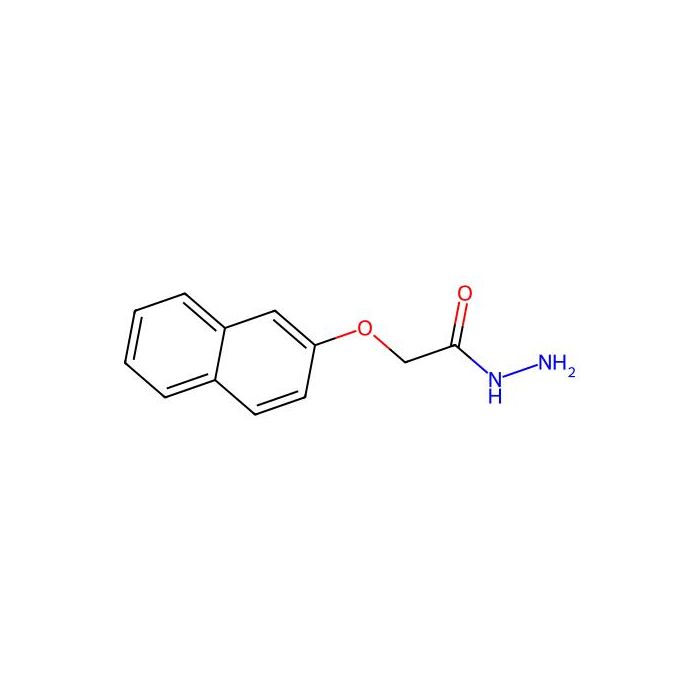
This compound belongs to the class of organic compounds known as naphthalenes. These are compounds containing a naphthalene moiety, which consists of two fused benzene rings.
External Descriptors
Not available
1. Djoumbou Feunang Y, Eisner R, Knox C, Chepelev L, Hastings J, Owen G, Fahy E, Steinbeck C, Subramanian S, Bolton E, Greiner R, and Wishart DS. ClassyFire: Automated Chemical Classification With A Comprehensive, Computable Taxonomy. Journal of Cheminformatics, 2016, 8:61.
Determine the necessary mass, volume, or concentration for preparing a solution.
Dilution Calculator
Determine the dilution needed to prepare a stock solution.
Reconstitution Calculator
Revisões
Avaliações dos Clientes
Application Protocols
No validated bioassay or immunoassay protocols are provided for this item in the Product Data. As a small-molecule building block, protocols are reaction-specific.
General example (literature) for hydrazone formation:
Dissolve carbonyl partner (1.0 eq) and 2-(2-naphthyloxy)acetohydrazide (1.1–1.5 eq) in EtOH/AcOH/H2O (e.g., 80:5:15 v/v/v) to a 10–50 mM concentration.
Stir at room temperature to 50 °C for 1–3 h; monitor by TLC (EtOAc/hexanes or MeOH/DCM) or LC–MS.
Quench with saturated NaHCO3, extract with EtOAc, wash, dry (Na2SO4), and concentrate. Purify by crystallization or silica gel chromatography.
For cyclodehydrations or couplings, consult the Reaction Conditions tab and adapt to your substrate set. Always perform preliminary solubility tests and small-scale trials.
Biological Roles
This product is a synthetic small-molecule reagent; no intrinsic biological role is claimed for the item.
General/literature context for acyl hydrazides:
Bioconjugation handle: Hydrazides react with aldehyde/ketone groups on oxidized glycans (e.g., periodate-oxidized carbohydrates) or aldehyde-tagged biomolecules to form hydrazones, enabling labeling or immobilization workflows under mild, aqueous conditions.
Reversible linkage: Hydrazone bonds can be hydrolytically reversible, with rates tunable by pH and anilinium catalysts; this underpins dynamic covalent chemistry in biochemical assemblies.
Metal coordination: Hydrazones derived from hydrazides can chelate transition metals, useful for constructing metallo-supramolecular structures or probes (application-dependent; no item-specific claims).
Important notes:
Any use with biological specimens should be validated for compatibility (buffer, pH, ionic strength). Avoid making therapeutic or diagnostic inferences—this product is for research use only (per Product Data).
Buffer Applications
While this compound itself is not a buffering agent, buffers are often used in its key transformations (literature guidance):
Hydrazone formation: Efficient between pH 4.5–6.0. Common buffers: 50–100 mM sodium acetate (pH 4.5–5.5) or citrate (pH 5–6). Add 1–10% MeOH/EtOH as cosolvent to enhance solubility of aromatic partners.
Catalysis: Small amounts of acetic acid (0.5–5% v/v) in aqueous alcohols can accelerate condensations with aldehydes/ketones. Aniline catalysts (10–50 mM) are sometimes employed for faster rates at near-neutral pH.
Typical recipe (example, literature): 0.1 M NaOAc, pH 5.2; dissolve substrates with 10–30% EtOH; react at rt–37 °C for 1–4 h (monitor by TLC/HPLC). Adjust organic content for solubility.
Notes:
Avoid strong basic buffers during storage or prolonged handling, as hydrazide hydrolysis or side reactions may increase.
For bioconjugation, ensure removal of excess aldehyde-generating oxidants (e.g., periodate) prior to reaction with hydrazide to prevent undesired side reactions.
Green Alternatives
Greener choices focus on solvent and reagent selection, as the substrate is fixed.
Greener solvent options (literature guidance):
Prefer EtOH or i-PrOH over DMF/DMSO when conducting hydrazone formation or simple derivatizations; add water (10–50%) and catalytic AcOH to accelerate.
Use MeCN as a more volatile alternative to DMF where solubility allows, improving workup and reducing energy for solvent removal.
Consider 2-MeTHF or CPME as greener ethers for extractions/workups instead of DCM/toluene when compatible.
Comparison (typical trade-offs):
EtOH/H2O: high EHS profile, easy removal; may need heat or longer times for poorly soluble aromatic hydrazides.
MeCN: good balance of polarity/volatility; less solvating for strongly H-bonding substrates than DMF/DMSO.
DMF/DMSO: superior solubility; higher toxicity/energy burden and challenging removal.
Reagent choices:
For dehydrations/cyclizations, explore CDI, T3P, or Burgess reagent as alternatives to harsher reagents (POCl3, SOCl2), balancing safety with yield.
For couplings to form diacyl hydrazides, favor EDC·HCl in aqueous alcohols (with NHS or HOAt alternatives per safety policies) to reduce halogenated solvent use.
Process intensification:
Microwave heating in green solvents (EtOH, MeOH) can shorten reaction times for condensations, reducing energy consumption.
Solventless grinding with catalytic acid has been reported for some aromatic hydrazone formations (case-by-case feasibility).
Pharmaceutical Uses
No pharmacopeial or excipient status is provided for this item. It is offered for research use only.
General (literature) relevance:
Synthetic intermediate: Acyl hydrazides are frequent intermediates en route to heterocycles (e.g., 1,3,4-oxadiazoles) and as handles for late-stage diversification of aromatic ethers like 2-naphthyloxyacyl frameworks.
Conjugation/linkers: Hydrazides can serve as linkers to aldehyde-bearing polymers or biomacromolecules in formulation research (e.g., matrix attachment, bead functionalization), with no clinical use implied.
Regulatory/process considerations:
For any GMP-related research, obtain a full CoA/Spec Sheet detailing purity, residual solvents, and elemental impurities if required by internal quality systems.
Avoid therapeutic claims; perform extractables/leachables and stability studies if formulating in contact materials. This listing provides no clinical suitability assertion.
Physical Properties
Item-specific physicochemical specifications (mp, bp, density, solubility, UV cutoff) are not provided in the Product Data for this SKU.
Appearance: Not specified for this item; refer to CoA/Spec Sheet.
Grade/Purity: Not specified for this item; refer to CoA/Spec Sheet.
Literature/general values and behavior (for guidance only):
Acid–base behavior: Amide N is weakly basic; terminal –NH2 of hydrazide can be protonated in strong acid (pKa values for acyl hydrazides typically <4 for conjugate acid; literature, compound-specific pKa not established).
Polarity/H-bonding: Multiple H-bond donors/acceptors; generally exhibits limited solubility in nonpolar media and improved solubility in polar protic/aprotic solvents (e.g., alcohols, DMSO, DMF; literature trends for acyl hydrazides).
Partitioning: Expected moderate polarity due to hydrazide; logP not established for this specific compound (literature value not confirmed).
Notes for handling based on chemical class (literature):
Thermal behavior: Acyl hydrazides are typically solids with melting points often 120–220 °C, but the exact mp for this compound is not specified; refer to CoA/Spec Sheet.
Solubility guidance: Stock solutions commonly prepared in DMSO or DMF; partial solubility in ethanol/methanol possible depending on purity and crystal form.
Quality and Grades
Grade/Purity: Not specified for this item; refer to CoA/Spec Sheet.
Stabilizers/antioxidants: Not specified for this item; refer to CoA/Spec Sheet.
Guidance on interpreting grades (general):
Analytical/Reagent grade: Suitable for most synthetic applications; typical impurity controls but not guaranteed for trace analyses.
HPLC grade (if applicable): Emphasizes low UV background and particulate matter, important for chromatographic use (less relevant to this solid building block unless used as standard).
Assay reporting: Hydrazides may be assayed by HPLC/LC–MS with purity reported as area%; confirm water and residual solvent levels on the CoA when critical for moisture-sensitive steps.
Item-specific recommendations:
For coupling, cyclizations, and hydrazone-forming workflows, request the CoA for assay, residual solvents, and (if available) water content by Karl Fischer when moisture sensitivity is a concern. If trace metals or peroxide content are relevant to your process, verify with the Spec Sheet; otherwise, standard organic-grade controls are typically sufficient for this class of reagent.
Reaction and Applications
This naphthyl ether acyl hydrazide is a versatile synthon for condensation, acyl transfer, and heterocycle formation. Key application families (literature):
Hydrazone/azomethine formation: Rapid condensation with aldehydes/ketones to give hydrazones; useful for reversible bioconjugation to aldehyde-tagged biomolecules or for carbonyl capture/purification. Catalyzed by AcOH or buffer at pH ~4.5–6; water/MeOH/EtOH commonly used.
Cyclodehydration to 1,3,4-oxadiazoles: Intramolecular or intermolecular dehydrative cyclization of acyl hydrazides with carboxylic derivatives affords 1,3,4-oxadiazoles (e.g., via POCl3, SOCl2, Burgess reagent, or CDI-mediated routes). The 2-naphthyloxyacetyl fragment can be preserved as an aryl substituent.
Acylation/derivatization: The terminal –NH2 can be acylated, sulfonylated, or carbamoylated to access diacyl hydrazides, ureas, semicarbazides, or imide-like derivatives.
Heterocycle annulations: Condensation with carbonyl di- or polyfunctional partners enables formation of pyrazoles or triazines after appropriate activation (multi-step sequences).
Ligand/chelation roles: Hydrazide-derived hydrazones act as N,O- or N,N-donors for coordination complexes; the naphthyl group enhances hydrophobic and π-stacking interactions in supramolecular assemblies.
Protecting/anchoring strategies: The hydrazide can serve in reversible protection of aldehydes (hydrazone protection) or in linker strategies where cleavage/regeneration is desired.
Practical notes:
Ensure substrates and glassware are free of trace carbonyl contaminants if undesired hydrazone formation must be avoided.
Control water content: traces can be beneficial for condensation but detrimental for dehydrations; select solvent accordingly.
Reaction Conditions
General, literature-based guidance (optimize per substrate; no item-specific specs assumed):
Hydrazone formation:
Solvent: EtOH/H2O (1:1 to 9:1), MeOH, or acetate buffer (pH 4.5–6.0) with 0.5–5% AcOH.
Temperature/time: rt–60 °C, 0.5–4 h (monitor by TLC/HPLC).
Typical workup: Direct filtration/crystallization or aqueous quench, extract with EtOAc, wash, dry, and concentrate.
Reagents: POCl3 (neat or in DCM/DMF), SOCl2, CDI, or T3P.
Solvent: DCM, toluene, or DMF depending on reagent; DMF often used catalytically with POCl3.
Temperature/time: 0 °C to reflux (e.g., 60–110 °C), 1–16 h.
Notes: Control stoichiometry and base (e.g., pyridine) to minimize overacylation.
Acylation to diacyl hydrazides:
Reagents: Acyl chlorides or coupling agents (EDC/HOBt alternatives; observe current safety guidance regarding additives).
Solvent: DCM, DMF, or EtOAc; base: DIPEA or pyridine.
Temperature/time: 0–25 °C, 1–3 h typical.
N-alkylation (careful to avoid overreaction):
Base: NaH or K2CO3 (substrate-dependent), solvent DMF/MeCN; 0–25 °C.
Expected yields vary widely (50–90% typical for clean condensations; literature). Always perform small-scale optimization and confirm compatibility of the 2-naphthyloxy ether with conditions (generally robust).
Safety and Handling
Hazard classifications are not provided in the Product Data for this SKU. Always consult the SDS for authoritative safety information.
GHS signal word/pictograms/H-statements: Not specified for this item; refer to SDS.
Likely hazards by functional class (general literature guidance): acyl hydrazides can cause irritation to skin, eyes, and respiratory tract; avoid inhalation of dust and contact with skin/eyes.
Best practices (general lab safety):
PPE: Lab coat, safety glasses or goggles, and appropriate chemical-resistant gloves (e.g., nitrile). Handle in a fume hood to minimize exposure to dust or vapors from solvents.
Incompatibilities: Strong oxidizers; strong acids/bases may lead to decomposition or hydrolysis. Hydrazide moiety can react with aldehydes/ketones—avoid unintended contact with carbonyl-containing reagents during storage/handling.
First aid (overview): If inhaled—move to fresh air; if on skin—wash with soap and water; if in eyes—rinse cautiously with water for several minutes; if ingested—rinse mouth and seek medical advice. Follow SDS instructions.
Spill response: Avoid dust formation; collect solids with minimal disturbance; absorb solvent residues with inert material. Dispose of according to local regulations.
Thermal/chemical stability: Generally stable under ambient conditions; avoid prolonged exposure to moisture and strong light to limit hydrolysis or discoloration (literature). Defer to SDS for decomposition hazards.
Research Use: For research use only (per Product Data).
Solvent Selection
As a polar, hydrogen-bonding acyl hydrazide, this compound typically dissolves best in polar solvents. Item-specific solubility is not provided; the following are literature-based guidelines for this class:
Polar aprotic: DMSO, DMF, and NMP often provide excellent solubility for stock solutions and reactions (couplings, cyclizations). MeCN may dissolve modestly depending on loading and temperature.
Polar protic: Methanol and ethanol can be suitable for hydrazone/oxime formations and recrystallizations; water solubility is variable and may be limited due to the naphthyl core.
Nonpolar/medium polarity: Poor solubility is expected in hexanes, toluene, or CPME unless cosolvents are used.
Selection tips (general):
For hydrazone formation with aldehydes/ketones: aqueous ethanol, methanol, or acetate buffer/MeOH mixtures, pH ~4.5–6 (literature), often with catalytic acid (AcOH).
For cyclodehydration to 1,3,4-oxadiazoles: polar aprotics (POCl3-mediated, or EDCI/Deoxo-Fluor-type dehydrations) frequently used with controlled temperatures.
For amide couplings/derivatizations: DMF or DCM/DMF mixtures with carbodiimides (EDC/DIC) or uronium salts (HATU/HBTU) facilitate activation.
Practical comparison (literature trends):
DMSO/DMF: highest solubilizing power; challenging removal and EHS concerns.
MeOH/EtOH: greener, easy workup; may require warming or higher volumes.
MeCN: balance of volatility and polarity; check solubility before scale-up.
Storage and Reconstitution
Storage temperature (Product Data): Room temperature.
Shipped in: Not specified for this item; refer to CoA/Spec Sheet.
Appearance: Not specified for this item; refer to CoA/Spec Sheet.
Storage guidance (general for acyl hydrazides):
Keep container tightly closed in a dry, well-ventilated place. Use a desiccant to minimize moisture uptake. Protect from strong light and incompatible reagents (oxidizers, strong acids/bases).
Avoid prolonged exposure to airborne carbonyl contaminants that could slowly form hydrazones.
Reconstitution/preparation of stock solutions (general):
Prepare concentrated stocks in DMSO or DMF (e.g., 10–100 mM), or in EtOH/MeOH if solubility allows. For bioconjugation in buffers, dissolve in a small volume of alcohol or DMSO, then dilute into buffer (final organic 1–10%).
Filter sterilize through 0.22 µm if sterility is required for downstream biological assays (research use only).
Store solutions refrigerated (2–8 °C) when feasible and use freshly when possible; hydrazone formation or slow hydrolysis can occur over time in solution. Discard if precipitation, discoloration, or significant degradation is observed.
Always refer to the latest CoA/Spec Sheet and SDS for item-specific guidance.
Structure and Identity
A naphthyl-derived acyl hydrazide featuring a 2-naphthyloxyacetic backbone terminated with a hydrazide (–CONHNH2), useful as a bifunctional building block for condensation and cyclization chemistry.
Product name (SKU): 2-(2-Naphthyloxy)acetohydrazide (N1071750)
CAS: 36304-47-9
PubChem CID: 720883 (literature)
InChIKey: Not specified for this item; refer to CoA/Spec Sheet.
SMILES: NNC(=O)COc1ccc2ccccc2c1 (literature)
Molecular formula: C12H12N2O2 (literature)
Molecular weight: ~216.24 g/mol (literature)
Structural features (descriptive):
Aromatic system: Fused bicyclic naphthalene ring, substituted at the 2-position.
Linker: Ether oxygen bridges the naphthalene to a methylene–carbonyl unit (–O–CH2–C(=O)–).
Terminal functionality: Hydrazide (–CONHNH2), providing two nitrogen donors (one amide, one hydrazino) capable of nucleophilic condensation (hydrazone formation) and metal coordination.
2D topology (words): Naphthalene ring bound via an ether oxygen to a –CH2–CO– group, which is further connected to –NH–NH2; planar aromatic core with a flexible, polar tail.
Synthetic Utility
Functional groups and reactivity (literature):
Hydrazide (–CONHNH2): Nucleophilic terminal –NH2 condenses with carbonyls to give hydrazones; can be acylated/sulfonylated; participates in cyclodehydrations to heterocycles.
Aryl ether (2-naphthyloxy–): Electron-rich aromatic system enables π–π interactions and can modulate reactivity; withstands many coupling and condensation conditions.
Representative transformations:
Hydrazone formation with aldehydes/ketones (AcOH catalysis, EtOH/H2O, rt–60 °C).
1,3,4-Oxadiazole synthesis via dehydrative cyclization with carboxylic acids/derivatives (POCl3, SOCl2, CDI, or T3P conditions), installing the naphthyloxy substituent on the heteroaromatic ring.
Urea/semicarbazide analogs via reaction with isocyanates or carbamoyl transfer reagents.
Diacyl hydrazides by acylation with acyl chlorides or activated esters; subsequent cyclizations yield imides or heterocycles.
N–N functionalizations: Formation of azocarboxamides or N-alkylated hydrazides under controlled conditions.
Retrosynthetic value:
The substrate provides a convergent point where the aromatic ether is pre-installed; downstream diversity is introduced at the hydrazide nitrogen(s) or via cyclization, enabling late-stage scaffold diversification without perturbing the naphthalene ether.
Target Specificity
Not applicable. This product is a small-molecule reagent, not a biological targeting agent or antibody. No antigen, epitope, or species reactivity information applies to this item.
Perguntas frequentes
What is the purity of this product?
This product is supplied at ≥97% purity (chemical assay). Lot-specific values are stated on the Certificate of Analysis.
How should this product be stored?
Store at room temperature.
What are the CAS number, molecular formula and molecular weight?
The CAS Number is 36304-47-9, the molecular formula is C12H12N2O2, and the molecular weight is 216.24 g/mol. InChIKey QSMAUHGVXYUJKN-UHFFFAOYSA-N.
What documentation is provided?
Available product documentation, including Certificates of Analysis (COA), Safety Data Sheets (SDS), and specification sheets, is shown in the product document area. Document availability and access follow the current site policy.
Usamos cookies para garantir o funcionamento adequado do site e, quando permitido, para melhorar a sua experiência. Você pode gerenciar suas preferências a qualquer momento nas Configurações. Saiba mais em nossa Política de Cookies.
Deseja que lhe enviemos uma mensagem quando tivermos descontos disponíveis?
Lembrar-me mais tarde
Obrigado! Por favor, verifique a sua caixa de entrada de e-mail para confirmar.
Products are supplied to verified businesses, institutions, and qualified professionals for research and development use only. Not for use in humans, animals, diagnosis, or therapy.