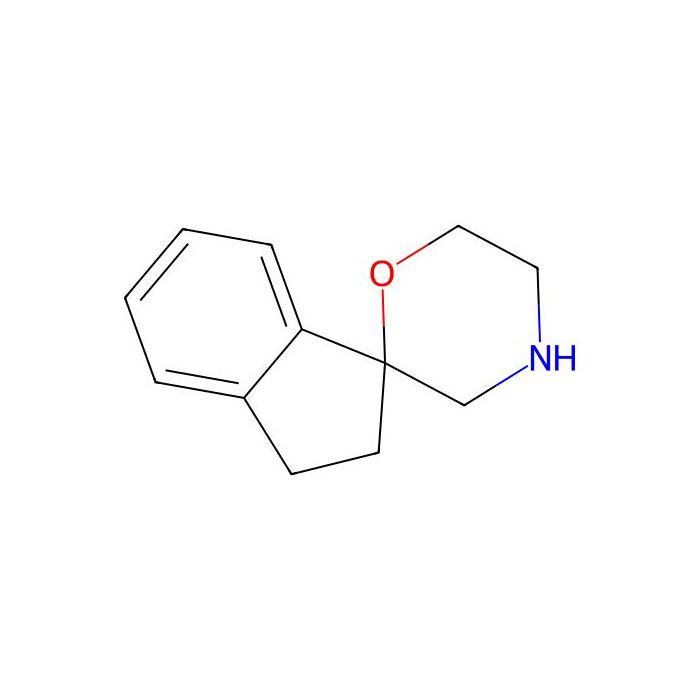
This compound belongs to the class of organic compounds known as indanes. These are compounds containing an indane moiety, which consists of a cyclopentane fused to a benzene ring.
External Descriptors
Not available
1. Djoumbou Feunang Y, Eisner R, Knox C, Chepelev L, Hastings J, Owen G, Fahy E, Steinbeck C, Subramanian S, Bolton E, Greiner R, and Wishart DS. ClassyFire: Automated Chemical Classification With A Comprehensive, Computable Taxonomy. Journal of Cheminformatics, 2016, 8:61.
Determine the necessary mass, volume, or concentration for preparing a solution.
Dilution Calculator
Determine the dilution needed to prepare a stock solution.
Reconstitution Calculator
Revisões
Avaliações dos Clientes
Application Protocols
No tested biological application protocols are provided for this item. As a small-molecule building block, usage is highly context-dependent.
General lab handling suggestions (non-binding guidance):
For biochemical testing, prepare 10–100 mM stocks in DMSO, filter (0.22 μm PTFE), and store aliquots at −20 °C to minimize freeze–thaw.
For synthetic use, confirm identity/purity by NMR and LC–MS upon receipt; adjust purification conditions (e.g., basic additives) to minimize amine tailing.
For any specific application (e.g., coupling, derivatization, or assay setup), refer to peer-reviewed procedures and optimize conditions accordingly.
Biological Roles
Item-specific biological roles are not provided for this compound. As a small-molecule, spirocyclic heterocycle, 2,3-dihydrospiro(indene-1,2′-morpholine) is primarily used as a research building block rather than a biochemical reagent.
General context (no medical claims):
Spirocyclic scaffolds are valued in medicinal chemistry due to their 3D shape, conformational restriction, and potential to improve ligand efficiency and physicochemical balance. Morpholine is a common basic, polar handle used to modulate solubility and permeability in screening libraries.
The secondary amine permits salt formation, which can improve aqueous compatibility for in vitro assays; however, any biological activity would be entirely dependent on additional substituents and target class and is not established for this parent scaffold.
The indane fragment provides an aromatic pharmacophore with benzylic positions amenable to diversification, enabling structure–property exploration.
If employing this compound in biochemical contexts (e.g., fragment-based screening or probe synthesis):
Confirm purity and counterion state (free base vs salt) to ensure reproducible assay conditions.
Evaluate nonspecific binding by including detergent controls and measuring aggregation propensity (e.g., DLS, orthogonal assays) as with any hydrophobic-containing fragment.
For any intended biological testing, follow institutional review and obtain appropriate approvals. This product is supplied strictly for research use only.
Buffer Applications
This compound is not a standard buffering reagent. While the morpholine nitrogen is basic, 2,3-dihydrospiro(indene-1,2′-morpholine) is used as a synthetic building block rather than a defined acid/base pair for buffering.
If aqueous handling is required (e.g., in bioassays), prepare stocks in DMSO or MeOH and dilute into a pre-selected biological buffer (e.g., PBS, HEPES) compatible with your assay.
For pH control, use established buffers (e.g., HEPES, MOPS, phosphate). This compound should not be relied upon for buffering capacity.
Refer to other sections (Solvent Selection, Storage & Reconstitution) for practical handling guidance.
Green Alternatives
While the compound itself is a building block (no direct "greener substitute"), greener choices can be made for its transformations and handling.
Greener solvent options (vs common incumbents):
Replace DCM/chloroform with ethyl acetate, 2-MeTHF, or cyclopentyl methyl ether (CPME) where compatible.
Use MeCN or ethanol instead of DMF/NMP when reaction scope permits; consider propylene carbonate for polar aprotic needs.
Favor aqueous micellar catalysis (e.g., TPGS-750-M) for certain couplings/alkylations to reduce organic solvent use.
Comparison snapshot (general guidance):
DCM vs 2-MeTHF: lower toxicity and renewable origin for 2-MeTHF; note water miscibility and potential peroxide formation in ethers—monitor and stabilize as needed.
DMF/NMP vs MeCN/EtOH: reduced reproductive toxicity profile but potentially altered solvation properties; may require catalyst/condition re-optimization.
Process intensification:
Solvent recycling (distillation, in-line purification) to minimize waste.
Catalyst loading reduction and flow chemistry to enhance heat/mass transfer and reduce solvent volumes.
Waste and EHS:
Segregate amine-containing waste; neutralize acids/bases prior to disposal per institutional SOPs.
Prefer salt formation for safer handling/shipping if volatility/odor present (general amine practice).
Note: Always validate reaction performance after solvent swaps; report E-factors and solvent usage in method development records to drive continuous improvement.
Pharmaceutical Uses
No pharmacopeial or excipient status is indicated for this item; it is offered for research use only.
General formulation/context notes (non-clinical, discovery-stage):
Scaffold for lead optimization: Spirocyclic morpholine motifs are frequently employed in medicinal chemistry campaigns to balance solubility and target engagement; however, this listing makes no claims about activity or suitability as a drug substance.
Salt screening (pre-formulation research): If evaluating physicochemical properties, form mineral acid (HCl, HBr) or organic acid (mesylate, tosylate) salts to explore solubility, hygroscopicity, and crystallinity—purely for research characterization.
Analytical characterization: Determine pKa (potentiometric), logD (shake-flask or chromatographic methods), and polymorphism (PXRD) as part of property profiling in discovery support.
Important: This product is not intended for human or veterinary use, and no therapeutic claims are made or implied. All work should remain within the bounds of laboratory research.
Physical Properties
Item-specific specifications (from Product Data):
Appearance: Not specified for this item; refer to CoA/Spec Sheet.
Molecular Formula: Not specified for this item; refer to CoA/Spec Sheet.
Molecular Weight: Not specified for this item; refer to CoA/Spec Sheet.
Boiling/Melting Point, Density, Refractive Index, UV cutoff, water/peroxide/metal limits: Not specified for this item; refer to CoA/Spec Sheet.
General/literature-based expectations for this scaffold (for context, not specifications):
Physical state: Many spirocyclic indane–morpholine derivatives are crystalline solids or low-melting solids; oils are also possible depending on substitution and purity (literature, varies by lot and form).
Acid–base behavior: Contains a secondary amine (pKaH of morpholine conjugate acids typically ~8.3–8.6, literature for morpholine family), enabling formation of bench-stable salts (e.g., HCl, TsOH).
Polarity/solubility: Expected good solubility in polar aprotic organic solvents (DMSO, DMF, acetonitrile) and chlorinated solvents; moderate in ethyl acetate/THF; limited in alkanes. Free base may have modest water solubility; salt forms enhance aqueous solubility (general behavior of morpholine-containing heterocycles).
Partitioning: Spirocyclic, partially saturated ring system with one heteroatom each of N and O suggests intermediate lipophilicity for the free base and higher hydrophilicity for salts (qualitative guidance).
Note: Use these qualitative points to guide method development. For exact values governing chromatography, formulation, or process design, consult the item’s CoA/Spec Sheet.
Quality and Grades
Item-specific grade/purity:
Grade/Purity: Not specified for this item; refer to CoA/Spec Sheet.
How to interpret common grades (general guidance):
Research grade: Suitable for discovery chemistry, method development, and general synthesis. Impurity profiles may vary slightly by lot; refer to CoA for assay and key impurities.
>95–98% assay (typical for building blocks): Supports most library synthesis and SAR studies; verify by NMR/LC–MS in-house if critical.
High-purity or HPLC grade (when applicable): Lower nonvolatile residue and UV-absorbing impurities, beneficial for photophysical or analytical applications.
Stabilizers/format considerations:
Stabilizers: None indicated for this item. If present in a specific lot, they will be listed on the CoA and may impact certain reactions (e.g., base- or acid-sensitive steps).
Salt vs free base: This listing appears to refer to the free base unless stated otherwise. If your application requires a defined counterion or enhanced aqueous solubility, consider preparing or requesting a salt (e.g., HCl, mesylate) and confirm by CoA.
Quality control best practices:
Verify identity by 1H/13C NMR and HRMS; confirm the spiro center connectivity (e.g., via HMBC/NOESY if needed).
Check chromatographic purity (LC–MS/UPLC) and residual solvents by GC.
For chiral applications, determine enantiomeric composition (if relevant) by chiral HPLC; material may be racemic unless otherwise specified.
Reaction and Applications
As a spirocyclic indane–morpholine scaffold, 2,3-dihydrospiro(indene-1,2′-morpholine) is a versatile building block for discovery chemistry, enabling vectorization from the nitrogen, the aromatic ring, and benzylic positions.
Alkylation (SN2) with alkyl halides under basic conditions (K2CO3/MeCN, DMF) to access tertiary amines.
Acylation and sulfonylation with acyl/sulfonyl chlorides in the presence of base (Et3N, DIPEA) for amides/sulfonamides.
Reductive amination using aldehydes/ketones with NaBH3CN or BH3–THF.
Aromatic derivatization of the indane ring:
Electrophilic aromatic substitution (nitration, halogenation, Friedel–Crafts acylation) with regioselectivity influenced by the spiro center and ring electronics.
Cross-coupling after prefunctionalization (e.g., convert to aryl bromide/boronate via directed metallation then Negishi/Suzuki).
Benzylic chemistry: Oxidation to ketones/acids (e.g., KMnO4, SeO2, or catalytic oxidations) or bromination (NBS) to install handles for subsequent substitution.
Salt formation: Protonation (HCl, HBr, MsOH) to create crystalline salts for purification, resolution, or solubility modulation.
Practical tips:
The secondary amine can coordinate to metals; for cross-couplings, consider protecting (Boc, Cbz) or employing ligand/catalyst systems tolerant of free amines.
Use additives (Et3N) in silica chromatography to minimize tailing.
For SAR libraries, vary N-substituents and aryl substitution to access orthogonal property space while retaining the rigid spiro geometry favored in conformational design.
Reaction Conditions
General literature-style conditions for typical transformations of morpholine-containing spirocycles (guidance only; optimize for your substrate):
N-Alkylation (tertiary amine formation): K2CO3 (2–3 equiv), alkyl bromide/iodide (1.1–1.5 equiv), MeCN or DMF, 50–80 °C, 2–16 h. Monitor by LC–MS. Avoid overalkylation by controlling stoichiometry.
N-Acylation / N-Sulfonylation: Acyl chloride or sulfonyl chloride (1.1–1.3 equiv), Et3N or DIPEA (2–3 equiv), DCM or THF, 0 °C to rt, 1–4 h. Alternatively, use EDCI/HOBt or acid anhydrides for milder conditions.
Reductive amination: Aldehyde/ketone (1.0–1.5 equiv), NaBH3CN (1.5–2.0 equiv) or NaBH(OAc)3 (3 equiv) in MeOH/THF with AcOH (catalytic), rt to 40 °C, 4–16 h.
Benzylic bromination: NBS (1.1 equiv), AIBN (cat.), CCl4 or safer alternatives (PhH, MeCN), reflux or hv, 2–6 h. Quench carefully and purify rapidly to minimize side reactions.
Aromatic halogenation (for cross-coupling handles): NBS/NCS (1.1–1.5 equiv) in AcOH or DMF, 0–25 °C, 1–3 h; or electrophilic iodination (I2/HIO3 variants). Assess regioselectivity experimentally.
Suzuki–Miyaura coupling (after aryl bromide formation): Aryl–Br (1.0 equiv), aryl/alkenyl boronate (1.2–1.5 equiv), Pd(PPh3)4 (1–3 mol%), K2CO3 (2–3 equiv), dioxane/H2O or MeOH/H2O, 60–90 °C, 2–12 h.
Directed ortho metalation: s-BuLi (1.1–1.3 equiv) with a suitable directing group installed; THF, −78 to −40 °C, then electrophile quench (CO2, DMF, B(OiPr)3). Protect the amine if needed to prevent deprotonation/chelation.
Workup and purification:
Protonate amines for aqueous workup (dil. HCl), wash organics, then basify and extract to recover the free base.
For silica chromatography, include 0.1–1% Et3N or use neutralized silica to mitigate tailing.
All values are typical literature ranges and must be tailored to your exact substrate and scale.
Safety and Handling
Item-specific hazard details:
GHS Classification, Signal Word, Pictograms, H-Statements: Not specified for this item; refer to SDS.
General laboratory safety guidance for morpholine-containing spirocyclic amines (informational only—consult SDS for authoritative instructions):
PPE: Wear lab coat, safety glasses or splash goggles, and appropriate chemical-resistant gloves (e.g., nitrile). Use within a fume hood to avoid inhalation of dust/vapors/aerosols.
Incompatibilities: Avoid strong oxidizers and strong acids/bases during storage. Amines can react with acid chlorides/anhydrides and may absorb CO2 to form carbamates; keep containers tightly closed.
First aid overview: In case of skin or eye contact, rinse with water for ≥15 minutes; remove contaminated clothing. If inhaled, move to fresh air. If ingested, rinse mouth—do not induce vomiting; seek medical attention. Always follow your institution’s EHS protocols.
Spill response: Contain solids with inert absorbent, avoid dust generation, collect for disposal per local regulations. For solutions, dike and absorb. Ventilate area and wash residues with suitable solvent followed by detergent/water as appropriate.
Thermal/chemical stability: Spirocyclic amines are generally stable under ambient conditions. No specific peroxide-formation hazard is expected (unlike ethers such as THF); nevertheless, minimize prolonged air/heat exposure.
Always defer to the product-specific SDS for definitive hazard classification, exposure limits, and disposal guidance.
Solvent Selection
This compound is a moderately polar spirocyclic amine–ether. While item-specific solubility is not provided, the following general guidance applies to morpholine-containing spirocycles.
Likely good solvents (method development starting points):
Polar aprotics: DMSO, DMF, NMP, acetonitrile
Ethers/esters: THF, 2-MeTHF, ethyl acetate
Chlorinated: DCM, chloroform
Limited solubility expected in: Hexanes/heptane and other nonpolar alkanes (free base). Aqueous solubility increases upon protonation (salt forms).
Polarity profile: The ether oxygen and secondary amine confer H-bond accepting/donating capacity; the indane ring contributes hydrophobicity. This dual character helps in biphasic extraction strategies (e.g., protonate to move to aqueous phase; basify to back-extract into organic).
Chromatography considerations:
Normal-phase silica: Add 0.1–1% NEt3 to eluents to suppress tailing of basic compounds.
Reversed-phase: Start with MeCN/H2O or MeOH/H2O with 0.1% formic acid or ammonium formate for MS compatibility.
Crystallization/precipitation: Salt formation (e.g., HCl, p-TsOH) can facilitate crystallization from alcohols/ethers and improve handling.
Comparison pointers:
Versus nonpolar aromatics, this scaffold is easier to dissolve in polar aprotics.
Versus highly polar polyamines, it shows better solubility in moderately polar organics and lower water solubility as a free base.
Always confirm final solvent choice empirically for your lot and application.
Storage and Reconstitution
Item-specific storage/shipping:
Storage Conditions: Room temperature (as provided in Product Data). Store in a tightly sealed container, protected from moisture and direct sunlight.
Shipped In: Not specified for this item; refer to CoA/Spec Sheet.
Appearance: Not specified for this item; refer to CoA/Spec Sheet.
General handling/reconstitution (guidance):
If needed, prepare concentrated stocks in DMSO, DMF, MeOH, EtOH, THF, or DCM depending on your downstream application. Verify compatibility with your reaction or assay.
For aqueous use, consider salt formation (e.g., HCl salt) to enhance water solubility; adjust pH as required. Filter solutions through 0.22 μm PTFE (organic) or 0.22 μm PES/nylon (aqueous) before use.
Minimize moisture uptake; amines can absorb CO2/acidic vapors. Use desiccant in storage cabinets where practical.
For long-term storage or sensitive applications, consider aliquoting under inert gas and storing at 2–8 °C or −20 °C to reduce oxidative or hydrolytic risk (optional; not required unless dictated by your process).
Always consult the product’s CoA/SDS for any lot-specific instructions and stability information. Research use only.
Structure and Identity
A spirocyclic nitrogen/oxygen heterocycle joining a 2,3-dihydroindene (indane) framework to a morpholine ring at a shared spiro center. The molecule features an aromatic benzene ring, a saturated five-membered carbocycle (from indane), and a six-membered morpholine ring (containing one O and one secondary amine N). The spiro quaternary carbon links the two rings orthogonally; such spiro centers can be stereogenic, though materials are commonly obtained as racemates unless otherwise specified.
SMILES: Not specified for this item; refer to CoA/Spec Sheet.
Functional group/structural features (general chemistry description):
Aromatic ring (benzene) embedded in an indane scaffold (2,3-dihydroindene).
Morpholine ring (six-membered O-heterocycle) with a secondary amine (–NH–) and an ether oxygen.
Spiro junction at indane C-1 and morpholine C-2′ creating an orthogonal ring arrangement.
Potential basic site (ring nitrogen) amenable to protonation, salt formation, and N-derivatization.
Molecular formula and molecular weight: Not specified for this item; refer to CoA/Spec Sheet.
Synthetic Utility
2,3-Dihydrospiro(indene-1,2′-morpholine) provides a compact, rigid, and vector-rich core for building diversified libraries.
Synthetic “handles” and typical transformations (general guidance):
Nitrogen (morpholine):
N-alkylation (alkyl halides, Mitsunobu variants for challenging alcohols) to install substituents that modulate lipophilicity and basicity.
N-acylation/sulfonylation to afford amides/sulfonamides, tuning HBD/HBA balance and metabolic soft spots.
N-oxidation (m-CPBA) to morpholine N-oxide as a polarity toggle or mechanistic probe.
Aromatic ring (indane benzene):
Electrophilic aromatic substitutions (EAS) for NO2, halogen, or acyl groups; then leverage to cross-couplings (e.g., convert NO2→NH2, then diazotize; or halide for Suzuki/Negishi).
Directed ortho metalation (DoM) strategies may be enabled by neighboring directing effects, followed by quench with electrophiles (CO2, aldehydes, B(OiPr)3).
Benzylic positions (indane side chain):
Radical bromination (NBS, AIBN) to provide a benzylic bromide for SN2/SN1-type diversification.
Oxidation to ketones/acids (e.g., TEMPO/bleach, MnO2, or catalytic aerobic methods) to introduce carbonyl functionality.
Spiro center integrity: Generally robust; avoids isomerization under mild conditions. Protect the amine (Boc, Cbz) when strong bases (e.g., BuLi) are employed for aryl lithiation.
The scaffold’s orthogonality often improves separability of regioisomers and facilitates SAR. It is suitable for parallel synthesis workflows (solid-supported scavengers for amines/acids; catch-and-release purification strategies).
Target Specificity
Not applicable. This product is a small-molecule building block, not a biological macromolecule or affinity reagent. No antigen/epitope, clone, isotype, or species reactivity information applies.
Perguntas frequentes
What is the purity of this product?
This product is supplied at ≥98% purity (chemical assay). Lot-specific values are stated on the Certificate of Analysis.
How should this product be stored?
Store at room temperature.
What are the CAS number, molecular formula and molecular weight?
The CAS Number is 1267983-86-7, the molecular formula is C12H15NO, and the molecular weight is 189.250 g/mol. InChIKey NUSTUPVYQBHZNZ-UHFFFAOYSA-N.
What documentation is provided?
Available product documentation, including Certificates of Analysis (COA), Safety Data Sheets (SDS), and specification sheets, is shown in the product document area. Document availability and access follow the current site policy.
Usamos cookies para garantir o funcionamento adequado do site e, quando permitido, para melhorar a sua experiência. Você pode gerenciar suas preferências a qualquer momento nas Configurações. Saiba mais em nossa Política de Cookies.
Deseja que lhe enviemos uma mensagem quando tivermos descontos disponíveis?
Lembrar-me mais tarde
Obrigado! Por favor, verifique a sua caixa de entrada de e-mail para confirmar.
Products are supplied to verified businesses, institutions, and qualified professionals for research and development use only. Not for use in humans, animals, diagnosis, or therapy.