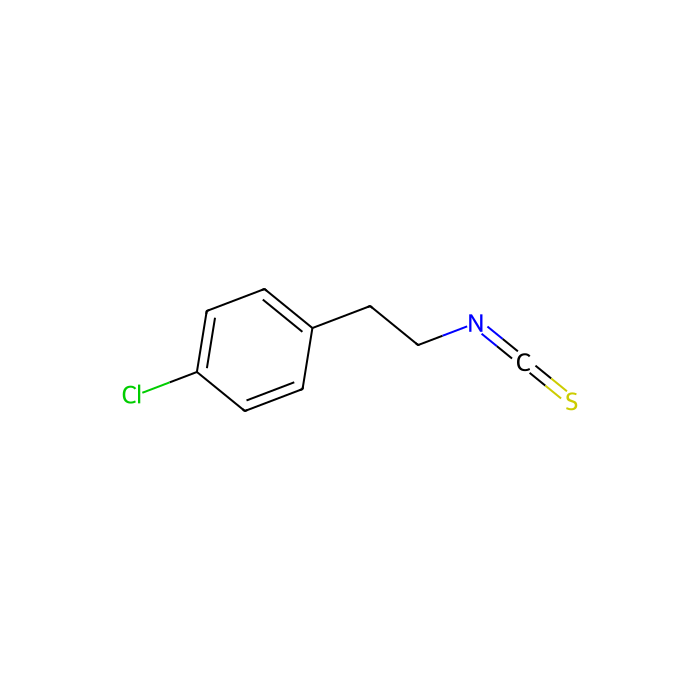
2-(4-Chlorophenethyl)isothiocyanate - ≥97% , CAS No.17608-10-5

CAS: 17608-10-5 Cat. No.: C167956 Fórmula: C9H8ClNS Peso molecular: 197.68 Número CE: 626-109-9
Disponível para encomenda
GRAU & PUREZA ≥97%
Synonyms
2-(4-Chlorophenyl)ethyl isothiocyanate|2-(4-Chlorophenethyl) isothicyanate|Benzene,1-chloro-4-(2-isothiocyanatoethyl)-|2-(4-Chlorophenethyl) isothiocyanate|1-Chloro-4-(2-isothiocyanatoethyl)benzene #|Benzene, 1-chloro-4-(2-isothiocyanatoethyl)-|2-(4-Chlorophenethyl)isothiocyanate|1-Chloro-4-(2-isothiocyanatoethyl)benzene|1-chloranyl-4-(2-isothiocyanatoethyl)benzene
Storage
Store at 2-8°C,Argon charged
Shipped In
Wet ice
★
Tamanho
Alemanha (EU)
USA*
Preço
Qtd
1g
C167956-1g
Sob encomenda · 8–12 semanas
75,41€
5g
C167956-5g
Sob encomenda · 8–12 semanas
307,96€
25g
C167956-25g
Sob encomenda · 8–12 semanas
1232,10€
Enter a quantity for the sizes you want to add.

Especificações

Sinónimos
2-(4-Chlorophenyl)ethyl isothiocyanate | 2-(4-Chlorophenethyl) isothicyanate | Benzene,1-chloro-4-(2-isothiocyanatoethyl)- | 2-(4-Chlorophenethyl) isothiocyanate | 1-Chloro-4-(2-isothiocyanatoethyl)benzene # | Benzene, 1-chloro-4-(2-isothiocyanatoethyl)- | 2-(4-Chlorophenethyl)isothiocyanate | 1-Chloro-4-(2-isothiocyanatoethyl)benzene | 1 Show more
Especificações e pureza
≥97%
Condições de armazenamento de armazenamento
Store at 2-8°C,Argon charged
Enviado em
Wet ice
Este produto requer transporte de cadeia fria. Serviços terrestres e outros serviços econômicos não estão disponíveis.
Pureza
≥97%
Nomes e identificadores
SMILES
C1=CC(=CC=C1CCN=C=S)Cl
IUPAC Name
1-chloro-4-(2-isothiocyanatoethyl)benzene
InChIKey
MRJJYUJULSZFDV-UHFFFAOYSA-N
InChI
1S/C9H8ClNS/c10-9-3-1-8(2-4-9)5-6-11-7-12/h1-4H,5-6H2
SMILES isoméricas
C1=CC(=CC=C1CCN=C=S)Cl
WGK Alemanha
3
Peso molecular
197.68
Reaxys
2719060
Reaxys-RN_link_address
https://www.reaxys.com/reaxys/secured/hopinto.do?context=S&query=IDE.XRN=2719060&ln=

Dados avançados

Taxonomic Classification

Taxonomy Tree

KingdomOrganic compounds
SuperclassBenzenoids
ClasseBenzene and substituted derivatives
SubclassHalobenzenes
Intermediate Tree Nodes Not available
Direct ParentChlorobenzenes
Alternative Parents Aryl chlorides  Isothiocyanates  Propargyl-type 1,3-dipolar organic compounds  Organopnictogen compounds  Organonitrogen compounds  Organochlorides  Hydrocarbon derivatives  
Molecular FrameworkAromatic homomonocyclic compounds
Substituents Chlorobenzene - Aryl halide - Aryl chloride - Isothiocyanate - Organic 1,3-dipolar compound - Propargyl-type 1,3-dipolar organic compound - Organic nitrogen compound - Organopnictogen compound - Hydrocarbon derivative - Organosulfur compound - Organonitrogen compound - Organochloride - Organohalogen compound - Aromatic homomonocyclic compound
DescriçãoThis compound belongs to the class of organic compounds known as chlorobenzenes. These are compounds containing one or more chlorine atoms attached to a benzene moiety.
External Descriptors Not available
Estrutura 3D
Modelo de Estrutura Química Interativa


Mecanismos de ação
Certificados(CoA,COO,BSE/TSE e Mapa de Análise)
C of A & Other Certificates(BSE/TSE, COO):
Analytical Chart:
Propriedades químicas e físicas
SensibilidadeMoisture sensitive
Índice de refraçãon20/D 1.6000
Ponto de inflamação (°F)>230 °F
Ponto de inflamação (°C)>110 °C
Peso molecular197.69
XLogP34.100
Hydrogen Bond Donor Count0
Hydrogen Bond Acceptor Count2
Rotatable Bond Count3
Exact Mass197.007 Da
Monoisotopic Mass197.007 Da
Topological Polar Surface Area44.500 Ų
Heavy Atom Count12
Formal Charge0
Complexity169.000
Isotope Atom Count0
Defined Atom Stereocenter Count0
Undefined Atom Stereocenter Count0
Defined Bond Stereocenter Count0
Undefined Bond Stereocenter Count0
The total count of all stereochemical bonds0
Covalently-Bonded Unit Count1
Segurança e perigos (GHS)
Pictograma(s)
GHS07,   GHS08
Sinal
Danger
Declarações de perigo

H302:Harmful if swallowed

H312:Harmful in contact with skin

H315:Causes skin irritation

H319:Causes serious eye irritation

H332:Harmful if inhaled

H334:May cause allergy or asthma symptoms or breathing difficulties if inhaled

H335:May cause respiratory irritation

Declarações de precaução

P261:Avoid breathing dust/fume/gas/mist/vapors/spray.

P264:Wash hands [and …] thoroughly after handling.

P270:Do not eat, drink or smoke when using this product.

P271:Use only outdoors or in a well-ventilated area.

P280:Wear protective gloves/protective clothing/eye protection/face protection.

P284:[In case of inadequate ventilation] Wear respiratory protection.

P321:Specific treatment (see ... on this label).

P330:Rinse mouth.

P302+P352:IF ON SKIN: wash with plenty of water.

P304+P340:IF INHALED: Remove person to fresh air and keep comfortable for breathing.

P305+P351+P338:IF IN EYES: Rinse cautiously with water for several minutes. Remove contact lenses if present and easy to do - continue rinsing.

P362+P364:Take off contaminated clothing and wash it before reuse.

P405:Store locked up.

P403+P233:Store in a well-ventilated place. Keep container tightly closed.

P501:Dispose of contents/container to an approved waste disposal plant.

P264+P265:Wash hands [and …] thoroughly after handling. Do not touch eyes.

P301+P317:IF SWALLOWED: Get medical help.

P317:Get emergency medical help.

P337+P317:If eye irritation persists: Get medical help.

P332+P317:If skin irritation occurs: Get medical help.

P319:Get medical help if you feel unwell.

P342+P316:If experiencing respiratory symptoms: Get emergence medical help immediately.

WGK Alemanha
3
Reaxys
2719060
Reaxys-RN_link_address
https://www.reaxys.com/reaxys/secured/hopinto.do?context=S&query=IDE.XRN=2719060&ln=
Calculadoras de soluções
Revisões

Avaliações dos Clientes

Application Protocols

No vendor-validated bioassay protocols (e.g., WB, IHC, IF, FC) are applicable to this small‑molecule reagent. For general laboratory use:

  • Small‑molecule synthesis: Combine with the chosen nucleophile in anhydrous solvent under inert atmosphere; monitor by IR/LC–MS; isolate thiourea/thiocarbamate by standard workup and purification.
  • Bioconjugation screening: Prepare a fresh DMSO stock (10–50 mM); add to amine‑containing target in pH 8–9 buffer (≤10% DMSO v/v); incubate 0.5–2 h at rt; quench excess with an amine scavenger; desalt/purify as appropriate.

For any application requiring quantitative performance claims, develop and qualify an in‑house SOP using the specific lot’s CoA and SDS.

Biological Roles

This substance is a synthetic arylalkyl isothiocyanate; it is not a known endogenous metabolite. The following describes general biochemical behavior of isothiocyanates (literature) and should not be construed as clinical or therapeutic claims.

  • Electrophilic reactivity: Isothiocyanates covalently modify nucleophilic residues (e.g., lysine ε‑amines, cysteine thiols) forming thiourea or thiocarbamate linkages. This underlies their frequent use in bioconjugation chemistry.
  • Stability in biological media: The N=C=S group can undergo hydrolysis or adduct formation in aqueous buffers, especially above neutral pH or in the presence of nucleophiles. Mixed aqueous/organic systems (e.g., DMSO stock → buffered media) are commonly used for dosing in biochemical assays.
  • Structural motif: The 4‑chlorophenethyl substituent increases hydrophobicity relative to unsubstituted phenethyl isothiocyanate, which can affect membrane association and protein binding in discovery assays; such effects are context dependent and require empirical validation.
  • Caution: Reactive electrophiles may exhibit nonspecific labeling at high concentrations; employ appropriate controls (e.g., scavenger nucleophiles, time‑dependence profiling) in proteomic or enzyme assays.

All uses are for research purposes only (Product Data: Research Use Only).

Buffer Applications

This compound is not a buffering reagent and is not typically used to prepare defined pH buffer systems. In aqueous work, it is usually introduced from an organic stock (e.g., DMSO/DMF) into pre‑made buffers for bioconjugation or assay purposes. For information on practical media for reactions with this electrophile, see Solvent Selection and Reaction Conditions.

Green Alternatives

Greener considerations focus on solvent choice and waste minimization when employing this reactive electrophile; the molecule itself is a halogenated arylalkyl isothiocyanate and is not readily replaced in structure–activity studies without affecting outcome.

Comparison of common media (general, literature):

  • DCM vs. EtOAc/MeCN:
    • DCM offers fast kinetics and easy workup but is a chlorinated solvent with higher environmental impact.
    • Ethyl acetate and acetonitrile often deliver comparable rates for amine additions and are preferred from a green perspective (EtOAc particularly, due to better biodegradability and lower toxicity).
  • THF vs. 2‑MeTHF/CPME:
    • 2‑MeTHF and CPME provide similar solvation to THF with improved sustainability profiles and better phase separation; both may tolerate water traces while still requiring dryness for isothiocyanates.
  • High‑boiling dipolar aprotics (DMF/DMSO) can be replaced, where feasible, by MeCN/EtOAc or by solvent‑free neat reactions when substrates are liquids/low‑melting solids.

Operational greening:

  • Run at ambient temperature to reduce energy use; many amine additions proceed efficiently at rt.
  • Use stoichiometric balance to minimize unreacted isothiocyanate quench streams; quench with nucleophiles that yield easily separable solids (e.g., aniline → precipitated thiourea) to simplify purification.
  • Consider 2‑MeTHF/EtOAc solvent systems for workup-friendly and lower-impact processing.
Pharmaceutical Uses

No pharmacopeial excipient status or formulation role is specified for this item. This reagent is provided for research use only (Product Data).

General R&D context (literature):

  • Employed as a synthetic intermediate to access thiourea‑containing scaffolds, which are common motifs in medicinal chemistry for H‑bond donor/acceptor tuning and conformational control.
  • The 4‑chlorophenethyl substituent can be used as a lipophilicity/halogen‑bonding vector in SAR exploration when embedded in thioureas, thiohydantoins, or related heterocycles.
  • Not intended for administration; avoid making clinical inferences. For any process development or preclinical use, qualification must be performed with appropriate GMP materials and suitability testing.
Physical Properties

Item-specific numerical specifications (bp, mp, density, refractive index, UV cutoff, residuals) are not provided in the Product Data.

  • Appearance: Not specified for this item; refer to CoA/Spec Sheet.
  • Boiling point / melting point: Not specified for this item; refer to CoA/Spec Sheet.
  • Density / refractive index: Not specified for this item; refer to CoA/Spec Sheet.
  • Water solubility: Expected to be low due to aryl/alkyl framework and isothiocyanate functionality (qualitative, literature expectation for arylalkyl isothiocyanates).
  • Solubility (organic): Generally soluble in common organic solvents (e.g., dichloromethane, ethyl acetate, THF, toluene, acetonitrile, DMF, DMSO) — qualitative guidance based on literature behavior of arylalkyl isothiocyanates.
  • Lipophilicity: Moderate (para-chloro and arylalkyl backbone increase logP relative to unsubstituted alkyl isothiocyanates) — qualitative, literature expectation.

Notes:

  • The isothiocyanate group is electrophilic and moisture/amine reactive; property measurements can be influenced by adventitious hydrolysis or adduct formation if not handled under inert conditions.
  • For definitive numerical values and test methods (e.g., GC assay, water content), consult the CoA/Spec Sheet for this specific lot.
Quality and Grades
  • Grade/Purity: Not specified for this item; refer to CoA/Spec Sheet.

Guidance on interpreting quality for this reagent type:

  • Analytical characterization typically includes NMR, IR (diagnostic N=C=S stretch ~2050–2100 cm⁻¹; literature), and GC/HPLC purity. For isothiocyanates, monitoring for thiourea or amine impurities is important due to nucleophile reactivity.
  • Stabilizers: None are indicated in the Product Data. In general, isothiocyanates are supplied neat without stabilizers. If a stabilizer were present, it could affect downstream nucleophile coupling kinetics and should be reported on the CoA.
  • Headspace/inerting: This item is specified to be argon charged, which helps maintain integrity by excluding moisture and reactive gases and is a positive indicator of care in packaging for reactive electrophiles.
  • Lot-specific specifications: For quantitative attributes such as assay (%), residual solvents, water content, or chromatographic suitability, defer to the lot CoA and specification sheet. Do not assume equivalence with other vendors’ materials due to potential differences in stabilizers, residuals, or impurity profiles.
Reaction and Applications

This electrophilic arylalkyl isothiocyanate is a versatile building block for assembling sulfur-containing urea analogs and heterocycles.

Representative applications (literature/general):

  • Thiourea synthesis: Rapid addition of primary/secondary amines to give N,N′-disubstituted thioureas under mild conditions (rt to 50°C). The para‑chloro phenethyl handle introduces a lipophilic/halogenated motif useful in SAR studies.
  • Isothiocyanate–lysine coupling: Formation of stable thiourea linkages with aliphatic amines in peptides/polymers (organic/aqueous mixed media) by analogy to FITC chemistry; useful for small‑molecule tagging when chromophores are not required.
  • Thiohydantoin and benzothiazolinone synthesis: Cyclization of thioureas with carbonyl equivalents (e.g., CDI) affords heterocycles; the 4‑chlorophenethyl substituent is retained as a tunable side chain.
  • Thiocarbamate formation: Alcohols/thiols add across the N=C=S in the presence of base to provide O‑ and S‑thiocarbamates.
  • Anilide diversification: Sequential amine addition then acylation/alkylation of the thiourea nitrogen furnishes libraries of urea/thiourea analogs.

Practical tips:

  • Use dry, oxygen‑ and moisture‑free conditions; charge/inert the vessel (argon or nitrogen) to match the product’s argon-charged packaging.
  • Add the isothiocyanate last to minimize premature consumption by adventitious nucleophiles.
  • Monitor reactions by IR (N=C=S band ~2050–2100 cm⁻¹, literature) or LC/MS; disappearance of the band signals conversion to thiourea/thiocarbamate.
Reaction Conditions

General conditions for common transformations (literature guidance; optimize per substrate):

  • Thiourea formation (amine additions):

    • Solvent: DCM, EtOAc, MeCN, or THF (anhydrous).
    • Base: Often unnecessary with neutral/secondary amines; for anilines, Et3N or DIPEA (0–1.0 equiv) can accelerate.
    • Temperature: 20–50°C; many reactions complete in 0.5–4 h at rt.
    • Monitoring: IR loss of N=C=S band; TLC/LC–MS.
    • Typical outcome: high conversions with minimal side products; precipitated thioureas may allow filtration isolation.
  • O-/S-thiocarbamate formation (alcohols/thiols):

    • Solvent: THF, toluene, or MeCN.
    • Base/catalyst: Et3N, DBU, or NaH (for hindered alcohols); for thiols, base is often unnecessary.
    • Temperature: 0–25°C for thiols; 25–80°C for alcohols depending on nucleophilicity.
  • Cyclization to thiohydantoins/imidazolinethiones from thioureas:

    • Reagents: CDI, EDC, or POCl3 depending on route.
    • Solvent: DMF/MeCN; 25–80°C.
  • Bioconjugation (amine labeling):

    • Stock: 10–100 mM in DMSO/DMF.
    • Buffer: pH 8–9 carbonate/bicarbonate for faster coupling; minimize exposure time to avoid hydrolysis.
    • Reaction time: 0.5–2 h at rt; quench unreacted isothiocyanate with an amine scavenger.

Always validate conditions on small scale; the argon-charged packaging underscores the need for dryness/inerting during setup.

Safety and Handling

Follow standard precautions for reactive electrophiles. Always consult the SDS for authoritative hazard and first‑aid information for this specific SKU.

  • GHS classification, signal word, H/P statements, pictograms: Not specified for this item; refer to SDS.
  • Likely hazards (literature, for isothiocyanates in general): skin/eye irritation, respiratory irritation, and potential skin sensitization; lachrymatory vapors possible.
  • Reactivity/incompatibilities:
    • Nucleophiles (amines, alcohols, thiols) react to give thioureas/thiocarbamates; avoid contact with amine-containing materials (e.g., some rubbers) and bases when storage is intended.
    • Hydrolysis under moist/basic conditions; exclude moisture and CO2 when feasible.
    • Strong oxidizers may cause exothermic reactions; avoid incompatible oxidants.
  • Handling recommendations:
    • Work in a fume hood; minimize vapor/aerosol exposure.
    • Use appropriate PPE: lab coat, safety glasses, and suitable chemically resistant gloves (e.g., nitrile). Change gloves regularly.
    • Use dry, inert solvents and equipment when weighing or dispensing to limit adventitious reaction.
  • First aid overview (general):
    • Inhalation: move to fresh air; seek medical attention if symptoms persist.
    • Skin/eye contact: rinse immediately with plenty of water for ≥15 minutes; remove contaminated clothing; seek medical advice.
    • Ingestion: rinse mouth; do not induce vomiting; obtain medical attention.
  • Storage (Product Data): Store at 2–8°C, argon charged. Shipments are sent on wet ice.
Solvent Selection

Although this is not a solvent, effective reaction performance depends on choosing appropriate media for isothiocyanate chemistry.

  • Polarity/miscibility considerations (general, literature):
    • Arylalkyl isothiocyanates dissolve well in moderately polar aprotic solvents (DCM, EtOAc, THF, MeCN) and in less polar aromatics (toluene).
    • For bioconjugation or screening, DMSO or DMF stock solutions can be prepared; dilute promptly into aqueous buffers to minimize premature hydrolysis.
  • Choosing solvents by reaction class:
    • Thiourea formation with amines: DCM, EtOAc, or MeCN at rt; DMF for poorly soluble amines.
    • O- or S-thiocarbamate formation with alcohols/thiols: THF or toluene with base (e.g., Et3N) to promote addition.
    • Heterocycle synthesis from in situ thioureas: polar aprotic solvents (DMF/DMSO) often aid cyclization.
  • Moisture sensitivity: Use anhydrous grades; pre-dry glassware. Trace water can reduce assay via hydrolysis to amine/thiocarbamate byproducts.
  • Comparison (general):
    • DCM: fast reactions, easy workup; low bp, halogenated waste.
    • MeCN: good balance of polarity and volatility; compatible with many bases.
    • THF/2-MeTHF: good for strongly basic conditions; ethers may require peroxide checks if stored long term.
    • DMSO/DMF: maximal solubility for polar substrates; challenging removal, consider antisolvent precipitation.
Storage and Reconstitution
  • Storage conditions (Product Data): Store at 2–8°C, argon charged. Shipments are provided on wet ice to maintain low temperature and limit volatilization/reactivity.
  • Container/atmosphere: Keep tightly closed under inert gas (argon or nitrogen). Minimize headspace oxygen and moisture; consider septum caps for repeated access.
  • Light/moisture: Store in a dry, dark place. Protect from ambient humidity; use desiccant in secondary containment if available.
  • Stability notes (general for isothiocyanates): Sensitive to nucleophiles and prolonged exposure to basic conditions; hydrolysis or thiourea formation may occur with trace contaminants. Maintain clean, dry tools and glassware.
  • Reconstitution/stock solutions:
    • Prepare concentrated stocks (e.g., 0.1–1.0 M) in anhydrous DMSO, DMF, MeCN, THF, or DCM as appropriate for the intended reaction.
    • For biochemical use, prepare fresh DMSO stocks immediately before use; avoid repeated freeze–thaw. Aliquot and store at ≤–20°C under inert gas if longer-term stock storage is required.
  • Shelf life: Not specified for this item; refer to CoA/Spec Sheet.

Always refer to the SDS and the lot-specific CoA for authoritative guidance on stability, handling, and safe use.

Structure and Identity

A para-chloro-substituted phenethyl isothiocyanate featuring an electrophilic –N=C=S group appended to a 4-chlorophenethyl scaffold.

  • Synonyms: 4-chlorophenethyl isothiocyanate; p-chlorophenethyl isothiocyanate
  • CAS: 17608-10-5 (Product Data)
  • PubChem CID: 140257 (Product Data)
  • InChIKey: Not specified for this item; refer to CoA/Spec Sheet.
  • SMILES: Not specified for this item; refer to CoA/Spec Sheet.
  • Molecular formula: C9H8ClNS (literature)
  • Molecular weight: ~197.68 g/mol (literature)

Structural features (descriptive):

  • Aromatic ring: monosubstituted para-chlorobenzene bearing a benzylic –CH2–CH2– tether.
  • Functional group: terminal isothiocyanate (–N=C=S) attached via nitrogen to the ethyl chain (…–CH2–CH2–N=C=S).
  • Substituent pattern: chlorine at the para position relative to the ethyl side chain on the phenyl ring.
  • No stereocenters; planar aryl core with a flexible two-carbon linker to the linear N=C=S functionality.

2D description in words: a 4-chloro phenyl ring bonded at the para position to a –CH2–CH2– chain, which terminates in an isothiocyanate group, N doubly bonded to C and singly bonded to the ethyl carbon; the isothiocyanate carbon is doubly bonded to sulfur.

Synthetic Utility

Key functional group: isothiocyanate (–N=C=S), a soft electrophile that undergoes nucleophilic addition with amines, alcohols, and thiols to deliver sulfur‑containing urea analogs and downstream heterocycles.

Useful transformations (literature/general):

  • Primary/secondary amines → mono/di‑substituted thioureas (often quantitative, minimal byproducts). Subsequent S/O‑alkylation or acylation diversifies functionalities.
  • Intramolecular cyclizations of thioureas → imidazolinethiones, thiohydantoins, benzothiazolinones under dehydrating or oxidative conditions.
  • Alcohols/phenols/thiols → O/S‑thiocarbamates and dithiocarbamates with base catalysis.
  • Isothiocyanate as a masked carbamoyl isothio donor: enables synthesis of guanidines via S→N rearrangements or via desulfurization/cyanamide pathways (e.g., with Hg(II) salts or thiophilic reagents; handle with care and seek greener alternatives).

Retrosynthetic value:

  • The arylalkyl portion (4‑chlorophenethyl) serves as a stable, readily modifiable substituent tolerating electrophilic aromatic substitution (on positions other than para, already chloro‑substituted) and cross‑coupling at the aryl chloride if transformed after appropriate functional group management.

Practical notes:

  • Maintain anhydrous, inert conditions to preserve N=C=S activity during multistep sequences.
  • IR monitoring (N=C=S ~2050–2100 cm⁻¹) is highly diagnostic for conversion tracking.
Target Specificity

Not an antibody, oligonucleotide, or targeted biological. No target/epitope specificity, clone, isotype, or species reactivity applies to this small‑molecule reagent. For biochemical reactivity with nucleophilic residues (amines/thiols), see Biological Roles and Reaction & Applications.

Perguntas frequentes

What is the purity of this product?
This product is supplied at ≥97% purity (chemical assay). Lot-specific values are stated on the Certificate of Analysis.
How should this product be stored?
Store at 2–8 °C under argon. It is supplied under an argon blanket; reseal under inert gas after each use.
How is this product shipped?
This product ships chilled on wet ice. Unpack on arrival and transfer it to the storage condition stated above.
What are the CAS number, molecular formula and molecular weight?
The CAS Number is 17608-10-5, the molecular formula is C9H8ClNS, and the molecular weight is 197.68 g/mol. InChIKey MRJJYUJULSZFDV-UHFFFAOYSA-N.
What documentation is provided?
Available product documentation, including Certificates of Analysis (COA), Safety Data Sheets (SDS), and specification sheets, is shown in the product document area. Document availability and access follow the current site policy.

Deseja que lhe enviemos uma mensagem quando tivermos descontos disponíveis?

Lembrar-me mais tarde

Obrigado! Por favor, verifique a sua caixa de entrada de e-mail para confirmar.

Ops! As notificações estão desativadas.