This compound belongs to the class of organic compounds known as nitroaromatic compounds. These are c-nitro compounds where the nitro group is C-substituted with an aromatic group.
External Descriptors
Not available
1. Djoumbou Feunang Y, Eisner R, Knox C, Chepelev L, Hastings J, Owen G, Fahy E, Steinbeck C, Subramanian S, Bolton E, Greiner R, and Wishart DS. ClassyFire: Automated Chemical Classification With A Comprehensive, Computable Taxonomy. Journal of Cheminformatics, 2016, 8:61.
Determine the necessary mass, volume, or concentration for preparing a solution.
Dilution Calculator
Determine the dilution needed to prepare a stock solution.
Reconstitution Calculator
Revisões
Avaliações dos Clientes
Application Protocols
No biologic assay or immunoassay application protocols apply to this small-molecule reagent.
General laboratory usage notes (chemistry-focused):
For SNAr: Combine substrate and nucleophile in dry DMF (0.1 M), add K2CO3 (2–3 equiv), heat 80–100 °C under N2, monitor by LC–MS. Cool, quench with water, extract, and purify.
For Suzuki coupling: Charge flask with substrate, boronic acid (1.2–1.5 equiv), Pd catalyst (1–2 mol% Pd), K2CO3 (3 equiv), 1,4-dioxane/H2O (10:1), heat 90 °C, 4–12 h. Work up and purify.
For nitro reduction: Stir solution in EtOH with 10% Pd/C (5–10 wt% vs substrate) under H2 (1–3 bar) at room temp until complete; filter through celite to remove catalyst; concentrate and purify.
These are illustrative, literature-style procedures to aid planning and are not item-specific validated protocols. Adjust stoichiometry, temperature, and time according to your substrate and scale.
Biological Roles
Item-specific biological/biochemical roles: Not applicable; this is a synthetic organic building block supplied for research use only.
General context (literature):
2,5-dichloro-3-nitropyridine is not an endogenous metabolite or nutrient. Its primary relevance in biochemistry is as a scaffold to prepare heteroaryl derivatives for target discovery campaigns (e.g., kinase inhibitors, ion-channel ligands), but the parent compound itself has no defined physiological role.
The nitro group and chloro substituents confer strong electron-withdrawing character, which modulates binding properties of derived analogues by affecting hydrogen-bond basicity at the ring nitrogen and influencing π–π and halogen-bond interactions when used as part of larger molecules.
In chemical biology, electron-deficient pyridines can function as electrophilic tags for SNAr-based protein labeling in specialized systems; however, such applications rely on tailored substituents and are not typical for the parent compound.
Safety note: Any use in biological systems must consider cytotoxicity potential typical of nitro- and halo-heteroarenes. Conduct appropriate dose-ranging and compatibility assessments where applicable. No medical, diagnostic, or therapeutic uses are claimed or supported for this material.
Buffer Applications
This compound is a neutral organic building block and is not used as a buffering agent. It lacks the requisite acid/base conjugate pair with a suitable pKa in aqueous media for practical buffer preparation.
Practical note:
If aqueous handling is required (e.g., for an assay with a derivative), dissolve the compound in a miscible organic co-solvent (DMSO, acetonitrile) and dilute into a biologically compatible buffer (e.g., PBS, HEPES). Assess solubility and precipitation limits empirically.
For buffer selection in related workflows, refer instead to standard biological buffers (phosphate, HEPES, MOPS, TRIS), which are designed for aqueous pH control.
Green Alternatives
Greener choices primarily relate to solvent and base selection and to activation strategies for aryl chloride substitution.
Solvent alternatives (literature/general):
Replace DMF/DMSO with 2-MeTHF, CPME, propylene carbonate, or sulfolane where feasible. 2-MeTHF and CPME offer lower toxicity, easier workup, and better sustainability metrics.
For cross-coupling, aqueous micellar conditions (e.g., TPGS-750-M in water) have enabled couplings of aryl chlorides at reduced solvent footprint.
Base and reagent choices:
Use inorganic carbonates (K2CO3, Cs2CO3) or bicarbonate in place of strong alkoxides to reduce hazards; phase-transfer catalysis can help.
Employ catalytic hydrogenation (H2/Pd or H2/Raney Ni) rather than stoichiometric metal reductions for converting the nitro group to an amine when compatible.
Energy and processing:
Continuous flow SNAr or Pd catalysis can shorten cycle times and improve heat/mass transfer, allowing lower temperatures and solvent volumes.
Comparison snapshot (general):
DMF vs 2-MeTHF: DMF maximizes SNAr rate but is problematic in waste streams; 2-MeTHF is biorenewable and easier to recover but may require higher temperature/longer time.
Dioxane vs CPME: dioxane is a suspected carcinogen; CPME offers comparable coupling performance with better safety profile.
Note: No item-specific green certifications or solvent restrictions are specified for this product. Selection should be guided by process safety, EHS metrics, and performance screening.
Pharmaceutical Uses
Item-specific pharmacopeial status or excipient role: Not specified for this item; refer to CoA/Spec Sheet.
General context (non-clinical, literature):
The compound functions as a heteroaryl intermediate in medicinal chemistry SAR campaigns. It provides two reactive chloro handles and a modifiable nitro group, enabling rapid access to 2,5-disubstituted-3-aminopyridines, 3-alkoxy/aryloxy analogues, and other pharmacophore-bearing derivatives.
No recognized role as a pharmaceutical excipient. It is not intended for human or veterinary use. Any incorporation into API synthesis would be as an upstream intermediate subject to process controls and impurity clearance strategies.
Considerations for development chemistry:
Residual nitroaromatic impurities are typically controlled tightly due to safety and genotoxicity assessments in drug substance routes.
Cross-coupling catalysts (Pd) and bases (halide content) should be controlled per ICH Q3D/Q3A where applicable in regulated contexts.
This product is provided strictly for research and laboratory synthesis. No therapeutic, diagnostic, or clinical claims are made.
Physical Properties
Item-specific specifications (bp, mp, density, UV cutoff, water/peroxide/metal limits, etc.): Not specified for this item; refer to CoA/Spec Sheet.
General/literature information for 2,5-dichloro-3-nitropyridine (for context only; not product specifications):
Physical state: typically a crystalline solid for closely related dichloro-nitropyridines.
Acid–base: weakly basic ring nitrogen (pyridine); nitro group is strongly electron withdrawing and reduces basicity versus unsubstituted pyridine (literature trend).
Solubility profile (qualitative, literature):
Low water solubility expected for halogenated nitro-heteroarenes.
Good solubility in polar aprotic organic solvents (DMSO, DMF, NMP, acetone, acetonitrile); moderate in ethyl acetate and chlorinated solvents; limited in alkanes.
Volatility: low to moderate for a small aromatic solid; sublimation unlikely under ambient conditions.
Partitioning: electron-withdrawing groups reduce lipophilicity compared to chloro-pyridines without nitro; overall moderate logP anticipated for handling as an organic building block (literature expectation).
Analytical handling tips (general):
Record mp by sealed capillary to minimize loss and decomposition; many nitro-heteroarenes darken on prolonged heating.
For HPLC/UPLC method development, begin with reversed-phase gradients using acetonitrile/water + 0.1% acid (for better peak shape), or normal-phase with EtOAc/hexanes where applicable.
Always consult the item’s CoA for authoritative numerical specifications.
Quality and Grades
Item-specific grade/purity and stabilizers: Not specified for this item; refer to CoA/Spec Sheet.
How to interpret common grades for heteroaryl building blocks (general guidance):
Research grade: suitable for synthesis and method development; actual assay, moisture, and impurity profiles are batch-dependent and reported on the CoA.
98% or >99% assay (if specified on CoA): indicates tight control of residual starting materials (e.g., monochloro-nitropyridines) and common byproducts (over-chlorinated or reduced species). For coupling chemistry, higher assay can improve catalyst turnover and reproducibility.
HPLC trace: low-UV baseline and single major peak are desirable when planning analytical tracking of downstream intermediates.
What to check on receipt (best practices):
Review CoA for assay method (e.g., HPLC/GC), residual solvents, and water (Karl Fischer) if provided. If water is critical to your process (e.g., for moisture-sensitive SNAr), verify by KF in-house.
For scale-up, consider screening for halide identity and content (ionic chloride vs. covalent) and trace metals if downstream steps are metal-catalyzed.
Note: This product is supplied for research use only. For regulated applications or GMP synthesis, request a comprehensive specification sheet and audit trail. No item-specific guarantees are implied beyond the CoA/Spec Sheet.
Reaction and Applications
As a dichloro nitro-pyridine, this substrate is strongly activated toward nucleophilic aromatic substitution and serves as a versatile electrophilic platform for diversity-oriented synthesis.
Key reaction classes (literature/general):
SNAr substitutions at C-2 and/or C-5:
Amination with alkyl/aryl amines or ammonia to give 2- or 5-aminated products; bases such as K2CO3, Cs2CO3, NaOtBu in DMF/DMSO/NMP; 60–130 °C depending on nucleophile.
O- and S-substitutions with alkoxides/phenoxides/thiolates to access aryl ethers and thioethers.
Regioselectivity can be tuned by nucleophile hardness, temperature, and additives; the nitro group and ring N bias activation ortho/para.
Cross coupling of C–Cl bonds:
Suzuki–Miyaura, Sonogashira, Negishi, and Buchwald–Hartwig couplings using tailored Pd catalysts and bulky ligands that activate aryl chlorides (e.g., XPhos, SPhos, BrettPhos systems).
Nitro group transformations:
Reduction to amine (e.g., catalytic hydrogenation, Fe/AcOH, Zn/NH4Cl) enabling subsequent acylation, diazotization, or cyclizations.
Nitration-derived chemistry such as nucleophilic attack on the ring followed by Meisenheimer intermediates.
Tandem sequences:
Sequential SNAr/cross-coupling to build 2,5-disubstituted-3-aminopyridines or 3-alkoxy/aryloxy analogues.
Applications (general):
Intermediate for agrochemical and pharmaceutical discovery programs where 2,5-disubstituted-3-amino/alkoxy/aryl derivatives are common motifs.
Precursor for heteroaryl ligands and functional materials where electron-deficient pyridyl units are desired.
Manufacturer application note: Not provided in Product Data; the above are expansions based on established reactivity of dichloro nitro-pyridines. For research use only.
Reaction Conditions
The following ranges are typical literature guidance for dichloro nitro-heteroarenes and should be optimized per substrate and scale. They are not item-specific specifications.
SNAr amination/aryloxylation:
Substrate 0.05–0.2 M in DMF, DMSO, NMP, or acetonitrile.
Base: K2CO3 or Cs2CO3 (2.0–3.0 equiv) for amines/phenoxides; NaOtBu or KOtBu (1.5–2.0 equiv) for hindered nucleophiles.
Temperature: 60–120 °C (oil bath or sealed tube for high-boiling solvents). Typical times 2–16 h.
Notes: Order of addition and controlled exotherm when generating alkoxides/thiolates in situ. Regioselectivity may favor C-2 due to ortho activation by ring N.
Pd-catalyzed couplings at aryl chloride positions:
Suzuki–Miyaura: Pd(PPh3)4 (1–3 mol%) or Pd2(dba)3 + SPhos/XPhos (1–2 mol% Pd), base K2CO3/K3PO4, solvent 1,4-dioxane/H2O or 2-MeTHF/H2O (80–100 °C, 2–12 h).
Buchwald–Hartwig amination: Pd2(dba)3 (1 mol% Pd) + BrettPhos/XPhos (2–3 mol%), NaOtBu or Cs2CO3, toluene/dioxane/DMAc (80–110 °C, 4–16 h).
Sonogashira: Pd(PPh3)2Cl2 (1–2 mol%) + CuI (2–5 mol%), Et3N or i-Pr2NH, THF/Et3N or DMF (rt–80 °C, 2–8 h).
Nitro reduction to amine:
H2 (1–5 bar) with Pd/C (5–10 wt% relative to substrate) in EtOH/EtOAc/IPA at rt–50 °C, 1–6 h; or Fe/AcOH or Zn/NH4Cl in EtOH/H2O at reflux.
Monitor for dehalogenation under hydrogenation; adjust catalyst and pressure to minimize.
Workup/purification:
Quench bases with water; extract with EtOAc or MTBE; wash brine; dry MgSO4/Na2SO4. Purify by column chromatography or crystallization as dictated by polarity.
All conditions should be validated on small scale before scale-up with appropriate safety review.
Safety and Handling
Hazard information specific to this catalog item (GHS classification, pictograms, signal word, H-statements): Not specified for this item; refer to SDS.
General safety considerations for nitro- and chloro-substituted pyridines (literature/experience-based; not product-specific):
Likely hazards: harmful if swallowed or inhaled; skin/eye irritation; nitro aromatics can present environmental hazards to aquatic life. Treat as a combustible organic solid.
PPE: wear lab coat, safety goggles, and appropriate chemically resistant gloves (e.g., nitrile). Use in a chemical fume hood to avoid inhalation of dust or solvent vapors from solutions.
Handling: avoid dust generation. Prevent contact with strong bases/nucleophiles unless deliberately performing reaction; avoid strong reducing agents (risk of exothermic nitro reduction) and strong oxidizers (combustion risk).
Incompatibilities (general): strong bases and nucleophiles may rapidly displace chloro substituents (SNAr). Strong reducing agents (e.g., hydrides, metals in acid) can reduce the nitro group; segregate from such reagents during storage.
First aid (general guidance; defer to SDS):
Inhalation: move to fresh air; seek medical attention if symptoms persist.
Skin/eye: rinse with water for 15 min; remove contaminated clothing; obtain medical advice.
Ingestion: rinse mouth; do not induce vomiting; seek medical attention.
Fire safety: use CO2, dry chemical, or foam. Combustion may produce NOx, HCl, and other irritant fumes.
Always consult the product SDS for authoritative hazard classification, exposure limits, and spill/accident procedures.
Solvent Selection
This compound is an electron-deficient, halogenated nitro-pyridine; it behaves as a moderately polar, aprotic aromatic building block.
Polarity and miscibility (general/literature):
Poorly soluble in water; soluble in polar aprotic organics (DMSO, DMF, NMP, acetonitrile); moderate solubility in ethyl acetate and chlorinated solvents; limited in nonpolar alkanes.
Dielectric constant preferences: reaction work typically favors ε > 20 solvents for SNAr and metal-catalyzed couplings.
Choosing a solvent by application:
Nucleophilic aromatic substitution (SNAr): DMF, DMSO, NMP, or sulfolane enhance anionic nucleophile reactivity; for volatile options, acetonitrile can work at reflux with soluble bases.
Pd-catalyzed cross-couplings: 1,4-dioxane, 2-MeTHF, toluene, CPME, or DMAc depending on catalyst/base; small water co-solvent (5–20%) can accelerate Suzuki.
Reductions (nitro → amine): ethanol, isopropanol, or ethyl acetate under catalytic hydrogenation; avoid protic solvents with strong bases if selective SNAr is desired.
Practical tips:
Start with 0.05–0.2 M in DMF/DMSO for SNAr; increase temperature to drive conversion as needed.
If crystallization is desired for isolation, screen EtOAc/hexanes, MTBE/hexanes, or toluene/hexanes mixtures.
Quick comparison (general):
DMF/DMSO: highest SNAr rates; harder to remove.
2-MeTHF/CPME: greener, easier workup; may require stronger base or higher temperature.
Dioxane/toluene: excellent for Pd catalysis with bulky ligands; limited substrate solubility may need warming.
Item-specific solubility numbers are not specified for this product; consult the CoA for any provided data.
Storage and Reconstitution
Storage conditions (from Product Data): Store at room temperature. Shipped at ambient (normal) conditions.
Container and environment (general best practices):
Keep tightly closed in an inert atmosphere (e.g., nitrogen) if long-term storage is anticipated, especially after partial use.
Store dry; moisture can promote unintended hydrolysis or facilitate SNAr with adventitious nucleophiles under basic contamination.
Protect from prolonged light and heat to minimize slow degradation of nitroaromatics.
Reconstitution/solution preparation (general guidance; not item-specific specs):
Prepare stock solutions in dry DMSO, DMF, acetonitrile, or ethyl acetate, depending on downstream application. Typical lab stocks: 10–100 mM in DMSO for screening chemistry.
Filter solutions through 0.2 µm PTFE if particulates are present. Use amber vials for light-sensitive solutions.
Solution stability: Not specified for this item; refer to CoA/Spec Sheet. As a precaution, prepare fresh solutions or store aliquots at 2–8 °C (short term) or −20 °C (longer term) in dry, sealed vials.
Handling after opening:
Record open date and minimize headspace. If crystallization or discoloration occurs, re-check purity by HPLC/LC–MS before critical use.
Research use only. Refer to the product CoA/SDS for authoritative storage, stability, and handling information.
Structure and Identity
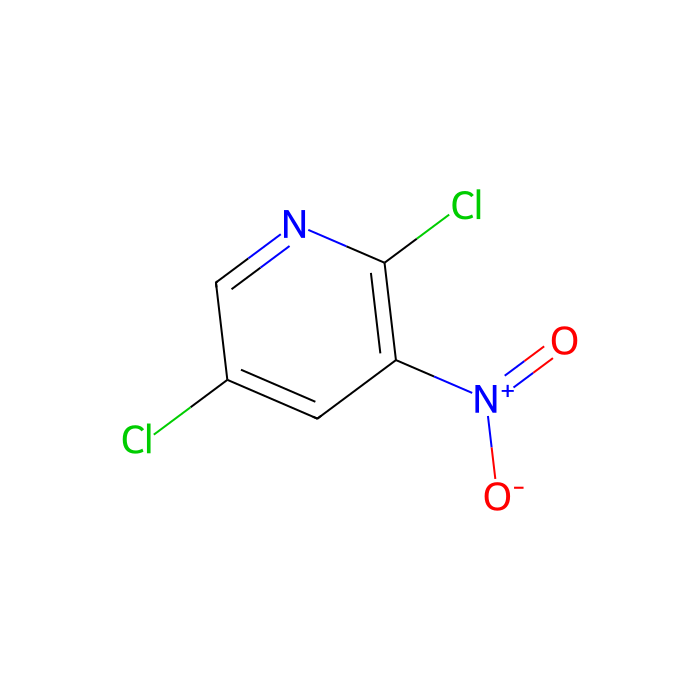
A halogenated, nitro-substituted heteroaromatic building block in the pyridine family; positions 2 and 5 bear chlorine, and position 3 bears a nitro group on a pyridine ring.
InChIKey (as listed): 253760 (note: non-standard format as provided; confirm via CoA/SDS)
SMILES: Not specified for this item; refer to CoA/Spec Sheet.
Core structural features (general/literature description)
Ring system: six-membered aromatic pyridine (one ring nitrogen at position 1).
Substitution pattern: chloro substituents at C-2 and C-5; nitro (–NO2) at C-3; two ring hydrogens remain at C-4 and C-6.
Functional groups: heteroaromatic azine (pyridine), two aryl chlorides (activated toward SNAr by both ring N and the nitro group), strongly electron-withdrawing nitro group.
Stereochemistry: achiral; no stereogenic centers.
Formula and formula mass (literature)
Empirical formula: C5H2Cl2N2O2 (literature)
Formula (relative) molecular mass: ~192.99 g/mol (literature)
2D description in words
A pyridine ring with the ring nitrogen at the 1-position; moving clockwise, the 2-position is chloro, 3-position nitro, 4-position proton, 5-position chloro, 6-position proton.
Note: Confirm all definitive identifiers for the supplied lot via the product CoA/Spec Sheet. This tab distinguishes product-listing facts from general/literature descriptors.
Synthetic Utility
Functional handles and their reactivity (literature/general):
Two aryl chlorides (C-2, C-5): activated toward SNAr by the adjacent ring nitrogen and para nitro group, enabling stepwise or selective substitution with N, O, S, and C nucleophiles.
Nitro group (C-3): reducible to an aniline-like 3-aminopyridine, convertible to other functionalities (e.g., via diazotization of the amine, Sandmeyer variants, or formation of amide/urea linkages after reduction).
Ring nitrogen: tunable basicity and potential for N-oxide formation (pyridine N-oxide) to guide regioselective substitutions or serve as a temporary directing group.
Retrosynthetic value:
Serves as a convergent hub: install diverse substituents at C-2 and C-5 via orthogonal strategies (SNAr and Pd-catalyzed coupling), then modify the nitro to amine for late-stage diversification.
Enables rapid library synthesis of 2,5-disubstituted-3-aminopyridines, a motif found across bioactive chemical space.
Representative transformations:
2-Amination (SNAr) with morpholine/K2CO3 in DMF, followed by 5-Suzuki coupling to append aryl groups.
5-O-arylation (SNAr with phenoxides) to give diaryl ethers; subsequent nitro reduction and acylation.
Dual cross-coupling at both chloro positions employing Pd/XPhos-type catalysts, then nitro-to-amine hydrogenation to furnish diamino/aryl–amino scaffolds.
Practical notes:
Regioselectivity in SNAr can be modulated by temperature and nucleophile hardness; monitor by LC–MS. Protect from adventitious moisture when using strong bases.
Target Specificity
Not applicable. This product is a small-molecule building block and is not an antibody, enzyme, or affinity reagent. No antigen/epitope, clone, isotype, or species reactivity information applies.
For intended use, refer to the synthetic chemistry sections (Reaction & Applications, Synthetic Utility, Reaction Conditions).
We use cookies to ensure the website functions properly and, where permitted, to improve your experience. You can manage your preferences at any time in Settings. Learn more in our Cookie Policy.
Shall we send you a message when we have discounts available?
Remind me later
Thank you! Please check your email inbox to confirm.
Products are supplied to verified businesses, institutions, and qualified professionals for research and development use only. Not for use in humans, animals, diagnosis, or therapy.

 D23061333