Determine the necessary mass, volume, or concentration for preparing a solution.
≥98% for sensitive chromatographic and analytical workflows requiring minimal baseline interference.
Room temperature,Argon charged Ships Normal Check lot-specific COA for exact specifications.
SDS, COA, datasheet, and spec sheet available for download. Lot-specific COA accessible via lot number lookup.
Cited in 7 peer-reviewed publications across chromatography, organic synthesis, and cross-coupling reactions.
Solubility in water: 800 g / L (25 ° C), dissolved in methanol, ethanol, acetone, pyridine, DMSO, and THF.
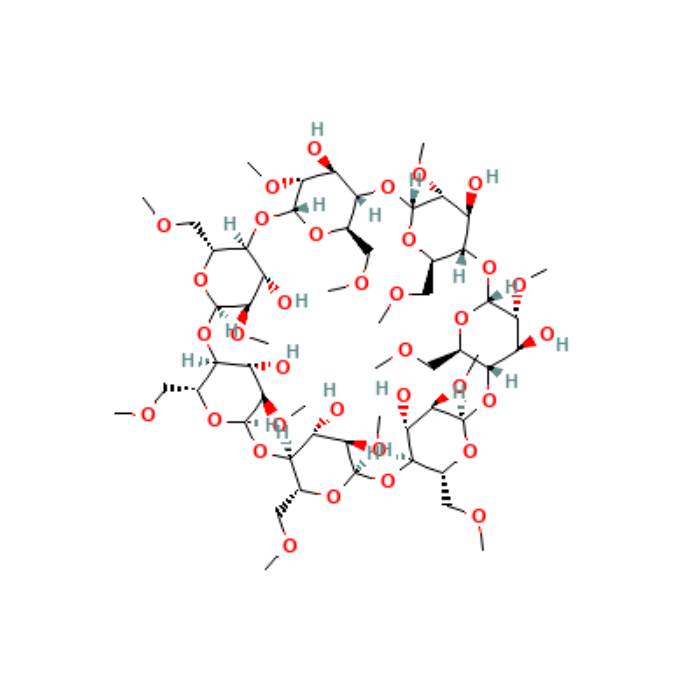
Heptakis(2,6-di-O-methyl)-β-cyclodextrin is a hydrophilic derivative of cyclodextrin that possesses the ability to effectively dissolve lipophilic drugs like steroid hormones, vitamins A, E, and K, etc. It can be utilized to increase the dissolution and bioavailability of weakly water-soluble pharmaceutical compounds.
Complexes are more soluble in aqueous solution than the corresponding complexes of β-cyclodextrin; Stimulation of fatty acid synthesis
Reactant involved in:
• Physicochemical studies of inclusion complexes
• Probing diffusion and single molecule interactions with reconstituted membrane proteins
• Interactions with micelles causing micellar rupture
• Studying cellular transport, used as a cell penetration enhancer
• Physicochemical and biopharmaceutical improvement of drugs particularly with solubilization and stability
• Interactions with cholesterol
Heptakis(2,6-di-O-methyl)-β-cyclodextrin may be used:
• To measure the equilibrium constant of its complexes with various enantiomeric pairs of chiral nitroxides by electron paramagnetic resonance (EPR) spectroscopy.
• To study the crystal structure of its complex with n-butyl acrylate and isobornyl acrylate using X-ray diffraction (XRD).
• As a chiral selector to resolve amphetamine related drugs by capillary zone electrophoresis.
Comprehensive hazard, handling, storage, and regulatory compliance document.
Download SDS →Lot-specific quality data. Enter your lot number to retrieve the exact COA.
Look up COA →Full quality attributes and acceptance criteria for this grade.
View spec sheet →Taxonomy Tree
| Kingdom | Organic compounds |
|---|---|
| Superclass | Organic oxygen compounds |
| Classe | Organooxygen compounds |
| Subclass | Carbohydrates and carbohydrate conjugates |
| Intermediate Tree Nodes | Not available |
| Direct Parent | Oligosaccharides |
| Alternative Parents | Oxanes Secondary alcohols Polyols Oxacyclic compounds Dialkyl ethers Acetals Hydrocarbon derivatives |
| Molecular Framework | Aliphatic heteropolycyclic compounds |
| Substituents | Oligosaccharide - Oxane - Secondary alcohol - Oxacycle - Organoheterocyclic compound - Polyol - Ether - Dialkyl ether - Acetal - Hydrocarbon derivative - Alcohol - Aliphatic heteropolycyclic compound |
| Descrição | This compound belongs to the class of organic compounds known as oligosaccharides. These are carbohydrates made up of 3 to 10 monosaccharide units linked to each other through glycosidic bonds. |
| External Descriptors | Not available |
Find and download the COA for your product by matching the lot number on the packaging.
| Lot Number | Certificate Type | Data | Item |
|---|---|---|---|
| Certificate of Analysis | Jul 08, 2026 | D100520 | |
| Certificate of Analysis | Jul 08, 2026 | D100520 | |
| Certificate of Analysis | Jul 08, 2026 | D100520 | |
| Certificate of Analysis | Jul 08, 2026 | D100520 | |
| Certificate of Analysis | Jul 08, 2026 | D100520 | |
| Certificate of Analysis | Jul 06, 2026 | D100520 | |
| Certificate of Analysis | Jul 06, 2026 | D100520 | |
| Certificate of Analysis | Jul 06, 2026 | D100520 | |
| Certificate of Analysis | Aug 11, 2025 | D100520 | |
| Certificate of Analysis | Jun 05, 2025 | D100520 | |
| Certificate of Analysis | Jun 05, 2025 | D100520 | |
| Certificate of Analysis | Jun 05, 2025 | D100520 | |
| Certificate of Analysis | Jun 05, 2025 | D100520 | |
| Certificate of Analysis | Jun 05, 2025 | D100520 | |
| Certificate of Analysis | Jun 05, 2025 | D100520 | |
| Certificate of Analysis | Jun 05, 2025 | D100520 | |
| Certificate of Analysis | Nov 04, 2024 | D100520 | |
| Certificate of Analysis | Jul 22, 2024 | D100520 | |
| Certificate of Analysis | Jul 22, 2024 | D100520 | |
| Certificate of Analysis | Jul 22, 2024 | D100520 | |
| Certificate of Analysis | Apr 29, 2024 | D100520 | |
| Certificate of Analysis | Apr 29, 2024 | D100520 | |
| Certificate of Analysis | Apr 29, 2024 | D100520 | |
| Certificate of Analysis | Aug 28, 2023 | D100520 | |
| Certificate of Analysis | Aug 28, 2023 | D100520 | |
| Certificate of Analysis | Aug 28, 2023 | D100520 | |
| Certificate of Analysis | Jun 29, 2022 | D100520 | |
| Certificate of Analysis | Jun 29, 2022 | D100520 | |
| Certificate of Analysis | Jun 29, 2022 | D100520 | |
| Certificate of Analysis | Jun 29, 2022 | D100520 |
| Sensibilidade | moisture sensitive |
|---|---|
| Ponto de inflamação (°C) | 187°C |
| Ponto de fusão (°C) | 180-182°C |
| Peso molecular | 1331.400 g/mol |
| XLogP3 | -7.500 |
| Hydrogen Bond Donor Count | 7 |
| Hydrogen Bond Acceptor Count | 35 |
| Rotatable Bond Count | 21 |
| Exact Mass | 1330.59 Da |
| Monoisotopic Mass | 1330.59 Da |
| Topological Polar Surface Area | 400.000 Ų |
| Heavy Atom Count | 91 |
| Formal Charge | 0 |
| Complexity | 1690.000 |
| Isotope Atom Count | 0 |
| Defined Atom Stereocenter Count | 35 |
| Undefined Atom Stereocenter Count | 0 |
| Defined Bond Stereocenter Count | 0 |
| Undefined Bond Stereocenter Count | 0 |
| The total count of all stereochemical bonds | 0 |
| Covalently-Bonded Unit Count | 1 |