This compound belongs to the class of organic compounds known as morpholines. These are organic compounds containing a morpholine moiety, which consists of a six-member aliphatic saturated ring with the formula C4H9NO, where the oxygen and nitrogen atoms lie at positions 1 and 4, respectively.
External Descriptors
Not available
1. Djoumbou Feunang Y, Eisner R, Knox C, Chepelev L, Hastings J, Owen G, Fahy E, Steinbeck C, Subramanian S, Bolton E, Greiner R, and Wishart DS. ClassyFire: Automated Chemical Classification With A Comprehensive, Computable Taxonomy. Journal of Cheminformatics, 2016, 8:61.
Determine the necessary mass, volume, or concentration for preparing a solution.
Dilution Calculator
Determine the dilution needed to prepare a stock solution.
Reconstitution Calculator
Revisões
Avaliações dos Clientes
Application Protocols
Not applicable.
No tested biological assay formats (e.g., WB, IHC, IF, FC) are relevant to this small-molecule reagent. For chemical synthesis usage, refer to the Reaction & Applications and Reaction Conditions sections.
Biological Roles
Applicability note
2,6-Dimethylmorpholine is a synthetic small molecule used primarily in chemical synthesis. It does not have a canonical biological role. The following context relates to the morpholine motif generally.
Morpholine ring in biology: The morpholine scaffold appears in various bioactive molecules and materials as a solubilizing, basic appendage due to its balance of polarity and basicity.
Protonation state in aqueous media: With conjugate acid pKaH typically near 9, morpholine derivatives exist predominantly as protonated ammonium species at physiological pH, increasing water solubility.
Metabolism considerations: Secondary amines may undergo N-dealkylation, N-oxidation, or ring-opening under oxidative metabolism; specific pathways depend on substitution.
Note
No medical, diagnostic, or therapeutic use is implied; for research laboratory use only (per Product Data).
Buffer Applications
Not typically applicable.
As a secondary amine with pKaH near 9 (literature), 2,6-dimethylmorpholine can act as a base, but it is not a standard biological buffer component like Tris, HEPES, or MOPS. Its nucleophilicity and odor generally preclude routine buffer preparation.
For buffer needs near pH 7–9, consider established Good’s buffers (e.g., HEPES, TAPS) designed for minimal biological interference.
Green Alternatives
Context (general; selection depends on the role of 2,6-dimethylmorpholine)
If used as a base/catalyst: Consider less volatile, less odorous, and/or bio-based bases. If used as a solvent, consider greener polar media to minimize amine emissions and corrosivity concerns.
Comparison (qualitative, literature)
2,6-Dimethylmorpholine vs alternatives:
Morpholine: More common, biodegradable; higher water miscibility. However, slightly more nucleophilic; may lead to increased side reactions.
DIPEA (Hunig’s base): Tertiary, non-nucleophilic; often preferred to suppress acylation or alkylation side products. Less hydrogen-bond donating; typically lower corrosivity toward metals.
2-MeTHF (as solvent alternative): Bio-based ether solvent with lower peroxide risk than THF; use with an external base (e.g., DBU, carbonate) if amine basicity is needed.
Carbonates (K2CO3, Cs2CO3) in green solvents (MeOH, water, Cyrene): Inorganics avoid amine odor/toxicity; applicable when heterogeneous base is acceptable.
Tradeoffs
Secondary amines can be nitrosated; managing nitrosamine risk may necessitate controls not needed with inorganic bases.
Replacing with less nucleophilic tertiary bases (e.g., DIPEA) can reduce waste from amide/carbamate byproducts but might change rates/selectivity.
Bio-based solvents (2-MeTHF, CPME) improve environmental profile but may not solubilize salts as effectively as amine-containing media.
Pharmaceutical Uses
Applicability note
No pharmacopeial grade or excipient status is provided for this item. Do not use for human or veterinary applications. For research use only (per Product Data).
General formulation context (literature)
Secondary amines like morpholine derivatives are occasionally used in process development as bases, catalysts, or intermediates (e.g., forming salts or transient protecting groups). However, residual amines are typically removed due to taste/odor, reactivity, and potential nitrosamine concerns.
If an amine is used in API manufacturing, thorough purge studies and sensitive methods (e.g., nitrosamine risk assessments) are required. This is process chemistry guidance only and not a use claim for this product.
Physical Properties
Item-specific (from Product Data)
Appearance: Not specified for this item; refer to CoA/Spec Sheet.
Grade/Purity: Not specified for this item; refer to CoA/Spec Sheet.
Literature/Computed values (context only; not product specification)
Physical state: Typically a colorless to pale liquid amine at ambient temperature (literature for 2,6-dimethylmorpholine).
Boiling point: Reported ~155–160 °C at 1 atm (literature).
Melting point: Often below 0 °C (literature; secondary amine liquids), exact value varies with isomer ratio.
Density: Reported around 0.90–0.94 g/mL at 20–25 °C (literature).
Basicity: Conjugate acid pKaH typically ~8.7–9.1 in water at 25 °C (literature; morpholine pKaH ~8.4; 2,6-dimethyl substitution modestly increases basicity).
Solubility: Miscible with many organic solvents; appreciable solubility in water expected due to polar ether/amine functionality (literature).
Vapor pressure/UV cutoff/trace impurities: Not specified here.
Notes for practitioners
The presence of two stereocenters can broaden melting/boiling ranges for diastereomeric mixtures. Use actual CoA values for method validation or safety calculations.
Quality and Grades
Item-specific (from Product Data)
Grade/Purity: Not specified for this item; refer to CoA/Spec Sheet.
Stabilizers/Inhibitors: Not specified for this item; refer to CoA/Spec Sheet.
General guidance for this compound class
Typical offerings for cyclic amines include: technical grade (process chemistry), laboratory reagent grade (general synthesis), and high-purity grades tailored for trace analysis or demanding catalysis. HPLC grade specifications (low UV absorbance, sub-ppm metals) are uncommon for amines unless intended as mobile phase modifiers.
Impurity profile considerations: Water content and residual low-boiling amines can impact reactivity in acylation/alkylation; trace peroxides are not typical for morpholine derivatives (unlike dialkyl ethers). Metal content is generally not critical unless used as a ligand/base in sensitive transition-metal catalysis; check CoA if ppm limits matter for your process.
UV/GC suitability: For quantitative GC, knowledge of residual water and stabilizers is important; verify on the CoA.
Actionable tip: If you need assured water content or tight assay, request the most recent CoA and, if needed, specify Karl Fischer or GC assay limits at purchase order stage.
Reaction and Applications
Item-specific (from Product Data)
Manufacturer applications: Not specified for this item; refer to CoA/Spec Sheet.
Research use note: For research use only.
Literature/general applications (for context; not product specification)
Organic base/catalyst: Acts as a moderately strong, sterically encumbered secondary amine base. Useful in neutralizing acids, promoting condensations, and catalyzing urethane (polyurethane) formation analogous to other morpholine catalysts when selectivity toward less nucleophilic pathways is desired.
Nucleophilic reagent and building block:
N-alkylation: Generates tertiary amines via alkyl halide or sulfonate displacement; careful control limits over-alkylation and quaternization.
Acylation/carbamoylation: Forms N-acyl morpholine derivatives and carbamates using acyl chlorides or chloroformates (useful activating groups or protecting handles).
Reductive amination: Serves as the amine component with carbonyl partners under NaBH3CN, NaBH(OAc)3, or catalytic hydrogenation; 2,6-substitution can modulate sterics and selectivity.
Ligand/borane complex formation: Secondary amines form amine–borane adducts; 2,6-dimethylmorpholine–borane can be prepared as a reducing agent with tailored stability (literature precedent for amine–boranes).
Polymer/curing chemistry: Morpholine derivatives function as epoxy/urethane curing accelerators; 2,6-dimethyl substitution may tune latency and volatility relative to morpholine.
Practical tips
Drying: If water-sensitive reactions are planned, dry over KOH pellets or molecular sieves; distill under reduced pressure if high purity is required.
Atmosphere: Use inert gas to avoid CO2 uptake (carbamate formation) and nitrosation in presence of nitrite/acid.
Workup: Salting-out by acidification (e.g., 1 M HCl), phase separation, then basify and extract as needed.
Reaction Conditions
General conditions (literature guidance; not product specification)
N-Alkylation: 2,6-Dimethylmorpholine (1.0–1.2 equiv) with primary alkyl halide or mesylate in acetonitrile, DMF, or acetone; K2CO3 or the amine itself as base; 20–60 °C, 2–16 h. Monitor for over-alkylation leading to quaternary salts.
Reductive amination: Carbonyl partner (1.0 equiv), 2,6-dimethylmorpholine (1.2–2.0 equiv), NaBH(OAc)3 (2–3 equiv) in DCE or MeOH with AcOH (pH ~5–6); 0–25 °C addition, then 25 °C for 2–12 h. Alternatively, catalytic hydrogenation (Pd/C) in EtOH under 1–5 bar H2.
Acylation/carbamoylation: Acyl chloride (1.0 equiv) with 2,6-dimethylmorpholine (1.1–2.0 equiv) as nucleophile/base in DCM or THF at 0–25 °C; add base (e.g., DIPEA) if needed to control HCl. Reaction typically complete in 0.5–3 h.
Salt formation: Titrate with mineral or sulfonic acids in anhydrous ether/EtOAc to precipitate morpholinium salts; maintain low temperature to control exotherm.
Operational notes
Drying/degassing: For moisture-/CO2-sensitive steps, dry over KOH or 3 Å sieves; blanket with argon (aligns with product storage guidance). Degas solutions if nitrosation risk exists (avoid nitrite contamination).
Workup/purification: Acid–base extraction is efficient. Tertiary products often purified by distillation under reduced pressure or by forming crystalline salts.
Expected outcomes: Yields are substrate-dependent; secondary amine nucleophilicity is moderated by 2,6-methyls—fewer side reactions than morpholine in acylations, but slower SN2 on hindered substrates.
GHS classification, signal word, pictograms, H-statements: Not specified for this item; refer to SDS.
General safety guidance (consult the SDS for authoritative information)
Likely hazards (amines of this class): May cause skin and eye irritation or burns; harmful if inhaled; strong, ammoniacal odor. Vapors may be irritating; ensure adequate ventilation or use fume hood.
PPE: Chemical-resistant gloves (e.g., nitrile), splash goggles, lab coat; use a respirator if ventilation is inadequate per risk assessment.
Incompatibilities: Avoid strong acids (forms salts/exotherm), acid chlorides/anhydrides (acylation), strong oxidizers (risk of exotherm/oxidation), nitrosating agents/nitrites in acidic media (risk of N-nitrosamine formation), and CO2-rich atmospheres (carbamate formation). Store under inert gas as specified.
Handling tips: Keep containers tightly closed. Purge headspace with argon after each use (matches product guidance). Minimize exposure to air and moisture to maintain assay and reduce byproduct formation.
First aid (overview): Eye/skin contact—rinse cautiously with water for 15 minutes; remove contaminated clothing. Inhalation—move to fresh air. Ingestion—rinse mouth; do NOT induce vomiting. Seek medical attention in all cases. Always follow site SOPs and SDS.
Fire safety: Amines are combustible; use CO2, dry chemical, or foam. Cool containers with water spray if safe to do so. Prevent runoff.
Waste: Collect as organic amine waste; neutralize and dispose per local regulations.
Solvent Selection
Applicability note
2,6-Dimethylmorpholine is primarily used as a base/catalyst or building block rather than as a bulk reaction solvent. However, its polarity and donor ability make it miscible with many organic media.
Polarity/proticity: Polar, basic, hydrogen-bond donor (secondary amine) and acceptor (ether and amine). Strong Lewis base toward acids/electrophiles.
Miscibility: Typically miscible with polar organics (alcohols, ketones, esters, chlorinated solvents) and shows good water compatibility due to the morpholine motif.
Dielectric/Donor ability: Morpholine donors are strong electron pair donors; dielectric constants are elevated relative to hydrocarbons (literature trend), but specific value for 2,6-dimethylmorpholine not cited here.
When to choose it vs. alternatives
Use as a reaction medium only when its basicity and nucleophilicity are compatible with substrates (e.g., for certain SNAr reactions, acylations where amide formation is desired, or as in situ base in condensations).
Prefer non-nucleophilic solvents (MeCN, toluene, 2-MeTHF) when amine participation is undesired; add 2,6-dimethylmorpholine stoichiometrically or catalytically as a base if needed.
Comparison (literature, qualitative)
Versus morpholine: Slightly more hindered and less nucleophilic at nitrogen; somewhat more basic. Lower water uptake anticipated.
Versus DIPEA/Et3N: Stronger H-bonding and higher polarity; more nucleophilic than sterically hindered tertiary amines; can form amides/carbamates.
Container: Store in tightly sealed amber glass under inert gas to minimize CO2 uptake (carbamate formation) and oxidative byproducts. Wipe septa before and after needle withdrawals; re-argon the headspace.
In-use stability: Secondary amines are generally stable under dry, inert conditions. Avoid prolonged exposure to air, acids, and oxidizers. Keep away from nitrosating agents.
Reconstitution: Not applicable—supplied neat. If solidification occurs at low temperature, gently warm to ambient and mix thoroughly before use.
Shelf life: Use CoA or label for specific retest/expiry; if unspecified, verify suitability by GC/NMR before critical use.
Spill/containment: Absorb with inert material; neutralize cautiously with dilute acid for waste treatment per institutional SOPs.
Structure and Identity
Item-specific (from Product Data)
SKU: D189017
Product name: 2,6-Dimethylmorpholine
CAS: 141-91-3
CID: 110862
InChIKey: 126461 (as provided)
SMILES: Not specified for this item; refer to CoA/Spec Sheet.
Molecular formula: Not specified for this item; refer to CoA/Spec Sheet.
Molecular weight: Not specified for this item; refer to CoA/Spec Sheet.
Literature/General structural information (for context; not product specification)
Expected formula and MW (literature): C6H13NO; ~115.17 g/mol for 2,6-dimethylmorpholine.
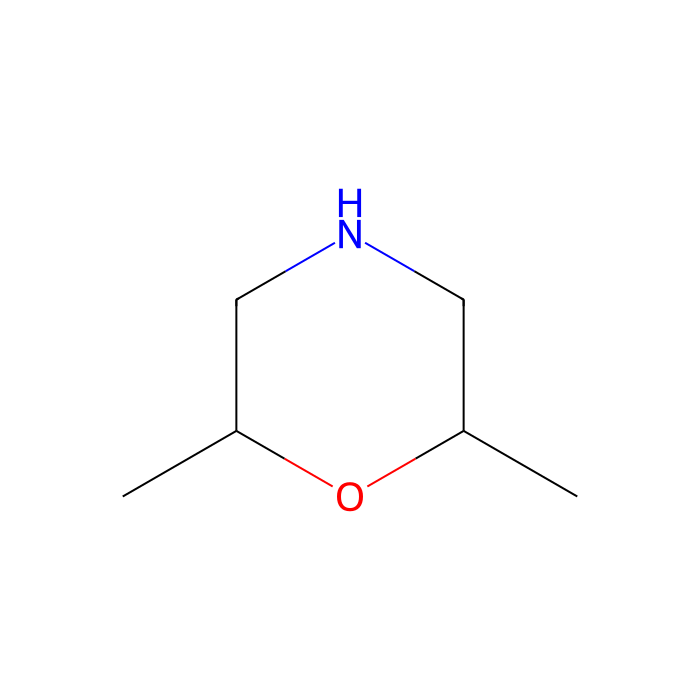
Representative SMILES (literature): O1C(C)CNCC(C)1 (racemic at C2/C6). InChIKey not provided here.
Core scaffold: Six‑membered saturated heterocycle containing one oxygen and one secondary amine (morpholine), with methyl substituents at the 2- and 6-positions (the ring carbons alpha to oxygen).
Functional groups: Secondary amine (HN–), ether (C–O–C within ring). Two stereogenic centers at C2 and C6; commercial material is often a mixture of diastereomers unless specified.
2D description: A chair-like morpholine ring where O and N occupy positions 1 and 4; methyl groups on the carbons adjacent to O (positions 2 and 6). The nitrogen bears one hydrogen (secondary amine).
Synthetic Utility
Key functional elements
Secondary amine (HN–): Amenable to N-alkylation, acylation, sulfonylation, carbamoylation; forms stable ammonium salts with acids.
Ether oxygen: Enhances polarity and donor ability; participates in hydrogen bonding and can coordinate to Lewis acids (dual-donor behavior with the amine).
2,6-Substitution: Introduces steric hindrance around nitrogen, reducing nucleophilicity vs unsubstituted morpholine while modestly increasing basicity—useful for selectivity control.
Named/representative transformations (literature)
Reductive amination: Coupling with aldehydes/ketones followed by reduction (NaBH3CN, NaBH(OAc)3, catalytic H2) to access N-substituted 2,6-dimethylmorpholines.
N-Acylation to morpholides: Reaction with acid chlorides/anhydrides in the presence of base (or self-base) to form amides that can act as activating groups or auxiliaries.
Amine–borane adduct formation: Useful for transfer hydrogenation and as reducing agents with tailored reactivity profiles.
Retrosynthetic value
The nitrogen-bearing ring provides a versatile handle for late-stage diversification (alkyl, acyl, sulfonyl). The 2,6-dimethyl pattern offers a steric bias that can direct regio-/chemoselectivity in multi-functional settings.
Target Specificity
Not applicable.
This product is a small-molecule reagent, not a biological targeting agent. No antigen, epitope, clone, or species reactivity information applies.
Usamos cookies para garantir o funcionamento adequado do site e, quando permitido, para melhorar a sua experiência. Você pode gerenciar suas preferências a qualquer momento nas Configurações. Saiba mais em nossa Política de Cookies.
Deseja que lhe enviemos uma mensagem quando tivermos descontos disponíveis?
Lembrar-me mais tarde
Obrigado! Por favor, verifique a sua caixa de entrada de e-mail para confirmar.
Products are supplied to verified businesses, institutions, and qualified professionals for research and development use only. Not for use in humans, animals, diagnosis, or therapy.

 F2519340