This compound belongs to the class of organic compounds known as triphenylenes. These are compounds containing a triphenylene moiety, which consists of four fused benzene rings forming a 9,10-benzo[l]phenanthrene.
External Descriptors
Not available
1. Djoumbou Feunang Y, Eisner R, Knox C, Chepelev L, Hastings J, Owen G, Fahy E, Steinbeck C, Subramanian S, Bolton E, Greiner R, and Wishart DS. ClassyFire: Automated Chemical Classification With A Comprehensive, Computable Taxonomy. Journal of Cheminformatics, 2016, 8:61.
Determine the necessary mass, volume, or concentration for preparing a solution.
Dilution Calculator
Determine the dilution needed to prepare a stock solution.
Reconstitution Calculator
Revisões
Avaliações dos Clientes
Application Protocols
No assay or bio-application protocols are associated with this small-molecule building block. For synthetic applications, see Reaction Conditions, Reaction & Applications, and Synthetic Utility for general procedural guidance.
For lot-specific handling or purification guidance (e.g., recrystallization/sublimation conditions), refer to the CoA/Spec Sheet or contact Aladdin Scientific technical support.
Biological Roles
This compound is a halogenated polycyclic aromatic hydrocarbon (PAH) used as a synthetic building block. It is not a biomolecule and has no established physiological role.
General context (literature): PAHs do not participate in normal metabolism and are typically hydrophobic, exhibiting low aqueous solubility and potential bioaccumulation if environmental exposure occurs. Halogenation further increases hydrophobicity and persistence.
Research relevance: While not used biologically, 2,7-dibrominated PAH motifs can be incorporated into π-conjugated materials for biosensing interfaces or bioelectronics research (e.g., organic semiconductors interfaced with biological systems). Any such uses are materials-science oriented, not biological function.
Enzymatic interactions: No specific enzymatic targets are associated with this compound. Oxidative metabolism of PAHs in vivo typically involves cytochrome P450 enzymes, but such context is outside the scope of routine lab handling and should not be inferred as a use case.
Note: All Aladdin Scientific products are for research use only. No clinical, diagnostic, or therapeutic claims are made or implied.
Buffer Applications
Not typically applicable. 2,7-Dibromotriphenylene is a non-ionic, water-insoluble aromatic building block and is not used to prepare aqueous buffers or biological buffer systems. For relevant information, see the Synthetic Utility, Reaction & Applications, and Solvent Selection sections.
Green Alternatives
Greener choices focus on solvent selection, coupling strategy, and minimizing halogenated waste.
Solvent substitution (general):
Replace dioxane/THF with 2-MeTHF or CPME where feasible; these have better EHS profiles and can tolerate water in Suzuki couplings.
Favor anisole, toluene, or propylene carbonate over chlorinated solvents when solubility allows; note that many PAHs still require high-boiling aromatics.
Catalytic strategy:
Employ Suzuki–Miyaura with aqueous bases to reduce organostannane waste vs Stille.
Explore Ni-catalysis at lower loadings for aryl bromides; consider micellar catalysis (TPGS-750-M) to run in water-rich media when solubility and substrate stability permit.
Process intensification:
Continuous-flow heating in high-boiling green solvents can cut solvent volumes and improve safety margins for elevated temperatures.
Post-reaction workup:
Use minimal chlorinated solvents; extract with greener alternatives (EtOAc, MTBE) when compatible, followed by carbon treatment to remove Pd/Ni traces.
Trade-offs (general):
Chlorinated aromatics offer superior solubility for PAHs but have poorer EHS scores; greener hydrocarbons may require higher temperature or lead to lower conversions.
Aqueous micellar systems reduce organic solvent use but may not solubilize rigid PAHs adequately without surfactants/co-solvents.
Choose conditions that balance EHS with performance; perform small feasibility trials before committing to greener routes at scale.
Pharmaceutical Uses
This product is a materials-science/synthetic building block and is not an excipient or active ingredient.
Pharmacopeia status: Not listed; no compendial monographs known for this specialty halogenated PAH.
Formulation role: None typical. Its hydrophobic, π-conjugated structure is intended for materials and organic electronics research rather than drug formulation.
Process chemistry note (general): While aryl bromides are common in pharmaceutical synthesis, the triphenylene core is rarely used in drug frameworks due to extreme hydrophobicity and planarity.
All uses are for research only; no clinical or therapeutic applications are implied.
Physical Properties
Item-specific properties
Appearance: Not specified for this item; refer to CoA/Spec Sheet.
Molecular formula: Not specified for this item; refer to CoA/Spec Sheet.
Molecular weight: Not specified for this item; refer to CoA/Spec Sheet.
Other specifications (bp, mp, density, solubility, UV cutoff, refractive index): Not specified for this item; refer to CoA/Spec Sheet.
Literature/general information (for context; not item specifications)
Expected physical form: Polycyclic aromatic dibromide solids are typically crystalline and pale to off-white; exact appearance depends on purity and particle size.
Solubility profile (typical): Poorly soluble in polar protic solvents (water, alcohols). Better solubility in high-boiling aromatic and chlorinated organic solvents (chlorobenzene, o-dichlorobenzene, 1,2,4-trichlorobenzene), and in some halogenated solvents (CH2Cl2) and hot toluene; limited solubility in acetonitrile/ethyl acetate.
Volatility: Negligible; high aromaticity and bromination increase lattice energy and reduce vapor pressure.
Thermal behavior: Aryl bromides on PAHs generally have high melting points (often >150 °C) and good thermal stability below decomposition; exact values vary with substitution pattern and purity.
Lipophilicity: High, due to the extended π-system and two bromine atoms; often favors aggregation/π–π stacking in solid state.
Always verify exact numerical properties for a specific lot using the CoA/SDS.
Quality and Grades
Item-specific information
Grade/Purity: Not specified for this item; refer to CoA/Spec Sheet.
Stabilizers/添加剂: Not specified for this item; refer to CoA/Spec Sheet.
Guidance on interpreting grades for halogenated PAH building blocks (general)
Research grade: Suitable for synthetic development, materials screening, and method optimization. Trace metal content and residual halogenated byproducts may vary by lot.
High-purity (≥98–99%, general literature context): Preferred for optoelectronic/materials applications (OLED/OFET/OPV) where defect density, trap states, and background fluorescence must be minimized; often accompanied by HRMS/NMR and residual solvent profiling.
Semiconductor/materials grade (general): May include additional purification (sublimation or gradient zone refining) and tighter specs on ash content and metal contaminants to ensure reproducible device performance.
What to check on the CoA/Spec Sheet for this item
Assay (% area by HPLC/GC or qNMR), identity confirmation (1H/13C NMR, HRMS), residual solvents, and point-of-use solubility.
Metals profile (ICP-MS) if the compound will be used in cross-coupling where Pd/Cu/Ni contamination could bias catalysis or device behavior.
Particle size/lot-to-lot color variation for thin-film deposition or crystal growth reproducibility.
Contact Aladdin Scientific for lot-specific CoA and, if required, sublimation-grade material.
Reaction and Applications
As a dibrominated polycyclic aromatic hydrocarbon, 2,7-dibromotriphenylene is a versatile synthon for constructing extended π-systems and 2D nanographenes.
Cross-coupling platform (general literature):
Suzuki–Miyaura (with aryl/alkenyl boronates) to introduce diverse aryl or heteroaryl groups at C2/C7.
Stille/Negishi/Kumada for robust C–C bond formation when boronates are unsuitable; Stille often used for challenging steric environments.
Buchwald–Hartwig amination less common on PAHs but possible with optimized ligands.
Cyclodehydrogenation (Scholl reaction): Coupled products can be further planarized (FeCl3, DDQ/TfOH) to yield larger nanographenes and contorted aromatics.
Materials science applications (general, non-claimed for this item): Precursors to OLED/OFET/OPV small molecules, discotic liquid crystals, porous organic frameworks, and graphene nanoribbons where the 2,7-vector defines growth direction.
Advantages of the 2,7-pattern: Places substituents opposite across the core, preserving conjugation and enabling linear extension or macrocyclization.
Practical points:
The aryl–Br bond in PAHs is typically reactive enough under Pd/Ni catalysis; however, catalyst/ligand choice strongly affects turnover on rigid PAH scaffolds.
Insolubility of products can limit conversion; add high-boiling aromatic co-solvents and consider slow addition of nucleophile.
Use rigorous exclusion of air/moisture for metal-catalyzed couplings; pre-dry solvents and bases.
Always optimize with small-scale screenings (ligand/base/solvent/temperature) before scale-up.
Reaction Conditions
General literature guidance for couplings and downstream transformations of 2,7-dibrominated PAHs (adjust to your system; verify experimentally):
Suzuki–Miyaura arylation:
Catalyst: Pd2(dba)3 (0.5–2 mol%) or Pd(OAc)2 with Buchwald-type ligands (SPhos, XPhos, RuPhos 1–4 mol%).
Base: K3PO4, Cs2CO3, or K2CO3 (2–3 equiv), often with H2O present.
Solvent: Toluene, anisole, CPME, or dioxane/2-MeTHF; add o-dichlorobenzene or t-amyl alcohol as co-solvent if solubility is limiting.
Temperature/time: 80–120 °C, 6–24 h; higher temps may be required due to substrate rigidity.
Stille coupling:
Catalyst: Pd(PPh3)4 or Pd2(dba)3/P(o-tol)3 (1–5 mol%).
Solvent: Toluene, chlorobenzene, or DMF/toluene; 90–120 °C.
Negishi/Kumada:
Ni or Pd catalysts with THF/2-MeTHF or toluene; maintain low moisture; 0–80 °C (Negishi) or 25–60 °C (Kumada) depending on reagents.
Scholl cyclodehydrogenation of coupled products:
Reagents: FeCl3 (anhydrous) in nitromethane or dichloromethane; or DDQ with Brønsted acid (TfOH) under controlled conditions.
Notes: Control overoxidation; monitor by TLC/MALDI; ensure substrate solubility in chosen medium.
Tips:
Degas solvents (sparging/freeze–pump–thaw). Dry glassware and bases. Seed with small catalyst portions if inhibition observed.
For poor solubility, use high-boiling aromatics (o-DCB, 1,2,4-trichlorobenzene) and sealed tubes/autoclaves rated for temperature/pressure.
All parameters are literature-style guidance and must be optimized for your substrate set.
Safety and Handling
Item-specific hazard details
GHS classification, signal word, pictograms, H-statements: Not specified for this item; refer to SDS.
Storage conditions: Room temperature (per Product Data).
Shipping: Normal (per Product Data).
General safety guidance for aryl bromide PAHs (literature/general; defer to SDS for authority)
Likely hazards: May cause skin/eye irritation and respiratory irritation as dust. Combustible organic solid. PAH derivatives can be harmful if swallowed or inhaled; minimize dust generation.
PPE: Lab coat, safety glasses or goggles, and appropriate chemical-resistant gloves (e.g., nitrile). Handle in a fume hood to avoid inhalation of dust and solvent vapors.
Incompatibilities: Strong oxidizers (risk of exotherm), strong electrophiles, and very strong bases at elevated temperature (possible debromination/elimination). Avoid prolonged exposure to intense UV/heat that could induce degradation.
First-aid (summary): If inhaled—move to fresh air, seek medical advice if symptoms persist. Skin contact—wash with soap/water. Eye contact—rinse cautiously with water for several minutes, remove contacts. Ingestion—rinse mouth, do not induce vomiting unless directed by medical personnel.
Fire-fighting: Use dry chemical, CO2, or foam; combustion may produce hydrogen bromide and brominated aromatics—wear self-contained breathing apparatus.
Spill response: Avoid dust, collect mechanically and place in suitable container for disposal; decontaminate area with appropriate organic solvent while observing flammability precautions.
Consult the SDS for definitive hazard classification and emergency procedures.
Solvent Selection
2,7-Dibromotriphenylene is a rigid, highly conjugated, hydrophobic aryl bromide. Solvent choice is driven by its low polarity, strong π–π interactions, and limited solubility in many common media.
Polarity class: Nonpolar to weakly polar aromatic halide; expected to have very low dielectric constant in solution.
Miscibility/solubility (general):
Good to moderate in chlorinated aromatics (o-dichlorobenzene, chlorobenzene), halogenated solvents (dichloromethane) and hot toluene/mesitylene.
Poor in alcohols, water, and many low-boiling ethers (e.g., THF) at room temperature, though THF/dioxane can be used in couplings with co-solvents and heat.
Typical use scenarios:
Cross-coupling: o-Dichlorobenzene, toluene, anisole, CPME, or 2-MeTHF (with co-solvent and heat) to maintain solubility and minimize precipitation of high-MW products.
Film formation/crystallization: Chlorobenzene or 1,2-dichlorobenzene for slow evaporation and controlled morphology.
Practical tips:
Pre-screen solubility at process temperature; many PAH derivatives dissolve only when hot.
For sensitive catalytic systems, avoid strongly coordinating solvents that can inhibit catalyst turnover; aromatic/hydrocarbon media often perform well.
Small comparison (general):
Chlorobenzene vs o-DCB: o-DCB offers higher solubility and higher bp for elevated-temperature couplings; chlorobenzene is less toxic and easier to remove.
Storage and Reconstitution
Item-specific storage/shipping
Storage conditions: Room temperature (per Product Data). Store tightly closed in a dry, well-ventilated place away from strong oxidizers.
Shipped in: Normal (per Product Data).
General handling guidance (solid PAH dibromides)
Moisture/air sensitivity: Typically air-stable; keep container closed to prevent contamination and adsorption of atmospheric moisture/odors.
Light sensitivity: Aromatic bromides are generally light-stable, but store in amber or opaque containers to minimize long-term photodegradation.
Reconstitution/solution prep: Dissolve in suitable organic solvents (e.g., chlorobenzene, o-dichlorobenzene, DCM, hot toluene) with gentle heat and stirring. Filter hot solutions (0.45 µm PTFE) to remove particulates prior to thin-film deposition or reactions.
Freeze–thaw: Not applicable to solids; for stock solutions, store in sealed amber vials under inert gas if prolonged storage is needed and avoid repeated heating–cooling cycles that can precipitate solids and change concentration.
Always consult the product’s CoA and SDS for lot-specific guidance and safety information.
Structure and Identity
Item-specific identifiers (from Product Data)
SKU: D154869
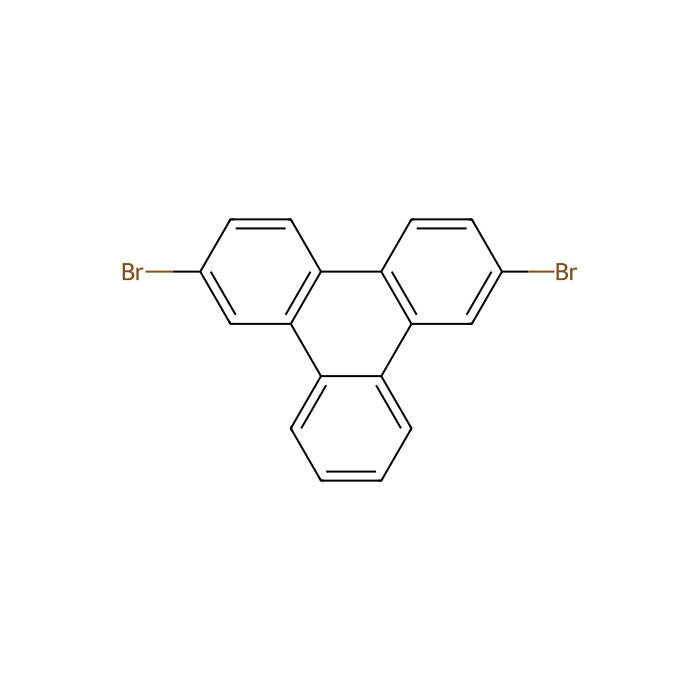
Product name: 2,7-Dibromotriphenylene
CAS: 888041-37-0
CID: 16122224
InChIKey: 30788 (as provided)
SMILES: Not specified for this item; refer to CoA/Spec Sheet.
Computed/literature structural information (for reference; not item-specific specifications)
Core scaffold: Triphenylene, a rigid planar polycyclic aromatic hydrocarbon (PAH) composed of four fused benzene rings in a D3h-symmetric arrangement.
Substitution pattern: Two bromine atoms at the 2- and 7-positions (para to each other across the central ring), yielding a dihalo-PAH with C2 symmetry.
Typical molecular formula (literature, based on structure): C18H10Br2.
Functional groups/features: Two aryl–Br bonds on a highly conjugated, planar PAH framework; no heteroatoms in the ring system.
2D structure described in words (general)
A central benzene ring fused on three sides to three additional benzene rings (triphenylene). Bromine atoms replace hydrogens at positions 2 and 7 on opposite outer rings, preserving planarity and extending polarizability at those sites. The molecule is rigid, disk-like, and strongly π-conjugated, supporting π–π stacking in the solid state and enabling cross-coupling at the C–Br bonds.
Synthetic Utility
2,7-Dibromotriphenylene provides two orthogonal aryl–Br handles on a rigid, planar PAH, enabling precise construction of extended π-architectures.
Functional handles: Two aryl bromides at 2,7-positions facilitate:
Bis-arylation via Suzuki–Miyaura, Stille, or Negishi couplings to access symmetric/asymmetric 2,7-disubstituted triphenylenes.
Sequential/orthogonal coupling (rate differentiation possible via sterics/electronics, ligand choice, temperature) for unsymmetrical substitution.
Lithiation–borylation route: Halogen–lithium exchange (at low temperature) followed by trapping (e.g., B(OR)3) to generate boronate esters for iterative cross-coupling; caution due to PAH insolubility and exotherm control.
Downstream transformations:
Intramolecular cyclodehydrogenation (Scholl) to build nanographenes/graphene nanoribbons.
Annulative π-extension (APEX) strategies using oxidative annulations onto the triphenylene edge.
Nucleophilic substitutions are generally unfavorable on aryl bromides of PAHs; transition-metal catalysis is preferred.
Retrosynthetic value:
Serves as a convergent node for dendritic/discotic materials and 2D macrocycles; 2,7-spacing defines linear extension across the disk.
Purification considerations:
Strong π–π interactions lead to tailing on silica; use deactivated silica, gradient elution with aromatic/halogenated solvents, or recrystallization from high-boiling aromatics. Sublimation under high vacuum can improve purity for device applications.
This synthon is thus central to building optoelectronic scaffolds and model nanocarbon fragments.
Target Specificity
Not applicable. This product is a small-molecule aromatic building block, not a biological targeting reagent or antibody. No antigen/epitope or species reactivity information applies.
Perguntas frequentes
What is the purity of this product?
This product is supplied at ≥98% purity (chemical assay). Lot-specific values are stated on the Certificate of Analysis.
How should this product be stored?
Store at room temperature.
How is this product shipped?
This product ships under standard ambient conditions. No temperature-controlled packaging is required.
What are the CAS number, molecular formula and molecular weight?
The CAS Number is 888041-37-0, the molecular formula is C18H10Br2, and the molecular weight is 386.09 g/mol. InChIKey BPGPBYGXGRDFQG-UHFFFAOYSA-N.
What documentation is provided?
Available product documentation, including Certificates of Analysis (COA), Safety Data Sheets (SDS), and specification sheets, is shown in the product document area. Document availability and access follow the current site policy.
Usamos cookies para garantir o funcionamento adequado do site e, quando permitido, para melhorar a sua experiência. Você pode gerenciar suas preferências a qualquer momento nas Configurações. Saiba mais em nossa Política de Cookies.
Deseja que lhe enviemos uma mensagem quando tivermos descontos disponíveis?
Lembrar-me mais tarde
Obrigado! Por favor, verifique a sua caixa de entrada de e-mail para confirmar.
Products are supplied to verified businesses, institutions, and qualified professionals for research and development use only. Not for use in humans, animals, diagnosis, or therapy.

 L2314186