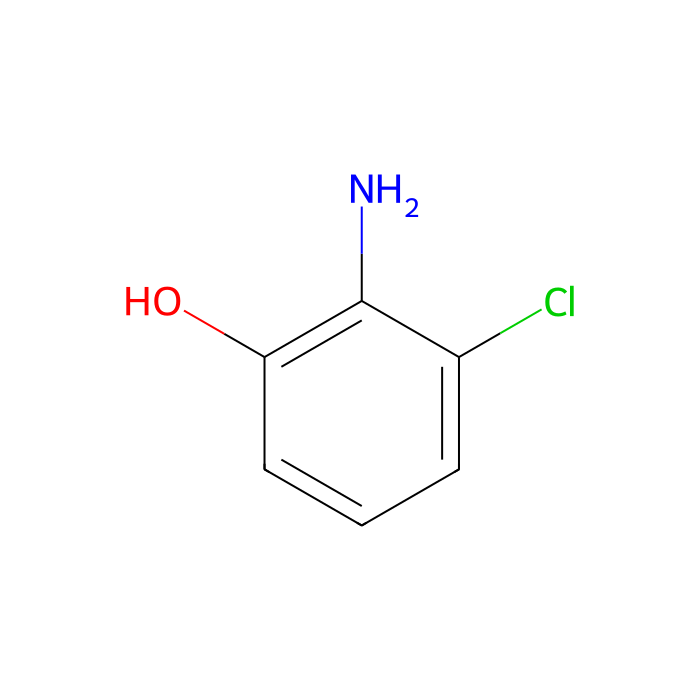
Determine the necessary mass, volume, or concentration for preparing a solution.
≥98% for sensitive chromatographic and analytical workflows requiring minimal baseline interference.
Room temperature Ships Normal Check lot-specific COA for exact specifications.
SDS, COA, datasheet, and spec sheet available for download. Lot-specific COA accessible via lot number lookup.
Cited in 0 peer-reviewed publications across chromatography, organic synthesis, and cross-coupling reactions.
Comprehensive hazard, handling, storage, and regulatory compliance document.
Download SDS →Lot-specific quality data. Enter your lot number to retrieve the exact COA.
Look up COA →Full quality attributes and acceptance criteria for this grade.
View spec sheet →Taxonomy Tree
| Kingdom | Organic compounds |
|---|---|
| Superclass | Benzenoids |
| Classe | Phenols |
| Subclass | Halophenols |
| Intermediate Tree Nodes | Chlorophenols |
| Direct Parent | M-chlorophenols |
| Alternative Parents | o-Aminophenols Aniline and substituted anilines Chlorobenzenes 1-hydroxy-4-unsubstituted benzenoids 1-hydroxy-2-unsubstituted benzenoids Aryl chlorides Primary amines Organooxygen compounds Organochlorides Hydrocarbon derivatives |
| Molecular Framework | Aromatic homomonocyclic compounds |
| Substituents | Aminophenol - O-aminophenol - Aniline or substituted anilines - 3-chlorophenol - 1-hydroxy-4-unsubstituted benzenoid - 1-hydroxy-2-unsubstituted benzenoid - Chlorobenzene - Halobenzene - Aryl chloride - Aryl halide - Monocyclic benzene moiety - Amine - Organohalogen compound - Organochloride - Organonitrogen compound - Organooxygen compound - Primary amine - Hydrocarbon derivative - Organic oxygen compound - Organic nitrogen compound - Aromatic homomonocyclic compound |
| Descrição | This compound belongs to the class of organic compounds known as m-chlorophenols. These are chlorophenols carrying a iodine at the C3 position of the benzene ring. |
| External Descriptors | Not available |
Find and download the COA for your product by matching the lot number on the packaging.
| Lot Number | Certificate Type | Data | Item |
|---|---|---|---|
| Certificate of Analysis | Dec 02, 2025 | A193993 | |
| Certificate of Analysis | Jun 12, 2025 | A193993 | |
| Certificate of Analysis | Feb 05, 2024 | A193993 | |
| Certificate of Analysis | Feb 05, 2024 | A193993 | |
| Certificate of Analysis | Feb 05, 2024 | A193993 | |
| Certificate of Analysis | Feb 05, 2024 | A193993 | |
| Certificate of Analysis | Feb 05, 2024 | A193993 |
| Peso molecular | 143.570 g/mol |
|---|---|
| XLogP3 | 1.800 |
| Hydrogen Bond Donor Count | 2 |
| Hydrogen Bond Acceptor Count | 2 |
| Rotatable Bond Count | 0 |
| Exact Mass | 143.014 Da |
| Monoisotopic Mass | 143.014 Da |
| Topological Polar Surface Area | 46.300 Ų |
| Heavy Atom Count | 9 |
| Formal Charge | 0 |
| Complexity | 99.100 |
| Isotope Atom Count | 0 |
| Defined Atom Stereocenter Count | 0 |
| Undefined Atom Stereocenter Count | 0 |
| Defined Bond Stereocenter Count | 0 |
| Undefined Bond Stereocenter Count | 0 |
| The total count of all stereochemical bonds | 0 |
| Covalently-Bonded Unit Count | 1 |
Not applicable. No tested biological assay protocols (e.g., WB, IHC, IF, FC) or analytical kit procedures are provided for this small-molecule reagent. For synthetic applications, refer to the Reaction Conditions and Synthetic Utility sections for general literature guidance.
This product is intended for research use only. No biological or clinical claims are made for the material itself.
General context (literature/biochemistry, not product-specific)
Relevance to assays
Note: Any biological behavior of derivatives depends on the specific transformation and target; evaluate cytotoxicity, solubility, and stability empirically for each use case.
2-Amino-3-chlorophenol is not a dedicated buffering agent and is not typically used to prepare biological buffers. While it possesses acid–base functionalities (phenol and aniline), its pKa values and solubility profile are not optimized for classical buffer ranges or compatibility.
Practical guidance
While 2-amino-3-chlorophenol itself is a substrate rather than a solvent, greener choices can be made for processes involving it.
Greener solvent choices (literature/general)
Comparison (general guidance)
Process-intensification strategies
Waste and safety
No pharmacopeial or excipient status is specified for this item. It is supplied for research use only.
General context in pharmaceutical R&D (literature/industry practice)
Formulation note
Item-specific specifications
Literature/general properties (for reference only; not item specifications)
Handling notes (practical)
Guidance on grades (general information for selection)
Stabilizers and additives
Quality control considerations (practical)
2-Amino-3-chlorophenol is a versatile building block combining an aniline, a phenol, and an aryl chloride. This enables orthogonal transformations for assembling heterocycles, ligands, and substituted aromatics.
Representative reaction families (literature/general)
Practical tips
The following are general literature conditions using o-aminophenols; adapt and optimize for 2-amino-3-chlorophenol and your substrate set. These are guidance, not item specifications.
Schiff base formation (with aldehydes)
Benzoxazole synthesis (cyclodehydration)
N- vs O-acylation
Cross-coupling at Ar–Cl (C3)
Notes
Product Data safety fields are not specified for this item. Always consult the SDS for authoritative information.
General GHS considerations for aromatic aminophenols (literature/generic; not product-specific)
Recommended PPE and controls
First-aid overview (consult SDS for details)
Storage and incompatibilities
This product is a multifunctional aromatic solid; solvent choice is application-driven (synthesis, purification, or analysis).
General solubility/miscibility guidance (literature/general)
When to choose alternatives
Small comparison (general)
Tip: For selective N- vs O-acylation, solvent polarity and basicity matter—use non-nucleophilic bases (e.g., DIPEA) in acetonitrile or dichloromethane for N-acylation; use stronger bases (e.g., NaH) in THF for O-acylation (general literature guidance).
Best practices (general)
Reconstitution/solution preparation
Stability notes
For any item-specific stability limits or impurity controls, refer to the CoA/Spec Sheet.
Brief description: 2-Amino-3-chlorophenol is an ortho-aminophenol bearing a chlorine substituent at the position meta to the phenolic OH (i.e., OH at C1, NH2 at C2, Cl at C3). It is an electron-rich, multifunctional aromatic building block enabling orthogonal N/O derivatization and further substitution on the ring.
Notes
Functional group leverage
Strategic considerations (literature/general)
Analytical handles
Not applicable. This product is a small-molecule chemical building block and is not an antibody, enzyme, or biological probe with a defined antigen/target. No target specificity data are provided in the Product Data.