This compound belongs to the class of organic compounds known as benzophenones. These are organic compounds containing a ketone attached to two phenyl groups.
External Descriptors
Not available
1. Djoumbou Feunang Y, Eisner R, Knox C, Chepelev L, Hastings J, Owen G, Fahy E, Steinbeck C, Subramanian S, Bolton E, Greiner R, and Wishart DS. ClassyFire: Automated Chemical Classification With A Comprehensive, Computable Taxonomy. Journal of Cheminformatics, 2016, 8:61.
Determine the necessary mass, volume, or concentration for preparing a solution.
Dilution Calculator
Determine the dilution needed to prepare a stock solution.
Reconstitution Calculator
Revisões
Avaliações dos Clientes
Application Protocols
Not applicable. There are no immunoassay or bioassay protocols (WB, IHC, IF, FC) associated with this small-molecule building block in the Product Data.
General laboratory use (synthetic):
Dissolve in an appropriate organic solvent (e.g., DMSO, DMF, CH2Cl2) for reaction setup.
For screening, prepare stock solutions (10–100 mM) in dry DMSO or DMF; store aliquots to avoid repeated freeze–thaw and moisture uptake.
Follow reaction-specific protocols provided in the Reaction Conditions section.
Biological Roles
This product is a synthetic organic building block; no intrinsic biological role is assigned in the Product Data.
General/literature context:
Scaffold utility: The benzophenone–aniline motif appears in medicinal chemistry as a starting point for SAR around kinase inhibitors, protease ligands, and photo-crosslinking probes (benzophenone core can serve as a photophore). However, such applications depend on downstream modification and do not imply biological activity of this compound per se.
Heterocycle precursors: 2-aminobenzophenone derivatives are precursors to quinazolinone/quinazoline systems, which are privileged motifs in chemical biology tool development. The biological profiles are dictated by the final heterocycles, not by the starting material.
Physicochemical properties: Moderately lipophilic with an aniline basic site; expected to bind nonspecifically to hydrophobic domains unless derivatized. The aryl bromide is a synthetic handle, not a biological recognition element.
Use limitations:
The item is labeled “For research use only.” It is not intended for food, drug, cosmetic, or household use. Any biological testing must be performed under appropriate approvals and with proper controls.
Conclusion:
Treat this material as a versatile precursor with potential to generate biologically relevant chemotypes after further synthetic elaboration; it is not itself a biological buffer, nutrient, or enzyme substrate.
Buffer Applications
This compound is a hydrophobic aromatic building block and is not used as a buffering agent.
Not a Brønsted buffer system; has a weakly basic aniline but lacks the solubility/acid–base characteristics required for practical laboratory buffers.
For solution-phase manipulations, dissolution in organic media (DMSO, DMF, EtOAc, CH2Cl2) is typical rather than aqueous buffer systems.
If you need to process it in water temporarily (e.g., extractions or crystallizations), forming an anilinium salt under strongly acidic conditions can increase apparent aqueous compatibility, but this is a processing tactic, not a true buffer application.
Green Alternatives
Opportunities to improve sustainability typically lie in solvent/catalyst choices and process design rather than replacing the building block itself.
Replace DMF/DMAc with 2-MeTHF, CPME, or propylene carbonate where solubility permits.
Use aqueous micellar catalysis (e.g., TPGS-750-M) to run Suzuki reactions in water-rich media.
Prefer air-stable Pd precatalysts and low catalyst loadings (ppm–0.1 mol%).
Carbonyl derivatizations: Run oxime/hydrazone formations in EtOH or water/EtOH mixtures; avoid chlorinated solvents.
Amide/sulfonamide formation: Employ green bases (e.g., K2CO3) and solvents such as EtOAc, 2-MeTHF, or Me-THF/toluene blends instead of CH2Cl2.
Small comparison (general):
| Use case | Conventional | Greener alternative | Trade-offs |
|---|---|---|---|
| Suzuki coupling | DMF, dioxane | 2-MeTHF, water/micelles | Solubility vs rate; phase behavior |
| Acylation (aniline) | CH2Cl2/TEA | EtOAc or toluene/2-MeTHF with K2CO3 | Base solubility, temperature |
| Workup | Brine/extractive | Minimizing solvent, in-line scavengers | Equipment needs |
Process-intensification:
Flow chemistry for hazardous intermediates (diazonium) to reduce inventory and improve heat/mass transfer.
Solvent recycling and in-process controls (ReactIR, PAT) to minimize overuse and rework.
Pharmaceutical Uses
No pharmacopeial/compendial status or excipient role is provided for this item.
General, non-clinical context:
Role in discovery chemistry: Serves as a modular intermediate to access biaryl, alkynyl, or heteroaryl derivatives via the aryl–Br handle and to introduce amide/sulfonamide motifs via the aniline. The benzophenone carbonyl facilitates imine/oxime formation for scaffold hopping and linker installation.
Photo-crosslinking probes: The benzophenone core is often incorporated into proteomic/photoaffinity labels; this compound can be a starting point for such probe synthesis once further derivatized. No claim is made about this material being a finished probe.
Impurity/reference standard: Could be used as a research standard for method development (e.g., HPLC) in laboratories studying related chemical series.
Compliance and use limitations:
Labeled For research use only; not intended for therapeutic use, diagnostic procedures in humans, or as a pharmaceutical excipient.
No GMP or ICH quality statements are made here. For regulated applications, request detailed specifications and quality documentation (CoA, residual solvent profile, elemental impurities) and qualify per your internal procedures.
Physical Properties
Item-specific specifications are not provided in the product data. Where helpful, literature values and general expectations for this structural class are noted; verify with the item’s CoA/Spec Sheet for lot-specific numbers.
Item-specific (from Product Data):
Appearance: Not specified for this item; refer to CoA/Spec Sheet.
Molecular Formula: Not specified for this item; refer to CoA/Spec Sheet.
Molecular Weight: Not specified for this item; refer to CoA/Spec Sheet.
Literature/general properties for 2-amino/4′-bromo benzophenone isomers (reference only):
Formula (literature): C13H10BrNO
Formula weight (literature): ~276.13 g/mol
Physical state: typically a crystalline solid (aromatic ketone with halogen/aniline substituents)
Acid–base behavior: aniline nitrogen weakly basic; conjugate acid pKa typically ~4.5–5.5 (literature, class value for anilinium ions)
Lipophilicity: expected moderate-to-high due to benzophenone core and bromo substituent; benzophenone logP ~3 (literature); anilide/bromo may increase partitioning
Solubility (typical, literature):
Good in polar aprotic organics (DMF, DMSO, NMP)
Soluble in chlorinated solvents (CH2Cl2, CHCl3) and ethyl acetate
Moderately soluble in toluene/THF; sparingly in hexanes; negligible in water
UV–Vis: aromatic ketones exhibit strong UV absorption (200–300 nm); specific cutoffs not established here
Melting/boiling: Not specified for this item; refer to CoA/Spec Sheet.
Density/refractive index: Not specified for this item; refer to CoA/Spec Sheet.
Note: Actual values depend on exact isomer and purity. Always consult the CoA/SDS for authoritative specifications.
Quality and Grades
Item-specific grade and purity are not provided in the Product Data.
Grade/Purity (Item-specific): Not specified for this item; refer to CoA/Spec Sheet.
Guidance on common grades (general information):
Reagent/Analytical grade: Suitable for most synthetic and analytical workflows; typical impurity profiles controlled but not necessarily optimized for trace analysis.
Synthesis grade/building-block grade: Emphasis on structural integrity; inorganic/volatile impurities minimized for reliable transformations (e.g., cross-couplings). Residual halides, water content, and trace metals can influence catalytic reactions.
Chromatography/HPLC grade (solvents): Not typically applicable to a solid building block, but low UV background is critical when used as analytical reference.
Stabilizers/inhibitors:
None are indicated for this item. If stabilizers were present, note their identity as they can interfere with downstream reactions (e.g., amines quenching acid chlorides, halides affecting Pd-catalysis). Since no stabilizer is specified, assume none are added; verify with CoA if your application is catalyst-sensitive.
Recommended QC checks before critical use (general best practice):
Verify identity by NMR (1H/13C), HRMS, and melting point.
Check halide content and potential hydrolysis/oxidation by LC–MS.
For cross-coupling, consider screening a test reaction to gauge catalyst compatibility.
For exact specifications (assay %, residual solvents, metals), consult the lot-specific CoA/Spec Sheet.
Reaction and Applications
This scaffold offers three orthogonal handles—an aryl bromide, an aniline, and a benzophenone carbonyl—enabling convergent and late-stage diversification.
Key reaction families (literature/general):
Aryl–Br cross-couplings:
Suzuki–Miyaura to build biaryl libraries (various boronic acids/esters)
Sonogashira (alkynylation) and Heck (vinylation) to install alkyne/alkene functionality
Negishi/Stille for specialized coupling partners
Aniline transformations:
Acylation/sulfonylation/carbamoylation to install amide, sulfonamide, and urea motifs
Sandmeyer/diazotization at the aniline to access diverse substituents on the amino-bearing ring
Buchwald–Hartwig amination (using the aniline as nucleophile with an external aryl halide) to form diarylamines
Carbonyl chemistry:
Oxime/hydrazone formation and Wolff–Kishner or Clemmensen reductions (where compatible)
Reductive amination with amines/aldehydes to generate benzylic amines
Imine formation with amines for downstream cyclizations
Heterocycle construction: 2-aminobenzophenone motifs are classical precursors to quinazolin-4(3H)-ones/quinazolines via condensations with nitriles, formamides, or amidines (literature precedents)
Directed metalation: The ortho-amino/ketone can chelate lithium/magnesium, enabling regioselective deprotonation and further functionalization (directed ortho metalation, DoM).
Practical tips:
Protect the aniline (e.g., as acyl/sulfonyl derivative) when selective cross-coupling at Ar–Br is desired to suppress catalyst poisoning.
Use dry, degassed solvents; halide impurities and moisture diminish Pd catalyst activity.
For electrophilic substitutions on the amino-bearing ring, consider transient diazotization to access substituent patterns not easily reached by direct SEAr.
Reaction Conditions
The following conditions are generalized literature guidance for the functional groups present; optimize for your specific substrate set.
Cross-coupling at aryl–Br (literature examples):
Suzuki–Miyaura: 0.5–2 mol% Pd(PPh3)4 or Pd2(dba)3/XPhos; 2–3 equiv aryl boronic acid/ester; 2–3 equiv K2CO3 or K3PO4; solvent 1,4-dioxane/H2O (3:1) or 2-MeTHF/H2O; 60–100 °C; 2–12 h. Typical isolated yields: 70–95% for well-matched partners.
Sonogashira: 0.5–2 mol% Pd(PPh3)2Cl2, 2–5 mol% CuI; Et3N or DIPEA; THF, DMF, or 2-MeTHF; 25–60 °C; 2–8 h.
Heck: 1–3 mol% Pd(OAc)2/PPh3; NEt3; DMF or NMP; 100–130 °C; 6–16 h.
Aniline derivatization:
Acylation: Acid chloride (1.1–1.5 equiv), NEt3 or DIPEA (2–3 equiv); CH2Cl2 or EtOAc; 0–25 °C; 0.5–2 h. Quench with aqueous bicarbonate.
Sulfonylation: Sulfonyl chloride (1.1–1.3 equiv), pyridine or NEt3; CH2Cl2; 0–25 °C; 1–3 h.
Diazotization/Sandmeyer: NaNO2 (1.1–1.5 equiv) in 2–4 M HCl at 0–5 °C; subsequent CuX-mediated substitution; maintain low temperature and vent carefully.
Carbonyl transformations:
Oxime formation: Hydroxylamine·HCl (1.2–2.0 equiv), pyridine or NaOAc; EtOH or MeOH; 25–60 °C; 1–6 h.
Carbonyl reduction: NaBH4 (1.1–2.0 equiv), MeOH or EtOH, 0–25 °C, 0.5–2 h.
Notes:
Dry, degassed solvents and base quality strongly influence coupling outcomes.
Consider protecting –NH2 during Pd-catalysis to avoid catalyst inhibition.
Monitor by LC–MS or TLC (UV active); benzophenone chromophore aids tracking.
Safety and Handling
Authoritative safety information resides in the SDS for this SKU; consult it before use. No item-specific GHS data are provided here.
Item-specific (from Product Data):
GHS Classification: Not specified for this item; refer to SDS.
Signal Word / H-Statements / Pictograms: Not specified for this item; refer to SDS.
Storage Conditions: Room temperature
Shipped In: Normal
Research Use: For research use only
General safety considerations for aromatic anilines and aryl brominated benzophenones (literature/good practice):
Hazards: May cause skin/eye/respiratory irritation. Anilines can be harmful if swallowed/inhaled; avoid dust formation. Aromatic ketones may be photosensitizers; minimize bright light exposure.
Engineering controls: Handle in a chemical fume hood; use local exhaust when weighing solids.
PPE: Lab coat, safety glasses/goggles, and suitable gloves (e.g., nitrile). Consider double-gloving for extended contact or solvent handling.
Incompatibilities: Strong oxidizers and strong acids/bases may cause degradation. Diazotization conditions (NaNO2 + strong acid) generate reactive diazonium salts—control temperature and quench carefully if used.
First aid (overview):
Inhalation: Move to fresh air; seek medical attention if symptoms persist.
Skin/eye contact: Rinse with water for ≥15 minutes; remove contaminated clothing; obtain medical advice.
Ingestion: Rinse mouth; do not induce vomiting; seek medical attention.
Spills: Avoid dust; collect mechanically, then wet-wipe area. Dispose per local regulations.
Always refer to the SDS for this catalog item for definitive hazard classifications and response measures.
Solvent Selection
As a polyaromatic ketone bearing an aniline and an aryl bromide, this compound shows good solubility in medium- to high-polarity organic solvents and limited aqueous solubility.
Polarity class (general): Moderately lipophilic aromatic with polar functional groups; prefers polar aprotic organics.
Useful solvents (literature/practice):
Highly soluble: DMSO, DMF, NMP
Good: CH2Cl2, CHCl3, ethyl acetate
Moderate: THF, toluene
Poor: alkanes (hexanes, heptane)
Aqueous: essentially insoluble; dissolves in strongly acidic media via anilinium salt formation (for temporary processing)
Dielectric considerations: Polar aprotics (ε ~20–40) aid dissolution and stabilize charged intermediates in cross-couplings and nucleophilic reactions.
When to choose specific solvents (general guidance):
Cross-coupling at Ar–Br: 2-MeTHF or dioxane/water mixtures balance solubility and green metrics; DMF/DMAc maximize solubility for challenging substrates.
Carbonyl derivatization (oximes, imines): EtOH/MeOH with acid/base catalysts, or pyridine/AcOH for hydroxylamine reactions.
Acylation/sulfonylation of the aniline: CH2Cl2 or toluene with a non-nucleophilic base (triethylamine, DIPEA).
Purification: Normal-phase silica using EtOAc/hexanes or DCM/MeOH gradients; aromatic amines often elute tailing—add a few percent base (e.g., TEA) to suppress adsorption.
Mini comparison (general):
CH2Cl2 (excellent solubility, volatile) vs EtOAc (greener, safer). DMSO (max solubility, hard to remove) vs THF/2-MeTHF (good solubility, easier workup). Choose based on reaction and downstream handling.
Storage and Reconstitution
Item-specific (from Product Data):
Storage Conditions: Room temperature
Shipped In: Normal
General guidance (good practice for this class):
Container: Store tightly closed in a dry, inert atmosphere. Use amber glass if extended storage under light is expected (aromatic ketones may be photosensitive).
Moisture/light: Keep away from moisture and strong light sources to prevent degradation or discoloration.
Reconstitution/solubilization:
Readily dissolves in DMSO or DMF to prepare concentrated stocks (e.g., 100 mM); also soluble in CH2Cl2 or EtOAc for immediate use in reactions.
Filter solutions (0.2 µm PTFE) if particulates are observed.
Stock handling: Prepare single-use aliquots to minimize air/light exposure. For DMSO/DMF stocks, store at room temperature or refrigerated depending on lab practice; avoid repeated freeze–thaw.
Stability monitoring: Inspect solids for clumping/discoloration before use; verify identity by TLC/LC–MS if long-stored.
Note: No item-specific stabilizers or shelf-life claims are provided. For critical applications, confirm suitability with a fresh CoA/Spec Sheet and perform a small-scale test reaction prior to scale-up.
Structure and Identity
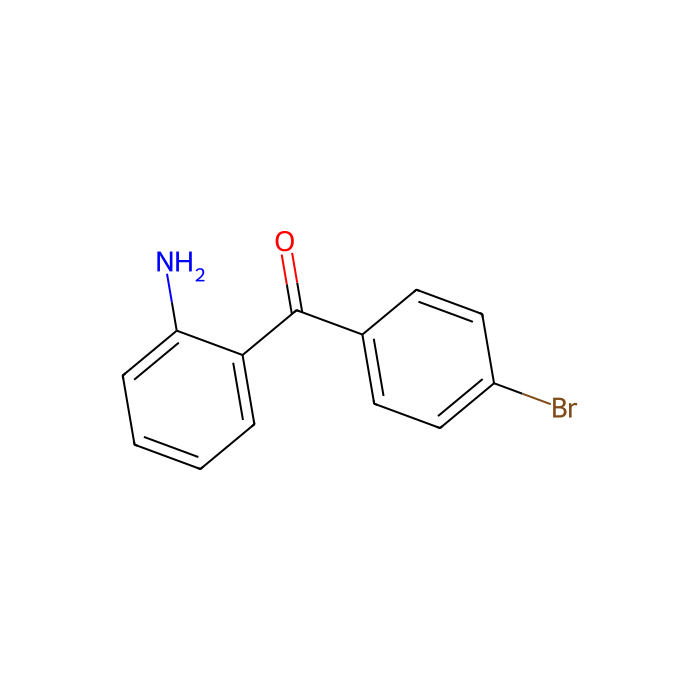
A brominated, anilide-bearing benzophenone scaffold useful as a bifunctional building block (aryl bromide + aniline + aryl ketone).
Product Name (Item-specific): 2-Amino-4′-bromobenzophenone (SKU: A138046)
CAS (Item-specific): 1140-17-6
CID (Item-specific): 5243931
InChIKey (Item-specific): 399200
SMILES (Item-specific): Not specified for this item; refer to CoA/Spec Sheet.
Molecular Formula (Item-specific): Not specified for this item; refer to CoA/Spec Sheet.
Molecular Weight (Item-specific): Not specified for this item; refer to CoA/Spec Sheet.
Literature/computed identifiers and features (for reference only):
Empirical formula (literature): C13H10BrNO (consistent with an amino-bromobenzophenone isomer)
Approx. formula weight (literature): ~276.13 g/mol
Core structural features:
A benzophenone framework (diphenyl ketone, Ar–CO–Ar′)
One ring bears an ortho-amino (–NH2) substituent relative to the carbonyl (2-amino on one phenyl)
The other ring bears a para-bromo (–Br) substituent (4′-bromo on the second phenyl)
Planar, conjugated, polyaromatic system with a polar ketone (C=O) and a basic aniline nitrogen
2D verbal depiction:
A central carbonyl (C=O) links two phenyl rings. On the “left” ring, an –NH2 group is positioned ortho (adjacent) to the carbonyl junction. On the “right” ring, a –Br is para to the carbonyl junction. The arrangement provides orthogonal handles: an electrophilic aryl–Br for cross-coupling, a nucleophilic aniline, and a versatile aryl ketone.
Synthetic Utility
Orthogonal functionality enables efficient diversification and convergent synthesis:
Functional handles and transformations (literature/general):
Aryl bromide (para on second ring):
Pd-catalyzed cross-couplings (Suzuki, Sonogashira, Heck, Negishi, Stille) to install aryl, vinyl, or alkynyl groups.
Halogen–lithium exchange (under cryogenic conditions) to access organolithium intermediates for further electrophile trapping (requires protection of the aniline).
Aniline (ortho on first ring):
Protection (acyl/sulfonyl/carbamate) to modulate reactivity and direct selectivity.
Electrophilic aromatic substitution tuned by the –NH2 activator; diazotization enables Sandmeyer-type substitutions.
N-arylation (Buchwald–Hartwig) with external aryl halides to form diarylamines.
Benzophenone carbonyl:
Formation of oximes/hydrazones; conversion to imines/enamines; reductive amination for benzylic amines.
Reductions to secondary alcohols (NaBH4, catalytic hydrogenation) or deoxygenation (Wolff–Kishner/Clemmensen; substrate/catalyst compatibility required).
Strategic notes:
The proximity of –NH2 to the carbonyl enables chelation-assisted metalation (DoM) and intramolecular cyclizations to quinazolin-4(3H)-ones/quinazolines with suitable partners (e.g., nitriles, formamides, amidines).
Protecting the aniline often improves Pd-catalyst longevity and suppresses competitive binding during cross-coupling at Ar–Br.
The aryl bromide is a reliable entry for late-stage diversification; leverage milder coupling conditions to preserve sensitive N-protecting groups or oxime functionality.
Purification/workup tips:
Basic additives (0.1–1% TEA) in silica eluent reduce tailing of anilines. For sensitive derivatives, use neutral alumina or reverse-phase chromatography.
Target Specificity
Not applicable. This product is a small-molecule building block, not a biological targeting reagent (e.g., antibody, enzyme inhibitor standard with defined target). No antigen/epitope, species reactivity, clone, or isotype information applies.
Perguntas frequentes
What is the purity of this product?
This product is supplied at ≥95% purity (chemical assay). Lot-specific values are stated on the Certificate of Analysis.
How should this product be stored?
Store at room temperature.
How is this product shipped?
This product ships under standard ambient conditions. No temperature-controlled packaging is required.
What are the CAS number, molecular formula and molecular weight?
The CAS Number is 1140-17-6, the molecular formula is C13H10BrNO, and the molecular weight is 276.13 g/mol. InChIKey WIISOMGJWLLMDG-UHFFFAOYSA-N.
What documentation is provided?
Available product documentation, including Certificates of Analysis (COA), Safety Data Sheets (SDS), and specification sheets, is shown in the product document area. Document availability and access follow the current site policy.
Usamos cookies para garantir o funcionamento adequado do site e, quando permitido, para melhorar a sua experiência. Você pode gerenciar suas preferências a qualquer momento nas Configurações. Saiba mais em nossa Política de Cookies.
Deseja que lhe enviemos uma mensagem quando tivermos descontos disponíveis?
Lembrar-me mais tarde
Obrigado! Por favor, verifique a sua caixa de entrada de e-mail para confirmar.
Products are supplied to verified businesses, institutions, and qualified professionals for research and development use only. Not for use in humans, animals, diagnosis, or therapy.

 K1526096