This compound belongs to the class of organic compounds known as m-fluorophenols. These are fluorophenols carrying a iodine at the C3 position of the benzene ring.
External Descriptors
Not available
1. Djoumbou Feunang Y, Eisner R, Knox C, Chepelev L, Hastings J, Owen G, Fahy E, Steinbeck C, Subramanian S, Bolton E, Greiner R, and Wishart DS. ClassyFire: Automated Chemical Classification With A Comprehensive, Computable Taxonomy. Journal of Cheminformatics, 2016, 8:61.
Determine the necessary mass, volume, or concentration for preparing a solution.
Dilution Calculator
Determine the dilution needed to prepare a stock solution.
Reconstitution Calculator
Revisões
Avaliações dos Clientes
Application Protocols
Not applicable. No immunoassay or cell-based application protocols (e.g., WB, IHC, IF, FC) are provided for this small-molecule reagent. For synthetic usage, refer to the Reaction Conditions and Synthetic Utility sections.
Biological Roles
This product is intended for research use in chemical/biochemical laboratories. No biological activity is claimed for this catalog item.
General literature context (not item-specific claims):
Aminophenols can participate in redox processes, forming quinone-imine species under oxidative conditions; such motifs are encountered in metabolic pathways of certain aromatic amines/phenols.
Fluorinated aromatics are valued probes/intermediates in chemical biology due to the bioisosteric and electronic effects of fluorine, which can modulate lipophilicity and metabolic stability when incorporated into ligands or materials.
The o-aminophenol functionality offers bidentate H-bonding/chelation potential, which is sometimes exploited in sensor dyes and metal-binding probes.
Any exploration of biochemical behavior should be performed under appropriate approvals and strictly as laboratory research. No clinical, diagnostic, or therapeutic use is implied.
Buffer Applications
Not typically used as a buffer component. As a small aromatic amine/phenol, it lacks the polyprotic, high-solubility characteristics required for robust buffering systems.
Practical notes:
pH-dependent solubility and ionization may be leveraged for extraction or purification (e.g., form the anilinium salt under acidic conditions), but this is not a buffer application.
For buffering near neutral pH, use established systems (e.g., phosphate, HEPES, acetate) instead of this compound.
Green Alternatives
While 2-Amino-5-fluorophenol is a solid building block rather than a process solvent, greener choices can be made in its use and processing.
Greener solvent choices (literature guidance):
Replace DMF/DMSO where feasible with MeCN, EtOAc, 2-MeTHF, CPME, propylene carbonate, or water/ethanol mixtures, balancing solubility and reactivity.
For extractions, prefer EtOAc or 2-MeTHF over chlorinated solvents when compatible.
Energy and workup:
Employ microwave or flow to reduce reaction time/energy if compatible.
Use solid-supported reagents/bases to simplify purification and reduce aqueous waste.
Oxidation control without heavy metals:
When oxidative cyclizations are required, consider organic oxidants (e.g., Oxone) or electrochemical methods instead of stoichiometric chromium or hypervalent iodine reagents, where literature supports.
Comparative snapshot (general):
DMF/DMSO: High solvency/reactivity; EHS challenges; difficult removal.
2-MeTHF/EtOAc: Renewable or low-tox; easier workup; may need higher temperature/longer time.
Water/EtOH: Greenest matrix; limited solubility; may require surfactants or pH-tuning (form phenolate/anilinium salts).
Adopt solvent selection tools (e.g., CHEM21, GSK, Pfizer guides) to balance performance and sustainability for your specific transformation.
Pharmaceutical Uses
No excipient or formulated pharmaceutical use is claimed for this item. It is supplied strictly for research use only.
General literature perspective:
Fluorinated aminophenol cores appear as intermediates in the synthesis of heterocycles (e.g., benzoxazoles/benzoxazines) and as precursors to dye/sensor scaffolds. Such intermediates may be evaluated in discovery pipelines for structure–activity studies, but this catalog item is not intended for human or veterinary use.
The phenol and aniline functional groups enable straightforward protection/deprotection strategies (e.g., Boc, acyl, silyl), useful when assembling complex small molecules during process development.
Refer to institutional guidelines for handling research chemicals and do not use in drug products.
Physical Properties
Item-specific values (specs):
Appearance: Not specified for this item; refer to CoA/Spec Sheet.
Molecular formula: Not specified for this item; refer to CoA/Spec Sheet.
Molecular weight: Not specified for this item; refer to CoA/Spec Sheet.
Literature/computed properties (for professional reference; not item specifications):
Calculated molecular formula: C6H6FNO (see Structure & Identity)
Calculated molecular weight: ~127.12 g/mol
Acid/base behavior (literature): Bifunctional. Phenolic pKa typically ~9–10 for aminophenols; anilinium conjugate acid pKaH typically ~4–5. A para/fluoro substituent slightly withdraws electron density, tending to lower amine basicity and increase phenol acidity modestly relative to o-aminophenol.
Polarity/partitioning (literature expectation): Moderately polar aromatic; expected logP near unity for related aminophenols, with hydrogen-bond donor/acceptor capacity (1 donor each for OH and NH2; OH/N as acceptors when deprotonated/unprotonated respectively).
Solubility (qualitative, literature): Poorly to moderately soluble in water (pH-dependent); improved solubility in polar organic solvents (MeOH, EtOH, acetone) and high in dipolar aprotics (DMF, DMSO). Forms water-soluble salts upon amine protonation under acidic conditions.
Thermal behavior: Aminophenols often melt/decompose upon heating; fluorination can raise thermal stability but oxidative darkening on air exposure is common.
Note: Use these literature values only as planning guidance. For exact specifications of this lot, consult the product CoA/Spec Sheet.
Quality and Grades
Item-specific grade/purity: Not specified for this item; refer to CoA/Spec Sheet.
Practical implications:
In absence of a declared grade (e.g., AR, HPLC, 98%), verify suitability by reviewing the CoA for assay, residual solvent, and impurity profile (e.g., related aminophenols, oxidative byproducts). For chromatographic or photochemical work, low-UV-absorbing and low-fluorescent impurity levels are desirable.
Given the tendency of aminophenols to oxidize, check the stabilization/atmosphere on the CoA. This item is supplied argon charged; maintain inert conditions after opening. If a stabilizer is declared on the CoA, assess its compatibility with your application.
Typical grade guidance (general):
Analytical Reagent (AR) grade: Tight limits on inorganic contaminants; suitable for quantitative analysis and synthesis where trace metals may matter (e.g., for catalysis-labile steps).
HPLC grade (when applicable to solvents): Low UV background; for solids like this, look for “LC/MS” suitability wording if relevant to trace analysis.
Synthesis grade (95–98%+): Common for building blocks; may require recrystallization or purification for sensitive transformations (e.g., SNAr polymerizations, intramolecular cyclizations to benzoxazoles).
Always verify lot-specific details in the CoA/Spec Sheet before use.
Reaction and Applications
2-Amino-5-fluorophenol is a versatile bifunctional aromatic building block combining a nucleophilic aniline and a phenol with a para-related aryl fluoride.
Intramolecular cyclodehydration to benzoxazoles/benzoxazines: Condense the –NH2 with carbonyl partners (e.g., aldehydes, carboxylic acids), followed by oxidative/cyclodehydrative steps to access heteroaromatics useful in materials and medicinal chemistry.
Selective acylation/alkylation: With appropriate base and acyl donors, chemoselective protection of –NH2 (e.g., Boc, acetyl) or –OH (e.g., silyl, carbonate) enables orthogonal elaboration.
Diazotization/azo coupling (on aniline): Formation of diazonium salts enables further transformations (e.g., Sandmeyer reactions) or coupling to activated aromatics for dye intermediates; manage phenol reactivity via protection or pH control.
SNAr leveraging the aryl fluoride (intermolecular): Although aryl F is generally less labile, the presence of ring activators and appropriate nucleophiles/bases in polar aprotics can enable substitution, enabling rapid library diversification.
O-arylation/N-arylation: As a nucleophile, phenoxide or anilide can undergo Ullmann–Goldberg or Buchwald–Hartwig couplings with suitable aryl halides/triflates after deprotonation/protection.
Practical tips:
Maintain inert atmosphere to minimize oxidative discoloration and byproduct formation.
Use orthogonal protection to direct selectivity (e.g., protect –NH2 when targeting O-functionalization).
For SNAr, increase activation with stronger bases (e.g., Cs2CO3) and higher-boiling polar aprotics; consider phase-transfer catalysts for heterogeneous setups.
Application domains (general):
Intermediate for fluorinated benzoxazoles, dyes, fluorescent probes, and specialty polymers where H-bonding or chelation motifs are beneficial.
Reaction Conditions
General literature guidance for typical transformations of o-aminophenol derivatives; adjust to your substrate and scale. These are not specifications for this item.
O-alkylation to form aryl ethers:
Conditions: Alkyl halide (1.1–1.5 eq), base (K2CO3 or Cs2CO3, 2–3 eq), solvent (acetone/MeCN/DMF), 25–80°C, 2–16 h.
Notes: Exclude moisture/air; monitor for competing N-alkylation and adjust base/solvent accordingly.
N-acylation (amide/carbamate formation):
Conditions: Acyl chloride/anhydride (1.1–1.5 eq), base (pyridine, DIPEA, or Na2CO3 aq.), solvent (DCM/THF/MeCN), 0–25°C, 0.5–4 h.
Notes: Low temperature improves N-selectivity vs O-acylation; alternative: activated esters (e.g., NHS) for milder conditions.
Benzoxazole synthesis (cyclodehydration):
Conditions: Condense with aldehyde (1.0–1.2 eq) in toluene or acetic acid, then oxidative cyclization using DDQ, I2/DMSO, or catalytic Cu(II), 60–120°C, 4–16 h.
Notes: Protect phenol or exploit intramolecular H-bonding to favor cyclization; remove oxygen-sensitive byproducts promptly.
Diazotization/azo coupling (from aniline):
Conditions: NaNO2 (1.1 eq) in HCl (2–3 M), 0–5°C to form diazonium; couple to activated aromatics at 0–10°C.
Notes: Phenol may need protection or pH control to manage O-coupling; diazonium salts can be hazardous—handle at low temperature and in small portions.
Yields are substrate- and condition-dependent; consult primary literature for optimization with this substitution pattern.
Safety and Handling
GHS/CLP information (item-specific):
Signal Word: Not specified for this item; refer to SDS.
H-Statements: Not specified for this item; refer to SDS.
GHS Classification: Not specified for this item; refer to SDS.
Pictograms: Not specified for this item; refer to SDS.
General safety considerations (literature/analog-based; not a substitute for SDS):
Irritation/sensitization: Aromatic amines and phenols can be skin/eye irritants; avoid contact. Phenolic compounds may cause burns at high concentrations.
Oxidation tendency: o-Aminophenol motifs readily oxidize in air/light to quinone-imine type species, leading to darkening. Handle under inert atmosphere as provided.
Peroxide formation: Not expected (non-ether), but oxidative polymerization/discoloration may occur; minimize oxygen and light exposure.
Handling and PPE:
Work in a fume hood. Wear lab coat, safety glasses, and appropriate chemically resistant gloves (e.g., nitrile). Avoid inhalation of dust and contact with skin/eyes.
Use inert gas blanket during manipulations to limit oxidation.
Incompatibilities (general):
Strong oxidizers (risk of exothermic oxidation), acylating/alkylating agents (reactive with –NH2/–OH), and strong acids/bases (salt formation/decomposition). Copper/iron salts can catalyze oxidation.
First-aid overview (consult SDS for full guidance):
Eye/skin contact: Rinse with water for ≥15 min, remove contaminated clothing. Seek medical attention.
Inhalation: Move to fresh air, monitor respiration. Seek medical attention if symptoms persist.
Ingestion: Rinse mouth; do not induce vomiting; seek medical attention.
Always defer to the official SDS for authoritative hazards and response measures.
Solvent Selection
This item is a moderately polar, multifunctional aromatic solid (phenol + aniline). Solvent choice should account for acid/base equilibria, hydrogen bonding, and potential for oxidation.
High solubility: DMSO, DMF, NMP; good in MeOH/EtOH/IPA and acetone/MeCN.
Limited solubility: Unmodified alkanes/ethers (heating may be required); solubility increases upon salt formation in water (acidic conditions) or deprotonation in basic media.
Selection by use-case:
Nucleophilic aromatic substitution (SNAr) or cyclizations to benzoxazoles: Polar aprotics (DMF, DMSO, sulfolane) favor reactivity and solvating power; remove oxygen and moisture.
Electrophilic acylation/alkylation at –NH2/–OH: Choose non-nucleophilic bases (DIPEA, pyridine) and polar organics (DCM, MeCN) or two-phase systems with aqueous base; keep temperatures low to control chemoselectivity.
Metal-catalyzed couplings (if aryl–X is installed): Alcohols/ethers (EtOH/2-MeTHF/CPME) or DMF/MeCN depending on catalyst system; ensure the phenol/amine is protected or deprotonated as required.
Comparison notes (general):
DMSO/DMF maximize solubility/reactivity but pose workup and EHS burdens.
2-MeTHF/EtOAc offer greener profiles for extractions and some couplings; may require protection or salt-formation strategies for solubility.
Validate solvent compatibility with downstream steps (e.g., avoiding conditions that promote oxidative darkening).
Storage and Reconstitution
Item-specific storage and shipping:
Storage Conditions: Store at 2–8°C, Argon charged (as provided).
Shipped In: Wet ice.
Research Use: For research use only.
Practical guidance (general, aligned with item conditions):
Keep container tightly closed under the argon headspace to minimize oxidation to quinone-imine species and prevent discoloration.
Minimize exposure to air, light, and moisture. If frequent access is expected, consider aliquoting under inert gas.
Allow to equilibrate to room temperature before opening to avoid condensation.
Reconstitution/dissolution (general suggestions):
Readily dissolves in DMSO, DMF, MeOH, EtOH, and acetone (literature). For aqueous work, adjust pH to form the anilinium (acid) or phenolate (base) salts to enhance solubility.
For stock solutions (e.g., for screening chemistry), prepare under inert atmosphere, filter if necessary (0.2 µm PTFE), and store cold and dark. Typical concentrations: 10–200 mM in DMSO/DMF depending on solubility.
Stability monitoring:
Inspect periodically for color change or precipitate formation; darkening can indicate oxidation. If observed, consider re-purification (e.g., rapid chromatography under inert eluent) before critical use.
Always consult the lot-specific CoA/Spec Sheet and SDS for definitive handling and stability information.
Structure and Identity
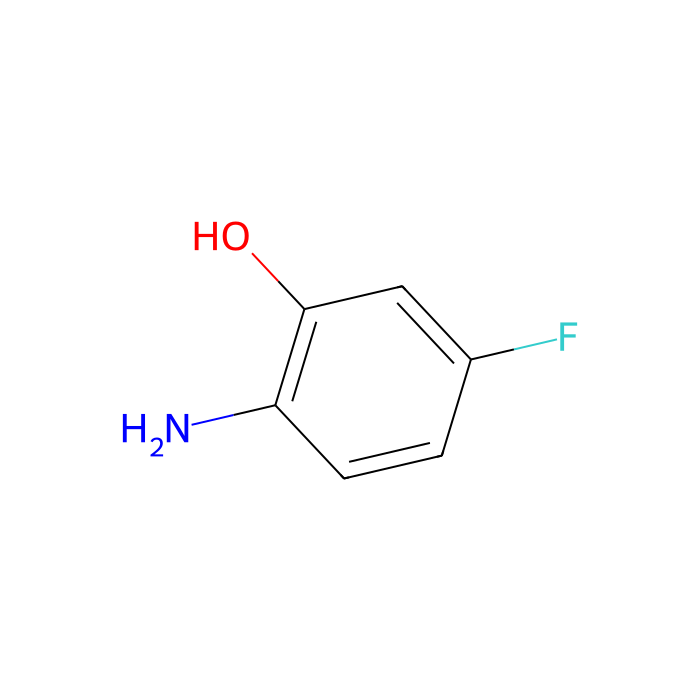
A fluorinated o-aminophenol building block featuring adjacent phenol (–OH) and aniline (–NH2) functions on a monosubstituted benzene ring.
Item-specific identifiers (from Product Data):
Product Name: 2-Amino-5-fluorophenol
CAS: 53981-24-1
CID (PubChem): 185763
InChIKey: 141618 (as provided)
SMILES: Not specified for this item; refer to CoA/Spec Sheet.
Literature/computed identity details (general):
Molecular formula (calculated): C6H6FNO
Molecular weight (calculated): ~127.12 g/mol
Core scaffold: Benzene ring bearing ortho-phenolic OH (position 1) and amino (position 2) groups; a fluoro substituent at the 5-position (meta to OH, para to –NH2 in the 2/5 relationship).
Functional groups: Phenol (acidic OH), aniline (basic amine), aryl fluoride (deactivated toward further EAS at the F-bearing carbon; activates for SNAr under appropriate conditions).
2D structure (described): A six-membered aromatic ring with –OH and –NH2 adjacent (ortho) and an F substituent two carbons away from –NH2 (para to –NH2, meta to –OH).
Stereochemistry: None (achiral, planar aromatic).
Synthetic Utility
Functional handles and reactivity:
Aniline (–NH2): Nucleophilic at nitrogen; engages in acylation, sulfonylation, carbamate formation, reductive amination (after prior formylation), diazotization → diversification via Sandmeyer-type steps.
Phenol (–OH): O-alkylation/acylation; conversion to carbonate/carbamate; activation (e.g., to triflate) for cross-coupling; generation of phenoxide nucleophile for SNAr and ether formation.
Aryl fluoride: Electron-withdrawing; can be displaced in SNAr when additional activation is present or after proper deprotonation/activation of nucleophile; also influences directing effects for EAS.
Strategic uses (retrosynthesis):
Benzoxazole formation: Condense –NH2 with carbonyl equivalents, followed by oxidative cyclodehydration (e.g., with POCl3, PPh3/I2, or catalytic conditions) to access heteroaromatics.
Orthogonal protection: Selective protection of –NH2 (Boc, Cbz) vs –OH (TBS, MOM, benzyl) enables stepwise elaboration and late-stage diversification.
Cross-coupling gateways: Convert the phenol to a triflate, then Suzuki–Miyaura, Buchwald–Hartwig, or Ullmann steps build complexity while preserving or transforming the –NH2.
Synthesis planning tips:
Control oxidation by excluding air and using antioxidants or rapid workups.
For chemoselectivity (N- vs O-alkylation), choose base and solvent deliberately: weak, non-nucleophilic bases and polar aprotics often favor O-alkylation; stronger bases (NaH) may favor O-deprotonation first but can also enable N-alkylation depending on conditions.
Consider transient protection of one site to avoid undesired bis-functionalization.
Target Specificity
Not applicable. This product is a small-molecule reagent and is not an antibody, protein, or targeted biological. No antigen/epitope or species reactivity applies.
We use cookies to ensure the website functions properly and, where permitted, to improve your experience. You can manage your preferences at any time in Settings. Learn more in our Cookie Policy.
Shall we send you a message when we have discounts available?
Remind me later
Thank you! Please check your email inbox to confirm.
Products are supplied to verified businesses, institutions, and qualified professionals for research and development use only. Not for use in humans, animals, diagnosis, or therapy.

 A2506005