This compound belongs to the class of organic compounds known as nitrobenzaldehydes. These are nitrobenzenes that carry an aldehyde group at any position of the benzene ring.
External Descriptors
Not available
1. Djoumbou Feunang Y, Eisner R, Knox C, Chepelev L, Hastings J, Owen G, Fahy E, Steinbeck C, Subramanian S, Bolton E, Greiner R, and Wishart DS. ClassyFire: Automated Chemical Classification With A Comprehensive, Computable Taxonomy. Journal of Cheminformatics, 2016, 8:61.
Determine the necessary mass, volume, or concentration for preparing a solution.
Dilution Calculator
Determine the dilution needed to prepare a stock solution.
Reconstitution Calculator
Revisões
Avaliações dos Clientes
Application Protocols
Not applicable as an assay reagent in immunotechniques. No validated protocols (WB, IHC, IF, FC) or dilutions are provided in the product data. For usage, refer to the Reaction & Applications and Reaction Conditions sections for synthetic procedures.
Biological Roles
Item-specific biological data are not provided. As an aryl aldehyde with nitro and bromo substituents, 2-bromo-5-nitrobenzaldehyde is not a natural metabolite and has no known physiological role.
General considerations (literature):
Aromatic nitro compounds can undergo bioreduction in microbial systems to give the corresponding anilines; however, this is context-dependent and not a property leveraged for biological function.
The aldehyde group can form reversible Schiff bases with primary amines; in biological matrices this leads to nonspecific adducts rather than defined signaling roles.
Use in life science labs:
Primarily as a synthetic building block for small-molecule libraries and probes after derivatization; not used as a buffer, nutrient, or biochemical cofactor.
Research Use Note: For research use only. Not for diagnostic or therapeutic applications.
Buffer Applications
This compound is not a buffering agent and is not used to prepare biological buffers. It lacks acid/base conjugate pairs suitable for maintaining pH in aqueous systems. For laboratory work with this substrate, refer instead to the Solvent Selection and Reaction & Applications sections.
Green Alternatives
Opportunities to improve the sustainability profile of work with 2-bromo-5-nitrobenzaldehyde focus on solvent choice and catalytic conditions rather than on the substrate itself.
Greener solvent swaps (literature guidance):
Replace DCM/chloroform with ethyl acetate or dimethyl carbonate for extractions and chromatography where feasible.
Substitute THF with 2-MeTHF or CPME in Wittig/Knoevenagel reactions and even in Suzuki couplings; these ethers offer higher boiling points and lower peroxide formation tendencies compared with THF, and are often biorenewable (2-MeTHF).
Use water/ethanol/toluene biphasic media for Suzuki–Miyaura couplings with water-tolerant ligands.
Comparison (general):
DCM vs EtOAc: EtOAc is less toxic and biodegradable; slightly less solvating power for very polar substrates.
THF vs 2-MeTHF: 2-MeTHF is greener and forms fewer peroxides; different miscibility with water may alter workups.
DMF/NMP vs propylene carbonate or Cyrene: greener high-boiling polar aprotics can sometimes replace DMF/NMP; verify catalyst/solubility compatibility.
Catalysis/process:
Employ ligand-optimized Pd catalysis to run at lower loadings and temperatures; consider Ni catalysis for certain couplings to reduce Pd usage.
Flow hydrogenation for nitro reductions can improve safety and solvent efficiency.
Note: Validate any substitution with small-scale trials to confirm reaction rate, selectivity, and isolation profiles.
Pharmaceutical Uses
No pharmacopeial or excipient status is provided for this item. 2-Bromo-5-nitrobenzaldehyde may serve as a synthetic intermediate in the preparation of small molecules during drug discovery and process development, but it is not itself an approved drug substance or excipient.
Formulation/manufacturing context (general):
Building block for structure–activity relationship (SAR) exploration where both an aryl bromide handle (for coupling diversification) and an aldehyde (for condensation/olefination) are desirable.
Potential intermediate toward anilide or heteroaryl derivatives after nitro reduction and subsequent functionalization.
Compliance note: Any use in cGMP or regulated settings should be supported by the supplier’s CoA/Spec Sheet detailing purity, residual solvents, and trace metals, as applicable. Research Use Only applies.
Physical Properties
Item-specific specifications are not provided in the product data; consult the CoA/Spec Sheet for definitive values.
General/literature information for 2-bromo-5-nitrobenzaldehyde (for context only; not item specifications):
Physical state: typically a crystalline solid; color often off-white to pale yellow for nitrobenzaldehydes.
Solubility: sparingly soluble in water; soluble in common organic solvents such as dichloromethane, chloroform, ethyl acetate, THF, acetonitrile, and alcohols (literature, qualitative).
Volatility: low; aldehyde function can exhibit odor consistent with aromatic aldehydes.
Acid/base: non-basic; the aldehyde can hydrate slightly in water; nitro group strongly deactivating/electron-withdrawing.
Partition behavior: expected moderate lipophilicity due to aryl bromide and nitro substituents (logP not widely tabulated for this specific isomer; literature values vary).
Not specified for this item; refer to CoA/Spec Sheet:
Melting point, boiling point, density, refractive index, UV-Vis cutoff, water/peroxide/metal limits.
Quality and Grades
Grade/Purity: Not specified for this item; refer to CoA/Spec Sheet.
Interpretation and guidance:
When provided, an analytical or synthesis grade specification for aryl aldehydes typically addresses purity by GC/HPLC and residual solvents. For cross-coupling uses, trace metal content may also be relevant.
UV/Vis profile and low-UV absorbance are not typically critical unless using as an analytical standard.
Stabilizers: Not commonly added to simple aromatic aldehydes; if present, they would be disclosed on the CoA. For sensitive applications (e.g., organometallic coupling), users often repurify by recrystallization or bulb-to-bulb distillation under reduced pressure.
Recommendation:
Verify assay, residual solvent levels, and any stabilizer on the CoA/Spec Sheet prior to regulated or highly sensitive synthesis steps.
Reaction and Applications
2-Bromo-5-nitrobenzaldehyde is a versatile bifunctional building block. The aryl bromide enables cross-coupling, the nitro group modulates electronics and can be transformed, and the aldehyde undergoes classic carbonyl chemistry.
Key application families (literature/practice):
Cross-coupling at C–Br: Suzuki–Miyaura (aryl/heteroaryl boronates), Heck (olefination), Sonogashira (alkynylation), and Buchwald–Hartwig (after nitro→amino conversion or via C–N formation with specialized systems). The nitro and aldehyde groups typically tolerate Pd-catalyzed couplings with proper base/ligand choice.
Aldehyde transformations: Wittig/Horner–Wadsworth–Emmons to install styrenyl or vinyl nitroarenes; Knoevenagel and Henry (nitroaldol) condensations; reductive amination to anilide-type products after nitro reduction.
Nitro group chemistry: Chemoselective reduction to the aniline (e.g., Fe/AcOH, SnCl2, catalytic hydrogenation), enabling subsequent acylation, diazotization, or intramolecular cyclizations. Alternatively, the nitro can participate in nucleophilic aromatic substitution if further activated.
Directed metalation: The nitro and aldehyde groups strongly deactivate the ring toward EAS, favoring cross-coupling routes. Orthogonal protection/derivatization sequences are feasible (e.g., protect aldehyde as acetal prior to strong base).
Use cases:
Assembly of push–pull cinnamaldehyde motifs (via HWE) for materials/optical probes.
Synthesis of diversified nitro- and amino-biaryls from a single handle using sequential coupling and nitro reduction.
Tip: If side reactions at the aldehyde occur under basic coupling conditions, protect as an acetal (ethylene glycol, p-TsOH) before cross-coupling, then deprotect.
Reaction Conditions
Typical literature conditions for transformations of 2-bromo-5-nitrobenzaldehyde (guidance only; optimize per substrate):
Suzuki–Miyaura coupling (Ar–Br):
Catalyst: Pd(PPh3)4 (1–3 mol%) or Pd2(dba)3 (1 mol%) with PPh3/XPhos.
Base: K2CO3 or K3PO4 (2–3 equiv).
Solvent: toluene/EtOH/H2O (2:1:1), 1,4-dioxane/H2O, or DMF.
Temperature: 70–100 °C; 6–16 h.
Notes: Protect aldehyde as acetal if base-sensitive side reactions occur. Nitro group tolerated.
Heck coupling (olefination):
Catalyst: Pd(OAc)2 (1–2 mol%) with PPh3 or phosphine ligands.
Base: Et3N or DIPEA.
Solvent: DMF, NMP, or toluene.
Temperature: 90–130 °C; 8–20 h.
Notes: Aldehyde can participate in conjugation if vinylic product formed ortho to CHO.
Sonogashira coupling (alkynylation):
Catalyst: Pd(PPh3)2Cl2 (1–2 mol%) + CuI (2–5 mol%).
Base: Et3N or iPr2NH.
Solvent: THF, DMF, or MeCN.
Temperature: 25–60 °C; 2–12 h.
Wittig/Horner–Wadsworth–Emmons (olefination of CHO):
Base: NaH, KOtBu, or K2CO3 (for stabilized ylides).
Solvent: THF, DCM, or MeCN.
Temperature: 0–25 °C (stabilized) to 25–50 °C (non-stabilized); 1–6 h.
Nitro reduction → aniline:
H2 (1–3 bar), Pd/C (5–10 wt% of substrate), EtOH or EtOAc, RT–50 °C, 2–6 h; or Fe/AcOH or SnCl2/HCl under reflux (aqueous/ethanolic).
Yields vary by partner and conditions; typical cross-couplings furnish 60–90% isolated yield when optimized (literature ranges).
Safety and Handling
Safety details are not specified for this item in the product data. Always review the SDS for authoritative guidance.
GHS (item-specific):
Signal word: Not specified for this item; refer to SDS.
Hazard statements (H-phrases): Not specified for this item; refer to SDS.
GHS classification/pictograms: Not specified for this item; refer to SDS.
General handling guidance for aromatic nitrobenzaldehydes (literature/practice):
Likely to cause skin/eye irritation and respiratory irritation; avoid dust formation and inhalation.
Wear appropriate PPE: lab coat, safety glasses or face shield, and chemical-resistant gloves (e.g., nitrile). Use in a fume hood.
Incompatibilities: strong bases (can cause aldol-type side reactions/condensation), strong oxidizers (risk of over-oxidation of aldehyde), strong reducing agents (may reduce nitro to amine), and nucleophiles that could add to the carbonyl.
Aldehydes can autoxidize to corresponding acids; minimize air exposure for long-term storage.
First aid (general): rinse skin/eyes with water for several minutes; move to fresh air if inhaled; seek medical attention as needed. Spill control with inert absorbent; collect as hazardous waste.
Research Use Note: For research use only. Not for human or animal consumption.
Solvent Selection
This substrate is a moderately polar aromatic aldehyde with an aryl bromide and nitro substituent. It is generally insoluble in water but dissolves in many organic solvents.
Practical, literature-based selection guidance:
Polar aprotic: DMF, DMAc, NMP, DMSO, and acetonitrile dissolve the compound well and support Pd-catalyzed cross-couplings and nucleophilic additions. DMF/DMAc are useful at elevated temperatures; MeCN for room-temperature condensations.
Moderately polar ethereal/ester: THF, 2-MeTHF, dioxane, and ethyl acetate are suitable for Wittig/Knoevenagel reactions and for workups/crystallizations.
Chlorinated: DCM and chloroform provide excellent solubility and are convenient for extractions and rapid chromatography; consider environmental/health impacts.
Alcoholic: Methanol/ethanol can be used for Henry (nitroaldol) or Knoevenagel condensations with secondary co-solvents if needed.
When to choose alternatives:
If aldehyde polymerization/side reactions are observed in basic media, switch to less basic conditions or buffered solvents.
For greener profiles, consider 2-MeTHF or CPME in place of THF, and EtOAc or Me-THF in place of DCM for extractions.
Note: Actual solubility limits and spectral transparency are method-dependent; confirm experimentally for your application.
Storage and Reconstitution
Storage Conditions (item-specific): Room temperature (per product data). Store tightly closed in a dry, well-ventilated place.
Shipped In: Normal (per product data).
General guidance for aromatic aldehydes (practice):
Protect from light and moisture to minimize oxidation of the aldehyde to the corresponding benzoic acid. Consider storing under inert gas for long-term retention of purity.
If frequent openings are anticipated, aliquot into smaller vials to limit headspace oxygen exposure.
Do not refrigerate in humid environments without desiccation, as repeated warming can cause condensation.
Reconstitution/Preparation:
Solid typically dissolves readily in DCM, THF, EtOAc, MeCN, or alcohols. Warm gently if needed and sonicate to assist dissolution. Filter if particulates remain.
For moisture-sensitive operations (e.g., strong-base couplings), dry solvents (molecular sieves or solvent system dry) are recommended.
Shelf-life: Not specified for this item; refer to CoA/Spec Sheet.
Research Use Note: For research use only.
Structure and Identity
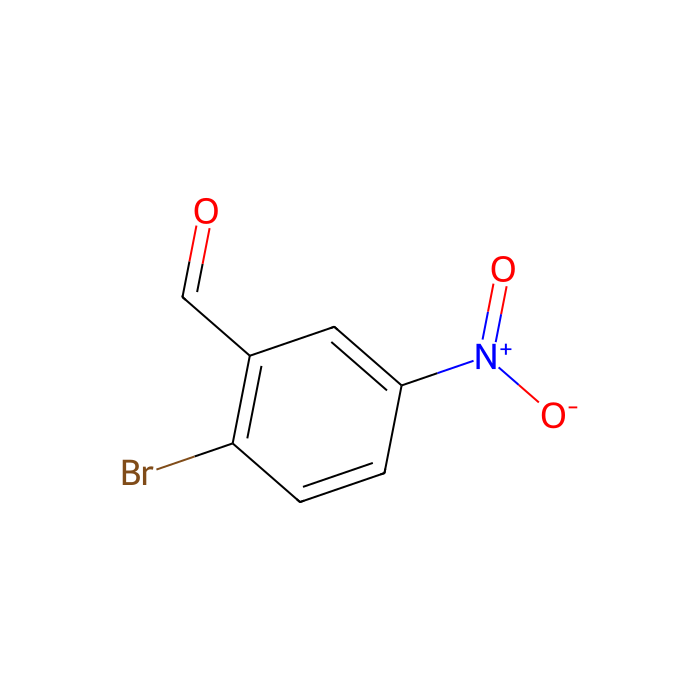
2-Bromo-5-nitrobenzaldehyde is an electrophilic aromatic aldehyde bearing two strong deactivating substituents (bromo and nitro) that provide orthogonal handles for cross-coupling and condensation chemistry.
SKU: B186858
CAS: 84459-32-5
PubChem CID: 11138942 (literature)
InChIKey: Provided in product data as "200779" (appears truncated). Full InChIKey: Not specified for this item; refer to CoA/Spec Sheet.
Functional group triad and their synthetic leverage:
Aryl bromide: Readily engages in Pd-catalyzed cross-coupling (Suzuki, Heck, Sonogashira). Ortho relationship to the aldehyde permits access to ortho-olefinated/vinylic motifs and can influence regioselectivity in subsequent transformations.
Nitro group: Strongly deactivating and meta-directing; provides a convertible handle to amine (via reduction), hydroxylamine (partial reduction), or can be displaced under SNAr when further activated. Also stabilizes anionic intermediates in some condensations.
Aldehyde: Undergoes Wittig/HWE olefination, Knoevenagel/Henry condensations, acetalization (protection), and can be oxidized to the acid or reduced to the alcohol.
Strategic sequences (literature):
Protect–couple–deprotect: Convert aldehyde to acetal, perform cross-coupling at C–Br under basic conditions, then deprotect to reveal the aldehyde for downstream condensation.
Sequential diversification: Cross-couple first to install diversity, then reduce nitro to aniline for intramolecular cyclizations (e.g., to benzoxazoles/benzimidazoles after formyl participation) or for urea/carbamate formation.
Orthogonal chemoselectivity: Nitro survives many Pd couplings; aldehyde may require protection if bases are strong (e.g., NaOtBu). Choice of ligand/base ensures C–Br activation without affecting aldehyde.
Workup/purification tips:
Aldehydes can hydrate/oxidize; avoid prolonged exposure to aqueous basic washes. Quench with mildly acidic conditions and minimize air exposure during concentration. Recrystallization from EtOAc/hexanes or EtOH/water mixtures is often effective (optimize case-by-case).
Target Specificity
Not applicable. This product is a small-molecule chemical reagent, not a biological targeting reagent. No antigen/epitope, species reactivity, clone, or isotype data are relevant. None specified in the product data.
We use cookies to ensure the website functions properly and, where permitted, to improve your experience. You can manage your preferences at any time in Settings. Learn more in our Cookie Policy.
Shall we send you a message when we have discounts available?
Remind me later
Thank you! Please check your email inbox to confirm.
Products are supplied to verified businesses, institutions, and qualified professionals for research and development use only. Not for use in humans, animals, diagnosis, or therapy.

 I2304311