This compound belongs to the class of organic compounds known as fluorenes. These are compounds containing a fluorene moiety, which consists of two benzene rings connected through either a cyclopentane, cyclopentene, or cyclopenta-1,3-diene.
External Descriptors
Not available
1. Djoumbou Feunang Y, Eisner R, Knox C, Chepelev L, Hastings J, Owen G, Fahy E, Steinbeck C, Subramanian S, Bolton E, Greiner R, and Wishart DS. ClassyFire: Automated Chemical Classification With A Comprehensive, Computable Taxonomy. Journal of Cheminformatics, 2016, 8:61.
Determine the necessary mass, volume, or concentration for preparing a solution.
Dilution Calculator
Determine the dilution needed to prepare a stock solution.
Reconstitution Calculator
Revisões
Avaliações dos Clientes
Application Protocols
No assay or immunoapplication protocols apply to this small-molecule reagent.
General laboratory usage examples (literature guidance; adapt to your system):
Cross-coupling setup: Charge an oven-dried vial with 2-bromo-9-fluorenone (1.0 equiv), boronic acid (1.3 equiv), K2CO3 (3.0 equiv), Pd(PPh3)4 (2 mol%), and a stir bar. Add degassed toluene/EtOH/H2O (2:1:1) under N2. Heat at 85–90 °C for 8–12 h. Monitor by TLC/HPLC. Cool, filter through celite, extract, and purify by chromatography.
Halogen–lithium exchange: In a dry, N2-flushed flask, dissolve the substrate in anhydrous THF (0.05–0.1 M) at −78 °C. Add 1.2 equiv n-BuLi dropwise, stir 15–30 min, then add an electrophile (e.g., DMF for formylation). Warm to 0 °C, quench with NH4Cl, extract, and purify.
These are illustrative starting points only. Optimize stoichiometry, temperature, and catalyst/ligand choice based on your substrate pairing and scale. Always consult the SDS and perform appropriate risk assessments.
Biological Roles
This product is a synthetic, halogenated fluorenone used primarily as a chemical building block. It has no established endogenous biological role.
General context (literature): Fluorenone derivatives have been studied for their photophysical properties and, in some cases, as scaffolds in probe development. Substitution at the 2-position modulates electronic distribution across the conjugated system, affecting fluorescence and intersystem crossing behavior.
Metabolism/toxicity perspective: Polycyclic aromatic ketones can undergo Phase I/II metabolism (reduction of the carbonyl, conjugation), but specific metabolic pathways and bioactivities are highly substitution-dependent and not well characterized for 2-bromo-9-fluorenone specifically.
Research-only use: Any exploration of bioactivity should be conducted under appropriate laboratory approvals and containment; no clinical or diagnostic applications are implied.
If your work involves biological systems (e.g., using 2-bromo-9-fluorenone-derived probes), ensure thorough characterization of purity, residual metals (from cross-coupling), and solvent residues to minimize confounding effects in assays.
Buffer Applications
Not typically applicable. 2-Bromo-9-fluorenone is a neutral, poorly water-soluble organic solid and does not serve as a buffering agent.
Practical note: For any aqueous-phase manipulations (e.g., biphasic couplings or extractions), select buffers based on the requirements of the reaction (carbonate/borate/phosphate) rather than properties of this substrate. Control pH to maintain boronic acid stability in Suzuki reactions (pH ~8–10 with carbonate or borate buffers is common in literature).
Green Alternatives
Greener choices focus on solvent and catalyst selection, as the substrate itself is a halogenated PAH derivative.
Replace DCM/CHCl3 with: 2-MeTHF, CPME, anisole, or toluene where feasible (workup simplification, lower toxicity). For polar needs, consider Cyrene or propylene carbonate in place of DMF/DMA.
Aqueous micellar media (e.g., surfactant-enabled Suzuki couplings) can reduce organic solvent volumes at scale.
Catalyst/base optimizations:
Use ligand-optimized nickel catalysis for some cross-couplings to minimize reliance on palladium (scarcity/cost).
Employ heterogeneous Pd/C or silica-supported catalysts for simplified recovery/reuse when compatible.
Energy and process intensification:
Continuous-flow couplings in high-boiling green solvents (e.g., propylene carbonate) can enhance heat/mass transfer and reduce solvent.
Lower-temperature organometallic steps via directed metalation using turbo-Grignards (iPrMgCl·LiCl) in 2-MeTHF reduce cryogenic needs.
Concise comparison (illustrative; not product specifications):
Dioxane (traditional) vs 2-MeTHF (greener): Similar coupling performance; 2-MeTHF is bio-based and has favorable phase-split for workups.
DMF vs Cyrene: Cyrene offers comparable polarity with a better environmental profile; check stability toward bases at elevated temperature.
Trade-offs: Solubility and reaction rates may differ; re-optimize base, ligand, and temperature. Validate impurity profiles (e.g., aldol in Cyrene, peroxide risk in ethers) and ensure product quality remains within your acceptance criteria.
Pharmaceutical Uses
No excipient or formulation use is associated with this compound. It is not used as a buffer, preservative, or solubilizer.
Relevant context (literature/general):
Role as an intermediate: Aryl-bromide-bearing fluorenones can serve as intermediates in the synthesis of fine chemicals, dyes, ligands, and research-grade small molecules that may be evaluated during early discovery. The aryl bromide facilitates late-stage diversification via cross-coupling.
Quality considerations for discovery research: When materials are destined for medicinal chemistry campaigns, researchers often specify higher purity assays, defined residual solvent limits, and screening for halide/metal residues post-coupling. These parameters are project-specific and must be set by the user.
Regulatory note: For research use only. No claims are made regarding GMP status, pharmacopeial monographs, or clinical suitability. If your project requires GMP or special documentation (e.g., TSE/BSE statements, elemental impurity profiles per ICH Q3D), contact us with your compliance needs so we can advise on availability.
Physical Properties
Item-specific numerical specifications (bp, mp, density, water content, residual metals, UV cutoff, etc.): Not specified for this item; refer to CoA/Spec Sheet.
Literature/typical properties for 2-bromo-9-fluorenone (for reference; not product specifications):
Physical state: Yellow to orange crystalline solid (literature general observation for substituted fluorenones).
Melting point: Commonly reported around 155–161 °C (literature ranges vary by source and purity).
Boiling point: Not commonly used operationally (compound typically handled as a solid and used below its decomposition temperature); literature often does not report a reliable bp due to thermal sensitivity.
Solubility: Sparingly soluble in water; soluble in halogenated and aromatic solvents (e.g., dichloromethane, chloroform, toluene), and in polar aprotics (THF, DMF, DMSO) (literature/general).
LogP: Expected in the moderate-to-high range for polycyclic aromatics with a single carbonyl (literature estimates ~3–3.5); exact value depends on measurement method.
UV–Vis: Conjugated aryl ketones exhibit strong absorption in the near-UV; substitution pattern modulates λmax (literature/general). For analytical purposes, determine an experimental spectrum in the intended solvent.
Stability: Aryl bromides are generally air-stable; the conjugated ketone is light-sensitive to some extent—store away from prolonged UV exposure (general best practice).
Note: Always confirm handling temperatures and any thermally mediated steps empirically on your scale and under your conditions.
Quality and Grades
Item-specific grade/purity: Not specified for this item; refer to CoA/Spec Sheet.
Interpretation and guidance (general):
If designated as “>98%” or similar on the CoA, this reflects assay determined by chromatographic or qNMR methods. For reactions sensitive to trace impurities (e.g., cross-couplings), higher assay and low halide/metal residues can materially improve outcomes.
Chromatographic grades (e.g., HPLC grade) are typically relevant to solvents rather than solids; for solids like 2-bromo-9-fluorenone, UV absorbance background and fluorescence tailing can matter for photophysical studies. If a low-UV grade is required, verify via spectral purity data.
Stabilizers: None are typically added to aryl ketone solids; if any stabilizer or inhibitor is used, it will be clearly disclosed on the CoA/Spec Sheet. Absent such disclosure, assume neat material only.
Trace metals/peroxides/water: Not specified for this item; refer to CoA/Spec Sheet. For air- and moisture-sensitive transformations (e.g., lithium–halogen exchange), consider drying under vacuum and, if needed, performing a metal-scavenging step after couplings.
Batch-to-batch consistency: Check CoA for appearance, assay, GC/HPLC purity profile, and residual solvent content. Minor color differences (yellow to orange) are not unusual for conjugated ketones and generally do not correlate with performance; rely on analytical data.
Reaction and Applications
2-Bromo-9-fluorenone is a versatile bifunctional building block combining an aryl bromide (for C–X activation) with a conjugated ketone (for carbonyl chemistry and photophysics).
Key application families (literature/general):
Cross-coupling platform: The aryl bromide participates in Suzuki–Miyaura (to install aryl/alkenyl groups), Stille/Negishi (organostannanes/zincs), Kumada (Grignards), and Buchwald–Hartwig amination (to form C–N bonds). Coupled products are valuable in materials chemistry (fluorenone/fluorene-derived scaffolds) and as intermediates toward heteroacenes.
Lithiation and electrophile capture: Lithium–bromine exchange (n-BuLi at −78 °C in dry THF) gives a 2-lithio-9-fluorenone species that can be trapped with electrophiles (CO2, aldehydes, acyl chlorides), enabling rapid diversification at C-2.
Carbonyl transformations: Reduction to 2-bromofluorenol (NaBH4, DIBAL-H) followed by further manipulation (e.g., Mitsunobu, dehydration) or chemoselective conversions (oxime/hydrazone, Wolff–Kishner/Beckmann routes) to modulate the ring system.
Intramolecular cyclizations and annulations: The ketone can direct ortho-functionalization and participate in ring-forming sequences after initial cross-coupling at C-2, giving access to fused polycycles.
Photochemistry and sensing: Fluorenone chromophores display characteristic fluorescence/ phosphorescence; substitution at C-2 tunes photophysical properties, relevant to probe/material design.
Practical notes:
For couplings, prioritize fresh bases and degassed solvents; residual water can hydrolyze boronic acids.
Steric/electronic effects of the adjacent carbonyl can accelerate oxidative addition relative to less-activated bromobenzenes; milder catalysts/temperatures may suffice.
Reaction Conditions
General literature guidance for common transformations of aryl-bromide fluorenones (optimize to your substrate and scale):
Suzuki–Miyaura coupling:
Reagents: Aryl/alkenyl boronic acid (1.2–1.5 equiv), Pd(PPh3)4 (1–2 mol%) or Pd-PEPPSI-type catalysts, K2CO3 or K3PO4 (2–3 equiv).
Solvent: Toluene/H2O/EtOH (2:1:1) or dioxane/H2O; 70–100 °C; 4–16 h.
Notes: Degas; include aqueous base to solubilize boron species. Electron-withdrawing ketone can facilitate oxidative addition.
Buchwald–Hartwig amination:
Catalyst/ligand: Pd2(dba)3 (1–2 mol% Pd) with XPhos or BrettPhos; base NaOtBu or Cs2CO3.
Solvent: Toluene or dioxane; 80–110 °C; 6–18 h.
Notes: For hindered amines, employ stronger bases and bulky ligands; monitor for ketone reduction under strongly basic, hydrogen-donating conditions.
Stille/Negishi:
Catalyst: Pd(PPh3)4 or PdCl2(dppf); toluene/DMF; 90–120 °C.
Notes: Ensure dryness and exclude air for organozinc/organostannane reagents.
Kumada coupling:
Reagents: Aryl/alkyl MgX; catalyst NiCl2(dppp) (5–10 mol%); THF; 0–25 °C to reflux depending on partner.
Halogen–lithium exchange:
Reagents: n-BuLi (1.1–1.3 equiv) in dry THF or Et2O at −78 °C; quench with electrophile.
Notes: Add electrophile at low temperature; carefully control exotherm and quench sequence to protect the ketone if needed (e.g., silyl protection or kinetic control).
Carbonyl reductions:
NaBH4 in EtOH/THF at 0–25 °C affords the corresponding secondary alcohol; work up with aqueous NH4Cl.
Yields vary widely (50–95%) depending on partners and conditions; run small-scale screens to optimize catalyst/ligand/base combinations.
Safety and Handling
Authoritative safety information resides in the SDS. The following summarizes available product data and general best practices for halogenated aromatic ketones.
Item-specific hazard fields (from Product Data):
Signal Word: Not specified for this item; refer to CoA/Spec Sheet.
H-Statements: Not specified for this item; refer to CoA/Spec Sheet.
GHS Classification: Not specified for this item; refer to CoA/Spec Sheet.
Pictograms: Not specified for this item; refer to CoA/Spec Sheet.
General precautionary guidance (literature/best practice):
Likely hazards: Irritation to skin/eyes/respiratory tract; harmful if swallowed; hazardous to aquatic life is common for halogenated aromatics. Avoid dust generation and inhalation.
PPE: Wear lab coat, safety glasses or splash goggles, and nitrile gloves. Use a certified fume hood for weighing and transfers.
Handling: Avoid contact with strong bases or strong reducing agents that could induce undesired transformations (e.g., debromination, over-reduction). Incompatible with strong oxidizers as with most organics.
Storage: Room temperature per Product Data; keep container tightly closed, in a dry, well-ventilated place. Protect from light to minimize photochemical degradation of the aryl ketone (good practice).
First aid (overview; defer to SDS):
Skin/eye contact: Rinse with plenty of water for ≥15 min; remove contaminated clothing; seek medical attention if irritation persists.
Inhalation: Move to fresh air; assist breathing if necessary; seek medical attention.
Ingestion: Rinse mouth; do not induce vomiting; seek medical advice.
Spills/waste: Collect solids with minimal dust; dispose according to local regulations for halogenated organic waste.
For research use only.
Solvent Selection
As a polycyclic aryl bromide bearing a conjugated ketone, 2-bromo-9-fluorenone is nonpolar-to-moderately polar and insoluble in water, but dissolves well in organic media.
Polarity/miscibility (literature/general):
Good solubility: Dichloromethane, chloroform, toluene, xylene, THF, dioxane, DMF, DMSO, acetonitrile (warming may help for high concentrations).
Poor solubility: Alkanes (hexanes, heptane) at ambient temperature.
Selection by operation:
Cross-couplings (Suzuki/Stille/Negishi/Buchwald–Hartwig): Toluene, dioxane, THF, DMF, or mixed toluene/EtOH/H2O systems are common. Aqueous co-solvent improves base solubility for Suzuki reactions.
Metal–halogen exchange and directed lithiation: Dry THF or Et2O at −78 to −30 °C are standard to control reactivity and aggregation.
Carbonyl chemistry (reductions/oxime/hydrazone formation): Alcoholic solvents (EtOH/iPrOH) for NaBH4 reductions; pyridine/AcOH blends or EtOH for oxime/hydrazone formation.
Analytical/processing: DCM and ethyl acetate for chromatography eluents; hot toluene or DCM/MeOH for recrystallization, adjusted based on impurity polarity.
Quick comparison (literature tendencies):
THF vs dioxane: THF offers better low-temperature performance for organolithium steps; dioxane is higher-boiling and often preferred for Buchwald couplings.
Toluene vs DMF: Toluene is greener/volatile and compatible with many Pd-catalyzed couplings; DMF provides higher polarity for challenging couplings but is higher-boiling and less benign.
Always validate solubility and stability experimentally under your specific conditions.
Storage and Reconstitution
Storage (from Product Data): Room temperature. Shipments: Normal conditions.
Container: Keep tightly closed in a dry, well-ventilated place. Protect from prolonged light exposure to minimize photodegradation of the aryl ketone chromophore (good practice).
Stabilizer/inhibitor: Not specified for this item; refer to CoA/Spec Sheet.
This is a solid; no aqueous reconstitution is typical. To prepare stock solutions, dissolve in a suitable dry organic solvent (e.g., DCM, THF, toluene, DMF, or DMSO) at a concentration compatible with intended use. Filter (0.2 µm PTFE) if particulates are present.
For moisture/air-sensitive steps (e.g., lithium–halogen exchange), prepare solutions under inert atmosphere using anhydrous, degassed solvents and oven-dried glassware.
Solution stability: Conjugated aryl ketones are generally stable in aprotic organic solvents for days to weeks at ambient temperature; for longer storage, keep solutions in amber vials at 2–8 °C under nitrogen. Validate by HPLC/LC–MS before critical use.
Disposal: Treat as halogenated organic waste; follow institutional and local regulations.
Research Use Note: For research use only.
Structure and Identity
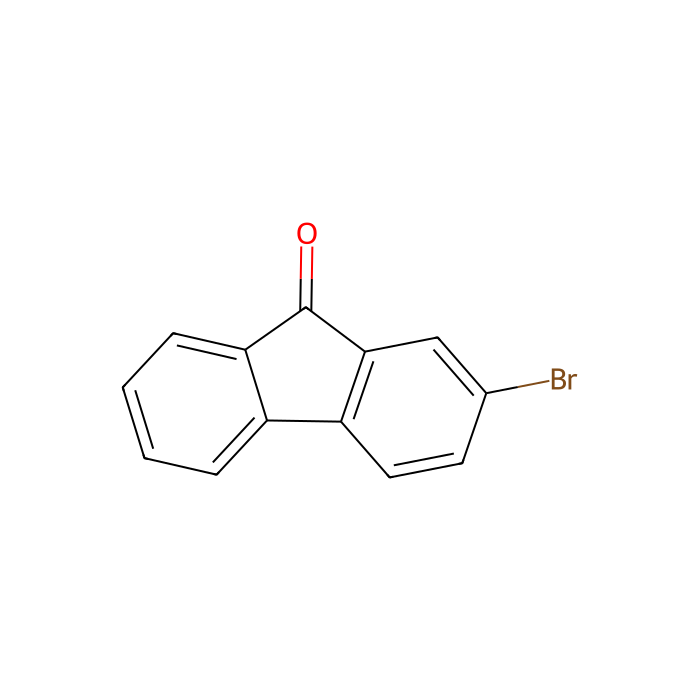
A halogenated polycyclic aromatic ketone, 2-Bromo-9-fluorenone is a functionalized fluorenone bearing a bromine at the 2-position of the fluorene ring system.
Item-specific (from Product Data):
CAS: 3096-56-8
InChIKey: 227813 (as provided)
Storage guidance: Room temperature; shipped under normal conditions
Literature/typical identifiers (for reference only; verify on CoA/SDS):
Molecular formula: C13H7BrO (literature)
Molecular weight: ~259.10 g/mol (literature)
SMILES: O=c1c2cc(Br)ccc2c2ccccc12 (literature)
InChIKey (literature): commonly reported for 2-bromo-9-fluorenone; consult authoritative databases for the exact 27-character key.
Structural features (general description):
Core scaffold: Fluorenone (9H-fluoren-9-one), a tricyclic system composed of two benzene rings fused to a central five-membered ring bearing a ketone at C-9.
Substitution: A bromine at the 2-position (ortho to the carbonyl on one of the benzene rings), providing an aryl bromide handle for cross-coupling and metal–halogen exchange chemistry.
2D depiction in words: Two fused benzene rings share a five-membered bridgehead carbonyl (C=O at position 9). One of the peri/ortho positions (C-2 on the annulated ring adjacent to the carbonyl) carries a bromine substituent.
Synthetic Utility
2-Bromo-9-fluorenone is strategically valuable because it unites two orthogonal handles: an aryl bromide for C(sp2)–X activation and a conjugated ketone for carbonyl chemistry.
Aryl bromide manifold:
Suzuki–Miyaura: Access to 2-arylfluorenones with diverse electronics/sterics; products can be further transformed (e.g., reduction to fluorene derivatives, cyclizations).
Buchwald–Hartwig/Chan–Lam: Installation of amines/anilines or heteroatoms for donor–acceptor systems.
Stille/Negishi/Kumada: Alternative platforms for challenging couplings or sensitive boron partners.
Directed metalation and halogen–lithium exchange:
n-BuLi or t-BuLi at cryogenic temperature affords 2-lithio-9-fluorenone; capture with electrophiles (formylation, acylation, silylation, borylation). Subsequent transformations of the carbonyl expand diversity.
Carbonyl functional group leverage:
Nucleophilic additions (RMgX/RLi with control) to give alkoxides that can be elaborated; selective reductions to alcohols; oxime/hydrazone formation enabling Beckmann-type rearrangements in related systems.
Retrosynthetic value:
The C-2 bromide provides a convergence point for late-stage diversification of the fluorenone core, allowing SAR matrices in materials/ligand design without re-building the polycyclic framework each time.
Tips:
The adjacent carbonyl can stabilize anionic intermediates; manage temperature and quench sequence carefully during metalations.
For couplings, ligands that accelerate oxidative addition to aryl bromides (e.g., XPhos, SPhos, P(tBu)3) often give robust performance.
Target Specificity
Not applicable. This product is a small-molecule chemical reagent, not a biological macromolecule or affinity reagent. No antigen/epitope/clone/isotype information applies.
Perguntas frequentes
What is the purity of this product?
This product is supplied at ≥99% purity (chemical assay). Lot-specific values are stated on the Certificate of Analysis.
How should this product be stored?
Store at room temperature.
How is this product shipped?
This product ships under standard ambient conditions. No temperature-controlled packaging is required.
What are the CAS number, molecular formula and molecular weight?
The CAS Number is 3096-56-8, the molecular formula is C13H7BrO, and the molecular weight is 259.1 g/mol. InChIKey MTCARZDHUIEYMB-UHFFFAOYSA-N.
What documentation is provided?
Available product documentation, including Certificates of Analysis (COA), Safety Data Sheets (SDS), and specification sheets, is shown in the product document area. Document availability and access follow the current site policy.
Usamos cookies para garantir o funcionamento adequado do site e, quando permitido, para melhorar a sua experiência. Você pode gerenciar suas preferências a qualquer momento nas Configurações. Saiba mais em nossa Política de Cookies.
Deseja que lhe enviemos uma mensagem quando tivermos descontos disponíveis?
Lembrar-me mais tarde
Obrigado! Por favor, verifique a sua caixa de entrada de e-mail para confirmar.
Products are supplied to verified businesses, institutions, and qualified professionals for research and development use only. Not for use in humans, animals, diagnosis, or therapy.

 G2416269