This compound belongs to the class of organic compounds known as pyridines and derivatives. These are compounds containing a pyridine ring, which is a six-member aromatic heterocycle which consists of one nitrogen atom and five carbon atoms.
External Descriptors
Not available
1. Djoumbou Feunang Y, Eisner R, Knox C, Chepelev L, Hastings J, Owen G, Fahy E, Steinbeck C, Subramanian S, Bolton E, Greiner R, and Wishart DS. ClassyFire: Automated Chemical Classification With A Comprehensive, Computable Taxonomy. Journal of Cheminformatics, 2016, 8:61.
Determine the necessary mass, volume, or concentration for preparing a solution.
Dilution Calculator
Determine the dilution needed to prepare a stock solution.
Reconstitution Calculator
Revisões
Avaliações dos Clientes
Application Protocols
Not applicable in the context of immunoassays or biological staining. This product is a synthetic intermediate rather than a reagent with WB/IHC/IF/FC protocols.
General laboratory use suggestions:
For stock solutions in screening: Prepare 10–100 mM solutions in dry DMSO or acetonitrile; store aliquots in tightly sealed vials under inert gas to limit moisture uptake. Verify concentration by weight and volume; consider 19F NMR for identity/purity checks.
For reaction screening: Employ 96-well or parallel formats using polar aprotic solvents; include 19F NMR or LC–MS as rapid analytics to assess conversion.
Biological Roles
This compound is a synthetic heteroaromatic building block and does not have a recognized endogenous biological role.
General context (literature):
Pyridine-containing nitriles appear in medicinal chemistry as fragments or intermediates due to their metabolic stability and ability to modulate polarity and H-bonding profiles.
The nitrile group can serve as a weakly polar, compact bioisostere for carbonyl-containing functions or as a latent handle for diversification (e.g., to tetrazoles) during hit-to-lead campaigns.
Fluorine at the 5-position can influence electronic distribution and pKa of the ring nitrogen, alter dipole moment, and increase metabolic stability of derived compounds.
No clinical or therapeutic claims are made or implied; this product is supplied strictly for research use only (as noted in the listing). Any biological evaluation should be undertaken within appropriate regulatory and safety frameworks.
Buffer Applications
Not typically applicable. 2-Cyano-5-fluoropyridine is a neutral organic building block rather than a buffering agent. It is not used to prepare defined pH buffer systems.
For experimental work involving this compound, select buffer systems (e.g., phosphate, acetate, HEPES) based on the needs of biological assays or workups, and ensure compatibility with organic cosolvents used to solubilize the compound (e.g., DMSO, MeCN).
Green Alternatives
Greener choices primarily concern solvent/catalyst systems used with this substrate; the molecule itself is a persistent, halogenated heteroarene, so minimize waste and optimize atom economy.
Replace dipolar aprotics:
Instead of DMF/NMP: Evaluate Cyrene (dihydrolevoglucosenone), propylene carbonate, or dimethyl sulfone in SNAr and coupling contexts, subject to solubility and base compatibility.
For amide/acid hydrolysis: Mixed water/MeCN or water/2-MeTHF systems can reduce reliance on dioxane.
Ether replacements:
2-MeTHF or CPME can substitute for THF/Et2O in reductions/metalations, offering higher boiling points, lower peroxide tendency (CPME), and bio-based sourcing (2-MeTHF).
Catalysis and energy:
Favor catalytic hydrogenations (Raney Ni, Pd/C) over stoichiometric hydrides where selectivity allows, and explore aqueous-phase or transfer hydrogenation to reduce hazards.
Microwave or flow processing can shorten reaction times and improve energy efficiency for SNAr and hydrolyses.
Illustrative comparison (general):
Traditional: DMF + Cs2CO3 for SNAr; THF + LiAlH4 for nitrile reduction.
Greener: Cyrene + K2CO3 for SNAr (if soluble); ethanol/water + catalytic hydrogenation for amine formation (substrate permitting); 2-MeTHF + borane complexes as milder hydrides when catalytic options are unsuitable.
Note: Validate green substitutions at small scale; heteroaryl nitriles can exhibit solvent- and base-dependent reactivity/selectivity.
Pharmaceutical Uses
Item-specific pharmacopeial status or excipient role: Not specified for this item; refer to CoA/Spec Sheet.
General, non-clinical context:
This compound is used as a synthetic intermediate in API route development and medicinal chemistry campaigns, enabling rapid access to fluorinated pyridine derivatives by SNAr, directed metalation, or nitrile transformations.
It is not an approved excipient and is not intended for human or veterinary use. Any presence in pharmaceutical manufacturing would be as an intermediate that is consumed and purged in the synthetic sequence.
Process considerations:
Downstream impurity control often targets residual aryl fluoride or derived amines/amide hydrolysis products; suitable analytical methods include HPLC with UV/fluorine-specific detectors and 19F NMR.
Ensure appropriate removal of polar aprotic processing solvents (DMF, NMP) and control of potential genotoxic impurities introduced during nitrile activation (if applicable) in accordance with ICH guidelines.
Physical Properties
Item-specific numerical specifications (bp, mp, density, UV cutoff, elemental limits) are not provided in the product listing.
Item-specific values: Not specified for this item; refer to CoA/Spec Sheet.
Literature/general expectations for 2-cyano-5-fluoropyridine (for context only):
Phase at ambient conditions: typically a low-melting solid or high-boiling liquid for small fluorinated cyanopyridines; exact mp/bp vary by isomer and source (consult primary data).
Polarity: moderately polar due to ring nitrogen and nitrile; capable of dipole–dipole and weak H-bond acceptance.
Solubility (qualitative, literature): generally soluble in polar aprotic solvents (DMSO, DMF, NMP, acetonitrile) and in some chlorinated solvents; limited solubility expected in water and nonpolar hydrocarbons.
Acid/base behavior: weakly basic heteroaromatic (pyridine N can be protonated); nitrile is neutral and non-ionizable under neutral conditions.
Partitioning: aryl nitriles on pyridines often exhibit low-to-moderate logP; actual value should be checked in databases if critical.
Practical notes:
Drying: If anhydrous conditions are required (e.g., for organometallic steps), dry under vacuum at ambient-to-mild temperature; avoid prolonged heating to prevent decomposition.
Volatility/odor: Nitrile-functionalized pyridines may have noticeable odor; use in fume hood.
Always consult the CoA/SDS for definitive physical data prior to process design.
Quality and Grades
Item-specific grade/purity and stabilizer information: Not specified for this item; refer to CoA/Spec Sheet.
Guidance on typical grades for heteroaromatic building blocks (general information):
Research grade: Suitable for discovery chemistry, route scouting, and library synthesis. Purity often ≥95% by HPLC/GC; exact thresholds vary by supplier—confirm on CoA.
High-purity/Low-residue variants: When used in catalytic reactions (e.g., Pd, Ni), trace metal content and halide/amine impurities can impact catalyst performance. If sensitive steps are planned, request metal analysis or higher-purity lots.
Stabilizers: Not commonly required for this class; nonetheless, verify that no stabilizer is added if downstream transformations are moisture/base sensitive.
Quality control best practices:
Verify identity by NMR (1H, 13C, 19F), MS, and melting range (if solid). 19F NMR offers a sharp handle for purity and isomer confirmation.
Check water content (KF) only if needed for moisture-sensitive steps. If a spec is critical to your process (e.g., water ≤500 ppm), confirm with CoA or request a tailored specification.
Note: This listing specifies storage at room temperature and normal shipping, indicating no special stabilization or cold-chain requirements for this item.
Reaction and Applications
As a 2-substituted (cyano) 5-fluoropyridine, this molecule is a versatile intermediate for heteroarene functionalization and discovery chemistry.
Key application areas (literature/general):
Nitrile transformations:
Reduction to primary amine (e.g., catalytic hydrogenation, borane, LiAlH4) or to aldehyde (DIBAL-H, controlled conditions).
Hydrolysis to amide (mild, catalytic hydration) or to carboxylic acid (strong acid/base, elevated temperature). Nitrile–imidate–amide pathways can access amidines and esters.
[3+2] Cycloadditions with azide to tetrazoles (Lewis acid or high-temperature conditions), expanding into bioisosteres.
Heteroarene functionalization:
Directed metalation: The 2-cyano group is a strong ortho-director; lithiations at C-3 (and sometimes C-4) using s-BuLi/LDA at low temperature enable installation of electrophiles.
C–H activation: Pd/Ni-catalyzed C–H functionalization on cyanopyridines can introduce aryl/alkyl groups at positions not bearing F; ligand choice tunes site selectivity.
SNAr at C–F: Although aryl fluorides are robust, the combination of ring N and the electron-withdrawing nitrile can permit SNAr with strong nucleophiles (amines, thiolates) under forcing conditions, giving 5-substituted derivatives.
Cross-coupling via C–F activation: Nickel-based catalysts with tailored ligands can, in select cases, activate C–F for coupling; however, aryl fluorides are substantially less reactive than bromides/iodides—feasibility should be validated.
Library synthesis: The scaffold enables rapid access to 5-amino/5-thio/5-alkoxy analogs and further manipulation at the nitrile, supporting SAR exploration.
Practical tips:
For lithiation, rigorously exclude moisture/air; quench with electrophiles (carbonyls, halides, B(OR)3, CO2) at low temperature to control regioselectivity.
In SNAr, increasing temperature, using polar aprotics, and employing cesium bases often boosts conversion. Monitor by 19F NMR to track C–F consumption.
Reaction Conditions
The following are literature-style, non-binding guidelines for typical transformations of 2-cyanopyridines/aryl fluorides. Optimize for your substrate and scale.
Base/solvent: K2CO3/Cs2CO3 in DMSO, DMF, or MeCN; NaH/alkoxides in alcohols for alkoxylation.
Temperature/time: 60–140°C, 2–24 h depending on nucleophile strength and activation.
Notes: Electron withdrawal from ring N and the 2-cyano group assists; monitor by 19F NMR.
Nitrile reductions:
To primary amine: H2 (Pd/C, Raney Ni) in EtOH/MeOH or acetic acid; or BH3·THF/THF; or LiAlH4/ether at 0–25°C to reflux.
To aldehyde: DIBAL-H (1–2 equiv) in toluene or CH2Cl2 at −78 to −20°C, careful quench to avoid over-reduction.
Hydrolysis:
To amide: Aqueous acid (H2SO4/HCl) or base (NaOH) under reflux; co-solvents (dioxane, MeCN) aid solubility.
To acid: Stronger conditions/longer times; consider microwave heating to accelerate.
Directed metalation (C-3):
Base/solvent: s-BuLi or LDA in THF or THF/hexanes, −78 to −40°C; quench with electrophiles (RX, carbonyls, B(OR)3, CO2).
Notes: The 2-cyano group is a strong ortho-director; maintain stringent anhydrous, oxygen-free conditions.
Yields/kinetics are substrate- and condition-dependent; consult primary literature when designing scale-up.
Safety and Handling
Item-specific GHS details (signal word, hazard statements, pictograms, classification): Not specified for this item; refer to SDS.
General safety considerations for heteroaromatic nitriles and aryl fluorides (literature/good practice; not product-specific):
Likely hazards: Harmful if swallowed or inhaled; causes eye/skin irritation; may cause respiratory irritation. Aromatic nitriles can release toxic fumes (HCN, NOx, HF) on thermal decomposition; pyridines can be irritating and malodorous.
Engineering controls: Handle in a certified chemical fume hood. Use local exhaust during weighing, transfers, and heating.
PPE: Lab coat, nitrile gloves (change regularly), splash goggles. For large-scale handling, consider face shield and chemically resistant gloves per SDS permeation data.
Incompatibilities: Strong oxidizers; strong bases/acids under forcing conditions (can hydrolyze nitrile); reactive metals/strong nucleophiles may induce substitution. Avoid moisture for moisture-sensitive transformations.
First aid overview:
Inhalation: Move to fresh air; monitor breathing; seek medical attention.
Skin/eyes: Rinse with water for at least 15 minutes; remove contaminated clothing; get medical advice.
Ingestion: Rinse mouth; do not induce vomiting; seek medical attention.
Spill/cleanup: Absorb with inert material, avoid dust/aerosols, collect in compatible waste container. Decontaminate area; ventilate thoroughly.
Fire-fighting: Use dry chemical, CO2, or foam. Combustion may release HF, HCN, NOx; firefighters should wear full SCBA.
Always defer to the product-specific SDS for authoritative hazard classification and response guidance.
Solvent Selection
This compound is a moderately polar heteroaromatic nitrile; solvent choice should balance solubility with reaction compatibility.
Polarity class (general): Polar aprotic preferred for dissolution and many transformations.
Reductions (DIBAL, borane, catalytic hydrogenation): Choose non-protic, non-coordinating or appropriately coordinating media (toluene, THF, Et2O). Avoid donor solvents incompatible with selected hydride.
Hydrolysis to amide/acid: Mixed aqueous-organic systems (MeCN/H2O, dioxane/H2O) can help; control pH and temperature.
Metalation/ortholithiation: Use anhydrous ethers (THF, MTBE) or hydrocarbon/ether mixes at low temperature.
Green chemistry perspective:
Consider Cyrene or propylene carbonate as drop-in replacements for DMF/NMP in SNAr when feasible.
2-MeTHF or CPME can substitute for THF/Et2O in reductions and metalations, with higher boiling points and improved safety.
Always verify solubility and stability experimentally on your specific substrate and scale.
Storage and Reconstitution
Item-specific storage and shipping (from Product Data):
Storage Conditions: Room temperature
Shipped In: Normal (no cold chain indicated)
Appearance: Not specified for this item; refer to CoA/Spec Sheet.
General handling and solution preparation:
Keep container tightly closed in a dry, well-ventilated area. Protect from prolonged exposure to heat and direct sunlight.
If moisture-sensitive steps are planned, store under inert gas (N2/Ar) with desiccant.
Reconstitution/stock solutions:
Common solvents: DMSO, acetonitrile, DMF, dichloromethane (choose based on application and compatibility).
Typical screening stocks: 10–100 mM in dry DMSO or MeCN. Filter if particulate is present (PTFE syringe filter, 0.2 µm) and label with concentration/date.
Stability: Small-molecule solutions are generally stable for weeks at 2–8°C and months at −20°C when protected from moisture and air; verify by LC–MS/NMR prior to critical use.
Freeze–thaw: Minimize cycles by aliquoting. Allow solutions to equilibrate to room temperature before opening to avoid condensation.
Refer to the CoA/SDS for any additional, item-specific storage precautions or incompatibilities.
Structure and Identity
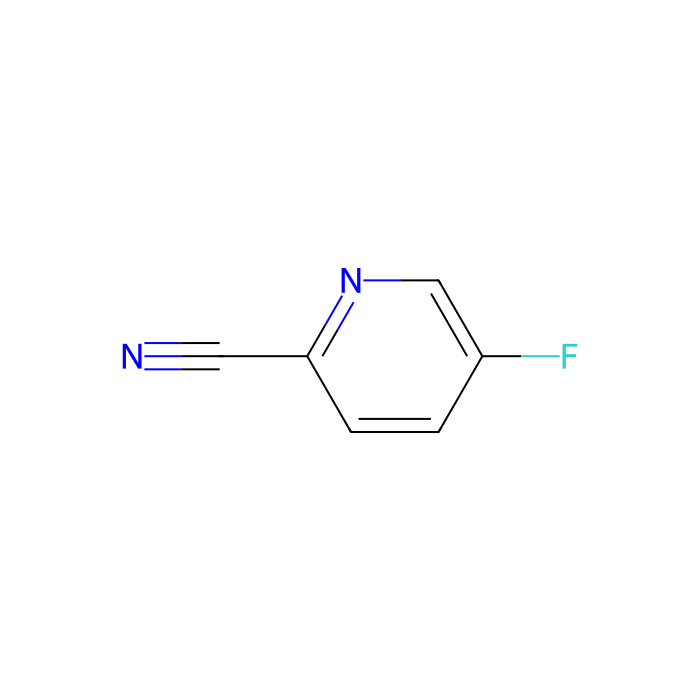
A heteroaromatic nitrile building block featuring a pyridine ring bearing a cyano group at C-2 and a fluorine at C-5.
Item-specific (from Product Data):
CAS: 327056-62-2
CID: 11332453
InChIKey: 25342 (as provided; appears non-standard — verify against CoA/SDS)
SMILES: Not specified for this item; refer to CoA/Spec Sheet.
Literature/computed identifiers and composition (for reference; not item specifications):
Molecular formula (literature): C6H3FN2
Molecular weight (literature): ~122.10 g·mol⁻¹
Structural features (general description):
Ring system: 6-membered aromatic pyridine (one ring nitrogen at position 1).
Substituents: nitrile (–C≡N) at the 2-position; fluorine at the 5-position.
Aryl fluoride at C-5: potential leaving group for SNAr under activating conditions; can engage in Ni-catalyzed C–F activations in advanced methods; serves as a spectroscopic handle (19F NMR).
Pyridine nitrogen: modulates electronics; can coordinate metals, influence regioselectivity, and act as a base/ligand in situ.
Retrosynthetic value (literature):
Enables modular access to 5-substituted 2-cyanopyridines via nucleophiles (amines, thiolates, alkoxides) at C-5.
Directed lithiation at C-3 (ortho to the nitrile) provides a route to 3-functionalized analogs upon quench with electrophiles (e.g., carbonyls, CO2, B(OR)3 → Suzuki handles after oxidation).
Nitrile-to-tetrazole conversion yields acidic bioisosteres; further cross-coupling or alkylation expands chemical space.
Workflow suggestions:
Start from 2-cyano-5-fluoropyridine, execute SNAr to install diversity at C-5, then transform the nitrile as needed (e.g., to amide/amine). Alternatively, ortholithiate, introduce a handle (B, Sn), and perform cross-couplings to elaborate the scaffold.
This combination of handles supports efficient parallel synthesis and SAR exploration.
Target Specificity
Not applicable. This product is a small-molecule chemical building block and is not an antibody, enzyme, or biologic. No target specificity data (antigen, epitope, species reactivity, clone, isotype) are relevant.
Perguntas frequentes
What is the purity of this product?
This product is supplied at ≥98% purity (chemical assay). Lot-specific values are stated on the Certificate of Analysis.
How should this product be stored?
Store at room temperature.
How is this product shipped?
This product ships under standard ambient conditions. No temperature-controlled packaging is required.
What are the CAS number, molecular formula and molecular weight?
The CAS Number is 327056-62-2, the molecular formula is C6H3FN2, and the molecular weight is 122.1 g/mol. InChIKey BHXHRMVSUUPOLX-UHFFFAOYSA-N.
What documentation is provided?
Available product documentation, including Certificates of Analysis (COA), Safety Data Sheets (SDS), and specification sheets, is shown in the product document area. Document availability and access follow the current site policy.
Usamos cookies para garantir o funcionamento adequado do site e, quando permitido, para melhorar a sua experiência. Você pode gerenciar suas preferências a qualquer momento nas Configurações. Saiba mais em nossa Política de Cookies.
Deseja que lhe enviemos uma mensagem quando tivermos descontos disponíveis?
Lembrar-me mais tarde
Obrigado! Por favor, verifique a sua caixa de entrada de e-mail para confirmar.
Products are supplied to verified businesses, institutions, and qualified professionals for research and development use only. Not for use in humans, animals, diagnosis, or therapy.

 A1315057